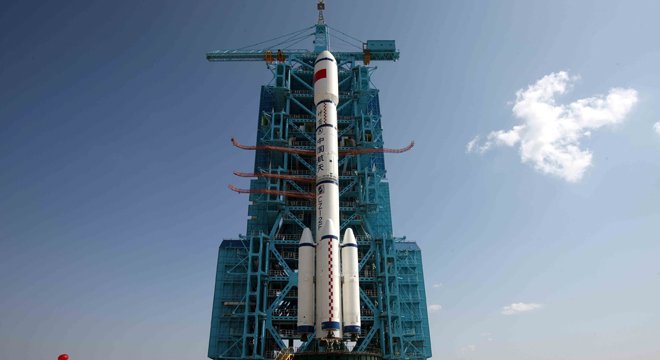
China is set to take a historic step in its space exploration efforts with the launch of the Tiangong-1, the country’s first “space station module,” later this week.
According to China’s state news agency Xinhua, the unmanned spacecraft will remain in space for two years to test docking procedures with Chinese crew capsules, first the unmanned Shenzhou-8, then the crewed Shenzhou-9 and Shenzhou-10, which are set to be launched in subsequent years.
The docking tests are the necessary precursor for China to achieve its goal of getting its own crewed space station up into orbit by 2020 or shortly thereafter.
“This is a significant test. We’ve never done such a thing before,” said Lu Jinrong, chief engineer at China’s Jiuquan Satellite Launch Center, located in the Mongolian desert, Xinhua reported.
Indeed, the launch, set to happen on Thursday or Friday, is an especially tense moment for the nacent but ambitious China National Space Administration. The 8.5-ton Tiangong-1, “Heavenly Palace-1” in English, was originally due to blast off in late August or early September, but the malfunction of a Chinese Long-March II-C rocket on takeoff on August 19 delayed the agency from moving forward until the problem had been diagnosed and remedied.
The Long March II-C is similar to the Long March II-F, the rocket that will transport the Tiangong-1 into space.
Still, the China National Space Administraiton espoused nothing but confidence in the state news report, saying “more than 170 technical improvements” had been made to the rocket and that it had also accomplished “more than 100 updates at the launch site.”
Cui Jijun,director of Jiuquan Satellite Launch Center, “said that engineers conducted a two-month comprehensive technical check on equipment at the launch site from March to May. The safety and reliability of all the instruments have been significantly improved,” Xinhua reported.
A rescheduled launch date of September 27 also had to be pushed back due to “a weather forecast showing the arrival of a cold air mass at the Jiuquan Satellite Launch Center.”
But once the China National Space Administration is fairly certain of a launch, there’s no turning back, as China Daily reported:
“Wang Xiaoqing, a publicity official at the launch site, said that the fuel loading usually begins one day before the launch. Once the fuel is loaded into the carrier vehicle, the launch becomes “irreversible”.”
Though the Chinese space program kicked off in 1970 with the launch of a satellite, it has made major progress in recent years, becoming the third nation in the world (after the U.S. and Russa) to independently put a human being in orbit in 2003. The country also aims to a craft to the moon in 2022.
Meanwhile, the International Space Station – officially the work of 16 nations but led primarily by NASA and Roscosmos, the Russian space agency – is due to be decommissioned and de-orbited in 2020.
Yet it is worth noting that China only completed its first spacewalk in 2008 (compared to 1965 for the U.S. and the Soviet Union, which was the first country to conduct a spacewalk), meaning that while the country’s ambitions are sky-high, they are relatively new at the game.