

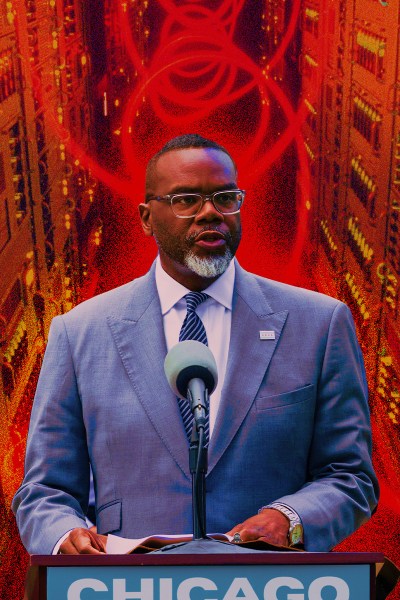


‘We Are Not For Sale’
Chicago Mayor Brandon Johnson officially kicked off his reelection campaign last Sunday for the Feb. 23, 2027 mayoral election where he will face a crowded field of challengers. At least 14 people have announced their intention to run for mayor of the Windy City, though that number is expected to drop once nominating petition filing deadlines pass in late October.
I’m talking to you about the Chicago mayoral race because, in one of his most sweeping actions he’s taken since launching his reelection bid, Johnson today announced a city-wide temporary moratorium on data center development and expansion in Chicago for 12 months. The move is backed by a handful of city alderpersons, and the ordinance will block any new construction or expansion while the city of Chicago focuses on developing a “comprehensive regulatory framework for data centers,” a press release announcing Johnson’s ordinance said.
Johnson is selling it as a temporary pause that will give the city time to develop a strategy for how to allow local data center development that spurs economic growth, while not actively allowing for the kind of rampant construction that Americans across the political spectrum now vehemently oppose. Community resistance to these new facilities has reached a fever pitch as we enter the final stretch of the midterms campaign cycle. A growing mountain of evidence shows the infrastructure that houses cloud computing and artificial intelligence model testing is increasingly draining communities’ water supplies and contributing to rising electric costs.
“Chicago is open for business, but we are not for sale,” Johnson declared in a statement announcing his decision. “We welcome innovation, investment, and the jobs and opportunities that come with it, but growth must be done responsibly and in a way that protects the health, safety and quality of life of Chicago residents.”
Some of his opponents in the mayoral race argue the measure doesn’t go far enough, claiming the mayor is just buying himself time for his reelection bid. Others, like Illinois Comptroller Susana Mendoza, have claimed that backlash to data centers is overblown and that a temporary ban on new construction ignores the fact that there are already 39 active data centers operating within city limits.
Illinois Gov. JB Pritzker has already joined a handful of other state leaders that have overturned or temporarily paused new tax breaks for Big Tech companies looking to build new data centers in the state. Ohio is another place where Republican candidates are desperate to show voters they support some level of softening of the state’s decade-old tax incentives for data center construction.
Several other cities across Illinois have already placed a pause on new construction of the facilities as public backlash spreads. Chicago joins several major U.S. cities that have recently placed new restrictions on development while they try to sort out how to properly regulate new construction and to pass off any monetary or environment costs onto the major tech companies fueling the AI boom. (Americans are increasingly revolting against AI itself as whistleblowers warn of doomsday scenarios and artificial intelligence threatens jobs).
It’s a bipartisan issue that elected officials across the political spectrum are rushing to be on the right side of. Except President Trump, who has actively insulted Americans who are suspicious of the new projects and whose administration is actively trying to change federal policy that allows for community input at the onset of new data center construction.
Join TPM to get full-access to our reporting, newsletters, and other member-only features.





Did she really say “ he has more energy than any boy “ or is that a typo and it was “ anybody “ ? I kinda hope it’s the former, such an energetic little boy !
Yeah, a lot of them are jerks. One said he would help the housing market by revoking the rule to pay prevailing wage to the construction workers. Nothing was said about the cost of materials to build. This guy also added that he would allow four story rentals to be built. Except there are building codes that do not support four story buildings. Conclusion: it won’t happen.
It is actually 39 companies and many are not in new construction but in old warehouses.
Judge Timothy J. Kelly did not immediately rule but in further reading:
So they were banned immediately on Friday night, but Tuesday (yesterday) letters were written telling them what caused their ban. Nice delayed after thought.
It could be her accent or it was a typo.
She obviously has not seen him falling asleep at the desk in front of cameras. That shows great energy. LOLOLOL
How would she know?..She’s never home.
“‘standards of professionalism and decorum expected of those given access to the White House
like the guy who was given access to the white house who calls people ‘piggy’?