



Big Tech Skeletons
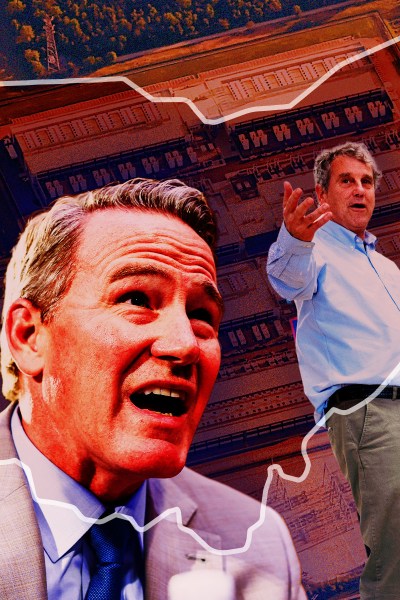
Sen. Jon Husted (R-OH) was appointed to fill Vice President JD Vance’s vacant Senate seat after Vance became vice president. He is currently running in the November 2026 special election to serve out the remainder of Vance’s term and is fending off an aggressive challenge from longtime Ohio Democrat and former Sen. Sherrod Brown (D-OH).
While Husted is a household name in Ohio thanks to his 25 year political career as a Republican in the state, there is one element of his legacy as lieutenant governor in Ohio — the position he held until Republican Gov. Mike DeWine hand-picked him for the Senate — that is not just coming back to bite him, but making Brown’s job incredibly easy: Husted’s past fervent support for new data center construction in the state.
As lieutenant governor, Husted was a stanch supporter of Ohio’s tax breaks for data center development, which were passed by Ohio lawmakers a decade ago to spur economic growth in the state. Ohio is currently home to at least 240 data centers — with one currently being constructed in Pike County that’s on track to be the world’s largest.
Ohio is one of several states that previously passed sales tax exemptions for the equipment needed to run data centers in order to help fuel the artificial intelligence boom. But that was before public outrage at the rampant development of new facilities for training AI models boiled over, among Americans of all political stripes, to become a dominating issue of the 2026 midterms. Husted was a major champion of new data center development in Ohio. He led ribbon-cutting ceremonies and issued press releases celebrating the construction of the new facilities in the state for years as a top official. Here’s one from February 2019, celebrating news that Google would construct a new $600 million data center in the state.
“Google investing in Ohio to open a new data center is great news for our state,” he said.
This is an unpaid cross promotion from our friends at Popular Information: Are you curious about what politicians are funded by major corporations? Would you like to know how money impacts important policy decisions? Would you like to peek behind the curtain of DC’s influence game? If you answered yes to any of these questions, we recommend signing up for Popular Information, an independent newsletter dedicated to accountability journalism.
Republican Shapeshifting 2026
Uproar at how the data center boom is impacting water supply, air quality and affordable electricity in communities across the nation has only reached a fever pitch in the last year or so. Politicians, primarily Republicans, who previously championed both data center construction and unregulated AI advancement are now scrambling to change course as these issues become politically toxic.
I wrote about this last week, but Ohio is one of several states that once encouraged data center construction with tax breaks for Big Tech companies whose politicians are now looking for ways to pause or repeal those tax incentives in response to voter demands that elected officials do something — anything — to keep the burgeoning American tech oligarchy in check:
After substantial public pushback, Republican Gov. Mike DeWine back in May placed a pause on new applications for sales-tax exemptions, and some state lawmakers are pushing for the sales-tax exemption to be repealed. Several other states are considering similar actions to end or pause these ongoing tax breaks for tech companies, which “seem to have more money than God,” as one Ohio lawmaker, state Rep. Tristan Rader (D-OH), put it to WSJ.
Husted is one of many Republicans trying to shape-shift on an issue they staunchly supported even months ago. While President Trump does all he can to make it impossible for members of the Republican Party to hold any position of nuance (You’re either 100% swallowing what Big Tech is shoving down our throats or you’re “backwards and poor”), Republican leadership in Congress has tried to create a middle-of-the-road policy position for vulnerable members and candidates this fall. It goes like this: Republicans are all for data center construction as an economic driver for rural and urban communities, but tech companies need to be footing the bill for rising electric costs.
It’s a messaging framework that Husted himself has adopted in recent weeks as he looks for ways to adjust to the public’s scorching outrage and his opponent’s relatively easy task of skewering him with related attack ads. In August, he told the local Ohio Statehouse News Bureau that he is in agreement with DeWine and Ohio state legislators’ push to, at the very least, place a pause on sales and tax breaks for tech companies constructing the new facilities in Ohio. He argued that big tech has done “a terrible job of talking about the value and virtue of” their technology.
“They’ve earned that backlash,” Husted said. “They haven’t been as forthcoming about the benefits that will come in terms of local jobs and construction worker jobs and reduced property taxes, and they haven’t offered things like paying the energy bills for local communities, for the power plants they build.”
Meanwhile, in Congress, Husted is using the last remaining days of the legislative session before the upper chamber goes on recess to try to convince his colleagues to take up a bill that he’s co-sponsoring that would force the tech companies behind data centers to cover the cost of utilities for their buildouts. The “Ratepayer Protection Act” would require state utility regulators to make sure that data centers and other big energy consumers cover the cost of any updates to the grid that need to take place to ensure their operations, among other things.
Politico has a new piece out today unpacking how this legislation is working its way through Congress and the work that Husted is doing to try to get his colleagues on board with quick passage in the Senate if it clears the House this week (tl;dr, it’s unlikely that Senate Democrats will jump to help a vulnerable Republican senator amid slam-dunk attack ads being lobbed at him by one of their former colleagues).
Join TPM to get full-access to our reporting, newsletters, and other member-only features.





I hope Sherrod Brown knocks this guy into next week.
AI rats on itself, indicating that the data centers in Ohio provide fewer than 20,000 permanent jobs, at a cost of $2.5B in tax breaks (no idea what the additional utility costs are). SO each one of those jobs costed taxpayers about $125,000.
This is the first time I can recall that Republicans aren’t arguing in favor the consumer subsidizing some of Bid Bidness’s expenses.
As we’ve established over the past half-century, it is incredibly unfair to hold Republicans accountable for their words and actions. Senator Husted is just a little birthday boy, and besides, Jesus forgives him.
Any guesses as to what TCF will say/do with his threat against raising the interest rate? Will he try to fire Walsh now?
Yeah, Jon, but it turns out that your Squeaker of the House has just sent everyone home again, recessing early to avoid the terrible threat that some actual Congressional oversight (in the form of the Dregseth impeachment) might happen, despite Mikey’s most ardent efforts to avoid it.
So, no messaging bill for you – too bad, so sad. Cue the very small violin.