


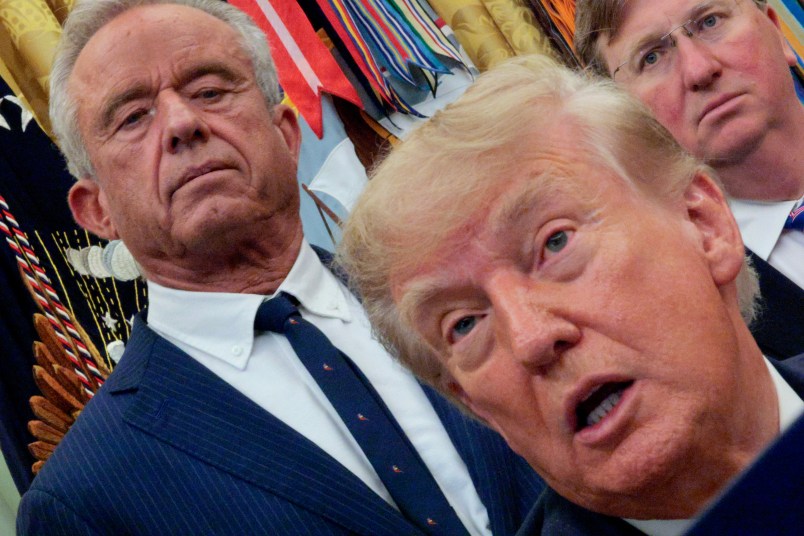
Robert F. Kennedy Jr. has escorted his dangerous vaccine skepticism into the homes of every American through his role as secretary of the Department of Health and Human Services. Now, public health experts and attorneys are worried that Kennedy might do away with effective federal vaccine recommendations altogether.
Right now, vaccines are recommended either on a universal basis, using a risk-based assessment for people with specific risk factors, or using what Kennedy’s HHS calls shared clinical decision-making, a controversial vaccine skeptical-adjacent category that the department has defined as an individualized process between a patient and physician. The comment period for an HHS request for information concluded on Sunday and sought comment on whether existing types of federal vaccine recommendations should remain in place.
The request, posted to the Federal Register, also sought to consider “individual autonomy and religious freedom…and the communication practices necessary to earn and maintain public trust,” related to the federal childhood vaccine schedule.
But while shrouded in language implying greater freedom, pediatric health advocacy groups, health attorneys, and public health researchers said in public comments that further changes to vaccine recommendations will only jeopardize public health and child safety.
And HHS’s apparent plan to change childhood vaccines is groundless.
““[T]here simply is no basis for the RFI’s implicit suggestion that the current recommendation framework produces unsafe results and needs fundamental revision,” wrote a group of health advocacy groups and scholars, including the American Public Health Association, Robert Wood Johnson Foundation, and Bruce G. Gellin, former deputy assistant secretary of Health and director of the HHS National Vaccine Program Office.
The HHS request poses its own potential vaccine categories, including vaccines that are recommended but not for babies, or recommended, but with other undefined caveats.
It comes as part of President Donald Trump’s August 2026 executive order, which required HHS to revive a defunct childhood vaccine task force and to reevaluate childhood vaccines.
“The arbitrary categories identified in the RFI without context, without accompanying evidence and without a clear communication strategy with medical professionals, the public health system, and the American public will inevitably produce widespread confusion and uncertainty,” the group of public health advocacy organizations and experts wrote in the public comment. “In the setting of such confusion, the principle of informed decision-making is at risk with the likely result that vaccine doses will be missed and diseases that are vaccine preventable will recur.”
Currently, America is experiencing its worst year for measles, the once all-but-eradicated viral disease, since 1991, according to the Associated Press. There have been 792 cases of the disease in Pennsylvania this year alone, and four people in the state have died of the illness since January. RFK battled Governor Josh Shapiro, claiming without evidence that state officials errantly attributed the deaths to measles. Kennedy had two of the Pennsylvania deaths removed from the Centers for Disease Control and Prevention measles dashboard which, as of Sept. 18, did not have any measles deaths listed.
Echoing Trump’s executive order, the HHS information request emphasizes that evidence, alongside freedom and trust, are paramount when considering vaccine recommendations. A public comment submitted by members of Georgetown University’s McCourt School of Public Policy, however, notes that patients overwhelmingly trust their personal healthcare providers. A July survey by KFF found 86% of respondents trust their own doctor compared to 51% who trust the CDC and 34% who trust RFK. Even MAGA Republicans are more likely to trust their healthcare provider than RFK, at 86% compared to 74%.
“Any change to the current categories could cause provider and public confusion, leading to greater mistrust and wider spread of misinformation,” Hannah Green, state health policy analyst, and Kelly Whitener, an associate professor, wrote in the Georgetown public comment.



Again???
Hasn’t RFK done enough damage?
He’s like the Energizer bunny, but more arrogant. There’s no way to get him to STFU and go away.
“Individual autonomy and religious freedom”
F*€# this guy. Nobody is forcing anyone by law to get vaccinated. But if you refuse to vaccinate your kids against diseases they contract and die from, you should be jailed for manslaughter. And if your kids infect other kids who die, same.
In the meantime, medical associations should take junkie-worn-brain to court to stop this nonsense.
When are people going to realize this guy is killing children. Their children and their neighbors children.. You don’t have to do internet research to realize he and his supporters are full of shit.