


Hello, and welcome back to The Franchise!
Despite the fact that the U.S. has entered the “quiet period” — the 90 day window before an election during which state election officials are federally barred from “systematically” removing people from voter rolls — the Trump administration is going full steam ahead in its crusade to control election administration and try to purge voters from the voter rolls.
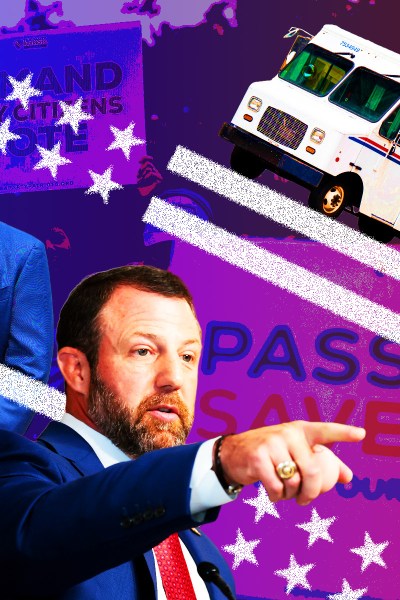
This week, the Justice Department asked the Supreme Court to allow it to continue its expanded use of the Systematic Alien Verification Entitlements database, the SAVE system, in an attempt to try to force state election administrators to verify citizenship of voters and remove alleged noncitizens from the rolls using the faulty federal database.
Let’s back up a little first.
SAVE was originally developed as an immigration tool managed by the United States Citizenship and Immigration Services — an agency of the Department of Homeland Security — to verify the immigration and citizenship status of those who applied for certain government benefits. The Trump administration, however, tried to expand the use of the database in 2025 to require states to use it to remove supposed noncitizens from state voter rolls. In their attempts to expand it, the administration has tried to pull in private data from the Social Security Administration, combined with immigration records. Privacy experts and those who are challenging the expanded use of the system have warned that the maneuver puts private data at risk and may lead to eligible voters being identified as ineligible by mistake.
There is evidence that the tool has actually already flagged eligible voters as being ineligible. This is part of the reason why, in June, District Court Judge Sparkle L. Sooknanan blocked the administration from expanding the SAVE system for the Trump administration’s voter roll purging purposes.
In response, the administration tried once again to block Sooknanan’s ruling in an emergency request. The D.C. Circuit Court of Appeals denied this request with Chief Judge Sri Srinivasan and Judge Robert Wilkins saying that the administration had not “satisfied the stringent requirements for a stay pending appeal.”
The expanded use of the SAVE system is all part of the administration’s continued efforts to both seize control of states’ constitutional right to administer elections by demanding access to voter rolls and requiring that states run their voter rolls through the faulty and insecure system.
On Tuesday, the DOJ submitted an application to the Supreme Court asking it to continue allowing the administration to use the SAVE database in this way, and to block Sooknanan’s order. In his application this week to the Supreme Court, Solicitor General D. John Sauer called the lower court’s ruling that blocked the expanded use of the SAVE system an “indefensible order that threatens the integrity of upcoming elections by vacating the federal government’s authority to internally use Social Security data when fulfilling its duty to respond to requests by States to verify the citizenship of individuals for voting and other purposes.”
This latest development occurred only days after a federal appeals court late last week rejected the administration’s emergency request to block a district court ruling against the DHS’s use of the flawed SAVE database to purge voter rolls.
“In attempting to satisfy its burden to make a strong showing of a likelihood of success on the merits of its appeal, the government initially argues that plaintiffs lack standing,” the ruling reads. “The government has not shown the requisite likelihood of success on that argument.”
As always, there is a lot to catch up on. Let’s dive in.
Mess in Missouri Is Thanks to Trump
The Supreme Court on Thursday blocked Missouri from using a maximal Republican gerrymandered map in the upcoming midterm elections. There have been a flurry of legal developments this week that my colleagues Kate Riga and John Light have been covering quite diligently, which you can catch up on chronologically here:
- Tuesday: Supreme Court Rules Against Missouri’s Bid to Snatch Extra Seat in Midterms
- Wednesday: Dueling Missouri Court Decisions Give Us a Preview of the Kind of Midterm We’re In For
- Thursday:
For some more context, the anti-gerrymandering activist group People Not Politicians collected over 300,000 signatures to petition against the new map that gave Republicans a 7-1 advantage. But, in August, on the last possible day that he could weigh in on the petition, Missouri Secretary of State Denny Hoskins rejected it and held the state’s August 4 primary under the new map. He claimed the referendum was not sufficient because the state constitution does not explicitly list redistricting as something voters can challenge. The Missouri Supreme Court, however, did not agree, and ruled on September 3 the petition was indeed valid. Then the U.S. Supreme Court weighed in just in time for a federal district court to issue a conflicting ruling, leading to the legal confusion Kate and John have covered above.
For now, Missouri must use the older map that gives Republicans a 6-2 advantage for the general election coming up. However, this whole mess is really thanks to President Trump and the redistricting pressure campaign that he launched many many months ago.
Trump kicked off a gerrymandering blitz last year by pushing state legislators in red states across the country to redraw their congressional maps in an effort to help Republicans maintain control of the House in the midterms.
In response to Trump’s nationwide bullying blitz, Republican state lawmakers created the “Missouri First” map, which was redrawn to give Republicans all but one of the state’s U.S. House seats. Missouri was the second red state to succumb to Trump’s pressure. Texas was the first.
The new map carves up a historically Black-majority district that includes Kansas City and is currently held by Rep. Emanuel Cleaver (D-MO).
The map was signed into law by GOP Gov. Mike Kehoe in September 2025, kicking off the beginning of this legal saga over which maps would be used in the general election.
USPS Opens Whistleblower Investigation
The USPS is opening an investigation into major concerns raised in a recent whistleblower complaint released by the office of Sen. Richard Blumenthal (D-CT) last week.
The whistleblower report warned that the Postal Service’s new mail-in ballot policies — written to comply with President Trump’s March executive order to restrict mail-in voting — were rushed and could be disastrous for the midterms. Democrats are now demanding an investigation into what they called “the Postal Service’s reckless actions.”
“We are currently analyzing the information and plan to conduct an independent review of these allegations,” a spokeswoman for the Postal Service’s inspector general said in a statement on Friday.
“We stand behind both the rigor of our process and the resulting system,” USPS Postmaster General David Steiner also said last week. “At the same time, we recognize that responsible system management does not end at deployment. We will continue to monitor performance, address issues as they arise, and make adjustments when warranted. The Postal Service remains committed to maintaining the security, reliability, and integrity of its systems.”
“We welcome thoughtful questions and appropriate oversight, and we are committed to transparency, accountability, and working constructively with election officials, Congress, the courts, and all stakeholders,” he added.
In Other Election News:
TPM: Supreme Court Rules Against Missouri’s Bid to Snatch Extra Seat in Midterms
AJC: What the raid on Fulton’s election warehouse did (and did not) accomplish
Politico: Republicans might still lose half the seats they gerrymandered to flip



We now wait for SCOTUS to decide the mail-in ballots case.
Once again, elections are administered by the states, not the Federal government. Please make it stop. 86 47
Butt outski, traitor trump.
Like, if he gave a crap about anything but his own stupid self, their arguments for interfering in something that is not their business at all, none of it, if CA doesn’t care about a couple of illegal votes slipping thru, too bad lying sack of traitor shit. Not your problem.
If the Calvinball 6™ were normal uncorrupt Justices who follow the Constitution this would be a 9-0 denial of appeal.
Note the absence of the word executive in this clause.
Unfortunately most of their decisions are based on what’s in it for them rather then the rule of law. With serious talk from the Democrats about Court reform they may perceive the loss of a Republican majority as a threat to their power.
You maybe right about this S.C. but they would disenfranchise millions of voters in red states. I am not sure they are ready to do it. This should be a 9-0 slam dunk but it could be 7-2.
Eight states and D.C. have all mail-in voting and Oregon since 2000.
California – Universal mail ballots made permanent in 2021.
Colorado – All-mail elections since 2013.
Hawaii – Switched statewide in 2020.
Nevada – Universal mail ballots enacted in 2021.
Oregon – Pioneer; all-mail since 2000.
Utah – Counties adopted mail voting over time; statewide by 2019.
Vermont – Permanent universal mail voting for general elections.
Washington – All-mail elections since 2011.
Washington, D.C. – Adopted all-mail elections beginning in 2023
28 states allow no excuse mail-in voting. Among them are many red states with large rural areas.
Those states are: