


Not Just a Problem for Democrats
Right-wing politicians in the U.S. have for decades pursued forms of voter suppression under the theory that the voters who are less likely to be able to overcome various hurdles to cast a ballot are also the voters more likely to support government spending or lenient immigration policies. Voters who might lack easy access to identification documents, or lack the time to stand in long lines on Election Day, or show up in databases with conflicting information about their citizenship, might be poorer, less healthy, or non-white: more likely, in other words, to support Democrats.
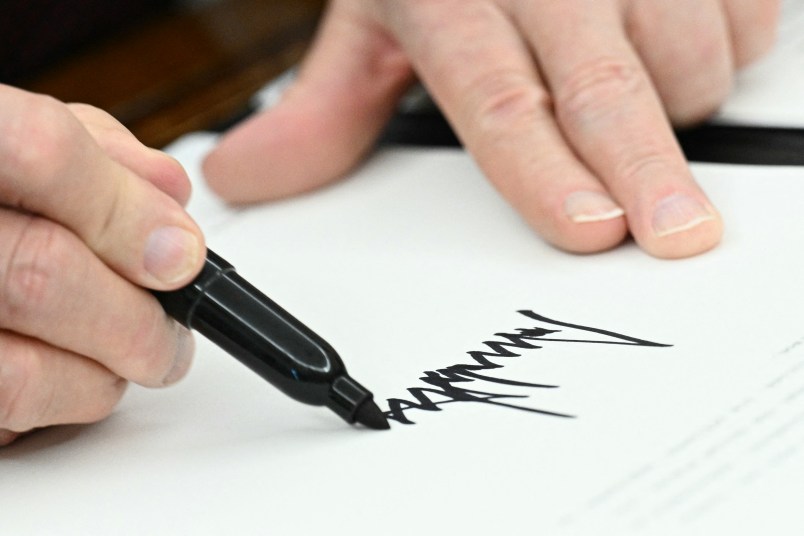
But in the Trump era, this logic is beginning to get a little more convoluted: in part because of the way in which party coalitions have shifted, but in part because of Trump’s singular fixation on a restricting voting by mail. It is used by — among others — older, white, rural voters, leading some large, Republican-run states to meekly object to his various attempts to restrict it.
We saw some more of that this week after the Supreme Court gave an initial greenlight to the administration, allowing it to draft policies implementing Trump’s March executive order on mailed ballots.
“One thing is, I think you’re going to see some blowback from Republicans in the coming weeks, because after all, Republicans are the older party and older folks like to vote by mail. They’re the rural party,” Ben Ginsberg, a prolific Republican election lawyer, said on CNN in the wake of that ruling (in remarks I first saw aggregated by The Hill).
Throughout this year, we’ve been interested to see signs of wariness from Republicans about Trump’s assault on the franchise. The comments by Ginsberg, who represented George W. Bush in Bush v. Gore and who in recent years has been an outspoken critic of Trump’s outlandish election conspiracy theories, were the latest installment.
“Certainly vote by mail is important to people in rural areas,” he continued. “And thanks to Donald Trump, there are many more low propensity voters in the Republican Party.”
“So this is kind of a flawed political strategy wrapped in a rather vocally charged policy from the president,” he added.
This is of course not to say that Trump’s executive order would hurt Republicans more than Democrats, or that it is something Democrats should cheer. It would be a disaster, potentially disenfranchising large numbers of voters (of both parties) and creating fertile ground for Trump to launch new theories about and schemes to meddle with the results.
But it is one more indication of how policy ideas that are downstream of conspiracy theories can create chaos.
Trump’s Anti-Abortion FDA Pick Encounters Opposition From MAHA
The Trump administration has for a year and a half of avoided acting on calls from the Christian right to use the FDA to curtail access to long-approved medications involved in abortion, perhaps concerned about voter backlash in the midterms. Now, however, there are signs officials are laying the groundwork to give these activists what they want after November.
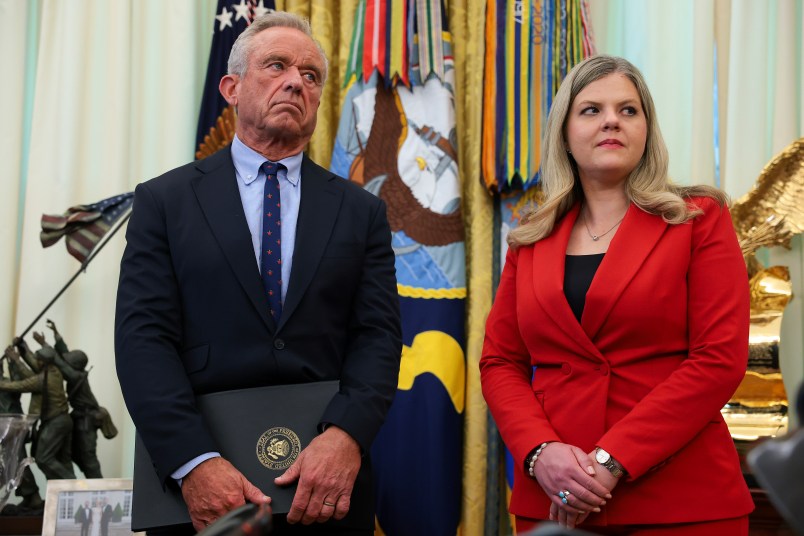
Last week, Trump appointed abortion opponent Heidi Overton to the head the agency, the latest clue that the administration may try to restrict the abortion pill mifepristone.
But her nomination is already encountering some trouble.
- Sen. Bill Cassidy (R-LA), who has opposed some of the excesses of the MAHA movement (though did vote for RFK Jr. to head HHS), has said he has “strong concerns” about Overton’s involvement in a recent White House executive order changing childhood vaccine schedules.
- Overton’s alignment with the White House, where she is a domestic policy aide, is encountering resistance from within the MAHA movement as well, as recent Washington Post and Politico articles document.
- Activists in the movement are upset about her involvement in an executive order to expand domestic production of glyphosate, the active ingredient in the weed-killer Roundup.
- Alex Clark, a prominent MAHA influencer, instructed her followers on X to call their senators to oppose Overton’s nomination, leading to the bizarre spectacle of the White House distancing Overton from the glyphosate order. “Heidi was only looped in at the end of this EO’s very close-hold process when she pushed as many MAHA-minded edits as possible to a mostly-baked EO that, again, was written with national security considerations in mind,” a White House spokesperson posted on X, quote-tweeting Clark.
Tabs
- The federal government is withholding public safety funds and counterterrorism funds from cities and states it believes haven’t done enough to confront the (largely made up) problem of noncitizens voting, leading those municipalities to sue with the contention that Trump is trying to “defund the police,” Axios reports.
- A geography professor was fired from West Point after attempting to teach about climate change, he said in a lawsuit filed Monday and reported by Stars and Stripes.
- Maine’s Republican nominee for governor told activists he will ask the Trump administration to send ICE to his state’s polling places, explaining he has a relationship with border czar Tom Homan, Nicole LaFond writes for TPM.
Man of the Hour
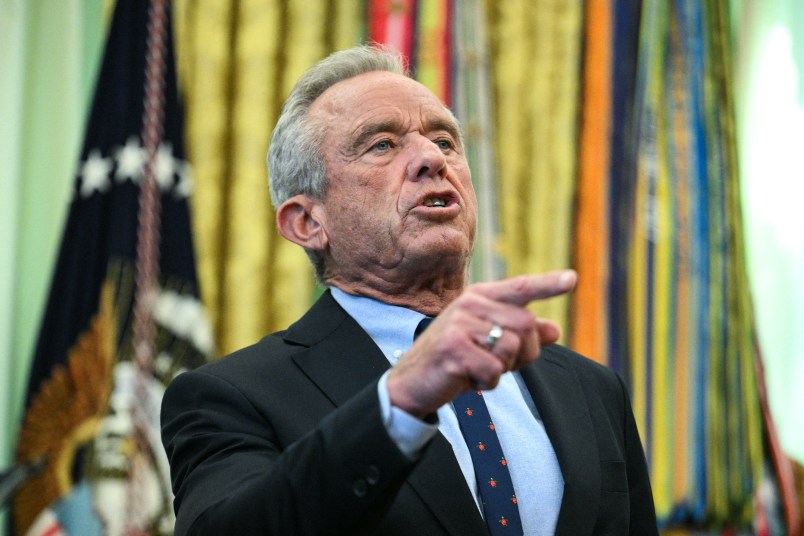
It’s HHS Secretary RFK Jr., baselessly claiming in an X post that Pennsylvania Governor Josh Shapiro’s office “altogether fabricated” news of two measles deaths in his state.
Are We at War?
The Atlantic has new details on the theme from Axios I highlighted yesterday — an effort by the administration to get the war out of the headlines ahead of the midterms, even if it’s not over. “Part of the plan, Trump advisers and allies tell us, is to try to push Iran to the background, while hoping that gas prices come down even a little and that Republicans can shift the nation’s focus to more politically palatable topics ahead of the midterms,” Jonathan Lemire and Nancy A. Youssef write.


Depending on Cassidy is an exercise in futility
Why does the US think it needs to do even more voter suppression? American voters are pretty passive as it is. Not all of the 240 million people in the potentially eligible national voter pool even bother to register (211 million registered in 2024), and not all those registered actually vote (154 million in the 2024 presidential). Ballots can be quite complicated reading comprehension exercises as representatives fob some of their work back onto the electorate. In high voter-participation parliamentary democracies such as the Nordics, registration is automatic at 18, early voting is convenient, and often the voting merely involves writing the number of a single candidate on a piece of paper in the privacy of the voting booth. Votes on election day are tabulated on site at the precinct-level, a process that takes a few hours, before being sent to the central facility for final checking. Discrepancies are rare and minute. The intent of rejected protesting ballots (e.g. write-in for “Donald Duck”) are clear. The rejected vote is not allocated, but the voter gets credit for trying to vote.
Oh no. Another “concerned” Senator who isn’t concerned enough to vote against a Trump supported measure.
speaking of MAHA
“Part of the plan, Trump advisers and allies tell us, is to try to push Iran to the background, while hoping that gas prices come down even a little and that Republicans can shift the nation’s focus to more politically palatable topics ahead of the midterms,” [Jonathan Lemire and Nancy A. Youssef write](The Real Reason Trump Wants Economic Sanctions in Iran - The Atlantic).
So, they’re gonna try to hide what they think people don’t like so’s the voters will forget about it by the election. Nothing changes, nothing is redressed, “Folks’ll become inured to it.”
Pretty typical of this crew.