


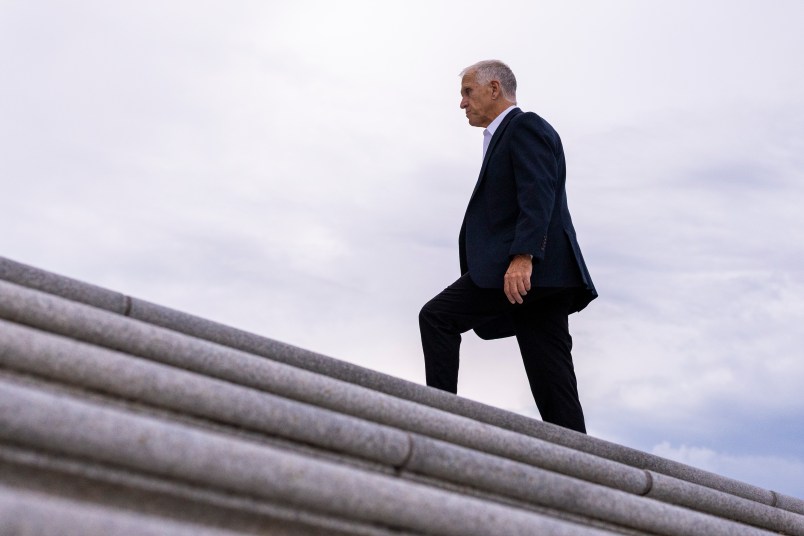
Welcome, Thom, to the Senate ‘Oops’ Caucus
Sen. Thom Tillis (R-NC) has a book to promote. In it, he revealed this week, he delves into his greatest regret: voting to confirm Defense Secretary Pete Hegseth.
“The president referred to Pete Hegseth as right out of Central Casting — and I agree with that: He’s an actor. He’s not a manager,” Tillis told MS NOW’s Morning Joe.
This confession comes with a hint of déjà vu. An outgoing senator with a brand as a moderate — at least within the spectrum of today’s Republican Party — regrets a pivotal confirmation vote. Perhaps it brings to mind Sen. Bill Cassidy (R-LA), the doctor-turned-legislator who, despite his reservations, confirmed Robert F. Kennedy Jr. to lead Health and Human Services. Kennedy then immediately broke promises Cassidy said he had made to him, and began acting on his life’s work to undercut the vaccine regimen in America. Who could have seen it coming?
Emine Yücel has a piece out at TPM this morning about another potential member of the “Oops” Caucus in the making: Sen. Susan Collins (R-ME) who, now that she is locked in a tight reelection fight, is outspokenly critical of White House Office of Management and Budget Director Russ Vought. Vought’s manifold creative ways to impound congressionally appropriated funds — seen by many experts as indicative of a veritable constitutional crisis — is, of course, a slap in the face of the Senate Appropriations Committee Chair, Collins.
But Collins voted to confirm Vought. Vought was confirmed by all 53 Republican senators. All Democrats voted against him.
As Emine details, Vought’s views, at the time of that vote, were clear. During Trump’s 2024 campaign, Vought, now famously, was caught on tape saying of government agencies, “we want their funding to be shut down.” “We want the bureaucrats to be traumatically affected,” he said.
He did not hide these views during his confirmation hearing, during which he said he believed the 1974 Impoundment Control Act, passed to rein in the Nixon administration’s refusal to spend congressionally appropriated funds, was unconstitutional. Collins voted for him after all this was public. Collins’ office did not answer Emine when asked whether the senator regrets her vote.
These “Oops” Caucus stories share a few factors: a senator viewed by much of the media as more reasonable or centrist than their colleagues, and a Trump administration figure taking actions that are exactly in line with who they were publicly known to be. Is it believable that Kennedy, America’s leading vaccine skeptic, would choose not to act on those beliefs once in government? Is it believable that Vought, who declared his intent to starve the government of funds, would then not do so once confirmed? Is it reasonable to believe that a weekend Fox News host, known for his extreme Christian views and lack of personal control, would undergo a total transformation once given authority over the most powerful military in the world?
Tillis’ support for Hegseth was particularly egregious given that he initially urged key witnesses to come forward against the nominee, suggesting that, if they did, the nomination would fail. As the Wall Street Journal reported in January 2025:
Tillis personally assured Danielle Hegseth in a call on Jan. 19, witnessed by two other people, that if she signed the statement testifying that she believed her former brother-in-law Pete Hegseth has an alcohol-abuse problem and was abusive to his second wife, it would carry weight, and potentially move three votes—his own, along with the votes of Sens. Susan Collins (R., Maine) and Lisa Murkowski (R., Alaska), those people said.
Danielle Hegseth did as Tillis asked. Tillis nonetheless cast the deciding vote to confirm Hegseth.
It takes 51 votes to confirm a member of the administration in the Senate, and in many cases, a two-thirds majority — 67 votes — to remove one. Once these people are in, they are in. The time to examine their records closely is before they are confirmed, not after. The “Oops” Caucus is made up of veterans of the Senate who know how this works. Keep that in mind when assessing their second thoughts.
To his (limited) credit, Tillis goes some way toward capturing the situation in his book, confessing that his and similar senators’ failure to do the job they were elected to do came from the fear of losing it.
“I know for a fact that there are others like me,” he writes, “Republicans who agreed to go along with the early demands of the Trump team no matter how ridiculous they were, believing that failing to do so would mean the end of their political career, and who now see that things have gone way too far.”
Trump Says He’ll Pay for Those ‘Government-Funded’ Campaign Ads After All
A rare climb-down from the commander in chief.
- The news came in a Truth Social post: “The Radical Left is upset with the fact that I am taking Ads, which I consider to be a positive promotion for our Great U.S.A., and paying for them with U.S.A. money.” He claimed (falsely) that this is “a rather standard thing to do” but said he would now “pay for them myself, and with money I raised for MAGA, Inc.,” a Super PAC.
- The U.S. government has spent more than $10 million on these ads, the New York Times reports. The money came from funding appropriated for the Department of Homeland Security.
- The ads appear to violate a provision of the 2026 appropriations law saying money can’t be used for “propaganda.” The new arrangement likely violates the law as well: The Campaign Legal Center, a good government group, has filed a complaint with the FEC over Trump’s claims to control MAGA Inc.’s money — Super PACs are supposed to be independent of the politicians they support. But the FEC is nonfunctional, with four of six commissioner seats vacant, and nothing is likely to happen.
Tabs
- “DHS is NOT arresting U.S. citizens by mistake,” the Department has told the press. ProPublica found more than 500 U.S. citizens it arrested by mistake.
- Ever since Karl Rove began noting that his party was being “taken over by a bunch of bigots,” he has disappeared from Fox News, Media Matters observes.
Man of the Hour

It’s Clint Curtis, the registrar of voters for Shasta County, California, who recently lost his own election, then called the FBI. Explaining to the Washington Post why he believed something was off, he dabbled in one of my favorite election denialist conspiracy theories: that the ballots were made of or tainted by bamboo fibers, a postulation that conspiracy theorists have in the past suggested might be evidence that China was somehow involved in distorting the results. (Nothing like this has ever come close to being proven.) “I have ballots that are rougher,” Curtis mused to the Post, listing reasons why something felt “off” enough to summon the FBI. “And I’ve been told that the bamboo fiber stuff would make it rougher. Do I know that’s true? I don’t know that’s true.”



I made my peace voting for fascism, but not this kind of whiny, incompetent fascism. I refuse to be associated with mandatory testosterone tests and losing wars.
FUNNIEST EVER: Hegseth Gets MOCKED in EPIC Viral Video
So, bravery comes when one doesn’t have anything to lose?
Freedom is just another word for nothing left to loose.
Senator Tillis, it was painfully obvious from the get-go that Hegseth was not qualified to run a damn lemonade stand, much less the Department of Defense. You, sir, were a toadying Trump moron then, and you are even more so now. Crawl back under your rock.