

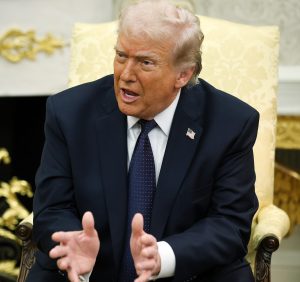

The U.S. is approaching a newly dangerous phase of its war against Iran. The administration is signaling that it will likely soon commence ground operations in Iran that will yet stop short of a full-scale invasion. Obviously, certainly to many TPM readers, this whole situation and war of choice are very bad things. But I want to point your attention to something specific.
Read More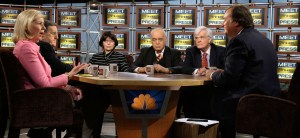
Over the weekend I noticed an example of one of the most significant features of the last decade-plus in American politics, though it’s one that still remains too little remarked upon. Lauren Egan writes a newsletter covering the Democratic Party for The Bulwark. Sunday night’s edition was about pundit and political analyst Stuart Rothenberg, “He Was a Legendary Independent Pundit. Then Trump Arrived.” Basically, How did Stuart Rothenberg come down with, as MAGA puts it, Trump Derangement Syndrome? Toward the end of the piece, Egan gets at what I think is the underlying issue here and some of the commonality I’m about to note.
Let’s start this story in the late ’80s and early ’90s. At the time, there were a handful of men — pretty much all men, as I recall — who played a very specific role in the political-journalistic ecosystem. They were rigorously, perhaps obsessively, non-partisan and were go-to people on basic questions of politics. They’d appear on shows, be on call for quotes for journalists at the big papers. Rothenberg and Charlie Cook played that role in the electoral analysis and predictions space. Larry Sabato also occupied that space, though he also played in the political analysis one. In the latter space were Norm Ornstein (AEI) and Thomas Mann (Brookings). I think they were on PBS Newshour for a long time as a pair. Their analysis was on the mechanics of governing, less the explicitly political stuff and generally not electoral stuff.
Read More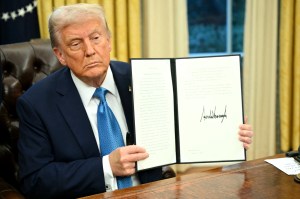
I wanted to share a few thoughts on questions that are adjacent to or secondary to the question the Supreme Court is being asked to take up today. That is in part because there is no real question they are being asked to take up. Birthright citizenship is the clear, intended and unambiguous law of the federal constitution. One might as well try to complicate or question whether the document creates a federal senate. I have a source and correspondent deep in the federal bureaucracy who is a specialist in a specific area of federal law unrelated to citizenship questions. And even though I’ve written about this at length over the years, by going over developments in this person’s area of law with them it has helped me crystalize my own thinking on this topic.
Almost all of these cases are based on the premise, the working assumption of what can the U.S. Constitution mean if we decide that words or established phrases simply have no meaning and we can simply piece the individual words together based on their dictionary definitions? So what does the “law of the land” mean? Well, it turns out some guy who did a stint at the Claremont Institute and now teaches at some obscure law school has written a bracing new law review article about how it refers to agricultural policy, mineral and agricultural rights and the law of farming. That’s really where we are here.
Read More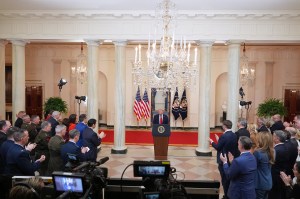
I want to reiterate all the points I made about Trump’s speech last night. Just for the sake of his own political standing, the whole idea was a mistake. It wasn’t a good speech. It wasn’t delivered well. And it didn’t either make favorable news or actually address the issues that have the public or energy markets upset. I didn’t realize as I was watching the speech that his vague “two to three weeks” prediction of when the war will end was really just a restatement of what we might call the Trumpian Constant, the prescribed duration after Trump will, purportedly, always have gotten things worked out and awesome. The time before the Obamacare replacement plan is released, when infrastructure week will finally arrive. I mean, two weeks is genuinely a cliche with Trump or, in more modern parlance, a meme. Trump just tacked on another week. As you might have seen there are lots of charts floating around showing how the price of oil and oil futures spiked pretty dramatically during his speech.
Read More
These days we often think of memes that capture a particular moment or idea. In the old days it was cartoons. There’s a classic that captures a big part of what is happening now with the stoppage of tankers (they’re not all oil or even other hydrocarbons) in the Strait of Hormuz. I think the cartoon in question is from The New Yorker. If anyone has a copy, do send it. In the cartoon a guy has jumped off a skyscraper. As he flies by the 50th floor a guy in the building asks him, “How’s it going?” The guy flying by says, “So far, so good!”
Read More
I frequently get asked what people can do to get involved or play some role in fighting for the future of their country — where to donate, what kind of activism has a real impact. Some people have always been activists. But many others aren’t and haven’t particularly wanted to be but now feel they have no choice. And yet the scale of the problem is overwhelming, and the range of organizations and movements calling on your time and money are almost equally so. Critically, if you’re semi-new to these things, you don’t want to find out you were wasting your time or at least not using that or your money most efficiently.
TPM is a news and commentary site, not an activism site. But at least here in the Editors’ Blog we’re not so finicky about that that we feel we can’t share our opinions, hopefully reasonably well informed and perhaps with additional reporting, about what is a good use of your time or money. So with that in mind, and after a friend suggested it, I wanted to do a series of posts on the idea of “What Can I Do?” And here I would love your participation, your suggestions via email. I have my own views of the matter but I certainly don’t have all the answers and, by design, I don’t get directly involved myself. So give me your ideas, and I will try to share my thoughts on practical ways we individually can try to save our country and, as I will explain in a moment, build a new one. What actually makes a difference and what is more like scattering seeds on the wind?
Read More
Here are a few additional thoughts about the state of the war between the U.S. (and Israel) and Iran.
First, we had news from Reuters over the weekend that the U.S. and Iran might be on the brink of a ceasefire agreement, maybe as soon as Monday. It now seems like that was yet another example of a mix of over-optimism from broker countries trying to bring the sides together and, even more, the White House trying yet again to force a quick-to-fade market bounce. Yesterday afternoon I saw this piece in Haaretz which says that Pakistan (a lead country trying to broker a deal between the two sides) believes that Iran is now under the effective control of the commander of the Islamic Revolutionary Guard Corps, that this commander thinks Iran is winning and that he’s not willing to compromise on Iran’s key demands or accede to the United States’. It also notes that Pakistan thinks the U.S. is more eager for a deal than Iran.
I don’t think you need to be Pakistan to see that last point. Everything President Trump does sends that message. Now, in the wake of the Trump’s threat to “end” Iranian civilization tonight, Iran has reportedly cut off participation in ceasefire talks with the U.S..
A few moments ago I saw this snippet in the Times:
Read More
First, just because Donald Trump is an inveterate liar, don’t assume that Iran is a reliable narrator about anything that was agreed to in this deal. (Was there a deal? We’ll get to that.) One thing both sides explicitly agree on, coming right from President Trump himself, is that the 10 point Iranian plan will serve as the basis for discussions over the next two weeks. The early accounts of what that document included focused on a lot things Iran wants, even including things it wanted before the war broke out. It doesn’t really focus on the things the U.S. notionally got into this war for. (We’ll get in a moment to what’s included in the document Iran released today.) For the U.S., this ceasefire is at best a ceasefire on the basis of a stalemate, where the fight is about a draw and both sides want to see if they can bring the fight to an end.
That’s the optimistic view. The U.S. has clearly been more eager to get to the negotiating table. It’s the U.S. that wants out most. The items on that list tilt heavily toward Iran. The Iranians appear to be exercising continued control of the Strait of Hormuz even if they may allow ships to go through — “allow” being the key word.
Read More
We need to talk about the president’s 2027 proposed defense budget. It’s not like there’s been a shortage of reporting about it. But even with all that, I don’t think people have really absorbed the extent of it, it’s significance, the scale of growth. The president wants to increase the defense budget by more than 40%. That comes on top of his request for $200 billion to fund his current war with Iran.
Read More
I wanted to share a few more thoughts on the current ceasefire and negotiations between the United States and Iran. As I noted earlier, there’s something so rich about sending JD Vance to lead the negotiations since the vice president has bent over backwards to signal to everyone who will listen (or write stories) that he was absolutely, positively against the war in the first place. President Trump has sent Vance to conduct and really own negotiations that almost certainly wouldn’t go well for the United States.
This cannot be an accident.
I started this post before the news broke that the first attempt at negotiations had broken down or, at least for now, had failed. That news just tightened the box into which Trump placed Vance. If the war resumes, Vance owns that continuation because he walked away from the negotiating table. It’s almost as though he gave the original order. If the negotiations fail, that’s on Vance too.
So where are we now?
Read More