


As I noted over the weekend, the arrival of Trump’s 100th day in office (April 30th), has been greeted by a raft of terrible polls. Most of the premium pollsters have fielded a poll to coincide with the 100 days milestone. The results range from approval in the low 40s to the very high 30s. Two put Trump’s approval number at 39%. His disapproval ranges from the mid to the high 50s. In response, there has been a predictable chorus that polls, or public opinion itself, simply doesn’t matter anymore. That’s either because Trump won’t face the electorate again, or because there won’t be elections again, or that there won’t be fair elections if they’re held, etc. The overarching argument is that public opinion doesn’t matter anymore because we’re no longer in the “normal” political space we’re used to.
This is categorically false, a basic misunderstanding of what politics even is.
Read More
There are a number of you who simply don’t agree with me about the role of public opinion in the battle against Trumpism, which I sketched out in yesterday’s Backchannel and in other posts over recent months. And that’s great. Because, among other reasons, you keep me on my toes. And TPM isn’t a community that has any one point of view, in any case. But I note this because I have to again whack this same hornets nest today. So apologies in advance, probably mostly to myself. But this time it’s not with an argument, not some proposition I want to convince you of. It’s more a personal interpretation, my perception of events.
Quite simply, I think Trump’s already lost.
Read More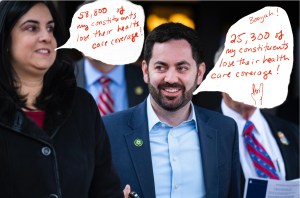
Here’s my latest hobby: looking at just how many constituents House Republicans, especially the so called “moderates,” want to strip of their health care coverage. Congressional Republicans are currently in hard negotiations and a game of chicken for how to pay for their big tax cut, which seems to be getting bigger by the day. They want to pay for it by taking away people’s health care coverage. But just how that gets done is the key. As Nicole Lafond pointed out this week, moderate House Republicans are saying they may not be willing to support $880 billion of cuts to Medicaid. But they might be willing to cut one of the major provisions of Obamacare, the so-called Medicaid expansion system, which pays 90% of the cost for states to substantially expand their Medicaid coverage to more people. This is a big part of how Obamacare dramatically reduced the number of people without coverage. It’s not just about the exchanges and the subsidies.
Read More
There’s been an emerging scandal in Florida for a few weeks now that directly affects not only Ron DeSantis but also his wife, Casey DeSantis, who is weighing a run to succeed Ron as governor. The gist of the scandal is the state of Florida settled an over-billing case against a major Medicaid contractor and then laundered a portion of the funds from the settlement through a series of foundations until … well, until somehow over $10 million ended up in the bank account of the Florida GOP and another $1.1 million ended up in Ron’s personal political committee. It’s good to be the king, right?
This story has been percolating for a few weeks. It got new life when a Republican state lawmaker, Rep. Alex Andrade (R), who has been leading a state House investigation into the issue, accused two top DeSantis associates of money laundering and wire fraud. What got my attention this morning is that the Miami Herald talked to four former federal prosecutors, of both political parties, who told the Herald that by normal standards there’s more than enough evidence to start a federal criminal investigation at least into the associates who directly made the relevant transfers if not the DeSantises themselves. (One of the associates who directly arranged things is then-DeSantis chief of staff and current Florida AG James Uthmeier.) The former prosecutors the Herald spoke to say that the question of whether this meets the bar for a federal investigation is not remotely a close call.
Read More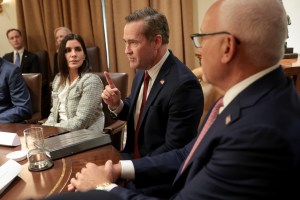
At least for the moment this hasn’t gotten much attention. So let me point your attention to a new part of the White House Signal chat story which is actually a pretty big deal. You likely saw that yesterday Reuters published a photo of a Trump Cabinet meeting in which Mike Waltz could be seen using Signal on his phone. That was pretty unbelievable. You could see several of the chats, though mainly who he was chatting with more than the contents. Embarrassing, etc. But 404 Media, a newish tech news site, noticed that there was more than that. He wasn’t actually using Signal at all. He was using a third-party Signal knock-off which allows you to use your Signal account but with additional features.
Read More
About a week ago, both Matt Yglesias and Jonathan Last at The Bulwark had pieces up arguing different electoral strategies for the Democratic Party. Yglesias argued that while the current Democratic Party is at least competitive in national majority votes (good enough for bragging rights and probably the House) they are at a decisive disadvantage when it comes to winning the Senate in 2026 and in a challenging position when it comes to the Electoral College. What’s necessary, he argues, is a major repositioning on issues like guns and fossil fuels (among other issues) to make Democrats competitive in Senate contests in states like Iowa or Texas, states that often seem like they might elect a Democrat but then don’t. For the purposes of this conversation, we might slot in immigration and trans rights for Yglesias’ fossil fuels and guns. In a way, the arguments were captured by a series of speeches freshman Senator Elisa Slotkin (D-MI) started giving around the same time, in which she argued that Democrats needed to shed their reputation for being “weak and woke” in order to battle and defeat Trump.
Read More
The following is very important news about the Trump White House’s unfolding war against biomedical/disease-cure research in the United States. But the set up is a bit complicated. So I want to note both the complexity and the importance in advance, because I want to really encourage you to read the set up and the details. It’s important stuff and most of it remains unknown to the public, though a few threads of the story have been published.
Back in late March and early April, the Trump administration announced grant freezes against a series of elite private universities, all notionally tied to charges of lax vigilance against antisemitism. The targeted universities eventually included Brown, Columbia, Harvard, University of Pennsylvania, Princeton, Cornell and Northwestern. Harvard eventually sued the administration. Princeton has decided to fight the cuts but hasn’t sued. But most of the universities have generally kept quiet about what they’re doing. And in most cases what that means is that they’re negotiating with the administration and trying to keep their faculties quiet to avoid antagonizing anyone during those notional negotiations.
Read More
Here is a brief follow-up on the question TPM Reader MA addresses in an earlier post: why does the Trump administration have it in for biomedical/disease research? It’s a really good question and one I have not seen an adequate explanation for. But having been reporting on this for a few months now I think I do get the outlines of it.
Read More
Two days ago, I wrote about a pattern operating largely under the radar in the President’s war against higher education. We know about the general grant freezes on about half a dozen elite universities. Then there are countless other grant terminations across a much larger group of universities. One of the complexities of this story is that there are so many different versions of cancellations and terminations going on, it’s hard to figure out which is which. It’s just as hard deciphering to what extent the differences even matter. There are ones tied to prohibited words and concepts (DEI, transgender); there are ones tied to targeted universities; others are terminated on generic efficiency grounds; others are canceled for no clear reason. Are these categories even meaningful or is that all just more smoke and mirrors and distraction?
Read More
Since late in Donald Trump’s first term as President something called “Schedule F” has figured high in his plans to gut and/or make the federal workforce personally loyal to him as opposed to the constitution. The gist of it is that Schedule F would allow Trump to redefine large numbers of civil servants as the equivalent of “policy-making” political appointees who are fireable at will. After he was forced to leave the White House in 2021, Schedule F played a big role in plans for a second term. For a long time I hadn’t looked that close at the specific legal details of Schedule F as opposed to its potential impact. It was usually presented to me as a kind of ingenious bit of lawyering which allowed Trump to undo the Civil Service system from the inside. And I don’t mean Trumpers calling it ingenious I mean either by supporters of non-partisan federal employment and/or journalists who cover these matters.
Read More