

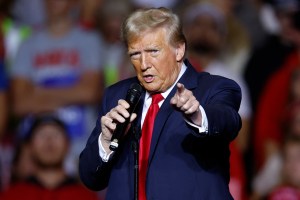

Some of you will disagree with this. And perhaps the future will vindicate your criticism. But I don’t think we should be distracted by Trump’s nonsense about Greenland, the Panama Canal or bum rushing Canada into becoming a U.S. state. We’re all under the grip of that line: “When someone tells you who they are, believe them.” But that doesn’t always work with con men and pathological liars. None of this stuff is going to happen. At a minimum, we shouldn’t get pulled into these outrage cycles or pretending any of this is a thing until you see the U.S. deploying military assets in Central America or … Maine? (I’m not sure where your deploy military assets to menace Greenland but wherever that is, wait for that.)
I saw this CNN article about how Danish officials “fear Trump is much more serious about acquiring Greenland than in first term.” And I get it: the U.S. is a nuclear power and Trump’s a freak. I don’t begrudge them being concerned. But I restate the point. None of this stuff is going to happen. What’s possible is a bunch of bullshit followed by some negotiations in which the Kingdom of Denmark agrees to some minor changes to the existing agreement which allows the U.S. military pretty vast liberties to defend and operate in Greenland. (That’s the NAFTA model: bullshit followed by some discussions and then huge fanfare for marginal changes to existing agreements.) It is the same story that we’ve talked about in other contexts: the constant stream of threats and maybes, all of which create what in this case may not be a penumbra of fear so much as a penumbra of reaction. Absurd tempests in teapots, the effect of which is to have everyone else in a pattern of reaction. He acts — or really doesn’t act, he jabbers — and everyone else reacts. And spin maybe 12 of those things at any one time. And that’s life under Trump.
Read More
I noted yesterday how Facebook’s Mark Zuckerberg is rushing to jump on the Trump tech bandwagon. He signaled this again when he announced that Meta is getting out of the content moderation business and adopting Musk-Era Twitter’s “community notes” model. He further added that he would relocate the remaining content moderation operations to Texas where people are less biased — yes, he really said that.
I want to make a broader point. The issue here is that one of the richest men in the world and one of the very most powerful has made himself and his vastly powerful tech platforms appendages of the Trump political machine and dedicated himself to flowing money to the Trump family directly. But let’s not get too upset about his “content moderation” decisions. The content moderation pivot is an example of the former decision, a carefully timed signal to curry favor. But it’s not some big disaster. The whole existence of it was just a ploy to get out from under his company’s last PR disaster back in 2017 and 2018. And on a more specific level we should be agnostic at best about whether Meta does “content moderation” at all. We should always have been highly skeptical of any corporate-backed effort at scale to determine what is and isn’t accurate information. This isn’t a new thought on my part. It goes back to what I was saying in 2018 and before.
Read More
You’ve likely seen that Mark Zuckerberg, newly re-branded as Donald Trump’s fluffy lap monkey, has announced that Facebook and Meta’s other properties are getting out of the content moderation business. They’ll move in the direction of “community notes,” semi-functional community moderation which Elon Musk pioneered at Twitter. What interested me much more was the Axios run-down of the news: “Elon Musk and Mark Zuckerberg are of one mind. The most powerful global information platforms should be governed by free speech — and the people — not by the platforms themselves.”
Who are we kidding here?
I’ve always been wary of the whole concept of “misinformation” in the context of corporate platform moderation. Not against precisely, but highly skeptical that you can actually come to such open and shut definitions at scale. But it’s all basically an impossible skein to untangle because of the unavoidable scourge of the platform monopolies themselves. These are private companies, not any kind of actual public square. Let them do whatever they want. Don’t do them the favor of granting the premise that their advertising and data platform is a public good. And yet the freedom to spin up untrammeled monopolies makes the conceit half true. There’s simply no extracting a “free speech” from these engines since they’re algorithms all the way down.
But again, who are we kidding here?
Read More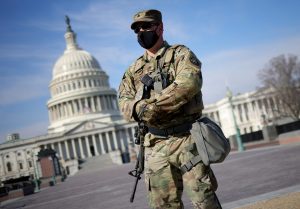
The defeated often hearten themselves with the belief that the verdict of history will be on their side. The reality is that history seldom has a verdict. It’s not like a trial where an unchanging judgment is handed down. That whole concept is mostly wrongheaded, and when there is such a judgment it is always contingent, subject to perspectives of future people we can’t hope to understand.
Today we’re seeing some commemorate the January 6th, 2021 insurrection as a shameful chapter of the past while we see a more consequential replay of the formalization of the 2024 election which looks more like a present-day vindication. Donald Trump refused to accept the results of the 2020 election, resorted to chicanery and eventual violence to upend the results of that election and to overthrow the republic itself. He failed, managed to evade legal repercussions for his actions and is now returning to power as the result of a subsequent election. Those seeking to commemorate that day four years ago as a shameful chapter upon which we are now hoping to close the book seem to ignore that we are beginning a whole new book written by the author of that shameful chapter.
A better way to look at all of this is that we remain in an intense, sometimes violent and close to deadlocked struggle over the future of the country. It is no more done today or tomorrow than it was four years ago.
Read More
It’s some testament to our times that there was an immediate and big hunger among many people to find some way that Matthew Livelsberger’s suicide-cum-Cybertruck fireworks incident in Las Vegas was tied in some way to the ISIS-inspired terrorist attack in New Orleans. The chances of that being the case now seem increasingly remote. I have yet to see any clear theory of what “message” Livelsberger was trying to send by torching his rented Cybertruck in front of a Trump building. But a pretty dark picture is emerging of the man himself, which provides some background for the ideation if not the “message” itself. Livelsberger appears to have been a hardcore Trump supporter and, in the description of at least one person who knew him, a chronic rage case who was abusive to multiple partners.
Read More
For years there’s been a running conversation in the United States about whether the country is heading towards a second Civil War. That conversation often stumbles on the fact that America’s profound divides today don’t line up on any clear regional lines, despite what the maps of presidential election results might seem to show. Divisions are at best intra-regional. So any kind of replay of the 1860s is highly unlikely. But of course plenty of civil wars either had no clear regional breakdown or at least don’t start with one — the Spanish Civil War, the Russian Civil War, the Chinese Civil War, the Syrian Civil War. Before going further I should note that as a general matter I’m a “no” on this question of “are we headed to a second American civil war?” But events yesterday and those of last month suggest the possibility of something more realistic and still ominous.
Let’s quickly review the details: yesterday in New Orleans we had what appears to be an ISIS-inspired lone wolf terrorist attack. The FBI is now discounting initial suspicions that others might be involved. Events like these happened with some frequency in the U.S. for a number of years. But there’s been some respite, more or less since the Pandemic. Then a Tesla Cybertruck exploded in front of a Trump building in Las Vegas. The driver was killed and the car appeared to be filled with high-powered fireworks and gas canisters. It’s still not clear what this incident was about. That’s not remotely how you’d build a car bomb if you wanted to injure anyone. But it certainly doesn’t seem like an accident either.
Read More
Sometimes I will write a post that somewhere midway through the writing starts to feel bloated and overwritten and then, in a pique of writerly nausea, I decide several sentences can and should — no, must, yuck! — do the work of a stable of paragraphs. This post began as one of those posts.
2024 was a deeply disappointing year. It capped two or three years that all had the feeling of playing out bad hands — a presidency defined by the jagged aftermath of COVID (a first-in-half-a-century inflation shock being the jaggedest), an increasingly frail president who couldn’t easily be replaced without doing even more damage than having him run for reelection. This doesn’t address decisions that should have been and could have been made differently. I focus on these because they were based on earlier decisions or events which were either right at the time or very difficult to avoid. Again, that steely but trapped feeling of playing out bad hands.
In 2025 we all face the consequences of those failures. But we are equally liberated from much of that history. Everybody is being dealt a new hand. We can make decisions differently, with more clarity, with less paralyzing concern over sunk costs. If there’s a message of the Biden years, it’s that there’s no simply going back to whatever we thought was the system that more or less worked before Trump arrived on the scene. You have to go forward on the basis of all we’ve seen over the last decade.
My takeaway is what I alluded to in this November piece about being the party of institutions in an era of distrust: Less reflexive protectiveness of institutions and norms and none for ones that can’t concretely justify their necessity in the future rather than the past. Enough valorizing process over results. This isn’t always obvious and doesn’t always come without real risks. But everything involves risk. Caution carries risks. The Trumpists control everything. They are the status quo. They were in many ways already the status quo but they are now in such a way that there is just no murkenizing or hiding it. All the billionaires have arrayed themselves on Trump’s side of the playground and said they’re on his team. We can see who is in charge and who’s powerful and who is the establishment. I find this liberating.
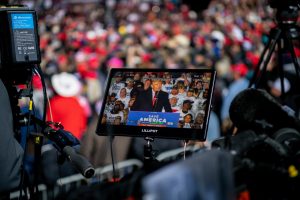
I wanted to flag this article to you. It’s a fascinating look at right-wing South Korean YouTubers and President Yoon’s recent attempt to impose martial law in the country, which ended with Yoon being impeached and removed from power. It matches with bits and pieces of what I’ve been able to pick up in the English language press in South Korea as well as from various commentators who write in English on social media.
One big takeaway is that South Korea is similarly awash in right-wing and left-wing YouTubers who have similarly either destabilized trust in traditional media or taken advantage of that lack of trust, depending on whether you’re on Team Chicken or Team Egg. The trajectory there seems more recent. A lot of it is over just the last two or three years, while in the U.S. these trends date back significantly further. But the most interesting detail is that this world seems to be a big part of the answer to a question that still looms over the whole attempted coup, which is: “what was President Yoon thinking?”
This isn’t the Cold War where you could either be fearing a communist takeover or exploit those fears as a justification for a coup. While South Korea’s democratic era only goes back to the late 1980s, it’s deeply entrenched. And while there was a protracted political crisis of sorts in the country, it really wasn’t one that anyone imagined leading to a replay of things that happened in the country in the 1960s of 1970s. And this isn’t some statement of naiveté: how the whole thing played out vindicates this perspective. The country’s reaction to the attempt can best be described as a widespread “What the fuck?” Like not even, “this won’t stand!” or “we’ll defend our democracy!”, though those were there too. The immediate reaction to Yoon’s move was as much bafflement as fear or anger. The whole thing was so crazy and out of left field that people struggled to understand what Yoon had even been thinking. That’s why the attempted coup played out as it did and why Yoon is currently out of power and looking at likely treason charges.
Read More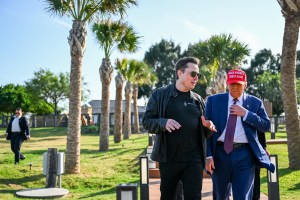
I admit I’ve been saying mostly the same thing in my last few posts on events on Capitol Hill. I must think that if I keep writing it it will finally be clear. Oh well. I just noticed someone say they were surprised that almost 40 House Republicans defied not only Trump but Elon Musk as well.
I don’t think that’s what happened. Was Musk for this Trump/Johnson clean up effort that went down to defeat last night? That doesn’t seem clear at all. It’s way over-literal, over-determined. He wasn’t really for it or against it. He blew the deal up and then just moved on to something else.
Here’s the chain of events I see.
Read More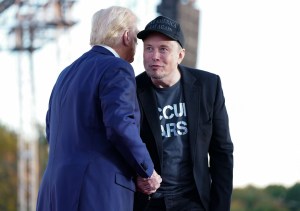
As you’ve likely seen, things kind of went off the rails on Capitol Hill. Speaker Mike Johnson had assembled one of those big spending packages to avoid a government shutdown. Then Elon Musk went off on the bill and started a stampede for the exits among House Republicans. Then Trump turned against it too. Then JD Vance. By the end of the day, it was clear not only that the bill was dead, there was a real question about whether Johnson’s speakership will survive the vote for speaker coming up on January 3rd.
But none of those points are the critical ones. This is about Elon Musk.
Read More