



People are scared and upset about Kash Patel becoming FBI director. There’s good reason to be. But the language illustrates problems we should have learned about during the election. I hear that he’s an “extremist,” that’s he’s a “norm-busting” pick, that he’s inexperienced, that he’s a “hardcore MAGA loyalist.” This all sounds like yada, yada, yada to me. In one ear and out the other.
What I want to hear Democrats saying is that Patel has literally promised to abuse his power as soon as he’s sworn into office. He’s said that repeatedly over the last year. I want to hear Democrats saying they don’t want an FBI director who has promised to abuse the powers of his office as soon as he’s sworn in. To me, that’s not complicated. That’s pretty straightforward. Everyone can understand it.
Read More
Over the past couple weeks, the thought of President Biden pardoning his son entered my head a few times. I tossed it around: good or bad idea? I could see it both ways. I still can. But I am fine with his decision. I’m glad he did it. Biden learned the right lesson: no one gives a fuck about norms. It’s unquestionably true that Hunter Biden wouldn’t be in this position if not for his dad. That’s basically the justification Biden gave. And he’s right. It may sound angry or cynical to say “no one gives a fuck.” But I mean it both in a general way and in this particular way: the reason for Biden not to do this was to allow his son to remain collateral damage of the GOP war against his presidency and to leave him in the hands of the Trump DOJ for at least the next four years all to make a point of principle about being better, different, more righteous, more norm-honoring than Donald Trump.
Truly. No one gives a fuck. If anything, that logic I just laid out sounds like one of those fastidious, hyper-process-oriented and baroque bits of reasoning that have of late left Democrats mesmerized while the real world is passing them by.
Either you know the difference or you don’t. This doesn’t shift the balance in anyone’s head.
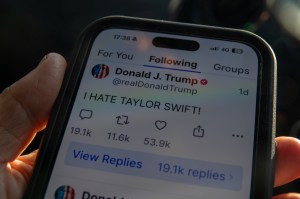
Ever since Elon Musk bought Twitter two years ago, those who despise his evolving mix of predatory trolling, stunted emotional development and right-wing extremism have been hoping for an alternative. There was “Post”; Meta got into the act with “Threads”; another entity of at first uncertain origins actually got its start with one of Twitter’s former CEOs, Jack Dorsey. That was Bluesky. There was also Mastodon, a sort of Linux of social media networks. Part of the problem there was that you may not be familiar enough with Linux to understand the analogy. And if you do, you’re part of a potential community not nearly big enough to sustain a mass adoption social media platform. Each in succession thoroughly failed to dislodge or even make much of a dent in Twitter’s disordered and Frankensteinian dominance. It’s the power of network effects. Everyone can want to leave (or at least a big chunk of users can want that) and yet everyone is simultaneously trapped. It’s a collective action problem.
Read More
A perennial feature of Trumpism is that Trump is constantly launching threats and shiny objects of all sorts. Some of those he’ll follow through on; most he won’t. They all put opponents back on their heels. And that is, of course, the point. Trump lets it all ride and acts on what seems to serve his interests in the moment. Or maybe he doesn’t. That’s also the point. He’s the actor; his opponents are the reactors.
That spurs a knock-on feature of Trumpism. His opponents are among the biggest proponents of the seriousness of his threats. We’ll come back to that.
Polls have come out in the days since the election showing clear majorities favoring Trump’s “mass deportation” plans. Or at least they seem to. One I saw over the weekend asked if respondents supported Trump’s plan start “a national program to find and deport all immigrants who are in the U.S. illegally.” 57% of respondents to a CBS/YouGov poll said they supported that. But let’s note that this is already U.S. government policy. There is a question of what’s prioritized, just what lengths the government goes to to find people. But the question in the poll described what is actually current policy. When asked how he plans to start “mass deportation,” incoming “Border Czar” Tom Homan says they’ll focus first on criminals and terrorist undocumented immigrants. Well, that is especially current U.S. policy.
Read More
We’ve been discussing a lot of plans and ingenious new strategies for a Democratic comeback which are variously half-baked, hyperbolic, histrionic or merely silly. Here’s one that I believe is not. It’s not even a strategy. It’s simply identifying a real challenge, or a knot Democrats need to untangle.
A key reason that many people are Democrats today is that they’re attached to a cluster of ideas like the rule of law, respect for and the employment of science and expertise, a free press and the protection of the range of institutions that guard civic life, quality of life and more. On the other side, say we have adherents of a revanchist, authoritarian politics which seeks break all those things and rule from the wreckage that destruction leaves in its path. So Democrats constantly find themselves defending institutions, or “the establishment,” or simply the status quo. Yet we live in an age of pervasive public distrust — distrust of institutions, leaders, expertise. And not all of this distrust is misplaced. Many institutions, professions, and power centers have failed to live up to their sides of the social contract.
In short, Democrats are by and large institutionalists in an age of mistrust. And that is challenging place to be.
Read More
For years I’ve had a love/hate relationship with Tom Edsall, the one-time Washington Post reporter and author who now writes a weekly column about politics for the Times. The love/hate has a temporal dimension. When I was first getting interested in politics as a teen and young adult I was very taken with Edsall’s books. They were very smart and opened my thinking to new ways to approach political questions, particularly how to think about political economy. In recent years he almost always drives me to distraction. I can’t tell you whether he’s changed or I have or, more likely, we’re just no longer in sync. In the 21st century, Edsall seems always to approach big questions with the idea that regardless of the situation it must be a disaster for the Democratic Party.
In any case, I was reading his latest column, which ends up raising some interesting questions about the politics of liberalism and freedom, building off a column by Noah Smith. Edsall starts with a premise that I think is clearly true. Over the last fifteen years or so, many of the more active Democrats (“strong Democrats,” they’re called in this piece) have moved significantly to the left not only of the median voter but even of the median Democrat on issues tied to sexuality, immigration, race, etc. It’s worth noting that being to the left of the median voter doesn’t mean you’re wrong. And it goes without saying — though it remains curiously unsaid in these discussions — that the same is true of party activists on the right. Still, that can create electoral challenges that need to be managed. That’s what the whole Jentleson/Favreau conversation about “saying no” is about.
So far, so good.
Read More
Let me return to something I wrote about yesterday and said I’d return to: Adam Jentleson’s piece in the Times on whether the Democratic Party can learn to say no to interest groups that often demand assent to various positions and commitments that are either obscure or toxic to a majority of voters. Trans rights aren’t the only issue Jentleson was talking about. But the larger debate clearly revolves around the ad the Trump campaign ran against Kamala Harris saying she supported tax payer-funded sex change operations/gender affirming care for prisoners. This was a question Harris checked “yes” to on an ACLU candidate questionnaire in 2019 as part of her 2020 run for the presidential nomination. There is at least the perception among some that it played a non-trivial role in turning the campaign against her
As a general matter I agree with Jentleson’s point. Not specifically about trans rights issues, but more generally. The goal of parties and campaigns is first to win elections.
But I can’t say that without noting some recent history.
Read More
Because these thoughts are provisional and in process, I’ve decided to package them seriatim, as a list of ideas, possibilities, counters and so forth.
- One of the shortfalls of the recriminationfests that come after a big political defeat is that the people getting the most attention are usually those shouting loudest and making the most totalizing claims. But there are important caveats and qualifiers to keep in mind. One is that anything obvious, sure-fire and without real costs would have been tried already. There’s no silver-bullet solution. This is just common sense, perhaps even conventional wisdom. At worst, it can be used to stifle new thinking or taking new chances. That’s another important pitfall. But it’s still true.

I’ve written in general against post-election recriminations since November 5th. This post may seem like one such recrimination on the surface. But I think if you bear with me, you’ll see that it’s really not. I should be clear, too, that being anti-recriminations, whatever that might mean, doesn’t or shouldn’t mean people shouldn’t try to figure out what was done right or wrong, criticize whoever needs to be criticized. Of course they should. What it means to me at least is that in the desolation of a really, really hard defeat, a very consequential one, people shouldn’t rush in to take shots at the folks they’ve always had it in for, using the devastation less as a wound to overcome than an opportunity for the old score-settling.
So here’s the issue I want to discuss.
Until his campaign began to come undone this last summer, it was widely understood and accepted among Democrats that Joe Biden, to the surprise of many, was the most progressive Democratic president, with the most consequential progressive legislative agenda, in at least half a century. This was widely believed because it was unquestionably true. Because of a series of decisions by both Biden and Sen. Bernie Sanders, Biden ended up governing with a trimmed down version of the legislative agenda of the progressive left. What counts here as “trimmed down” is obviously a pretty critical question. There was no Medicare for All. But on lots of policy and regulatory positions, the left’s agenda was Biden’s. This isn’t just me saying this. Ask Bernie Sanders, or at least ask him until a week ago. The point I’m making here really isn’t open to much debate.
Read More
In the waning days of the 2024 presidential campaign, Amazon mogul Jeff Bezos became the target of widespread and deserved disgust for nixing The Washington Post’s policy of endorsing presidential candidates to avoid antagonizing Trump. As I wrote at the time, it’s not that there’s anything magical or even necessary about newspaper endorsements. The whole concept strikes me as a bit dated. The issue was why they were being dropped. Bezos wasn’t being paranoid. There is abundant and persuasive evidence that Trump used the levers of government to punish Bezos through Amazon and his Blue Origin space delivery company during his first term. The phrase many people used to describe this behavior is “anticipatory obedience.” (I’ve been told the phrase might originate with Timothy Snyder. I don’t know if he coined it or simply brought it to wider use.) But there’s another kind of anticipatory obedience I’ve seen like a torrent in the days since Trump won the election, and it’s more paradoxical because it comes from people who feel they are the most intense of opposers.
During harrowing times some people become overwhelmed and even lose hope. It’s not a one-way progress. Almost everyone has their moments. But there’s a particular kind of militant doomerism afoot at the moment. Any discussions of next steps in the battle against Trumpism or the preservation of civic democracy, any suggestions or strategies, are met with a chorus of, “don’t you get how it worked under Hitler and Stalin!!?!” Or “don’t you know rules don’t matter to Donald Trump!?!?!”
Read More