



The Post’s Ishaan Tharoor has an interesting rundown of differences and similarities between the events of Jan. 8 in Brazil and Jan. 6 two years ago. The fundamental difference, which any expert would have told you in advance, is the role of the Brazilian military and security services. Less than 40 years ago, Brazil was under military rule. Military rule is not some fantastical dystopia there. It’s the reality that most of the country’s political class grew up in.
Brazil’s insurrectionists had studied Jan. 6 closely. You can see that in so many of the visuals. But there was a key difference. The focus of the insurrectionists’ plan, in advance and on the day of, was to build support within the military. They camped out around military bases. They tried to build links to military factions. Nor was this some vain hope. It’s generally agreed that the military and security services were and are sympathetic to Bolsonaro. But political sympathy is not the same as a willingness to intervene to overthrow the political order. Tom Shannon, a former U.S. Ambassador to Brazil, told Tharoor: “The Bolsonaro people had really studied January 6 and the conclusion that they came to was that Trump failed because he relied on a mob and that he had no institutional support.” Institutional support, in this case, being the army and the police.
Join

A number of you have asked me via email just how it is that Jair Bolsonaro is in the U.S. at all? He may be informally on the lam or trying to stay out of the reach of Brazilian authorities. But he didn’t come seeking asylum. I told these readers I figured former heads of state and rich people and just VIPs generally don’t have much problem making extended visits to the United States. But really, I had no idea. But this Reuters story has what seems like the real story. It’s much more interesting and suggests more planning.
There’s such a thing as an A-1 visa which the U.S. reserves for heads of state and high-ranking government officials. Bolsonaro entered the U.S. on his second-to-last day as president. (He pulled a Trump, refusing to participate in the inauguration of his successor.) There’s no way to know specifically without more information from U.S. consular authorities. But according to consular officials and outside experts, Bolsonaro almost certainly entered the U.S. on his A-1 visa.
Join
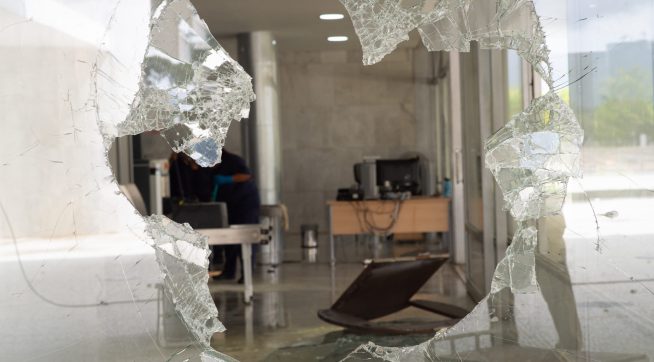
I’m going to resist commenting too directly on yesterday’s events in Brazil because it is far outside any expertise of mine. But allow me a few observations. The parallels to the January 6 insurrection in the U.S. are obvious and uncanny. To some degree that seems to have been intentional. But there is at least one key difference. On January 6, 2021, the American insurrectionists were trying to disrupt a specific constitutional process essential to the transition of power to the new president. That doesn’t seem to have been the case here. Lula is already president. The Brazilian Congress wasn’t in session. And Lula was in another part of the country.
Even in Brazil there seems to be some real question about just what the plan was and just how far into the military and state security services support for the insurrection went. Watching press reports yesterday there were a number of key governmental officials who are suspected of either being part of the insurrection or passively supporting it who then made showy efforts to arrest perpetrators once things got out of hand. From a distance it looked like something went wrong, like it became clear that whatever was intended wasn’t working and then players who had been taking a wait-and-see approach made hasty efforts to distance themselves from violence. All this said, Brazil is a different country with internal politics I have little understanding of and a very different history from the United States.
Join
Covering the ongoing implosion of George Santos is, in a way, mostly fun and games. But we saw over the last four days how it will soon be something rather different. If you watched TV and photographic coverage of the speakership drama, Rep. Santos spent a lot of time on the floor with Matt Gaetz, Marjorie Taylor Greene and Lauren Boebert. Indeed, he seemed glued to them increasingly over the course of the four days. I doubt that is a coincidence. If there are any GOP reps you want in a foxhole with you against the “fake news” media and the GOP’s RINO establishment, it’s these three. This cannot be an accident.
Right now there are 212 Democrats and 222 Republicans. That will move to 213 to 222 after the special election in Virginia next month. If Santos were to resign he would be replaced in a special election and Democrats would be solid, if not strong, favorites to win that race. If a Democrat was elected, that would move the numbers to 214 to 221. In that scenario Republicans can only lose three members on any vote.
Join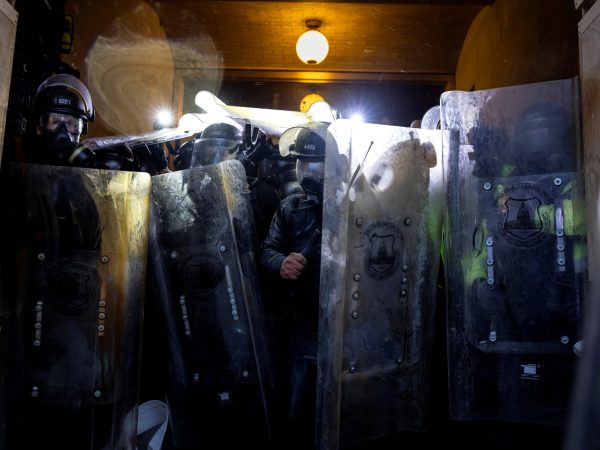

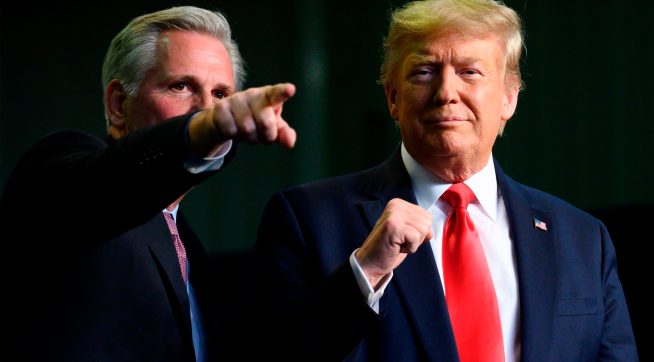
TPM Reader JO makes a point I confess had not occurred to me. If Republicans again place Donald Trump’s name in nomination to serve as the next speaker, Democrats should raise a point of order that Trump is in fact ineligible to serve as speaker under the 14th Amendment because he previously “engaged in insurrection” against the United States. The Constitution placed essentially no qualifications on potential speakers. They do not have to be members of Congress. But the 14th Amendment prohibition clearly trumps that open door by disqualifying anyone who has engaged in insurrection or rebellion from holding “any office, civil or military, under the United States.” That unquestionably includes the speakership, one of only a handful of federal offices explicitly created by the constitutional text. If Trump engaged in insurrection, he is clearly ineligible to serve as speaker.
Join
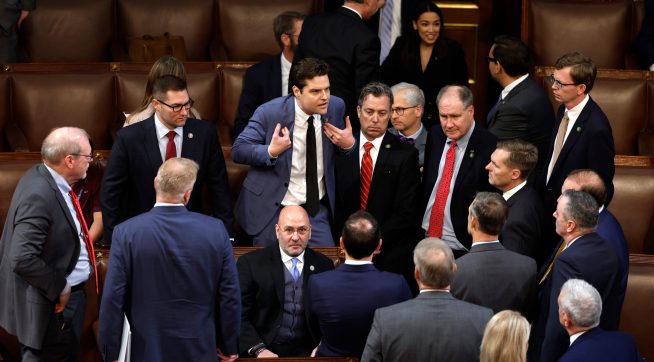
I thought it was worth making a simple point. The spectacle of the last two days is an embarrassment. The House GOP and really the GOP generally has shown itself incapable of governing in the most basic sense. But I’ve heard some suggestions that this is sort of a lo-fi reenactment of the events of two years ago: more chaos, more craziness, more dysfunction. It’s worth pushing back a bit on that appraisal. This is democracy. If anything there is something a bit invigorating about seeing vote after vote where the outcome, immediate or eventual, isn’t at all clear. One vote, followed by various frenzied negotiation, another vote, followed by more.
Join