Your briefing on developments in the Supreme Court confirmation battle.
Mutterings against Judge Michelle Childs, a member of President Joe Biden’s shortlist for the Supreme Court, have started bubbling up from the pro-labor world.
These numbers came out a week or ten days ago. I had seen them before. But seeing them mentioned again today just made me marvel. In December 2021 unvaccinated people in the United States were 97 times more likely to die of COVID than people who are vaccinated and boosted. 97 times more likely. Just think about that number.
The metric is ‘only’ 14 times more likely compared to people who are vaccinated but not boosted. That is a remarkable level of protective benefit by any standard. But I find the degree of benefit from the booster even more eye-popping. It’s not a marginal difference. And to think tens of millions of Americans simply refuse to take this simple, free step.
Corey Lewandowski, a relic of the Trump administration, said that he’s on a mission from the former President to field quality candidates against New Hampshire Gov. Chris Sununu (R) and Sen. Maggie Hassan (D-NH).
There’s a fascinating passage in these new Trump election lawyer memos from the pre-January 6th period. One particularly jumped out at me in which Trump campaign lawyer Kenneth Chesebro casually runs down the relative difficulty of stealing the election in each of the key states.
“In conclusion, it appears that voting by an alternative slate of electors is unproblematic in Arizona and Wisconsin; slightly problematic in Michigan (requiring access to the senate chamber); somewhat dicey in Georgia and Pennsylvania in the event that one or more electors don’t attend (require gubernatorial ratification of alternates); and very problematic in Nevada (given the role accorded to the Secretary of State).”
A new episode of The Josh Marshall Podcast is live! This week, Josh and Kate discuss news around the Supreme Court nomination, including the Republican reaction, and the push for legislative election reform.
You can listen to the new episode of The Josh Marshall Podcast here.
MAGAworld was founded by a man who flung himself into pop culture and political relevance via reality TV.
Plagued by the scarlet letter of ties to former President Trump, several of the TV president’s past allies and White House staffers have had trouble finding work post-presidency — some have even faced professional repercussions, like, I don’t know, losing their license to practice law.
Jobless and defeated, why not follow in The Apprentice star’s footsteps?
The Pennsylvania Supreme Court will draw a new state congressional district map after Democratic Gov. Tom Wolf and the GOP-controlled Pennsylvania legislature got locked in a stalemate over the map drawn by Republicans.
The New York Times on Wednesday published two memos from the 2020 Trump campaign legal team showing their early planning for using alternate electors and the Jan. 6 Electoral College certification date to overturn Joe Biden’s victory.
These climate shifts are triggering immense challenges, such as structural collapses as long-frozen ground thaws and risks to life and property from increasing wildfires. Agriculture is one area in which climate change may actually bring some benefit to our state, but not without stumbling blocks and uncertainties.
Our research suggests that planning for future decades and even future generations may be crucial for keeping Alaska fed, healthy and economically stable. We have created online tools to help Alaskans start thinking about the possibilities. https://www.youtube.com/embed/2fynjF0GEeI?wmode=transparent&start=0 Alaska currently produces only 5% of its food supply. Expanding agriculture could make the state more food-secure.
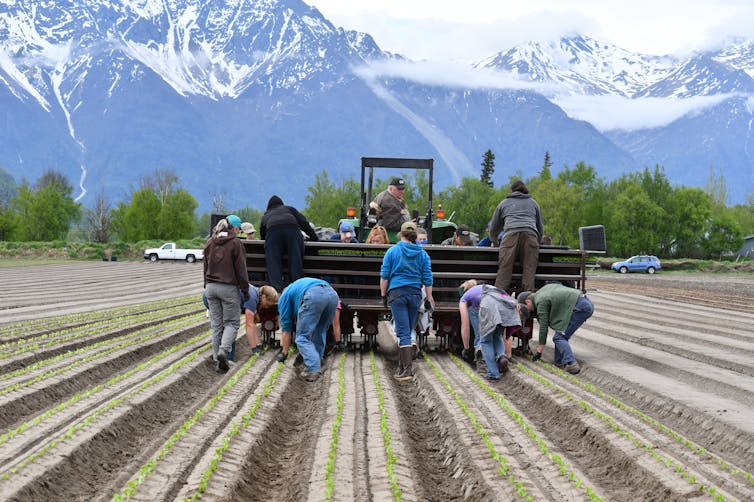
Transplanting lettuce seedlings from greenhouses to fields in mid-May at VanderWeele Farm in Palmer, Alaska. Tracy Robillard, NRCS Alaska/Flickr
Farming in a cold climate
Alaska’s vast size is reflected in its wide range of climate zones, from the temperate and rainy Tongass National Forest to the rapidly greening but still frigid Arctic tundra. In ocean-moderated Anchorage, the first fall frost doesn’t typically arrive until late September, but historically, average July temperatures were a modest 59 F (15 C). Even that is warm compared with 56 F (13 C) for Juneau and 51 F (11 C) for Nome. Here in Fairbanks, July is a little more summery, but frost often strikes in August, and winter temperatures regularly drop to -40 F (-40 C).
With cool summers, short growing seasons and frigid winters, most farming in Alaska has long been limited by the state’s cold climate. Although home gardens are popular, with growers favoring hardy crops such as cabbages, potatoes and carrots, agriculture is a tiny industry. Recent data from the U.S. Department of Agriculture tallies a mere 541 acres of potatoes, 1,018 acres of vegetables and 22 acres of orchards in our 393 million-acre state.
Crops of the future
Our climate modeling suggests a dramatically changing future for Alaska crops by 2100, with frost-free seasons extending not just by days, but by weeks or months; cumulative summer heat doubling or more; and the coldest winter days becoming 10 or 15 degrees less extreme.
Perhaps the most startling projected shift is in what is known as “growing degree days” – a measurement of the cumulative buildup of daily heat above a crop-specific minimum threshold, across an entire summer.
For example, barley is a cold-hardy species that can start sprouting at temperatures as low as 32 F, but the speed of its growth nonetheless depends on warmth. If the average temperature on a given day is 50 F, 18 degrees above barley’s threshold, that day counts as 18 growing degree days; a 60-degree day would count as 28. Barley won’t reach maturity until it experiences a total of about 2,500 growing degree days above 32 F – a target that could be reached in about 138 days at 50 F, or 89 days at 60 F.
The math changes for other thresholds. Broccoli, cauliflower, cabbage and Indiana wheat won’t grow unless temperatures exceed about 40 F. “Warm” crops such as corn and tomatoes are even fussier, with a threshold of 50 F; for these plants, a 60-degree day represents only 10 growing degree days. Such crops have been almost entirely out of reach for Alaskans except in greenhouses.
In the past, I would have been able to expect only about 850 growing degree days above a 50 F threshold here in Fairbanks over the course of a typical summer, nowhere near the roughly 1,500 that corn would require to produce mature ears. But by the year 2100, my grandchildren might anticipate 2,700 growing degree days each year above a 50 F threshold – more than enough to harvest sorghum, soybeans, cucumbers, sweet corn and tomatoes.
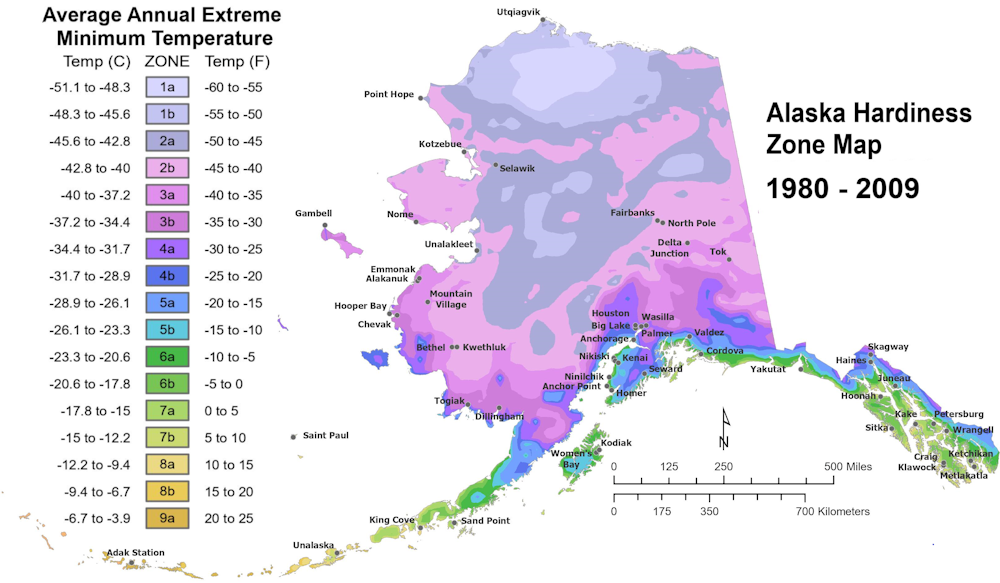
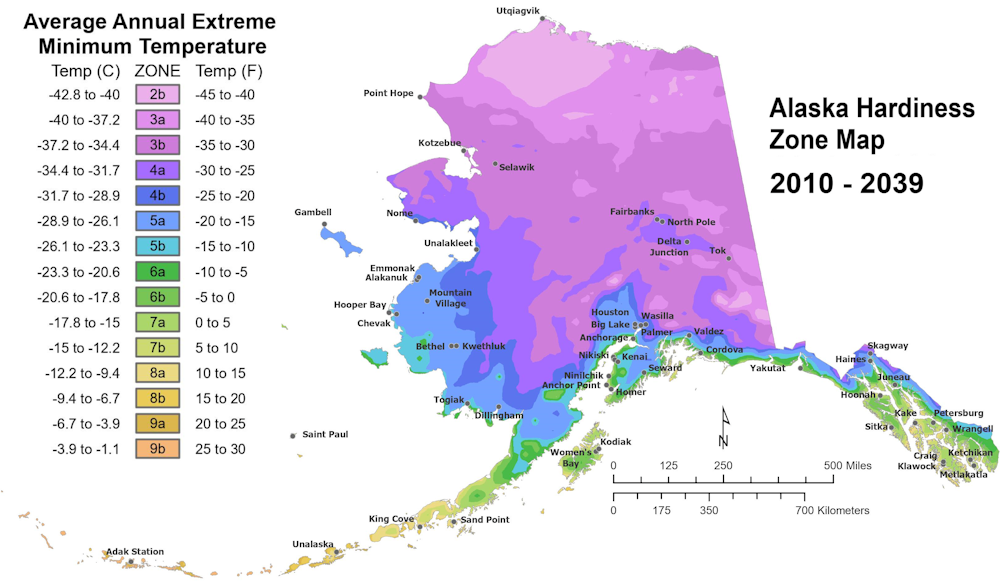
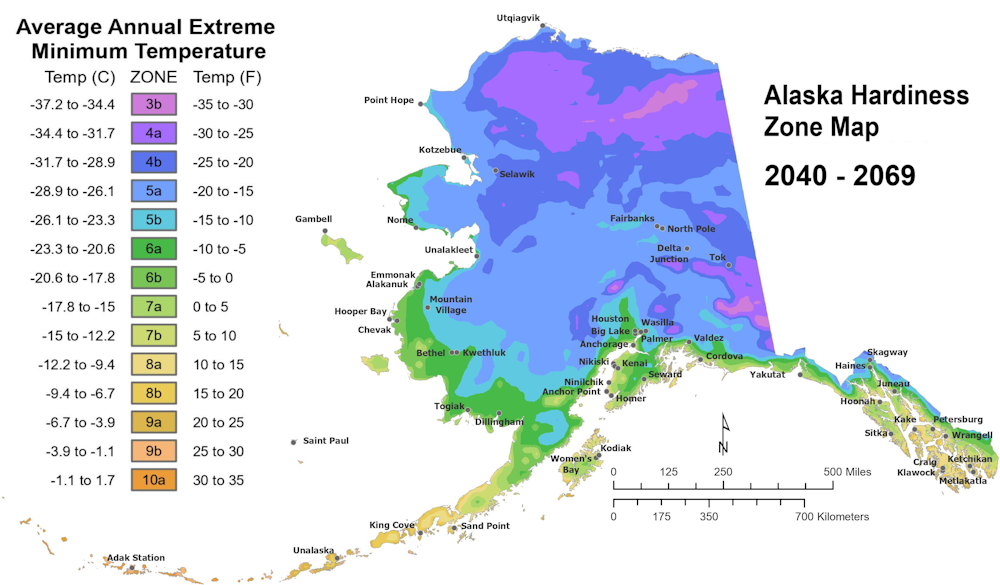
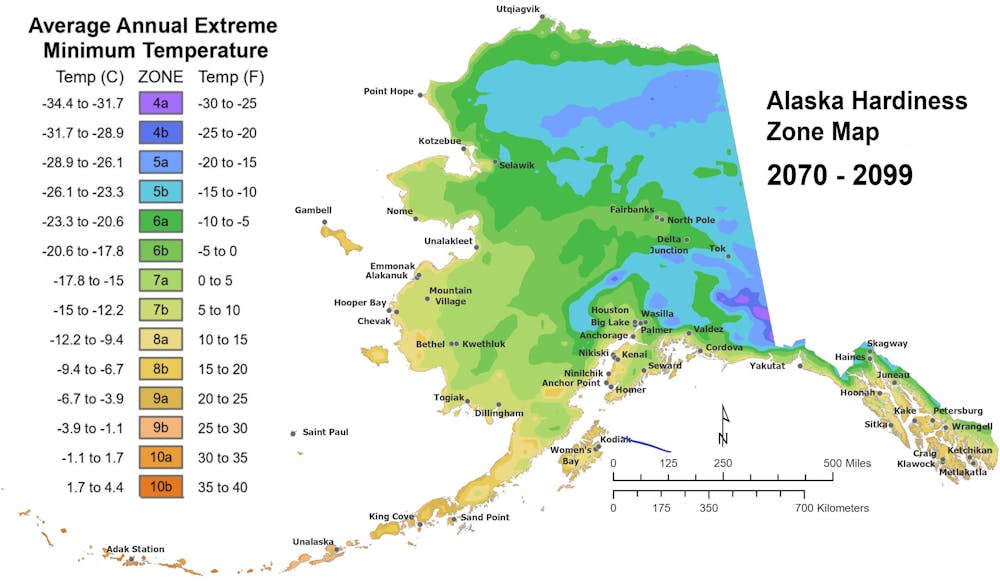
We’re also likely to see huge changes in potential perennial crops because of our loss of winter chill. Many gardeners are familiar with USDA Plant Hardiness Zones, which are based on the average coldest winter temperature for a given area. Using the same categories as the USDA, we projected Alaska Hardiness Zones.
Dramatic shifts in these maps provide a snapshot of just how profound climate change is in the far north. Historically, my Fairbanks home is in Zone 1 or 2. By the end of the century, it is projected to be in Zone 6 – the current zone in such places as Kansas and Kentucky.
Only 5% of the food we consume in Alaska is grown or raised here. Shipments from the Lower 48 travel vast distances to reach our state and its dispersed communities. Alaskans are vulnerable to supply chain disruptions when even a single barge fails to arrive or one road is blocked.
Growing more fresh foods here would help Alaska economically and nutritionally – but it won’t happen automatically. To achieve meaningful long-term increases in agriculture, the Alaska Food Policy Council has recommended creating a proactive state-funded nutrition education program, developing more food storage infrastructure, offering financial incentives for expanding agriculture and teaching residents about northern growing methods. The council’s research suggests that the state could realize major benefits from investments in training, technology, support for clustered businesses such as packaging and storage, and programs to foster a farming culture.
A tool for gardeners and farmers
To make the results of our modeling available to home gardeners and rural villages, we created an online tool, the Alaska Garden Helper, and a fact sheet. Alaskans can select their community, decide which of the above questions to explore, and choose what temperature thresholds are of interest, from “hard frost” (28 F or -2 C) to “warm crops” (50 F or 10 C).
The tool includes brief explanations of unfamiliar concepts such as growing degree days. It also includes lists of potential crops such as barley, beans, cabbages and corn, each with minimum values gleaned from published literature, for the summer season length and growing degree days necessary for that crop to successfully mature.