

Michael Gableman, the former Wisconsin state Supreme Court justice leading the Wisconsin legislature’s Trumpified investigation into the 2020 election, is calling on the lone elected Republican who criticized him to resign.
Continue reading “Wisconsin GOP’s Election Investigator Calls On Republican Who Criticized Him To Resign”Trump Spox Sues To Block Jan. 6 Committee From Accessing His Financial Records
Former President Trump’s spokesperson, Taylor Budowich, sued the Jan. 6 committee on Friday in an effort to block the panel from obtaining his financial records — and, in doing so, gave an account of his cooperation with the investigation so far.
Continue reading “Trump Spox Sues To Block Jan. 6 Committee From Accessing His Financial Records”Here’s Where Republicans Are Aiming The Brunt Of Their Gerrymandering Might
While anti-partisan gerrymandering legislation languishes in a Senate gridlocked by Republicans and the filibuster, both parties on the state level are actively mapping out how best to craft congressional districts to give them easy wins.
Continue reading “Here’s Where Republicans Are Aiming The Brunt Of Their Gerrymandering Might”The Low-and-Slow Approach to Food Safety Reform Keeps Going Up in Smoke
This story first appeared at ProPublica. ProPublica is a Pulitzer Prize-winning investigative newsroom. Sign up for The Big Story newsletter to receive stories like this one in your inbox.
For Nancy Donley, the fight for safer food started one agonizing summer night in 1993.
She and her family had hamburgers for dinner, and soon after, her 6-year-old son Alex complained of a stomachache. Within hours, he had curled himself into a ball and was begging his mother for comfort.
The next morning, thinking Alex might have appendicitis, Donley took him to the pediatrician. The doctor sent Alex to the emergency room at a children’s hospital near their home in Chicago.
A toxin was invading the boy’s body. Blood began to flow from Alex’s bowels, and when he became too weak to stand, Donley helped change a stream of soaked diapers. Soon Alex lost neurological control and battled tremors and hallucinations. His kidneys shut down, then his lungs. After Alex suffered a massive seizure, his mother watched as the brain waves on his monitor flatlined. “He was gone,” Donley said.
On July 18, 1993, Alex died of hemolytic uremic syndrome, which can result when bacteria damages the blood vessels.
In Alex’s case, it was caused by a dangerous strain of E. coli known as O157:H7, which originates in livestock feces.
It was the same bacteria that had generated national headlines less than a year before when it killed four children who had eaten Jack in the Box hamburgers. Federal officials had closed their investigation into the “hamburger disease” in February 1993, but the pathogen was still circulating because the country’s turn-of-the-century meat safety laws didn’t outlaw the sale of bacteria-tainted beef.
The children’s deaths captured the attention of policymakers and spawned a fervent push for safer food. Donley, seeking to channel the anger and grief that consumed her, joined the fight. “Alex was very much let down by industry, by government,” she said.
Donley became a prominent national voice for food safety, successfully pushing the U.S. Department of Agriculture to take steps toward modernizing meat inspection and inspiring officials to ban the sale of meat contaminated with the type of E. coli that killed Alex.
These victories in the early years of her advocacy seemed to presage sweeping changes to the country’s food safety system, a maze of 15 agencies operating under nearly three dozen laws, with no single person or entity in charge.
But then one effort at reform after another fell short, leaving Donley deeply frustrated — and leaving the failed regulatory scheme much as it was.
“To say it’s broken suggests that it was working properly before,” said Thomas Gremillion, the director of food policy for the Consumer Federation of America. “We’ve just followed this path and it’s become more and more dysfunctional.”
ProPublica’s recent investigation into a nearly four-year-old salmonella outbreak found that when an antibiotic-resistant strain took hold of the chicken industry, food safety officials were powerless to stop it from sickening the public.
That outbreak, which continues to this day, was yet another reminder of the shortcomings that for more than 70 years have led consumer advocates like Donley, along with government experts, members of Congress and several presidents, to call for a single food safety agency.
But the idea has stalled again and again, easy to propose but all but impossible to enact.
Over the last 25 years, three presidents — Bill Clinton, Barack Obama and Donald Trump — have proposed unifying the food safety system, but none of them have made it a political priority. The Clinton administration, for example, released its plan on his last day in office.
Since 1970, the nonpartisan investigative arm of Congress now known as the Government Accountability Office has issued 16 reports documenting the dysfunction of our food safety system. But the GAO’s repeated calls to create a single agency have gone unheeded.
Congress has held more than two dozen hearings where the idea was raised, often prompted by one of those damning GAO reports or by news of a deadly outbreak somewhere in the country. And over the last two decades, legislators have introduced 10 bills that proposed creating a single agency.
But none of them stood a chance. The congressional committees that oversee various arms of the food safety system have shown little appetite for giving up power — as some would have to do if the bureaucracy were consolidated into a single agency.
So the country remains saddled with a system that prohibits meat safety inspectors from regulating farms, that makes cheese pizza the purview of one agency and pepperoni pizza the responsibility of another, and that can’t ban raw poultry tainted with dangerous strains of salmonella — unless it’s in pet food.
To understand why comprehensive food safety reforms have proved so elusive, ProPublica reviewed decades of government reports and hundreds of pages of congressional testimony, in addition to interviewing current and former food safety officials, industry representatives, consumer advocates, White House advisers, and members of Congress and their staffers.
Our examination shows a recurrent cycle of good intentions and government inaction. Outbreaks involving hamburgers, peanut butter or spinach spark angry rhetoric followed by bills, congressional hearings and presidential commissions. These, in turn, have in some instances led to notable changes that nonetheless left the system fundamentally flawed.
Michael R. Taylor, who held food safety posts at both the USDA and the Food and Drug Administration, helped push through the ban on the E. coli strain that had killed Alex Donley. But in the decades since that breakthrough, he’s seen the country grow inured to the vulnerabilities in its food safety system and indifferent to the pleas of parents like Nancy Donley.
In the end, Taylor said, there’s an unwillingness to undertake the large-scale improvements needed to ensure the country’s food is safe. “Nobody cares enough,” he said.
A Conflict More Than a Century Old
When U.S. food safety regulations were first devised in the late 1800s, all of the responsibility fell to the USDA. But from the start, the agency had to grapple with dueling agendas. While the secretary of agriculture was charged with supporting American food producers, the head of the agency’s Bureau of Chemistry tracked tainted foods and pushed aggressively for poisonous and impure products to be removed from the market. For decades, the two positions were at loggerheads.
In 1940 President Franklin D. Roosevelt tried to resolve the USDA’s internal conflicts when he moved the chemistry bureau — what had become the FDA — to what is now the Department of Health and Human Services.
That move cemented the split in food regulation. Meat and poultry remained under the USDA while most other foods fell to the FDA, setting up the present system, where the FDA inspects production lines making frozen cheese pizzas and sandwiches while the USDA inspects the lines that turn out frozen pepperoni pizzas and open-faced sandwiches.
It wasn’t long before there were calls to reunify the system. The Hoover Commission, created by President Harry Truman to improve government efficiency, said in 1949 that the multiplicity of agencies regulating food “creates great overlap and also confuses the public.” The commission concluded that all of the federal food safety responsibilities should be transferred to the USDA, but the recommendation went nowhere.
Confusion and conflict continued to plague the system.
In 1975, a consumer advocacy group tested eight brands of beef and poultry pot pies and found rodent hairs or insect parts in every package. The group petitioned the FDA to set limits on the amount of “filth” that could be found in the product, but the FDA forwarded the request to the USDA. A month later, the USDA returned the petition to the FDA, telling the consumer group that “while it is true that the production of meat and poultry pies is subject to USDA’s inspection program, the responsibility for the wholesomeness of spices delivered for use in meat and poultry plants rests with the FDA.”
In the end, neither agency took any action.
Over the years, Congress and various presidential administrations have complicated the regulatory landscape by assigning pieces of food safety to other agencies. The Environmental Protection Agency has been charged with overseeing drinking water and pesticides, for example, while the National Oceanic and Atmospheric Administration was tasked with grading seafood. Today, a total of 15 agencies have a hand in food safety, but the primary divisions are between the FDA and the USDA, which regulate the vast majority of the country’s food supply.
The GAO has repeatedly urged changes to the fragmented food-inspection system. This year, in its most recent review of food safety, the GAO noted that a number of its longstanding recommendations, including one dating back 20 years, have gone unfulfilled by Congress and the White House.
Many have come to see the GAO’s critiques as out of touch with the political realities of Washington and more aspirational than actionable. “When you’re talking about overhauling the entire statutory scheme that governs food safety, it’s an unimaginable task,” said Timothy Lytton, a Georgia State University law professor who has studied food safety regulation. “I mean, this Congress can barely get a budget passed.”
The four congressional committees that oversee the USDA and FDA are at the heart of why the U.S. hasn’t moved toward a single food safety agency, experts say. The agriculture committees in the House and Senate would, for example, have to relinquish aspects of their oversight authority if the Agriculture Department’s food safety functions were shifted out of the agency. “The people in charge of reorganizing that structure would have to give up the one piece of leverage that they have politically that’s useful for them,” Lytton said.
For many years in the late 2000s and early 2010s, former Rep. Jack Kingston of Georgia was the top Republican on the House subcommittee that made appropriations to the USDA and the FDA. Congressional committees are fiercely protective, he said. “They don’t want to give up what they consider their territory or areas of expertise.”
That reality has stymied legislators such as Rep. Rosa DeLauro, D-Conn., and Sen. Dick Durbin, D-Ill., who have routinely introduced bills to consolidate the food safety system.
“Continuing this disjointed approach to oversight will only put more consumers at risk of serious or fatal foodborne illness,” Durbin told ProPublica in a statement. “By creating a single, independent food safety agency, Americans can gather around the dinner table knowing that their meal is safe for them and their family.”
Durbin and DeLauro’s most recent bill, the Safe Food Act of 2019, received little attention and didn’t move forward after it was introduced.
Even supporters of a single food safety agency were skeptical of its prospects. “It was a messaging bill,” said Gremillion of the Consumer Federation of America, which backed the legislation. “At the end of the day, I don’t think anyone expected the Safe Food Act to be seriously debated in Congress.”
Many Proposals, but Little Desire to Act
Perhaps one of the clearest opportunities to create a single food safety agency came in 1993, after the E. coli outbreak in Jack in the Box hamburgers killed four children under the age of 7. The incident put food safety on the Clinton administration’s priority list, and it seemed to create an opening for a serious national discussion about reorganizing the system.
Within months of the outbreak’s end, the White House recommended that all federal food safety oversight be taken over by the FDA.
Consumer advocates favored the idea, as did some former USDA officials, who complained in congressional hearings that the Agriculture Department’s efforts on food safety were outdated and reactive. But some influential members of Congress wanted the USDA to handle the country’s food safety regulation, while the meat industry was divided on the idea of moving everything under a single agency.
Then-Rep. Edolphus Towns, D-N.Y., the House subcommittee chair who convened a May 1994 hearing and advocated for a comprehensive food safety policy, also wasn’t sure that creating one agency was the solution. “Simply changing the organizational boxes will not save lives,” he said during the hearing.
By 1996, the Clinton administration had retreated on the issue. A White House report focused instead on improving coordination between the agencies and enacting more easily attainable policies, like requiring meat plants to develop and implement plans that curb food safety hazards.
A fresh chance for a single system came in 1998. The National Academy of Sciences issued a report that echoed decades of concern about the “inconsistent, uneven, and at times archaic food statutes.” The authors called on Congress to rewrite the laws so that food safety would be overseen by a single official.
Clinton, in his second term, responded by creating the Council on Food Safety. It was charged with creating a strategic plan for “a seamless, science-based food safety system.” It resurrected the idea of consolidation, arguing that “it is in the best interest of the American consumer to have a comprehensive food safety statute with a corresponding organizational structure.”
But what was supposed to be a roadmap to reform only led to another dead end. It was released the day before Clinton’s second term ended in January 2001.
After President George W. Bush took office, his administration made it clear through a White House policy committee that it saw interagency coordination — not consolidation — as the key to an improved food safety system.
Still, government efficiency drew some Republicans to the idea of a single food safety agency. Early in Bush’s second term, then-Rep. Jon C. Porter, a Republican from Nevada, convened a hearing titled, “Question: What Is More Scrambled Than An Egg? Answer: The Federal Food Inspection System.”
Within a few minutes of the hearing’s start, Porter ventured that he already knew who was responsible for the byzantine system. “The blame lies primarily with Congress, which has haphazardly passed the laws making the system what it is today throughout the years,” he said.
The moment of introspection did not lead to policy changes, however. A couple years later, the idea of a single food safety agency got another boost when Democrats won control of Congress and DeLauro became chair of the appropriations subcommittee that funds the USDA and the FDA.
For years, she’d been introducing legislation that would unify the food safety system. Her powerful new role seemed to offer an opportunity to advance the idea.
But Brian Ronholm, an ex-DeLauro staffer and former USDA official, said her ascension did not eliminate the power dynamics that had long stalled the idea. And DeLauro’s early efforts faced a newer obstacle — the creation of the Department of Homeland Security after 9/11, a complicated reorganization of nearly two dozen agencies that some in Washington saw as a cautionary tale about the kind of culture clashes and mismanagement that can result from combining bureaucracies.
“It has created such an overwhelming narrative about the consolidation of agencies that I think it still impacts the debate now,” said Ronholm, now the director of food policy at Consumer Reports.
Another deadly outbreak in 2009 seemed to open the door yet again. More than 700 fell sick and nine people died after contracting salmonella poisoning from peanut products. Obama announced on NBC’s “Today” show that his administration intended to examine why the FDA hadn’t caught the problem faster. And DeLauro reignited the push to restructure food safety by introducing a bill in 2009 that would have established a Food Safety Administration.
But even with an expanded Democratic majority in the House, DeLauro, who declined to comment for this story, could not secure a formal hearing for her bill. And when the idea for a single agency did come up in Congress, at a Senate hearing looking into the peanut scandal, support for a unified system was underwhelming.
Then-Sen. Tom Harkin, D-Iowa, asked a panel of consumer advocates if a single regulatory agency would improve food safety. They weren’t so sure. Echoing earlier comments, a former FDA commissioner asked whether reorganizing the system would simply cause too many logistical headaches. “Would you spend all your time moving boxes as opposed to fixing the problem?”
The Obama administration tried to make one last attempt at food safety consolidation toward the end of his second term. His 2016 budget request proposed creating a new agency under the Department of Health and Human Services. The idea had a noteworthy supporter: Agriculture Secretary Tom Vilsack.
In a Congressional hearing, Vilsack told legislators that he had met with the parents of a child who had died after eating a hamburger tainted with E. coli, and he was convinced that creating a single agency would improve government accountability. “You would be able to point the finger at the agency that is responsible for food safety and say, ‘Why did you not do your job?’” Vilsack told legislators.
But the support of the USDA’s highest official wasn’t enough. Congressional aides said that too much political energy had already been spent on passing the Food Safety Modernization Act, which led to major changes to the FDA. And a few years after it became law in 2011, policymakers remained focused on the intricacies of implementing the legislation, leaving little bandwidth for another big reform effort.
In 2018, Trump revived the idea of the USDA assuming responsibility for all federal food safety. But it was widely viewed as little more than a way to burnish his administration’s credentials on government efficiency.
Katy Talento, Trump’s health adviser on the Domestic Policy Council, told ProPublica that “it wasn’t something that policy councils were working on.”
Vilsack, who has returned to the USDA’s top post under President Joe Biden, said in a statement that he still believes the country would be “better off with a single food safety agency” and that “from an efficiency perspective it’s common sense.”
A Push to Update Food Safety Laws
As proposals to unify food safety have ebbed and flowed, longtime proponents of a single agency say they’ve come to believe that modernizing food safety laws needs to happen first.
After the peanut outbreak, even as the idea of a single agency stalled yet again, support was building for reforms at the FDA. Like the USDA, the FDA was largely governed by laws written early in the 20th century. Those laws, for example, didn’t consider the role that bacteria play in food safety. But the increasing frequency of E. coli and salmonella outbreaks in foods regulated by the FDA, such as lettuce, had persuaded legislators, consumer advocates and even the food industry that the FDA needed new powers suited to the 21st century food supply. The Food Safety Modernization Act gave the FDA authority to issue recalls for tainted food and, given the growth in imported foods, to regulate products from abroad.
The USDA still can’t issue recalls, and efforts to expand its authority have been stagnant. “The problem, in terms of the effectiveness of the food safety system, isn’t just the organizational division,” said Taylor, the former federal official. He now serves on the board of the consumer group Stop Foodborne Illness. The USDA’s Food Safety and Inspection Service remains limited in its ability to prevent the sale of meat and poultry tainted with disease-causing bacteria and is operating under antiquated statutes that “weren’t conceived with today’s problems in mind,” he said.
But the meat industry hasn’t embraced the prospect of modernized meat safety laws. “A lot of people in the meat and poultry industry have said, ‘Hey, we’re comfortable with the system that we have, we understand it,’” said Mike Robach, a former food safety executive at the meat processing giant Cargill and a supporter of updating meat inspection. “I think there’s general apprehension about opening the book and just staring at a blank page.”
As a result, what changes are made are done incrementally, through the federal rulemaking process, not through legislation, which is far less easy to roll back when a new administration takes office. The USDA recently announced that it will “rethink” its approach to salmonella in raw meat and poultry. But it’s been more than 25 years since the Jack in the Box outbreak spurred major changes at the USDA.
The lack of progress has worn down even food safety’s most ardent activists. Nancy Donley, who had a leadership role with Stop Foodborne Illness for about two decades, said she began to back away from advocacy work about five years ago because “there was nothing on the slate to really fight for.”
“I just got tired,” she said. “I mean, the death of your child never ever goes away. But you change. It gets different. You never get over it, you get through it. That trite expression is true. But I would be picking open that scab every single trip I’d make, every single meeting I’d attend. You’re picking open that scab and exposing the wound again and again and again and again.”
In a 1999 congressional hearing where she’d advocated for a single food safety agency, Donley had opened her remarks by acknowledging that she hadn’t spent much time thinking about food safety until it affected her personally.
“Until July 18, 1993, food safety was a non-issue as far as I was concerned,” Donley told lawmakers. “I did what most of the public does. I assumed that the food we fed our families was safe. I assumed that our government had the situation of ensuring the safest food supply possible well in hand. I assumed that the food industry was governed under the strictest of regulations to produce food to have the highest safety level possible. I assumed that companies violating food safety law were dealt with swiftly and harshly. I assumed that there was an entity ultimately responsible for protecting my family from unsafe food. I assumed wrong on all counts. Dead wrong.”
It’s been nearly three decades since Donley first began to demand a safer food system. Alex would have been 34 this year if he had lived, turning 35 next month, and his mother is left to wonder what kind of tragedy it would take for policymakers to actually tackle the problem head-on.
“Does it have to be yours?” she asked recently. “Is that what it’s gonna take to get it?”
In State Legislatures Nationwide, Republicans Are Consolidating Power
Congress gets most of the national attention in the redistricting wars, but state legislatures are key battlegrounds that deserve some scrutiny.
For one thing, there are thousands of state legislative districts — all the more opportunity for a sneaky gerrymander to slip by unnoticed.
Also, state legislatures, as we’ve seen over the past year, hold immense power in the democratic process — including setting election rules and responding (or not) to the COVID pandemic.
Here are five of the most dramatic examples of state-level gerrymandering we’ve seen this year.
Texas
Texas Republicans’ redistricting maps, which were signed into law by Gov. Greg Abbott (R) in October, have attracted their share of lawsuits, including the Justice Department’s only redistricting lawsuit so far this year.
The DOJ sued over the congressional and state House maps, alleging that the legislature had “eliminated Latino electoral opportunities in the State House plan through manipulation or outright elimination of districts where Latino communities previously had elected their preferred candidates.”
The suit highlights House District 118, which had a solid Latino majority leading into the redistricting process. The Texas House adopted an amendment to alter the district over the objections of the majority of the Bexar County delegation, the suit noted, and the change allegedly resulted in a 10 percent decrease to the Latino citizen voting-age population in the district.
The maps protect GOP incumbents in the state and their legislative majorities. And despite people of color making up 95% of Texas’ population growth over the past decade, there are no new Latino-majority districts in the new state House and Senate maps, nor new Black-majority districts. The House map actually decreases the number of districts with Black or Latino majorities.
North Carolina
Amid the multiple lawsuits over North Carolina Republicans’ state legislative and congressional maps, the state’s Supreme Court postponed primary elections, citing “the great public interest in the subject matter.”
It’s not hard to see why people are interested: The maps passed by the state legislature would give Republicans 24 safe Senate seats, as opposed to 17 safe seats for Democrats, the News Observer reported. In the House, the balance of safe seats is 55-41 in Republicans’ favor.
The Princeton Gerrymandering Project, a nonpartisan group that scores redistricting proposals, gave the state House and Senate maps “F” grades overall, as well as Fs for partisan fairness.
Ohio
Donald Trump won Ohio’s presidential electors with 53% of the state’s vote to Joe Biden’s 45% in 2020, up a few points from his 51-43% win over Hillary Clinton in 2016. Before that, Barack Obama won the state in back to back presidential contests.
And yet, the maps approved by Ohio’s redistricting commission, on a party line vote, would effectively give Ohio Republicans 64.4% of the legislature, the Columbus Dispatch reported — a 62-37 House margin and a 23-10 Senate margin. This despite Ohio voters passing two initiatives over the past decade to rein in partisan gerrymandering.
Presidential margins are a rough metric, but what Republicans on the Ohio redistricting commission used is perhaps more bizarre: Republican candidates won 13 out of the 16 last statewide elections, or 81%, they said, and the vote proportion in those elections went for Republicans 55-45.
“Thus, the statewide proportion of voters favoring statewide Republican candidates is between 55% and 81%,” the commission said in a statement. In the words of the Columbus Dispatch’s editorial board: “Huh?” By this logic, New York, which always elects Democrats to state-wide office, would be justified in drawing a map with 100% Democratic districts, noted an analysis on Democracy Docket, the website from Democratic election lawyer Marc Elias.
Ohio Gov. Mike DeWine (R), a member of the redistricting commission, voted for the maps even though he later acknowledged, “What I am sure in my heart is that this committee could have come up with a bill that was much more clearly constitutional. I’m sorry that we did not do that.”
Wisconsin
Wisconsin is a perfect example of how redistricting wins in years past can build on themselves: In 2011, Republicans controlled the state’s legislature and governorship, and they passed a redistricting map heavily slanted in their own favor. This year, with Democratic Gov. Tony Evers in office, things weren’t going to be so simple.
Typically, the partisan split would result in courts drawing the districts, Wisconsin Public Radio noted. But this time, the right-wing Wisconsin Institute for Law and Liberty sued, calling for the court to pursue a “least changes” map — that is, incorporating the fewest number of changes to the previous, Republican dominated map. The state’s Supreme Court not only agreed with them, it said the new map wouldn’t necessarily have to change on account of being disproportionately Republican.
The state doesn’t have its final map yet: Watch this space. But things are not looking good. Evers has submitted his own proposed “least changes” map to the court, but it’s improving on a heavily gerrymandered state, and as such, can only go so far.
Georgia
Republicans control both the legislature and governor’s mansion in Georgia, and the party will reap the rewards.
The effect will be especially clear in certain districts: Joe Biden won 59% of State Sen. Michelle Au’s district in 2020, for example, but the map set to be signed by Gov. Brain Kemp would make the area a 52% Trump win.
There are also issues of racial representation that open the state up to lawsuits — which are expected en masse. House Speaker David Ralston (R) acknowledged earlier this month that “abusive use of the political process” was just part of redistricting, and pointed to Democratic perpetrators like Illinois and New York to make the case that both sides do it.
“You never hear those talked about — the blatant abusive use of the political process — but it’s a part of the process, and I don’t know how you take it out,” Ralston said. “I think the maps, notwithstanding the rhetoric, are fair. They very carefully followed the law. They follow the Voting Rights Act. Now we’ll see what happens.”
Merry Christmas, Everyone
Merry Christmas, everyone. (If you don’t celebrate, just let it roll over you.) I want to thank everyone who is a reader of this site and especially our over 33,000 members. You make all this possible and we really cannot thank you enough. I hope everyone has a wonderful day with their families, whether that’s an extended clan or just a special person in your life, and a day full of warmth and free of care.
Gutfeld!: A Monument To Lazy Conservative Comedy
Gutfeld! is Fox News’ weekday late night show hosted by Greg Gutfeld that promises to “look at the news of the day through a satiric lens fused with pop culture” and “feature refreshing, light-hearted takes on the day’s top headlines” from various guests. The show debuted in April, and it’s been an undeniable success since then, rising above almost all other late night comedy programs in the ratings, according to Nielsen. It was also among the ten top rated cable news shows in November (all the other programs with higher ratings were also Fox shows, reinforcing the right-wing outlet’s status as the country’s most-watched TV network).
Continue reading “Gutfeld!: A Monument To Lazy Conservative Comedy”2021’s Climate Disasters Revealed An East-West Divide
This article is part of TPM Cafe, TPM’s home for opinion and news analysis. It first appeared at The Conversation.
Alongside a lingering global pandemic, the year 2021 was filled with climate disasters, some so intense they surprised even the scientists who study them.
Extreme rainstorms turned to raging flash floods that swept through mountain towns in Europe, killing over 200 people. Across Asia, excessive rainfall inundated wide areas and flooded subway stations in China. Heat waves shattered records in the Pacific Northwest, Europe and the Arctic. Wildfires swept through communities in California, Canada, Greece and Australia. And those were only a few of the extremes.
In the U.S. alone, damage from the biggest climate and weather disasters is expected to total well over US$100 billion in 2021.
Many of these extreme weather events have been linked to human-caused climate change, and they offer a glimpse of what to expect in a rapidly warming world.
In the U.S., something in particular stood out: a sharp national precipitation divide, with one side of the country too wet, the other too dry.
As a climate scientist, I study the impact of global warming on precipitation and the water cycle. Here’s what happened with precipitation in the U.S. in 2021 and why we’re likely to see similar scenarios in the future.
The east-west weather divide
The eastern U.S. weathered storm after storm in 2021. Record rainfall in Tennessee triggered deadly flash flooding in August. The remnants of Hurricane Ida merged with another front days after the hurricane hit Louisiana and became so intense they set rainfall records and flooded subway stations and basement apartments in New York and Pennsylvania, with devastating consequences. Severe storms hit several states with deadly tornadoes in December.
Almost the entire West, meanwhile, was in some stage of drought, helping to fuel wildfires that swept through forests and towns.
This kind of east-west weather divide can be enhanced by La Niña, a periodical phenomenon fueled by Pacific Ocean temperatures that tends to leave the Southwest drier than normal and the North and much of the eastern half of the U.S. wetter.
But something else is going on: Global warming fuels both dryness and extreme rainfall.
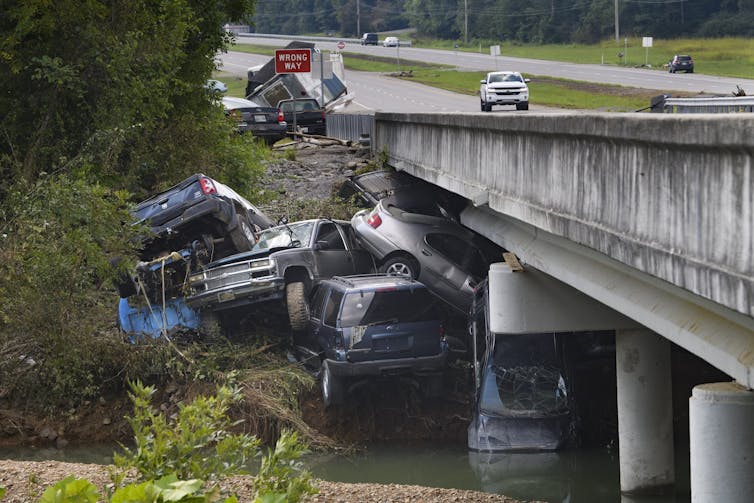
3 impacts of global warming on rainfall
Three things in particular happen to precipitation when the planet warms.
1) Global warming leads to more overall precipitation.
Higher temperature increases evaporation from Earth’s surface. It also increases the atmosphere’s capacity to hold moisture at a rate of about 7% per degree Celsius that the planet warms. With more moisture evaporating, global precipitation is expected to increase, but this increase is not uniform.
2) Global warming leads to more intense precipitation.
With higher temperature, more moisture is needed to reach the condensation level to form precipitation. As a result, light precipitation will be less common. But with more moisture in the atmosphere, when storm systems do develop, the increased humidity leads to heavier rainfall events.
In addition, storm systems are fueled by latent heat – the energy released into the atmosphere when water vapor condenses to liquid water. Increased moisture in the atmosphere also enhances latent heat in storm systems, increasing their intensity.
Research shows that both the frequency and intensity of heavy precipitation events has increased since the 1950s over most land areas.

3) Global warming tends to make wet places wetter and dry places drier.
Precipitation is not distributed evenly over the planet because of the global atmosphere circulation pattern. This global circulation brings moisture to places where winds come together, such as the tropical regions where we find most of the world’s rainforests, and away from places where winds diverge, such as the midlatitudes where most world’s deserts are located.
Assuming no significant changes in global wind patterns, increases in evaporation and moisture will mean more moisture is transported from dry areas to wet areas and into the storm tracks at higher latitudes. Global warming could also potentially change the global circulation pattern, causing a shift in the world’s wet and dry regions.
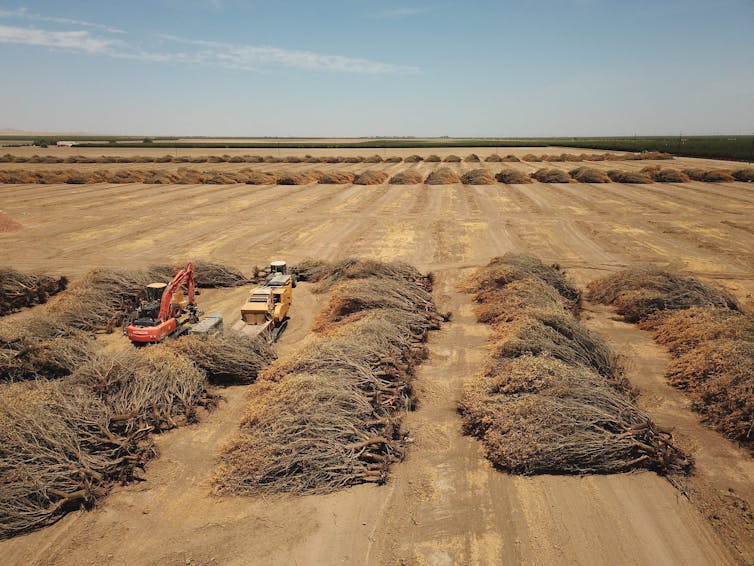
Mountains, moisture and the east-west divide
These dynamics are also affected by local conditions, such as the shape of the land, the types of plants on it and the presence of major water bodies.
The western U.S., with the exception of the West Coast, is dry in part because it lies in the rain shadow of mountains. The westerly wind from the Pacific Ocean is forced upward by the mountain ranges in the West. As it moves up, the air cools and precipitation forms on the windward side of the mountains. By the time the wind reaches the leeward side of the mountains, the moisture has already rained out. As the wind descends the mountains, the air warms up, further reducing the relative humidity.
Higher temperature in areas like these where the moisture supply is already limited means less humidity in the air, leading to less rain. Higher temperature and less precipitation would also reduce snow packs in the mountains and cause earlier melt in spring. All these changes are likely to increase aridity in the West.
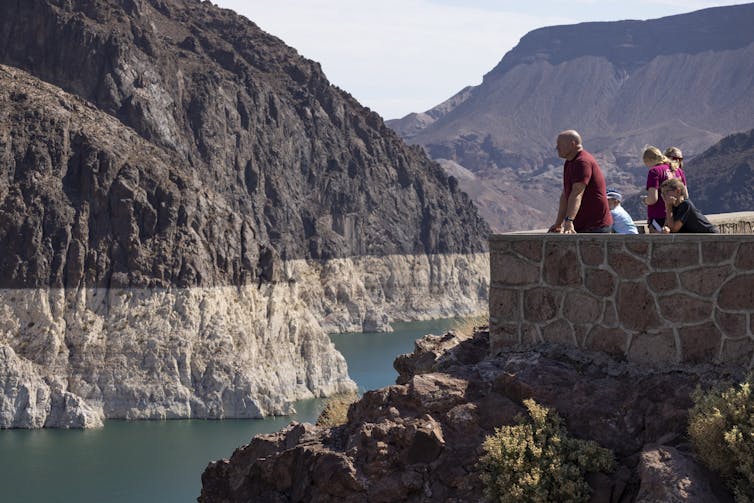
The eastern U.S., on the other hand, receives abundant moisture from the North Atlantic and the Gulf of Mexico carried by the easterly trade wind. With abundant moisture supply, increasing temperature means more moisture in the atmosphere, leading to more precipitation and stronger storms.
This is what years of precipitation records show and what is projected for future precipitation based on climate models. Both show a decrease in annual precipitation in the West, likely meaning more long periods of drought, and an increase in the East with global warming.
Shuang-Ye Wu is a professor of geology and environmental geosciences at the University of Dayton.
This article is republished from The Conversation under a Creative Commons license. Read the original article.

A Look Back At Some Of The Most Birdbrained Alleged Insurrectionists We’ve Met This Year
Jan. 6 saw a horrifying attack on the Capitol that exposed huge cracks in the country’s democratic project, and ex-President Donald Trump and his top enablers — many of whom are still in Congress — have made it clear that the assault only swelled their thirst to maintain power at any cost. Several of Trump’s toadies helped the former president fuel and foment the insurrection using their top positions in government.
But let us also not forget the more ridiculous Jan. 6 characters, e.g. the QAnon Shaman, who have utterly beclowned themselves during and in the aftermath of the attack — like Wile E. Coyote running directly into a wall with a fake tunnel painted on it.
Continue reading “A Look Back At Some Of The Most Birdbrained Alleged Insurrectionists We’ve Met This Year”Where Things Stand: Looking Back On The Dumb
We’re ending the year in a befuddling place. The past week I’ve been having déjà vu, rocketing myself back to a simpler, but overall more confusing time — once again rounding out each evening with stupid little Victorian-era strolls around the neighborhood as my one activity for the day, all to maintain my stupid sanity.
The last few weeks have not been promising for the sweetly naive among us who were still holding on to hope for a brighter 2022. And the year as a whole has been a hard one. Kicking off the year with a literal insurrection didn’t do much to forecast optimism. Some of you, understandably, had to step away from the news at points throughout the year. And we don’t blame you! Between the Capitol attack and another impeachment and the GOP embrace of anti-vaxxers and extremists continuing their gradual takeover of Congress and the lingering Big Lie and this deadly COVID spike — it’s all been a lot. (Though, we did have a few bright spots this week!)
But our gallows humor got us through. And if we can’t, at least, release a few dark cackles into the void while the world burns, then we’ve lost our humanity.
Continue reading “Where Things Stand: Looking Back On The Dumb”