This article first appeared at ProPublica, a Pulitzer Prize-winning investigative newsroom. Sign up for The Big Story newsletter to receive stories like this one in your inbox.
Despite the Trump administration’s public pronouncements that it has hired enough wildland firefighters, documents obtained by ProPublica show a high vacancy rate, as well as internal concern among top officials as more than 1 million acres burn across 10 states.
I’ve told you before about my kind of love/hate feelings about Tom Edsall, longtime reporter for The Washington Post, who more recently writes a weekly column for the New York Times. It’s not too much to say that almost regardless of the facts of the moment he’ll come up with an explanation for why those facts are terrible news for Democrats. Yesterday’s column is a kind of tour de force in this genre (“This Is a Realignment That Has Significant Staying Power.”) The column collects quotes and quick exchanges with a range of political scientists who argue that the first six months of 2025 have shown just how enduring Donald Trump’s 2024 realignment is turning out to be and quickly dismisses the views of the few observers he quotes who disagree.
As someone who tries to comment on and understand current events as best as I’m able, columns like this are kind of a warning sign of a path not to go down, that path being looking for the analyses and data points which back your preferred view of things or the one you feel reflexively must be the case. So I tried my best to not do that while thinking about this piece.
During what sources who spoke to the Wall Street Journal describe as a “routine briefing that covered a number of topics” in May, President Trump was informed that his name appeared multiple times in the documents that the Justice Department reviewed on the Jeffrey Epstein case.
In two rulings issued within a curiously short time of each other Wednesday afternoon, a federal judge in Tennessee cleared the way for Kilmar Abrego Garcia to be released from custody pending his criminal trial and a federal judge in Maryland barred the Trump administration from detaining him for immigration proceedings once he’s released.
As scandalous and horrible as Jeffrey Epstein’s crime were, that’s not what’s giving the story legs or Democrats political leverage in this crazy moment. It’s the conspiracy-addled MAGA backlash against President Trump and Attorney General Pam Bondi that is undergirding the politics of this. Without that fundamental weak spot, this story probably follows the familiar track of so many other would-be scandals of the Trump era. In fact, it had been following that trajectory for years until MAGA’s barking-dog-catches-car epiphany.
The madcap events of yesterday showed that the administration is still trying to placate the pressure from the right while protecting Trump from whatever investigative files may contain:
In a bizarre and troubling move, Deputy Attorney General Todd Blanche announced he is seeking a meeting with imprisoned Epstein accomplice Ghislaine Maxwell. The astounding conceit of Blanche’s announcement was that he was finally going to get to the bottom of this whole thing, another way of feeding the MAGA conspiracists.
Not to get left behind, the House Oversight Committee voted to subpoena Maxwell.
Maxwell’s lawyer, no doubt sensing the opportunity to win leniency for his client, ingratiated her to Trump: “We are grateful to President Trump for his commitment to uncovering the truth in this case.”
Two federal judges in Manhattan ordered the Trump administration to provide much more robust factual and legal bases for unsealing grand jury transcripts from the prosecutions of Epstein and Maxwell.
Sen. Ron Wyden (D-OR) kept the Democratic pressure on with a letter to Bondi urging her to explore the financial angle to Epstein’s criminal conduct. Wyden’s office tells Greg Sargent that the senator attempted to investigate this angle last year via subpoena but was stymied by Republicans on the Senate Finance Committee. You can see the trolling here to feed the MAGA fire: more Epstein coverups!
An agitated President Trump blamed anyone and everyone else, trying to pivot to false claims that Democrats engaged in a “treasonous coup” in 2016, when he … WON:
REPORTER: Gabbard has submitted a criminal referral. Who should the DOJ target?TRUMP: It would be President Obama. And Biden was there with him … the leader of the gang was Obama. Barack Hussein Obama. He's guilty. This is treason.
As it promised back in March, the Trump EPA is poised to overturn the agency’s own 2009 “endangerment finding” that gave it legal justification to regulate greenhouse gas emissions. As Lisa Friedman writes: “That finding is the foundation of the federal government’s only tool to limit the climate pollution from vehicles, power plants and other industries that is dangerously heating the planet.”
Bondi Fires Judges’ Replacement for Alina Habba
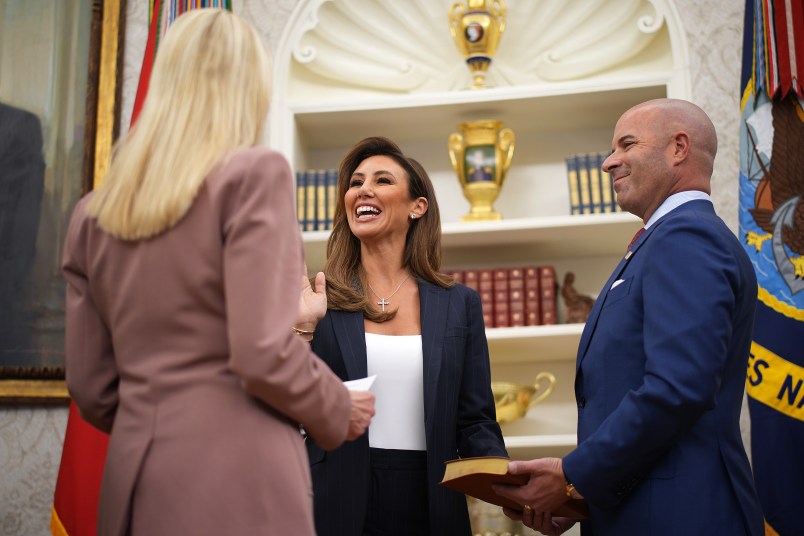
WASHINGTON, DC – MARCH 28: U.S. Attorney General Pam Bondi (L) swears in Alina Habba as interim U.S Attorney For New Jersey as Habba’s husband Gregg Reuben (R) holds a copy of the Bible in the Oval Office at the White House on March 28, 2025 in Washington, DC. Trump’s former personal attorney, Habba currently serves as a White House presidential counselor. (Photo by Andrew Harnik/Getty Images)
Attorney General Pam Bondi immediately canned the career federal prosecutor New Jersey federal judges had named U.S. attorney to succeed Alina Habba when her 120-day interim term ended. In explosive language, Bondi ripped the “rogue” judges, even though the chief judge was a Bush II appointee and the practice of judges naming U.S. attorney replacements is enshrined in the law. Bondi deputy Todd Blanche went farther, accusing the judges of “backroom” collusion and pursuing a “left-wing agenda.”
Habba’s nomination for the permanent position is stalled in the Senate. It’s not clear what the White House’s next move will be to fill the position. The interplay of various laws that govern filling the U.S. attorney position is exceedingly complicated. If you’re wanting the full explanation, the leading expert on vacancies weighs in here.
Desiree Leigh Grace was the first assistant U.S. attorney under Habba before the judges elevated her to the top spot. She wasn’t just removed as U.S. attorney by Bondi but fired from the Justice Department entirely, Politico reports.
AEA Detainees at CECOT Recount Beatings
Three of the Venezuelan nationals deported by the Trump administration to CECOT and now repatriated to their home country are describing beatings, lack of medical attention, and other mistreatment while in the notorious Salvadoran detention center.
Wrongfully Deported ‘Cristian’ Pushes for Contempt Finding
In a hearing Tuesday before U.S. District Judge Stephanie Gallagher of Maryland, lawyers for Venezuelan national “Cristian” — who was wrongfully deported under the Alien Enemies Act in violation of a pre-existing settlement agreement — said they will ask her to open criminal contempt proceedings against the Trump administration for its conduct in the case.
Trump Attack on Higher Ed: George Mason Edition
The Trump administration has launched its fourth investigation of George Mason University in the last month over its DEI practices. The focus on GMU comes while it is led by its first Black president and follows the ouster of the superintendent of VMI, who was also Black, and the president of UVa.
Sign of the Times
The publisher of the Harvard Educational Review has spiked an issue on Palestine, the Guardian reports.
Still Awaiting a Verdict
The Guardian’s Alice Speri offers these takeaways from the just-concluded trial challenging the Trump administration’s targeting of pro-Palestinian international students for their political views:
The Trump administration relied on lists from shadowy pro-Israel groups
Immigration officials admitted to the unprecedented nature of the arrests
The government tried to block the release of documents
A huge chilling effect
Quiet Capitulation
To comply with President Trump’s anti-trans executive order, the U.S. Olympic & Paralympic Committee quietly banned transgender women from competing in Olympic women’s sports, tucking a vaguely worded paragraph that doesn’t include the word “transgender” into its “Athlete Safety Policy,” the NYT reports.
Under pressure from the Trump administration, blue state hospitals are cutting back on gender-affirming care for transgender minors:
Children’s National Hospital in D.C. is discontinuing the prescription of transition medications;
The University of Pittsburgh Medical Center will no longer provide puberty blockers and hormone therapy for those under the age of 19;
UChicago Medicine is ending all pediatric transition care;
Children’s Hospital Los Angeles closed its Center for Transyouth Health and Development;
Stanford Medicine in the Bay Area paused surgical procedures, including new puberty blocker implants, for under-19 patients.
Rationalizing Capitulation
David Pressman, the U.S. ambassador to Hungary from 2022-25, writes that the key similarity between Hungary and the United States isn’t Orban and Trump but how elites have responded to the authoritarian threat:
After years watching Hungary suffocate under the weight of its democratic collapse, I came to understand that the real danger of a strongman isn’t his tactics; it’s how others, especially those with power, justify their acquiescence. …
Here, too, powerful people are responding to authoritarian advances just as their Hungarian counterparts have — not with defiance, but with capitulation, convinced that they can maintain their independence and stay above the fray.
Quote of the Day
“We keep talking about an imperial court that is slowly but certainly constructing an imperial executive, but none of that can happen without the learned helplessness of an American public that was intended to be sovereign.” —Dahlia Lithwick, on the Supreme Court and the unitary executive
If you’ve been reading TPM for awhile, you may already know that our organization can shift on a dime. We typically have around five reporters. (A few of our editors also write.) That means, unlike larger news organizations, we don’t have people with particular beats. We don’t have people who author a particular kind of story — no one who just writes breaking news or just writes features or just does a newsletter or a podcast. Everyone, at any moment, can pitch in with anything on any topic.
Though it wasn’t always the result of a conscious decision on the part of the editors, TPM has made use of this flexibility during this unprecedented time. We’ve reinvented our approach to the news repeatedly since August 2024, when our last Journalism Fund drive concluded, with our reporters working in different modes and in different styles across a wide range of topics to contend with a historic moment in American history.
As we reflect on the many ways TPM is unique during the journalism fund drive, I thought readers might enjoy a glimpse of how we see the journey we’ve traveled over the last year — in terms of what we understood ourselves to be providing to readers, and what we understood readers to need from us.
By now you’ve maybe seen the news that House Speaker Mike Johnson (R-LA) is, effectively, shutting down the House’s legislative work and sending everyone home early for August recess in order to block any House floor action on the release of investigative files on Jeffrey Epstein, the deceased convicted sex offender.
Every time I think Donald Trump is putting some distance between himself and the Epstein scandal he does some new thing to make it the centerpoint story in the American news ecosystem. Last night House Speaker Mike Johnson (R-LA) decide to shut the entire House of Representatives for the rest of the summer so members don’t have to make any more painful coverup votes related to the Epstein case. Yesterday, the White House ordered the release of a vast trove of FBI files about Martin Luther King, Jr., a bizarre, pathetic, wrong and ultimately counterproductive attempt to distract from the Epstein Files.
We should start by noting that the King files were overwhelmingly the product of illegal surveillance that then FBI-director J. Edgar Hoover ordered to get blackmail information on King either to discredit him, force him out of public life, or, in specific cases, drive him to suicide. So it was anything but disinterested surveillance, and FBI agents had a huge incentive to include rumor, innuendo and more, whether it was true or not. With that said, King was also what used to be known as a womanizer. This is simply a fact of history along with King being one of the giants and heroes of the American 20th century. We know this mainly from the FBI files that were released decades ago — which is to say that we know from illegal surveillance that was conducted with the specific intent of neutralizing him as a leader of the civil rights movement.
I can only imagine that Trump ordered this with the idea that people can say “Ahha! Many prominent men had subpar sexual morality! Ahha! Ahha!” Either that, or to somehow cast Trump as another freedom fighter who the deep state is trying to bring down with sexual peccadillos. It is very important to note that I don’t think there’s ever been evidence or the suggestion that King’s paramours were anything but adult and willing. The part of this that is so wild is that I don’t think Epstein was really top of mind in the news world Monday morning, certainly not as much as was any day last week. But Trump put it right back there with the King materials. It’s the most obvious thing: releasing any trove of documents just reminds people of the trove Trump is moving heaven and earth not to release. I don’t think anything is more obvious. It’s like a quick fix that deepens the craving.
Today we learn that Deputy Attorney General Todd Blanche will be meeting with convicted sex trafficker Ghislaine Maxwell looking for the “real pedophile” and presumably coordinating stories. And just this morning while meeting with the President of the Philippines, President Trump told reporters his intelligence chief has now proven that Hillary Clinton and “Barack Hussein Obama” are guilty of “treason” and they “ought to take a look at that and stop talking about” the Epstein files.
It’s really not too much to say that just as the House has been shut down to avoid more Epstein cover-up votes, the executive branch is now more or less exclusively focused on trying to shut down the Epstein story: MLK assassination documents, a meeting with Maxwell, a new Hillary/Obama treason investigation. It’s all they’re doing.
I keep thinking some new thing will happen or people will lose interest. This weekend there was an emerging conventional wisdom in the Beltway publications that Trump had flipped the script with the Wall Street Journal article, something that never made much sense. But that clearly wasn’t the case and Trump himself forced it back to the top of news attention with his flurry of new diversions.
On June 24, 2025, Erez Reuveni, a former Department of Justice attorney who worked with Bove, released an extensive, 27-page whistleblower report. Reuveni claimed that Bove, as the Trump administration’s acting deputy attorney general, said “that it might become necessary to tell a court ‘fuck you’” and ignore court orders related to the administration’s immigration policies. Bove’s acting role ended on March 6 when he resumed his current position of principal associate deputy attorney general.
When asked about this statement at his June 25 Senate confirmation hearing, Bove said, “I don’t recall.”
And on July 15, 80 former federal and state judges signed a letter opposing Bove’s nomination. The letter argued that “Mr. Bove’s egregious record of mistreating law enforcement officers, abusing power, and disregarding the law itself disqualifies him for this position.”
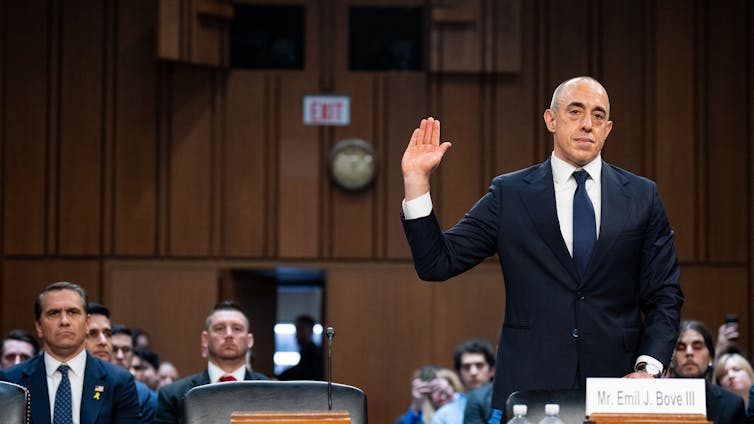
Emil Bove, Donald Trump’s nominee to serve as a federal appeals judge for the 3rd Circuit, is sworn in during a confirmation hearing in Washington, D.C., on June 25, 2025. Bill Clark/CQ-Roll Call, Inc, via Getty Images
A day later, more than 900 former Department of Justice attorneys submitted their own letter opposing Bove’s confirmation. The attorneys argued that “Few actions could undermine the rule of law more than a senior executive branch official flouting another branch’s authority. But that is exactly what Mr. Bove allegedly did through his involvement in DOJ’s defiance of court orders.”
On July 17, Democrats walked out of the Senate Judiciary Committee vote, in protest of the refusal by Chairman Chuck Grassley, a Republican from Iowa, to allow further investigation and debate on the nomination. Republicans on the committee then unanimously voted to move the nomination forward for a full Senate vote.
As a scholar of the courts, I know that most federal court appointments are not as controversial as Bove’s nomination. But highly contentious nominations do arise from time to time.
Here’s how three controversial nominations turned out – and how Bove’s nomination is different in a crucial way.
Robert Bork testifies before the Senate Judiciary Committee for his confirmation as associate justice of the Supreme Court in September 1987. Mark Reinstein/Corbis via Getty Images
Robert Bork
Bork is the only federal court nominee whose name became a verb.
“Borking” is “to attack or defeat (a nominee or candidate for public office) unfairly through an organized campaign of harsh public criticism or vilification,” according to Merriam-Webster.
In opposing the Bork nomination, Sen. Ted Kennedy of Massachusetts took the Senate floor and gave a fiery speech: “Robert Bork’s America is a land in which women would be forced into back-alley abortions, blacks would sit at segregated lunch counters, rogue police could break down citizens’ doors in midnight raids, schoolchildren could not be taught about evolution, writers and artists could be censored at the whim of government, and the doors of the federal courts would be shut on the fingers of millions of citizens for whom the judiciary is often the only protector of the individual rights that are the heart of our democracy.”
Ultimately, Bork’s nomination failed by a 58-42 vote in the Senate, with 52 Democrats and six Republicans rejecting the nomination.
Republican Sen. John Ashcroft, from White’s home state of Missouri, led the fight against the nomination. Ashcroft alleged that White’s confirmation would “push the law in a pro-criminal direction.” Ashcroft based this claim on White’s comparatively liberal record in death penalty cases as a judge on the Missouri Supreme Court.
However, there was limited evidence to support this assertion. This led someto believe that Ashcroft’s attack on the nomination was motivated by stereotypes that African Americans, like White, are soft on crime.
Even Clinton implied that race may be a factor in the attacks on White: “By voting down the first African-American judge to serve on the Missouri Supreme Court, the Republicans have deprived both the judiciary and the people of Missouri of an excellent, fair, and impartial Federal judge.”
White’s nomination was defeated in the Senate by a 54-45 party-line vote. In 2014, White was renominated to the same judgeship by President Barack Obama and confirmed by largely party-line 53-44 vote, garnering the support of a single Republican, Susan Collins of Maine.
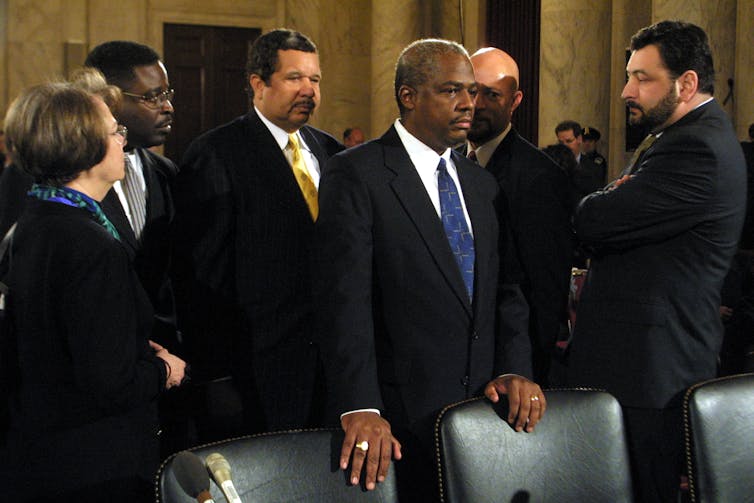
Ronnie White, a former justice for the Missouri Supreme Court, testifies during an attorney general confirmation hearing in Washington in January 2001. Alex Wong/Newsmakers
Estrada, who had earned a unanimous “well-qualified” rating from the American Bar Association, faced deep opposition from Senate Democrats, who believed he was a conservative ideologue. They also worried that, if confirmed, he would later be appointed to the Supreme Court.
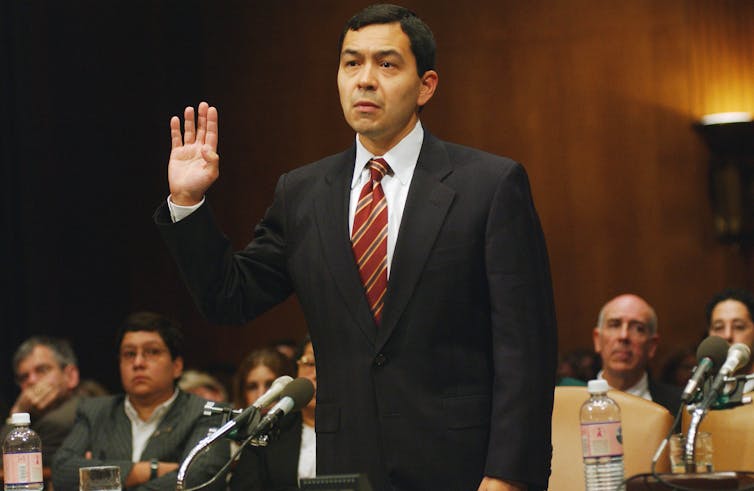
Miguel Estrada, President George Bush’s nominee to the U.S. Court of Appeals for the District of Columbia, is sworn in during his hearing before Senate Judiciary on Sept. 26, 2002. Scott J. Ferrell/Congressional Quarterly/Getty Images
However, unlike Bork – who had an extensive paper trail as an academic and judge – Estrada’s written record was very thin.
Democrats sought to use his confirmation hearing to probe his beliefs. But they didn’t get very far, as Estrada dodged many of the senators’ questions, including ones about Supreme Court cases he disagreed with and judges he admired.
Democrats were particularly troubled by allegations that Estrada, when he was screening candidates for Justice Anthony Kennedy, disqualified applicants for Supreme Court clerkships based on their ideology.
According to one attorney: “Miguel told me his job was to prevent liberal clerks from being hired. He told me he was screening out liberals because a liberal clerk had influenced Justice Kennedy to side with the majority and write a pro-gay-rights decision in a case known as Romer v. Evans, which struck down a Colorado statute that discriminated against gays and lesbians.”
When asked about this at his confirmation hearing, Estrada initially denied it but later backpedaled. Estrada said, “There is a set of circumstances in which I would consider ideology if I think that the person has some extreme view that he would not be willing to set aside in service to Justice Kennedy.”
Unlike the Bork nomination, Democrats didn’t have the numbers to vote Estrada’s nomination down. Instead, they successfully filibustered the nomination, knowing that Republicans couldn’t muster the required 60 votes to end the filibuster. This marked the first time in Senate history that a court of appeals nomination was filibustered. Estrada would never serve as a judge.
Bove stands out
As the examples of Bork, Estrada and White make clear, contentious nominations to the federal courts often involve ideological concerns.
This is also true for Bove, who is opposed in part because of the perception that he is a conservativeideologue.
More than three months after the D.C. Circuit Court of Appeals “temporarily” blocked contempt of court proceedings against the Trump administration in the original Alien Enemies Act (AEA) case, it showed signs of life for the first time yesterday — but only after the detainees at CECOT were repatriated to Venezuela over the weekend.
Like a drunk after a bender, the appeals court wandered into the aftermath of its own misconduct with lots of questions and few answers. In a new order, the court insouciantly noted the weekend developments:
The [government] sought this Court’s intervention based, in part, on their view that the order impermissibly pressured the [government] to engage in diplomacy with El Salvador. … The [government] informed this Court that on July 18, 2025, El Salvador transferred the class members to Venezuela, which has made certain assurances to the U.S. government.
With events having long ago overtaken the court, it ordered the Trump administration to file a brief of no longer than 2,500 words by tomorrow “addressing whether and how these factual developments affect their position in this case.” It set what for this panel is a blindingly fast briefing schedule of about a week for the parties to address this and related issues in the case, including the government’s response to a motion that plaintiffs filed last week to try to nudge the court along.
It should be noted that only two of the three judges — Gregory Katsas and Neomi Rao (Trump appointees) — agreed to grant the Trump’s administration’s request for an administrative stay in April. The third judge — Cornelia Pillard (an Obama appointee) — opposed the stay.
As Morning Memo noted last week, the unconscionable delay by the appeals court blocked U.S. District Judge James Boasberg from continuing with contempt proceedings after he found probable cause that the Trump administration had committed criminal contempt by continuing with the Alien Enemies Act removals in defiance of his orders to turn back the deportation flights.
To put a blunt point on it: If Boasberg’s order had been followed, there would have been no Venezuelan nationals imprisoned at CECOT, at least not until higher courts in the U.S. had weighed in. Given how courts have ruled subsequently, it’s not clear anyone would have been removed under this AEA proclamation. It’s hard to conceive of conduct in contempt of court more far-reaching, historic, and consequential.
In the three months since the appeals court stay went it effect, fired DOJ lawyer Erez Reuveni turned into a whistleblower and released internal department communications that showed more starkly than ever before how purposefully and willfully defiant the administration had been in the face of Boasberg’s orders. DOJ official Emil Bove emerged as perhaps the central villain in the account provided by Reuveni, but by this time President Trump had nominated Bove to a seat on the Third Circuit Court of Appeals. Still, the D.C. Circuit panel didn’t issue a ruling or move to lift the stay or otherwise bother itself with the case in any public way.
The inexcusable delays had compounding effects in other cases against the Trump administration. While Boasberg had a head start as the judge in the first AEA case, that advantage was squandered by the appeals court, with the result that the administration could engage in similar stonewalling and defiance with subsequent judges in various others challenges to executive power without the specter of a criminal contempt proceeding, let alone a contempt finding, hanging over its head.
With the new briefing schedule, it appears likely that the “temporary” administrative stay will have lasted from April until late July or early August. The world kept spinning while the appeals court dawdled.
Awaiting Big Decision I: Pro-Palestinian International Students
Trial ended Monday in the case challenging the Trump administration’s targeting of pro-Palestinian international students for their political views. U.S. District Judge William G. Young of Boston said he would need some time to render his verdict.
Awaiting Big Decision II: Harvard’s Case Against Trump
During a two-hour hearing Monday, U.S. District Judge Allison D. Burroughs of Boston appeared receptive to Harvard’s arguments that President Trump has unlawfully targeted it with contingent funding cuts. Harvard is seeking summary judgment, meaning there are no disputed facts to be resolved at trial and the judge should rule now.
CBO: 10 Million Will Lose Health Insurance Under BBB
The CBO’s final tally on the centerpiece legislation of Trump II is in: 10 million people will lose health insurance coverage as the deficit balloons by $3.4 trillion over 10 years. The bulk of the deficit spending comes from the permanent extension of Trump’s 2017 tax cuts.
Medicaid Cuts Will Hit Disabled Americans Hard
NYT: “Federal law deems most home- and community-based services as optional, so they are often targeted when states have to tighten their belts. When temporary Great Recession increases in Medicaid funding expired in the early 2010s, for example, every state reduced home care by limiting enrollment or lowering spending on existing recipients.”
While President Trump plays all the old MAGA hits to try to woo back disillusioned right-wing conspiracists, House Republicans basically shut down the lower chamber rather than face votes on troll-y amendments by House Democrats calling for the release of more records related to Jeffrey Epstein. The upshot is that not much will get done this week before the House leaves for August recess.
Trump Punishes WSJ Over Epstein Letter
Thanks to a D.C. Circuit Court of Appeals decision last month that allowed President Trump to continue punishing the Associated Press for not using “Gulf of America” in its stories, there was nothing stopping him from retaliating against the Wall Street Journal for reporting on his letter to Jeffrey Epstein. The White House yanked the WSJ from the press pool covering the president’s upcoming trip to Scotland.
Good Riddance
Today is the last day on the job for interim U.S. attorney Alina Habba of New Jersey. The former Trump lawyer and hanger-on has been a disaster in the temporary role, and the federal judges in the state declined to extend her term.
Retribution Watch: Thomas Windom Edition
House Judiciary Chair Jim Jordan (R-OH) has issued a subpoena to former DOJ prosecutor Thomas Windom, who was deeply involved in the criminal cases against Donald Trump both before and after the appointment of Special Prosecutor Jack Smith. The subpoena — part of the larger Trump-led retribution against prosecutors and investigators — comes after Windom declined to answer some committee questions in a private session last month. The subpoena calls for Windom to appear before the committee in September.
FEMA Search and Rescue Chief Resigns
Ken Pagurek’s, the head of FEMA’s Urban Search and Rescue unit, resigned Monday after it took more than 72 hours for Homeland Security Secretary Kristi Noem to authorize deployment after the catastrophic flooding this month in Texas, CNN reports.
Dems Plot Counter to GOP Redistricting in Texas
Democratic leaders are considering mid-decade redistricting in five blue states — California, New York, New Jersey, Minnesota and Washington state — to counter the GOP redistricting effort underway in a special session in Texas, according to CNN.
Colbert Mock-Relishes His Role as a Martyr on the Cross