

Everyone is very confused about why Sen. Lindsey Graham (R-SC) has taken on anti-abortion advocacy as his new hobby horse — and why now. While he’s irritated half his colleagues by proposing a 15-week federal abortion ban just weeks out from a midterm election when Republicans’ extreme positions on abortion could very likely spell doom for the party’s Senate majority, he also just managed to make the GOP’s stance on the issue even more confusing.
Continue reading “Where Things Stand: Graham Explains That His Abortion Bill Is *Actually* A Dunk On China”High On Their Own Supply
We have many more details on the hearing this afternoon in Brooklyn, where Josh Kovensky was at the courtroom reporting for us. But Judge Dearie, aka “the special master,” is leaving the Trumpers pretty disappointed in today’s hearing. The amazing thing is that they asked for Dearie because they managed to convince themselves that his involvement with the FISA court and the Carter Page matter had made him into an anti-Deep State zealot, or an “FBI-skeptic,” as the Trumpers put it. That seems like quite a silly surmise, to put it mildly. There had been confusion that Trump’s team had requested him, a respected senior-status judge. Now we know why. Now they’re finding out that he’s your average federal judge, the type who goes in with the assumption that classified documents are classified rather than owned by former Presidents, the type who doesn’t go in with the assumption that the FBI is run by Antifa. I’m surprised that I’m surprised that they managed to bamboozle themselves like this.
Trump’s Hand-Picked Special Master Does Him No Favors
BROOKLYN, NEW YORK — U.S. District Judge Raymond Dearie for the Eastern District of New York injected some normalcy into former President Trump’s civil case against the Justice Department during a Tuesday court hearing.
Continue reading “Trump’s Hand-Picked Special Master Does Him No Favors”Fox’s Bret Baier Urged Fox To Undo Arizona Call On Election Night To Soothe Trump, Book Says
Fox News host Bret Baier was truly desperate to pacify then-President Donald Trump on election night after Fox called Arizona for Joe Biden, according to a new book by New Yorker journalist Susan Glasser and New York Times reporter Peter Baker.
Continue reading “Fox’s Bret Baier Urged Fox To Undo Arizona Call On Election Night To Soothe Trump, Book Says”Trump To Appeals Court: I Get To Say Who The Docs Belong To
President Trump told the Eleventh Circuit Court of Appeals in a Tuesday filing that as a former President, he still gets to say which government records belong to him and which do not.
Continue reading “Trump To Appeals Court: I Get To Say Who The Docs Belong To”Russia Puffs Up Its Chest As Putin’s Ukraine Campaign Falters
Facing serious defeats in Ukraine, the Kremlin is putting on a high-stakes show on Tuesday with what seems to be a clear objective: moving Russia closer to total war in its invasion of Ukraine.
Continue reading “Russia Puffs Up Its Chest As Putin’s Ukraine Campaign Falters”Wisconsin’s Failed Election Fraud ‘Auditor’ Is Now Calling For A ‘Revolution’
Former Wisconsin Supreme Court Justice Michael Gableman, who led his state’s sham 2020 election audit and failed to find any voter fraud whatsoever, urged fellow conservatives to carry out a “revolution” earlier this month.
Continue reading “Wisconsin’s Failed Election Fraud ‘Auditor’ Is Now Calling For A ‘Revolution’”Special Master Has Already Undercut Trump’s Classified Doc Game
A lot of things happened. Here are some of the things. This is TPM’s Morning Memo.
A Dog Ate My Declassification
Trump’s legal team on Monday night wrote a letter to U.S. District Judge Raymond Dearie, who has been appointed as the special master to sift through the documents Trump stashed at Mar-a-Lago, saying that it doesn’t want to disclose whether Trump declassified the seized documents–despite Trump repeatedly claiming (out of court) that he declassified them.
- The lawyers’ argument admits the possibility that the Mar-a-Lago investigation could lead to criminal charges, saying that disclosing whether Trump declassified the documents would force him to “fully and specifically disclose a defense to the merits of any subsequent indictment without such a requirement being evident in the District Court’s order.”
- Shorter Trump: I want a peek at the government’s evidence pre-indictment, but don’t make me disclose anything this soon!
- Trump’s special master gambit doesn’t seem to be going as planned for him: His lawyers recommended Dearie as a candidate for special master because they believed he was a skeptic of the FBI and would therefore boost Trump’s case, according to Axios.
- Dearie has further alarmed Trump’s legal team by proposing an aggressive schedule for his review of the seized documents. The team wants to drag it out through the end of November. Dearie has proposed wrapping up the review by Oct. 7.
- Dearie has summoned the parties to his courtroom in Brooklyn today for an initial hearing on the matter. TPM’s Josh Kovensky is scheduled to be there, too.
Migrants Flown To Martha’s Vineyard Were Given Fake Brochures About Receiving Benefits
The Venezuelan migrants Florida Gov. Ron DeSantis (R) exploited in his Martha’s Vineyard stunt last week were handed brochures full of lies claiming they’d receive benefits like food and cash assistance in Massachusetts.
- Here’s a copy of the brochure obtained by Popular Information author Judd Legum, who got it from a Boston-based legal group that represents some of the migrants:
- The migrants have said that they were tricked into boarding DeSantis’ planes with bogus promises of jobs and housing, and that they weren’t told they were being taken to Martha’s Vineyard.
- Another piece of the hoax allegedly involved a woman who baited the migrants in Texas into accepting the flights and identified herself as “Perla.”
- The Bexar County Sheriff’s Office in Texas announced on Monday evening that it had opened an investigation into DeSantis’ scheme.
Jan. 6 Panel Presents Bill To Coup-Proof Future Elections
House Jan. 6 Committee vice chair Liz Cheney (R-WY) and committee member Rep. Zoe Lofgren (D-CA) on Monday officially introduced the panel’s proposed legislation on adding safeguards to keep Trump and other would-be authoritarians from overturning an election. The bill’s title is the “Presidential Election Reform Act” (PERA).
- Some of what the bill does: ensures that the vice president’s role in the electoral vote count process is purely ministerial, limits how easily congressional lawmakers can challenge the results during the count, and blocks governors from withholding election results from Congress.
- Cheney and Lofgren had previewed the measure on Sunday in a joint Wall Street Journal op-ed.
- Here’s a fact sheet on the bill that gives a fuller rundown:
- The legislation is similar to the Senate’s bipartisan proposed reforms to the Electoral Count Act, though the Jan. 6 committee’s bill includes more specifics, as Politico reporter Kyle Cheney points out:
Wisconsin Sham Election Auditor Calls For Revolution After Finding Zero Voter Fraud
Ex-Wisconsin state Supreme Court Justice Michael Gableman, the so-called “auditor” of his state’s 2020 election results, argued during a local GOP event on Sept. 9 that “revolution” was “the only way to keep an honest government.”
- There was an unmistakable hint of violence in Gableman’s declaration, with the ex-justice claiming that “Thomas Jefferson said that the tree of liberty must be watered by the blood of revolution in every generation.”
- “I don’t think that’s going to happen,” Gableman lamented.
Judge Overturns Adnan Syed’s Murder Conviction
Adnan Syed, who was featured in the hit podcast “Serial,” was released on Monday after a judge in Baltimore vacated his murder conviction.
- Prosecutors have 30 days to decide whether to drop the charges against Syed.
- Syed spent 23 years in prison for the murder of his high school ex-girlfriend, Hae Min Lee, in 1999.
Must Read
“Read the Books That Schools Want to Ban” – The Atlantic
Mr. Pillow Fails To Escape Smartmatic Lawsuit
A federal judge on Monday shot down MyPillow CEO Mike Lindell’s request to throw out voting tech firm Smartmatic’s defamation suit against him and MyPillow.
Beyond Meat Executive Arrested For Biting Man’s Nose
Doug Ramsey, the chief operating officer of Beyond Meat, was taken into custody and charged with third-degree battery in Arkansas on Saturday after he allegedly started a fight in a parking garage and bit the other person’s nose.
Do you like Morning Memo? Let us know!
US Is Becoming A ‘Developing Country’ On Global Rankings That Measure Democracy, Inequality
This article is part of TPM Cafe, TPM’s home for opinion and news analysis. It was originally published at The Conversation.
The United States may regard itself as a “leader of the free world,” but an index of development released in July 2022 places the country much farther down the list.
In its global rankings, the United Nations Office of Sustainable Development dropped the U.S. to 41st worldwide, down from its previous ranking of 32nd. Under this methodology – an expansive model of 17 categories, or “goals,” many of them focused on the environment and equity – the U.S. ranks between Cuba and Bulgaria. Both are widely regarded as developing countries.
The U.S. is also now considered a “flawed democracy,” according to The Economist’s democracy index.
As a political historian who studies U.S. institutional development, I recognize these dismal ratings as the inevitable result of two problems. Racism has cheated many Americans out of the health care, education, economic security and environment they deserve. At the same time, as threats to democracy become more serious, a devotion to “American exceptionalism” keeps the country from candid appraisals and course corrections.
‘The other America’
The Office of Sustainable Development’s rankings differ from more traditional development measures in that they are more focused on the experiences of ordinary people, including their ability to enjoy clean air and water, than the creation of wealth.
So while the gigantic size of the American economy counts in its scoring, so too does unequal access to the wealth it produces. When judged by accepted measures like the Gini coefficient, income inequality in the U.S. has risen markedly over the past 30 years. By the Organization for Economic Cooperation and Development’s measurement, the U.S. has the biggest wealth gap among G-7 nations.
These results reflect structural disparities in the United States, which are most pronounced for African Americans. Such differences have persisted well beyond the demise of chattel slavery and the repeal of Jim Crow laws.
Scholar W.E.B. Du Bois first exposed this kind of structural inequality in his 1899 analysis of Black life in the urban north, “The Philadelphia Negro.” Though he noted distinctions of affluence and status within Black society, Du Bois found the lives of African Americans to be a world apart from white residents: a “city within a city.” Du Bois traced the high rates of poverty, crime and illiteracy prevalent in Philadelphia’s Black community to discrimination, divestment and residential segregation – not to Black people’s degree of ambition or talent.
More than a half-century later, with characteristic eloquence, Martin Luther King Jr. similarly decried the persistence of the “other America,” one where “the buoyancy of hope” was transformed into “the fatigue of despair.”
To illustrate his point, King referred to many of the same factors studied by Du Bois: the condition of housing and household wealth, education, social mobility and literacy rates, health outcomes and employment. On all of these metrics, Black Americans fared worse than whites. But as King noted, “Many people of various backgrounds live in this other America.”
The benchmarks of development invoked by these men also featured prominently in the 1962 book “The Other America,” by political scientist Michael Harrington, founder of a group that eventually became the Democratic Socialists of America. Harrington’s work so unsettled President John F. Kennedy that it reportedly galvanized him into formulating a “war on poverty.”
Kennedy’s successor, Lyndon Johnson, waged this metaphorical war. But poverty bound to discrete places. Rural areas and segregated neighborhoods stayed poor well beyond mid-20th-century federal efforts.
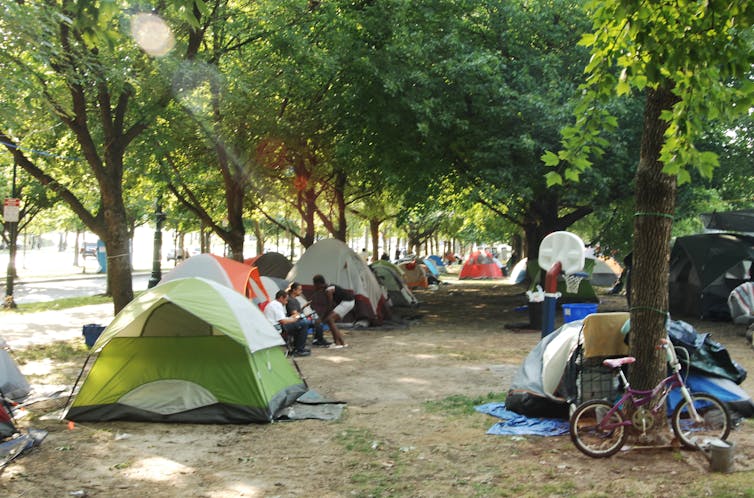
In large part that is because federal efforts during that critical time accommodated rather than confronted the forces of racism, according to my research.
Across a number of policy domains, the sustained efforts of segregationist Democrats in Congress resulted in an incomplete and patchwork system of social policy. Democrats from the South cooperated with Republicans to doom to failure efforts to achieve universal health care or unionized workforces. Rejecting proposals for strong federal intervention, they left a checkered legacy of local funding for education and public health.
Today, many years later, the effects of a welfare state tailored to racism is evident — though perhaps less visibly so — in the inadequate health policies driving a shocking decline in average American life expectancy.
Declining democracy
There are other ways to measure a country’s level of development, and on some of them the U.S. fares better.
The U.S. currently ranks 21st on the United Nations Development Program’s index, which measures fewer factors than the sustainable development index. Good results in average income per person – $64,765 – and an average 13.7 years of schooling situate the United States squarely in the developed world.
Its ranking suffers, however, on appraisals that place greater weight on political systems.
The Economist’s democracy index now groups the U.S. among “flawed democracies,” with an overall score that ranks between Estonia and Chile. It falls short of being a top-rated “full democracy” in large part because of a fractured political culture. This growing divide is most apparent in the divergent paths between “red” and “blue” states.
Although the analysts from The Economist applaud the peaceful transfer of power in the face of an insurrection intended to disrupt it, their report laments that, according to a January 2022 poll, “only 55% of Americans believe that Mr. Biden legitimately won the 2020 election, despite no evidence of widespread voter fraud.”
Election denialism carries with it the threat that election officials in Republican-controlled jurisdictions will reject or alter vote tallies that do not favor the Republican Party in upcoming elections, further jeopardizing the score of the U.S. on the democracy index.
Red and blue America also differ on access to modern reproductive care for women. This hurts the U.S. gender equality rating, one aspect of the United Nations’ sustainable development index.
Since the Supreme Court overturned Roe v. Wade, Republican-controlled states have enacted or proposed grossly restrictive abortion laws, to the point of endangering a woman’s health.
I believe that, when paired with structural inequalities and fractured social policy, the dwindling Republican commitment to democracy lends weight to the classification of the U.S. as a developing country.
American exceptionalism
To address the poor showing of the United States on a variety of global surveys, one must also contend with the idea of American exceptionalism, a belief in American superiority over the rest of the world.
Both political parties have long promoted this belief, at home and abroad, but “exceptionalism” receives a more formal treatment from Republicans. It was the first line of the Republican Party’s national platform of 2016 and 2020 (“we believe in American exceptionalism”). And it served as the organizing principle behind Donald Trump’s vow to restore “patriotic education” to America’s schools.
In Florida, after lobbying by Republican Gov. Ron DeSantis, the state board of education in July 2022 approved standards rooted in American exceptionalism while barring instruction in critical race theory, an academic framework teaching the kind of structural racism Du Bois exposed long ago.
With a tendency to proclaim excellence rather than pursue it, the peddling of American exceptionalism encourages Americans to maintain a robust sense of national achievement – despite mounting evidence to the contrary.
Kathleen Frydl is a Sachs lecturer at Johns Hopkins University.
This article is republished from The Conversation under a Creative Commons license. Read the original article.
Congress Failed To Pass Paid Family Leave. Now It Could Be On The Ballot
On weekend mornings this fall, when Maine residents head to the farmer’s market or their children’s little league games, they may be confronted by advocates wanting to talk to them about paid family leave. In July, a coalition seeking to put a question on next year’s ballot to ensure all residents can take 16 paid weeks off for a new baby, a serious illness, in the case of military service or domestic violence, or to care for a disabled or sick family member started fanning out with clipboards to collect enough signatures.
Continue reading “Congress Failed To Pass Paid Family Leave. Now It Could Be On The Ballot”