There’s More To Texas State Gov’s Takeover Of Houston Schools Than Meets The Eye

This article is part of TPM Cafe, TPM’s home for opinion and news analysis. It was originally published at The Conversation.

When the state of Texas took over Houston’s public school district on March 15, 2023, it made the district one of more than 100 school districts in the nation that have experienced similar state takeovers during the past 30 years.

The list includes New York City, Chicago, Boston, Philadelphia, Detroit, New Orleans, Baltimore, Oakland and Newark. Houston is the largest school district in Texas and the eighth largest in the U.S.

While the state of Texas claims the planned takeover is about school improvement, my research on state takeovers of school districts suggests that the Houston takeover, like others, is influenced by racism and political power.

States fail to deliver

State governments have used takeovers since the late 1980s to intervene in school districts they have identified as in need of improvement. While state administrations promise that takeovers will improve school systems, 30 years of evidence shows that state takeovers do not meet the states’ promised expectations. For instance, a recent report called Michigan’s 15-year management of the Detroit schools a “costly mistake” because the takeover was not able to address the school system’s major challenges, which included adequately funding the school district.

But while the takeovers don’t deliver promised results, as I show in my book, they do have significant negative political and economic consequences for communities, which overwhelmingly are communities of color. These negative consequences often include the removal of locally elected school boards. They also involve decreases in teachers and staff and the loss of local control of schools.

Despite the highly problematic history of state takeovers, states have justified the takeovers on the grounds that the entire school district is in need of improvement. However, this is not the case for the Houston takeover because by the state’s own standards, the Houston school system is not failing.

Low threshold for state intervention

Following a 2015 law, HB 1842, the state of Texas was granted authority to take over a school district if a single school in that district fails to meet state education standards for five or more years. The bill was passed by the Republican controlled state legislature with Democratic support. However, Democratic state lawmakers representing Houston argue that the law was a mistake and urged for it to be revised.

Although the state has given the Houston Independent School District a B rating, it plans to take over the Houston schools because one school, Wheatley High School, has not made sufficient progress since 2017. According to state law, the state can take over a school district or close a school if it fails to meet standards for five years.

The Houston Independent School District has 280 schools. The district serves over 200,000 students. It employs roughly 12,000 teachers. Wheatley High School serves roughly 800 students and has roughly 50 teachers.

So why would a state take over a school district that has earned a B rating from the state? And why base the takeover on the performance of one school that represents fewer than 1% of the district’s student and teaching population?

In order to understand the logic of the planned state takeover of the Houston schools, it pays to understand the important role that schools have played in the social, political and economic development of communities of color. Historically, communities of color have relied on school level politics as an entry point to broader political participation. School-level politics may involve issues like ending school segregation, demanding more resources for schools, increasing the numbers of teachers and administrators of color, and participating in school board elections.

The process of gaining political power at the local level – and eventually state level – often begins at the schools, particularly the school board. For instance, before Blacks and Latinos elect members of their communities to the city councils, the mayor’s office and the state legislatures, they often elect members to the school board first.

Political representation at stake

In Texas, communities of color are politically underrepresented. Although Blacks, Latinos and Asians represent nearly 60% of the population in Texas, their political power at the state level is not proportional to their population. Whites make up 54% of the state legislature. The Republican Party controls the governorship, state House of Representatives and state Senate, but only 12% of all Republican state legislators are of color. Communities of color in Texas have filed lawsuits arguing that they have been prevented from gaining political representation at the state level by Republicans through racial gerrymandering and voter identification laws that disenfranchise Black and Latino voters.

However, despite years of systematic exclusion of people of color, the political landscape is changing in Texas. Texas is increasingly urbanizing as a result of population growth in the state’s cities. Since urban voters are more likely to vote Democratic, the growth in the urban population may potentially alter political dynamics in the state. Also, while African Americans have solidly identified with the Democratic Party in Texas, Latinos have not. But that, too, is changing. Polls show that Latino support for Republican presidential candidates in Texas went from a high of 49% during George W. Bush’s reelection in 2004 to 35% for John McCain in 2008, 29% for Mitt Romney in 2012 and a low of 18% for Donald Trump in 2016, before bouncing back to 41% for Trump in 2020.

Houston, as the largest urban center in Texas, is at the forefront of this challenge to the Republican grip on state power. The Houston schools, in particular, are representative of the state’s demographic and political future. The nine-member Houston school board is reflective of the community it serves. It has three Latinos, four African Americans and two white school board members. This, in my view, is what has put the Houston public school system and school board at the forefront of a battle that is really about race and political power.

The Houston public school system is not failing. Rather, Republican Gov. Greg Abbott, Education Commissioner Mike Morath and the Republican state legislature are manufacturing an education crisis to prevent people of color in Houston from exercising their citizenship rights and seizing political power.

This is an updated version of an article previously published Jan. 10, 2020. This article is republished from The Conversation under a Creative Commons license. Read the original article.

The Conversation

A Florida-Sized Roadblock For The League Of Women Voters

This article was originally published at ProPublica, a Pulitzer Prize-winning investigative newsroom.

The nonpartisan League of Women Voters has been facing a nationwide backlash after decades of going about its business of surveying candidates, registering voters, hosting debates and lobbying for its causes with little fuss.

Continue reading “A Florida-Sized Roadblock For The League Of Women Voters”

On It Not Actually Mattering

If you think back over the last three years, we’ve had a series of epic socio-cultural smackdowns over COVID: Lockdowns, masks, vaccines, schools. Each of these have tended to array broadly similar groups against each other, though with some key variations. But whatever you made of those fights, the public debate had really immense and immediate real world consequences. That is what is so odd and mystifying about the intensity of Lab Leak Discourse. It doesn’t actually matter. Or rather there are basically no real-world implications to either side being “right” or “winning.” I was talking to someone today who said how incredibly important it was. But after thinking about it for a bit, I thought, why? Now it’s much better for people to think up is up rather than up is down. And there are probably important secondary effects of getting this wrong, whichever way is “wrong.” But in any direct sense it’s not clear it has any real impact on anything.

Continue reading “On It Not Actually Mattering”

Keep An Eye Out

I just wanted to flag for you that we’ve got our annual sign up drive coming up in a couple weeks. It’s a very important one. So if you’ve been a member and lapsed or if you’re a TPM Reader who’s never taken the plunge please consider becoming a member during this drive. Before we kick it off I’ll be sharing a few more thoughts with you about our membership business model, why we do these drives and what we’re doing more broadly today as an organization.

Cap Police Attorney: House GOP Ignored Requests To Review Jan. 6 Footage Before Carlson Aired It

House Republicans ignored repeated requests from the Capitol Police to review and approve any Jan. 6 security footage that would be made public, according to Capitol Police general counsel Thomas DiBiase. 

Continue reading “Cap Police Attorney: House GOP Ignored Requests To Review Jan. 6 Footage Before Carlson Aired It”

Judge Orders Trump Atty To Testify In Mar-a-Lago Case

Outgoing Chief U.S. District Judge Beryl Howell for the District of Columbia ordered a key Trump attorney to testify before the grand jury investigating the Mar-a-Lago document scandal, multiple news outlets reported on Friday.

Continue reading “Judge Orders Trump Atty To Testify In Mar-a-Lago Case”

A Bit of Earlier Context on Lab Leak Discourse

At present, my main contribution to Lab Leak Discourse is making fun of it. I say this operating on the distinction provided to us by TPM Reader JS a couple weeks ago, noting that Lab Leak Discourse is now entirely autonomous from the actual ongoing research into the origins of COVID-19. Indeed, I noticed yesterday that it has now taken a new turn focusing on public opinion surveys showing that a majority of Americans believe COVID began with a laboratory accident at the virology lab in Wuhan, China. The “wisdom of crowds,” one Lab Leak advocate told me, should be given its own weight along with the judgments of those with domain expertise in virology, genomics and other fields.

Continue reading “A Bit of Earlier Context on Lab Leak Discourse”

Michael Cohen Says He Believes Prosecutors Have All The Info They Need To Indict Trump

Donald Trump’s former personal attorney Michael Cohen said, in his view, Manhattan prosecutors have enough evidence to indict and convict the former president as part of the office’s investigation into the hush money payment to adult film actress Stormy Daniels.

Continue reading “Michael Cohen Says He Believes Prosecutors Have All The Info They Need To Indict Trump”

Is The Western Drought Finally Ending? That Depends On Where You Look

This article is part of TPM Cafe, TPM’s home for opinion and news analysis. It was originally published at The Conversation.

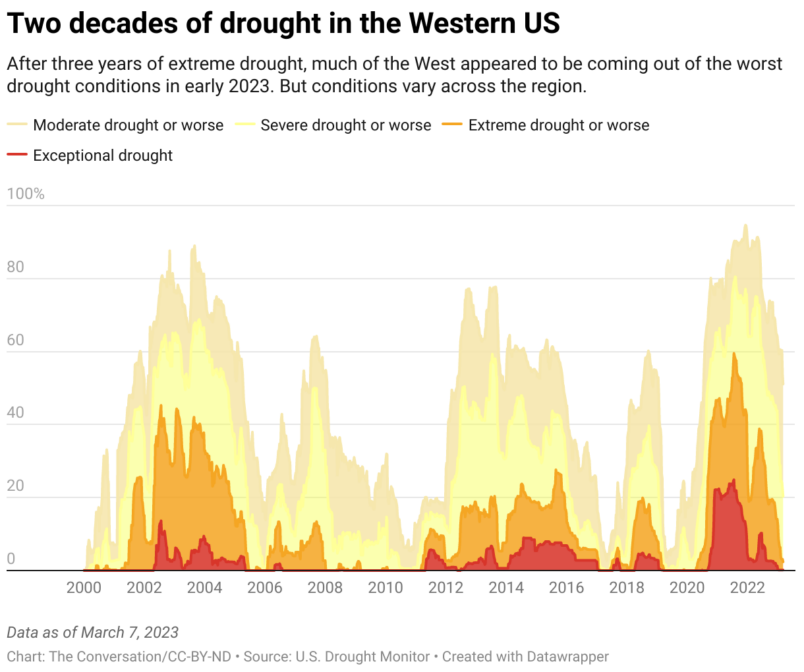
After three years of extreme drought, the Western U.S. is finally getting a break. Mountain ranges are covered in deep snow, and water reservoirs in many areas are filling up following a series of atmospheric rivers that brought record rain and snowfall to large parts of the region.

Many people are looking at the snow and water levels and asking: Is the drought finally over?

There is a lot of nuance to the answer. Where you are in the West and how you define “drought” make a difference. As a drought and water researcher at the Desert Research Institute’s Western Regional Climate Center, here’s what I’m seeing.

How fast each region recovers will vary

The winter of 2023 has made a big dent in improving the drought and potentially eliminating the water shortage problems of the last few summers.

I say “potentially” because in many areas, a lot of the impacts of drought tend to show up in summer, once the winter rain and snow stop and the West starts relying on reservoirs and streams for water. Spring heat waves like the ones we saw in 2021 or rain in the mountains could melt the snowpack faster than normal.

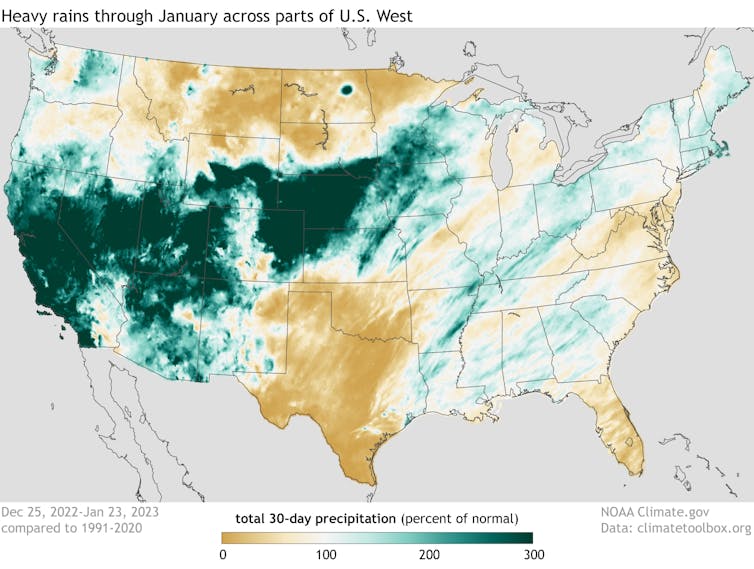
A US map shows heavy rain across much of California, Nevada, Utah, Colorado, Wyoming, Nebraska and Arizona
Atmospheric rivers in January brought heavy rain across large parts of the West. Another powerful storm system hit in March. Climate.gov

California and the Great Basin

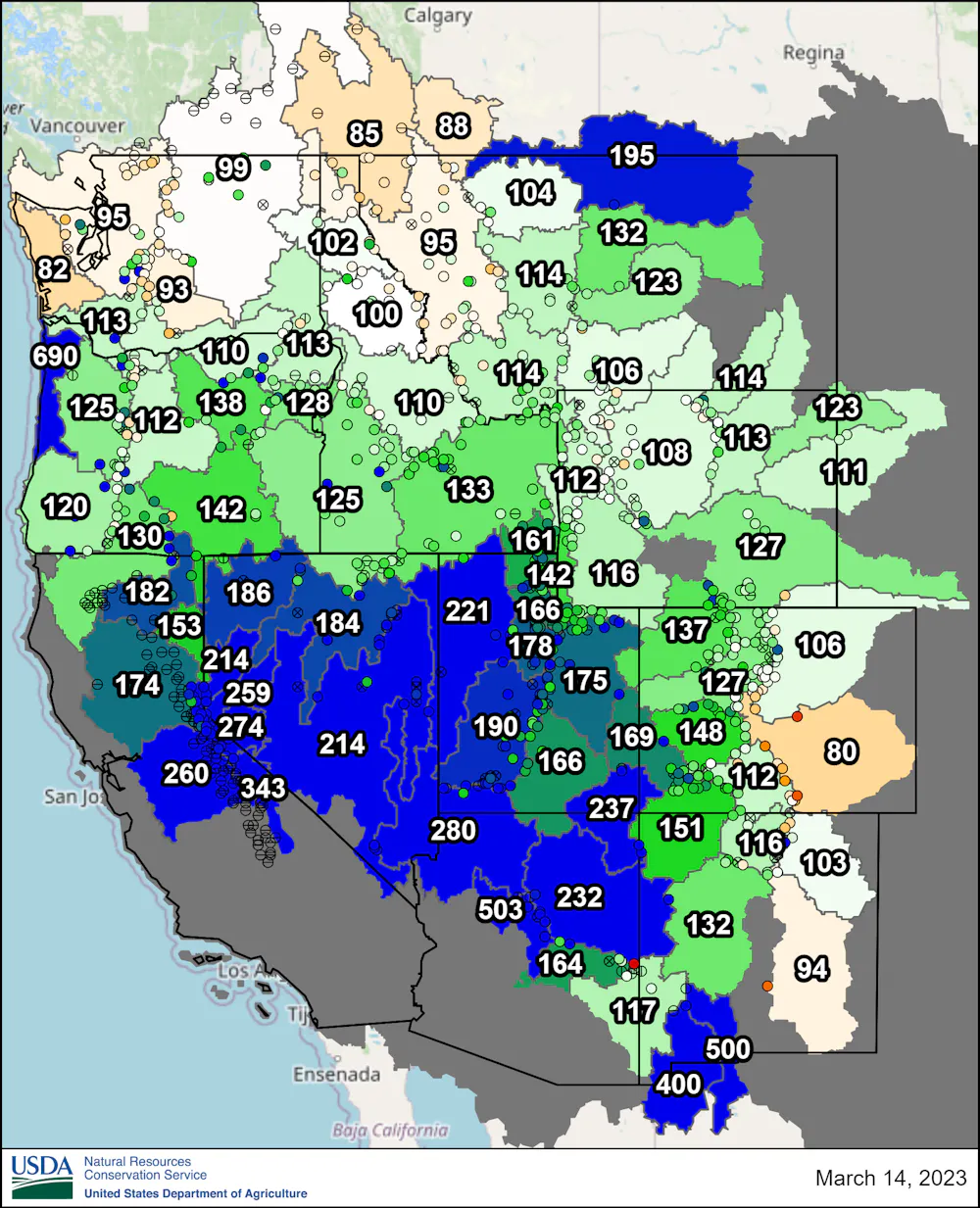
In California, the state’s three-year precipitation deficit was just about erased by the atmospheric rivers that caused so much flooding in December and January. By early March, the snowpack across the Sierra Nevada was well above the historical averages — and more than 200% of average in some areas. The Metropolitan Water District of Southern California announced it was ending emergency water restrictions for nearly 7 million people on March 15.

It seems as though most of the surface water drought — drought involving streams and reservoirs — could be eliminated by summer in California and the Great Basin, across Nevada and western Utah.

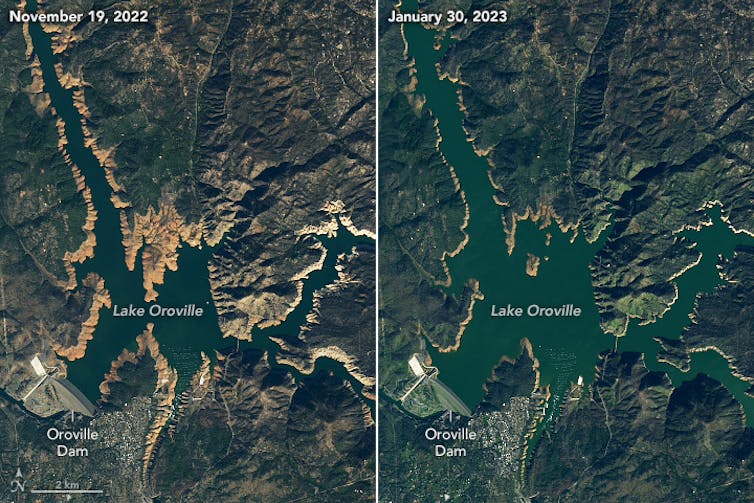
Two images of Lake Oroville, from November 2022 to late January 2023 show a sharp decline in water levels and a wide ring around the edge.
The early 2023 storms likely could have filled Lake Oroville, one of California’s largest reservoirs. But reservoirs are also essential for flood management, so managers balance how much water to retain and how much to release. NASA Earth Observatory images by Lauren Dauphin

But that’s only surface water. Drought also affects groundwater, and those effects will take longer to alleviate.

Studies in California have shown that, even after wet years like 2017 and 2019, the groundwater systems did not fully recover from the previous drought, in part because of years of overpumping groundwater for agriculture, and the aquifers were not fully recharging.

In that sense, the drought is not over. But at the broader scale for the region, a lot of the drought impacts that people experience will be lessened or almost gone by this summer.

The Colorado River Basin

Similar to the Sierra Nevada, the Upper Colorado River Basin — Wyoming, Colorado, Utah and northwestern New Mexico — has a healthy snowpack this year, and it’s looking like a very good water year there.

Map showing highest snow water equivalent in California, the Great Basin and Arizona
The snow water equivalent, a measure of snowpack, was over 200% of average in several areas on March 14, 2023. Drought.gov

But one single good water year is not going to fill Lake Mead and Lake Powell. Most of the region relies on those two reservoirs, which have declined to worrying levels over the past two decades. NOAA’s seasonal drought outlook released on March 16 noted that both remained low.

Two good water years won’t do it either. Over the next decade, most years will have to be above average to begin to fill those giant reservoirs. Rising temperatures and drying will make that even harder.

So, that system is still going to be dealing with a lot of the same long-term drought impacts that it has been seeing. The reservoirs will likely rise some, but nowhere close to capacity.

The Pacific Northwest

The Pacific Northwest isn’t having as much rain and snow, and it’s a little drier there. But it’s close to average, so there’s not a huge concern there, at least not right now.

Forests, range land and the fire risk

Drought can also have longer-term impacts on ecosystems, particularly forest health.

The Sierra Nevada range has seen large-scale tree die-offs with the drought in recent years, including in northern areas around Lake Tahoe and Reno that weren’t as affected by the previous drought. Whether the recent die-offs there are due to the severity of the current drought or lingering effects from the past droughts is an open question.

Even with a wet winter, it’s not clear how soon the forests will recover.

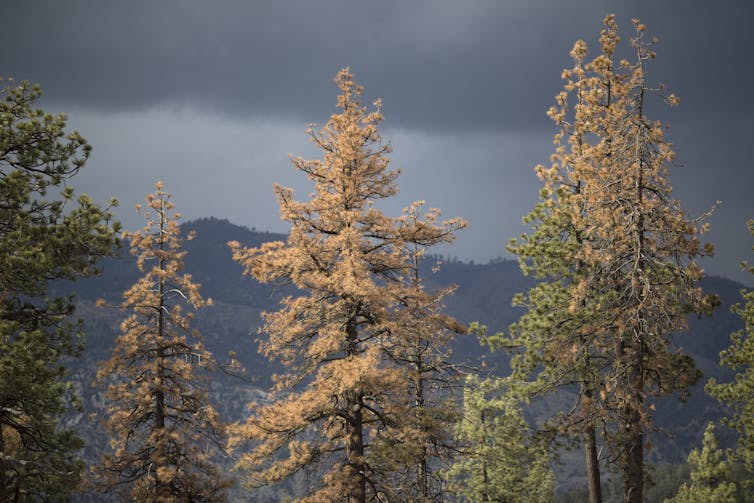
Dead and dying trees with yellow needles on a forest ridge.
Drought and bark beetles have killed millions of trees across California in recent years, contributing to wildfire risk. David McNew/Getty Images

Rangelands, since they are mostly grasses, can recover in a few months. The soil moisture is really high in a lot of these areas, so range conditions should be good across the West — at least going into summer.

If the West has another really hot, dry summer, however, the drought could ramp up again, particularly in the Northwest and California. And then communities will have to think about fire risk.

Right now, there’s a below-normal likelihood of big fires in the Southwest for early spring due to lots of soil moisture and snowpack.

In the higher-elevation mountains and forests, the above-average snowpack is likely to last longer than it has in recent years, so those regions will likely have a later start to the fire season. But lower elevations, like the Great Basin’s shrub- and grassland-dominated ecosystem, could see fire danger starting earlier in the year if the land dries out.

Long-term outlooks aren’t necessarily reliable

By a lot of atmospheric measures, California appears to be coming out of drought, and the drought feels like it’s ending elsewhere. But it’s hard to say when exactly the drought is over. Studies suggest the West’s hydroclimate is becoming more variable in its swings from drought to deluge.

Drought is also hard to forecast, particularly long term. Researchers can get a pretty good sense of conditions one month out, but the chaotic nature of the atmosphere and weather make longer-range outlooks less reliable.

We saw that this year. The initial forecast was for a dry winter 2023 in much of the West. But in California, Arizona and New Mexico, the opposite happened.

Seasonal forecasts tend to rely heavily on whether it’s an El Niño or La Niña year, involving sea surface temperatures in the tropical Pacific that can affect the jet stream and atmospheric conditions around the world. During La Niña — the pattern we saw from 2020 until March 2023 — the Southwest tends to be drier and the Pacific Northwest wetter.

But that pattern doesn’t always set up in exactly the same way and in the same place, as we saw this year.

There is a lot more going on in the atmosphere and the oceans on a short-term scale that can dominate the La Niña pattern. This year’s series of atmospheric rivers has been one example.

This article is republished from The Conversation under a Creative Commons license. Read the original article.