

The White House responded Tuesday to TPM’s reporting that Rep. Ralph Norman (R-SC) called for then-President Donald Trump to impose martial law in the final days of his presidency.
Continue reading “White House On Norman Call For ‘Marshall Law’: ‘A Disgusting Affront To Our Deepest Principles’”Inside Team Trump’s Chaotic Attempts To Overturn The 2020 Vote In Georgia
It was Nov. 5, 2020. Votes were still being counted in the presidential race, but it was looking increasingly grim for President Donald Trump. Mark Meadows, Trump’s White House chief of staff, had an idea to turn things around.
Continue reading “Inside Team Trump’s Chaotic Attempts To Overturn The 2020 Vote In Georgia”I Was Frustrated!
Rep. Ralph Norman (R) of South Carolina tells local press that his January 17th, 2021 call to place the United States under martial law to keep Trump in office — first reported yesterday by TPM — came from “frustration.”
Norman Responds To TPM Revelations Of His Call For ‘Marshall Law’: Texts Came From ‘Source Of Frustration’
Rep. Ralph Norman (R-SC), whose Jan. 17, 2021 text to then-Chief of Staff Mark Meadows called for Donald Trump to invoke “Marshall Law,” has responded to the revelations.
“Obviously, Martial Law was never warranted,” Norman said in a statement to local South Carolina outlet The State. “That text message came from a source of frustration, on the heels of countless unanswered questions about the integrity of the 2020 election, without any way to slow down and examine those issues prior to the inauguration of the newly elected president.”
TPM first reported Norman’s January text on Monday.
Continue reading “Norman Responds To TPM Revelations Of His Call For ‘Marshall Law’: Texts Came From ‘Source Of Frustration’ “Rep. Rick Allen Shared ‘Wild’ Romanian YouTube Conspiracy Theories As He Challenged The 2020 Election
Rep. Rick Allen (R-GA) is not one of the better-known figures in the extended universe of former President Trump’s political allies. However, based on text messages obtained by TPM, Allen is one of the members of Congress who worked most aggressively behind the scenes to reverse Trump’s loss in the 2020 election. Allen’s attempts to challenge the vote included passing unproven YouTube conspiracy videos from Romania to the White House and pressuring Georgia’s secretary of state. At least one of the paranoid election theories Allen texted to Meadows made its way directly to Trump.
Continue reading “Rep. Rick Allen Shared ‘Wild’ Romanian YouTube Conspiracy Theories As He Challenged The 2020 Election”Morning Memo
Get your Morning Memo fix here.
DID WE MENTION THE MEADOWS TEXTS???
A lot of things happened. Here are some of the things. This is TPM’s Morning Memo.
Big Day At TPM
Over the past month, a team of reporters, editors and designers at TPM has been hard at work putting together a landmark series on the text messages that Trump White House Chief of Staff Mark Meadows turned over to the Jan. 6 committee.
Obtained by TPM’s Hunter Walker, the more than 2,000 text messages sent and received by Meadows between Election Day 2020 and Inauguration Day 2021 were turned over to the committee before Meadows stopped cooperating. It is believed that Meadows also turned them over to the Justice Department in response to a grand jury subpoena.
As Hunter puts it in the introductory post:
The vast majority of Meadows’ texts described in this series are being made public for the very first time. They show the senior-most official in the Trump White House communicating with members of Congress, state-level politicians, and far-right activists as they work feverishly to overturn Trump’s loss in the 2020 election. The Meadows texts illustrate in moment-to-moment detail an authoritarian effort to undermine the will of the people and upend the American democratic system as we know it.
How To Read It
Start with the introduction: A Plot To Overturn An American Election
Then go to the seminal post of the series: Mark Meadows Exchanged Texts With 34 Members Of Congress About Plans To Overturn The 2020 Election
Next zero in on Rep. Scott Perry (R-PA), who was already known to be a key player in the election subversion scheme but not with this level of detail: Freedom Caucus Chair Scott Perry’s Work To Overturn 2020 Election Included A ‘Cyber Team’ And An Italian Job
Finally, Day One of the series concludes with special focus on Rep. Andy Biggs (R-AZ), who was one of Meadows’ most frequent texting buddies and is now challenging Rep. Kevin McCarthy (R-CA) for speaker of the House: As The 2020 Election Slipped Away, Andy Biggs And Mark Meadows Schemed To Reverse The Vote In Arizona
How It Came To Be
TPM’s Hunter Walker has had the Meadows texts for some time. They were a key element of Hunter’s recent book – The Breach: The Untold Story of the Investigation into January 6th – which he coauthored with former Rep. Denver Riggleman (R-VA), who after leaving Congress became a senior technical adviser to the Jan. 6 committee. Other outlets also obtained some or all of the Meadows texts and reported on some of them.
But no news outlet had yet published a comprehensive review of the texts and contextualized them as part of the broad scheme to subvert and overturn the 2020 election. Until now.
Hunter, who after a nearly decade away, rejoined TPM’s staff in November, got to work right away on unpacking the Meadows texts. We quickly realized that to do the texts justice would require an all-hands-on-deck effort. The team has been working night and day for weeks. We knew the texts were highly newsworthy, but we also thought they had historical value and deserved a fuller treatment than they’d been given. The public reaction to yesterday’s launch of the series exceeded all our expectations.
Initial Reaction To The Meadows Texts
Heather Cox Richardson: “Today, Talking Points Memo began an explosive series covering texts to and from Meadows in the time around the 2020 election and its aftermath….The series, by Hunter Walker, Josh Kovensky, and Emine Yücel, examines texts not previously available to the public as well as some we have already seen.”
Rachel Maddow, who gave over the A block to the Meadows texts, opened with Rep. Ralph Norman (R-SC) text calling for “Marshall law”:
David Frum: “Two concepts of reporting: @TPM breaking new inner-circle details of an ex/president’s plot to over throw an election and the Constitution; new @Twitter and selected writers arguing that well actually, Trump is the true victim here because his attempted coup lost him his account”
Bill Grueskin:
**UPDATED** Keep An Eye Out
Hunter Walker led off Morning Joe this morning:
What’s Next?
We’ll be rolling out more stories on the Meadows Texts all week. Three more are planned for today. I can’t give away too much, but one of them delves into the efforts to overturn the election results in a particularly high-profile state.
More New Subpoenas From Jack Smith
We’re still learning the contours of Special Counsel Jack Smith’s Jan. 6 investigation. A couple of more clues dropped Monday:
Secretaries of State:
- Smith subpoenaed Georgia Secretary of State Brad Raffensperger.
- Updating the list of known subpoenas to secretaries of state: Arizona, Michigan, Georgia.
Counties:
- Smith subpoenaed Clark County, Nevada (Las Vegas) election officials.
- Updating the list of known subpoenas to counties: Milwaukee and Dane County, Wisconsin; Wayne County, Michigan; Allegheny County, Pennsylvania; Clark County, Nevada.
One additional point: The Clark County subpoena was dated Nov. 22, which suggests it was part of the initial batch that went out to the other counties; the Georgia subpoena was dated Dec. 9, which suggests it went out with a later batch of subpoenas to secretaries of state.
It’s Official
Under orders from the appeal court, U.S. District Judge Aileen Cannon dismissed Donald Trump’s special master gambit.
SBF Arrested
It’s coming down fast for Sam Bankman-Fried. He was arrested yesterday in the Bahamas in anticipation of being extradited to face charges in the United States. A federal indictment against SBF is expected to be unsealed today in Manhattan. Meanwhile, the SEC this morning has filed civil fraud charges against him. All of this of course stems from the spectacular collapse of his crypto exchange FTX.
Keeping It In Perspective
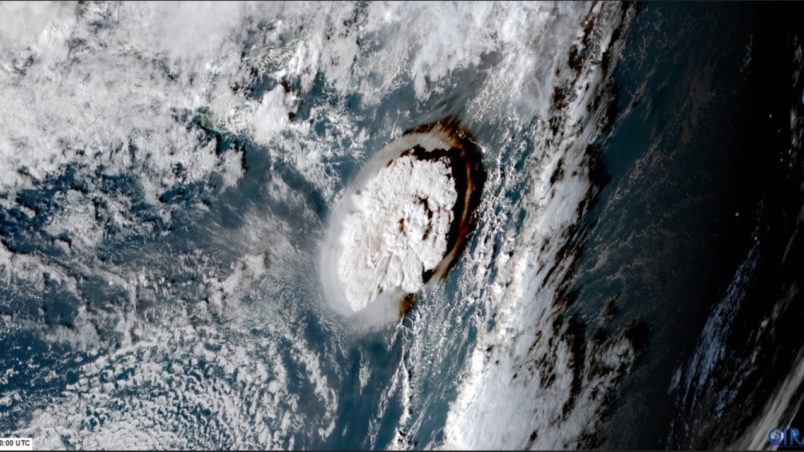
We’re still learning details about the ferocity of the January eruption of Hunga Tonga, a shallow-water volcano in the Pacific:
The eruption of the Hunga Tonga undersea volcano in the Pacific Ocean early this year was so powerful that it sent a massive plume of water vapor into space, according to research released Monday. A volcano launching water beyond the atmosphere had never before been observed by scientists.
Do you like Morning Memo? Let us know!
As The 2020 Election Slipped Away, Andy Biggs And Mark Meadows Schemed To Reverse The Vote In Arizona
The election-night exchanges between Rep. Andy Biggs (R-AZ) and former White House Chief of Staff Mark Meadows on Nov. 3, 2020, read like any other conversation between a campaign stakeholder and his ally in a battleground state.
Continue reading “As The 2020 Election Slipped Away, Andy Biggs And Mark Meadows Schemed To Reverse The Vote In Arizona “Freedom Caucus Chair Scott Perry’s Work To Overturn 2020 Election Included A ‘Cyber Team’ And An Italian Job
It had been one week since the 2020 presidential election and three days since news outlets called the race, and Rep. Scott Perry (R-PA) was frantically working to reverse President Trump’s loss.
Perry had an aggressive plan. Based on the text log obtained by TPM, Perry wrote Trump White House Chief of Staff Mark Meadows about his efforts to set up a “cyber team.” It would seize voting machines around the country and put them under “lock and key.”
Perry, who later became the chairman of the far-right House Freedom Caucus, was one of 34 members of Congress who exchanged more than 400 texts with Meadows about efforts to overturn Trump’s loss in the 2020 presidential election. Those texts were included in the log that Meadows turned over to the House select committee investigating the Jan. 6 attack. For this series, The Meadows Texts, we are relying on the identifications of those texting with Meadows that were made by the committee’s investigators. To read more about the story behind that text log and our procedures for publishing the messages, check out the introduction to this series. Perry and his office did not respond to a request for comment.
The log may only be a partial record of Meadows’ communications, but Perry was one of the chief of staff’s most frequent correspondents included in it. The pair exchanged at least 62 messages in the period from Election Day, Nov. 3, 2020, through Biden’s inauguration on Jan. 20, 2021. CNN has previously published some of Perry’s messages with Meadows.
The texts between Perry and Meadows show the congressman attempting to involve himself in nearly every aspect of the campaign to block Biden’s win. They also reveal Perry to be someone who appeared to sincerely buy into outlandish conspiracy theories that the election was stolen by an array of shadowy international cyber warriors — and who was willing to use his position and influence in government to sow doubt and subvert the vote based on those deeply paranoid convictions.
Officials at every level of state and federal government — including multiple high-level members of Trump’s own administration — have confirmed there was no widespread fraud in the 2020 presidential election. Voting machines were central to the many thoroughly debunked conspiracy theories espoused by Trump and his allies in Pennsylvania and other key states. Pennsylvania counties each have different election procedures; however, they all complied with a 2018 directive from Trump’s Department of Homeland Security that called on local jurisdictions to use voting systems that include paper ballots that can be audited and verified by hand. The only notable issue reported in the state during the 2020 election was a man who used the names of dead relatives to cast multiple votes for Trump.
On Nov. 8, 2020, the day after Biden was projected as the winner of the election, Perry texted Meadows and urged him to connect with Sidney Powell, the firebrand far-right attorney. Powell would go on to pin Trump’s defeat on a communist conspiracy masterminded by deceased Venezuelan president Hugo Chavez. In messages with other contacts, Meadows, who entertained some conspiracy theories about the vote, indicated that Powell’s ideas were too far-fetched even for him. Perry seemingly had no such doubts and pressed Meadows, “please do not delay in speaking” with Powell.
The next day, Perry relayed a request from Cleta Mitchell, another right-wing attorney who worked on the Trump campaign’s failed legal blitz to challenge the election results in multiple states. According to Perry’s text, Mitchell was eager to set up a 501(c)(4) non-profit to support her efforts.
“Cleta asked if she should set up a C4 to deal with raising money and paying for the cyber portion. She offered to do it if necessary,” Perry wrote.
The text message log did not include responses from Meadows to Perry’s missives about the lawyers. However, in multiple messages, Perry indicated he was also communicating with Meadows on Signal, an encrypted messaging platform, and urged the chief of staff to check the Signal app.
By Nov. 10, Perry was working on the “cyber team.” In a series of texts that day, Perry said he was attempting to contribute to efforts in three key swing states: Michigan, Wisconsin and Arizona.
After sending Meadows the “instructions” from the “cyber forensic team” about locking down voting machines, Perry passed along a link to a conspiracy theory about the vote count in Pennsylvania posted by the Epoch Times, a far-right pro-Trump newspaper affiliated with the Falun Gong religious movement. Perry also asked Meadows for “a point of contact in Wisconsin and Arizona,” and for other people associated with “the cyber effort.” Meadows appeared to direct Perry to Rep. Chip Roy (R-TX), although Trump’s chief of staff misspelled the congressman’s first name as “Cip.”
“Roger, thank you. I will contact him now,” Perry wrote.
Roy’s text messages with Meadows were previously reported by CNN in April. When asked for comment on this series, a spokesperson for Roy pointed to a statement he issued at that time declaring, “No apologies for my private texts or public positions.”
As time went on, Perry appeared to become increasingly consumed by conspiracy theories related to the election. On the morning of Nov. 12, he sent a flurry of messages to Meadows and Rep. Jim Jordan (R-OH). Perry’s download to the pair began with a rambling 501-word, six-part strategy for challenging the vote in Pennsylvania that Perry said he was forwarding from a legislator in the state. Perry described the missive as a “a reasonable assessment,” but it was filled with easily debunked election delusions.
“People think Dominion software was hacked,” the lengthy text said, referencing a voting machine company that was central to many 2020 conspiracies. Multiple Trump administration officials have testified that the claims about Dominion had no merit. In some of his text messages, Meadows actually indicated he was skeptical of the theory. Dominion ultimately filed a series of defamation lawsuits against Trump allies who pushed the theory publicly. While some of those cases are ongoing, the company has had some success in initial court decisions.
Perry followed that message up by sending Meadows and Jordan what he described as a tip received “from an intel friend.”
“DNI needs to task NSA to immediately seize and begin looking for international comms related to Dominion – was china malware involved?” Perry wrote.
One minute later, he added that the Office of the Director of National Intelligence — run at that time by a former House colleague of his — needed to “audit their overseas accounts at CIA” and also take a look at the National Endowment for Democracy, a grantmaking organization for foreign NGOs. It’s not clear how the endowment was supposed to be involved. The organization’s board of directors includes prominent Trump allies: Rep. Elise Stefanik (R-NY) and Elliott Abrams, a Trump administration diplomat. Meadows’ text logs do not show any reply to Perry’s messages from Meadows or Jordan. Nevertheless, he persisted.
“This whole situation was seen coming a hundred miles away and they did nothing,” Perry wrote, adding, “And Gina is still running around on the Hill covering for the Brits who helped quarterback this entire operation.”
Perry’s message is seemingly a reference to a massive cover-up being orchestrated by Trump CIA director Gina Haspel and the United Kingdom. While the log doesn’t contain any response from Meadows or Jordan to these messages. Jordan and his office did not respond to requests for comment on this story.
On the afternoon of Nov. 12, Meadows wrote Perry asking if one of his contacts would be “willing to sign an affidavit,” presumably detailing claims about the election. Perry was, of course, eager to make the connection and also shared another series of conspiracy theories about the vote in his home state.
One week later, on Nov. 19, Perry let Meadows know he was working with “Rudy’s folks in Philly,” an apparent reference to the legal effort being run by Trump’s personal attorney, former New York City Mayor Rudy Giuliani. Over the next few days, Perry communicated with Meadows about connecting Pennsylvania lawmakers both with “Rudy’s folks” and Trump. Giuliani did not immediately respond to a request for comment.
Perry also expressed a desire to push U.S. Attorney for the Eastern District of Pennsylvania Bill McSwain, a Trump appointee, to investigate the vote. McSwain’s decision not to challenge the results was apparently a source of frustration for Trump. Earlier this year, as McSwain mounted an unsuccessful bid for governor, Trump attacked him for doing “absolutely nothing on the massive election fraud that took place in Philadelphia and throughout the commonwealth.”
Perry’s correspondence with Meadows, as recorded in the log, thinned out in Dec. 2020. However, the congressman was clearly still on board with the effort to challenge Trump’s loss. On Dec. 19, Rep. Jody Hice (R-GA), who was playing a leading role organizing the objection to the electoral certification that was set to take place at the Capitol on Jan. 6, 2021, wrote Meadows a message where he indicated he was confident Perry would back the effort. Perry was ultimately one of the 147 congressional Republicans who objected to the electoral certification in the hours after the Capitol was stormed by Trump supporters.
On Christmas Eve 2020, Perry tried to connect with Meadows.
“Mark, let me know if we can talk some strategy. Just a few minutes,” he wrote.
There was no reply in the logs. Perry texted Meadows again after the holiday. His tone was decidedly urgent.
“Mark, just checking in as time continues to count down. 11 days to 1/6 and 25 days to inauguration. We gotta get going!” Perry wrote.
Just over a half hour later, Perry was pressing Meadows to install Jeffrey Clark, the assistant attorney general for the DOJ’s natural resources section, as acting attorney general.
Clark became the central figure in a bizarre episode where Trump essentially tried to launch a coup through the DOJ, attempting to enlist federal law enforcement in his campaign to reverse his defeat.
As the linchpin of that plan, Trump wanted Clark, a longtime environmental lawyer and staunch loyalist, installed as acting attorney general. On his Twitter page, Clark has described himself as someone who was simply “concerned about the 2020 election” and as “one of the top targets of the politically motivated J6 Committee.”
Per a Senate Judiciary Committee report released last year, if he was placed atop the Justice Department, the plan was for Clark to send letters to multiple swing states informing them the DOJ had concluded that their election results were indeterminate. That report identified Perry as the one who introduced Clark to Trump.
The texts show Perry was pressing Meadows to speak with Clark over and over again.
Part of what Clark was meant to do once in power was tee up the White House to make use of an executive order that Trump signed in 2018. That order, which was nominally aimed at combating foreign interference in American elections, granted broad power to the president and his Cabinet to impose sanctions if law enforcement officials declared there had been foreign meddling. In the wake of his loss, various Trump allies fixated on the order and the idea that a declaration of outside interference in the election could trigger all manner of responses, including the seizure of voting machines and martial law.
Perry appeared to be convinced there had been foreign interference. Per the texts, he was fixated on what later became known as “ItalyGate.” This conspiracy theory posited that Trump’s loss was really due to a hacking effort masterminded by an Italian defense contractor that used military-grade satellites to zap voting machines and steal the election for Biden. A House committee found last year that Meadows urged senior DOJ officials to investigate the theory, while the Jan. 6 committee found that a Trump appointee got the Pentagon to examine it. Per the Senate report, on both Dec. 29 and Dec. 30, 2020, Meadows urged DOJ officials to investigate ItalyGate.
On Dec. 30, Perry texted Meadows that “US 18-95” had been poorly explained at a meeting the previous day — an apparent reference to the U.S. statute that governs the activities of foreign agents on American soil.
On New Year’s Eve, shortly before midnight, Perry had another idea that he texted to Meadows.
“Why can’t we just work with the Italian government?” Perry asked.
He followed that message up with a link to a YouTube video outlining the conspiracy. Days later, on Jan. 2, 2021, Perry was juggling both the alleged Italian menace and the fate of Jeff Clark, whose bid to become attorney general was imploding as senior DOJ and White House legal officials threatened Trump with mass resignations were he to be appointed AG.
Perry pressed Meadows to get Trump on the phone with Rome. According to the log, Perry sent Meadows a message that seemed to suggest Trump should reach out to former Italian Prime Minister Giuseppe Conte, whose name was misspelled in Perry’s text.
“Also,has POTUS been able to have a conversation with Conti? Can he move the ball today?” Perry asked.
The log does not include any responses from Meadows to Perry’s various messages about ItalyGate. However, it seemed Perry was aware Meadows was in communication with Clark.
“Please call me the instant you get off the phone with Jeff,” Perry wrote on the evening of Jan. 2.
Clark’s quest to become the country’s top federal law enforcement officer crashed and burned that very evening when DOJ officials spent hours persuading Trump to drop him as attorney general, putting an end to the scheme.
But it wasn’t the only plot afoot. The most dramatic of Trump’s efforts to stay in power came on Jan. 6 as the former president urged the thousands of his supporters who had converged on Washington to “fight like hell” as they stormed the U.S. Capitol. Perry, the texts show, was not done with the Trump White House after that fateful day. On Jan. 7, he sent Meadows one more message.
“Mark, please call when you can,” Perry wrote.
Mark Meadows Exchanged Texts With 34 Members Of Congress About Plans To Overturn The 2020 Election
White House Chief of Staff Mark Meadows exchanged text messages with at least 34 Republican members of Congress as they plotted to overturn President Trump’s loss in the 2020 election.
Continue reading “Mark Meadows Exchanged Texts With 34 Members Of Congress About Plans To Overturn The 2020 Election”