

Thursday The New York Times published a retrospective and analysis of the “Durham investigation,” the probe Bill Barr stood up to discredit the earlier Trump/Russia probes and which long served as the shining hope of Trump partisans, the vehicle of a promised vengeance that never arrived. Indeed, Durham’s investigation has lasted almost four years, far longer than any of the various probes it purported to scrutinize. The picture the Times story paints is stark if unsurprising: a politicized, instinctively unethical and deeply corrupt effort which managed to embody in almost cartoonish fashion the story it sought to tell about the original Russia investigation. The one thing a criminal investigation is never supposed to be is one that starts knowing the conclusion it wants to arrive at, brings a heavy dose of political motivation and bends rules and cuts corner to get where it wants to go. That caricature describes the Durham probe to a T. The two cases Durham managed to bring to trial were mainly vehicles for airing tendentious conspiracy theories he couldn’t prove and had no real evidence for. The actual cases were laughed out of court with speedy acquittals.
Continue reading “The ‘Weaponization’ Committee is Just a Reboot of the ‘Durham Probe’ from Capitol Hill”Loneliness And Cupcakes: How Santos Is Spending His First Few Weeks In Congress
Wondering what the Anna Delvey of Capitol Hill Rep. George Santos (R-NY) has been up to the last few weeks — besides dodging reporters and claiming he knows nothing about those FEC filings? It seems he is trying to make the best out of the time he has in Congress.
Continue reading “Loneliness And Cupcakes: How Santos Is Spending His First Few Weeks In Congress”The Worst Attorney General In 50 Years Was Even More Corrupt Than We Thought
A lot of things happened. Here are some of the things. This is TPM’s Morning Memo.
Single Malt Justice
It turns out Bill Barr and John Durham were sipping scotch as they burned down Main Justice.
Extraordinary new reporting from the New York Times peels back more layers of corruption, malfeasance, and politicization within the Barr Justice Department. In a groundbreaking story that is focused on Special Counsel John Durham but is really an indictment of Barr, the NYT unveils several previously unreported episodes:
- Durham Investigated Trump?!? The most explosive revelation in the NYT piece is that Barr allegedly directed Durham to dramatically expand his brief beyond “investigating the investigators” by opening a financial crimes investigation in the fall of 2019 of President Donald Trump based on a tantalizing tip from Italian authorities. It’s unclear how and to what extent Durham investigated the tip. No charges ever resulted. While it’s unclear what exactly Durham did with the tip, the strong impression left by the story is that the Trump investigation was buried.
- Oopsies! The New York Times and other news outlets later misleadingly reported that Durham’s review of the origins of the Trump-Russia probe had turned into a criminal investigation, suggesting that the Durham was zeroing in on the investigators of Trump. In fact, Durham’s criminal probe involved Trump himself. Barr never sought to correct the widespread public misperception:
The news reports, however, were all framed around the erroneous assumption that the criminal investigation must mean Mr. Durham had found evidence of potential crimes by officials involved in the Russia inquiry. Mr. Barr, who weighed in publicly about the Durham inquiry at regular intervals in ways that advanced a pro-Trump narrative, chose in this instance not to clarify what was really happening.
- Resignations … Lots Of Them. Multiple members of Durham’s team allegedly resigned in disputes over prosecutorial ethics and the charging decisions he was making.
- Bogus Intel. In an unbelievably ironic twist, Durham allegedly used dubious intel from the Dutch and sidestepped a federal judge’s objections to obtain emails from a U.S. citizen who worked at a pro-democracy organization founded by George Soros. Later the Trump administration would infuriate the Dutch by publicly revealing the intel.
- Election Interference. The bad-faith machinations of Barr and Durham reached their zenith in the summer of 2020, when Barr allegedly pressed Durham to draft an interim report before Election Day. The draft interim report was never released but it prompted the resignation of a longtime Durham protege. Then there’s this nugget about how Durham’s original investigation had never panned out:
By summer 2020, it was clear that the hunt for evidence supporting Mr. Barr’s hunch about intelligence abuses had failed. But he waited until after the 2020 election to publicly concede that there had turned out to be no sign of “foreign government activity” and that the C.I.A. had “stayed in its lane” after all.
There’s a lot more. Definitely worth a read.
John Eastman Faces Disbarment In California
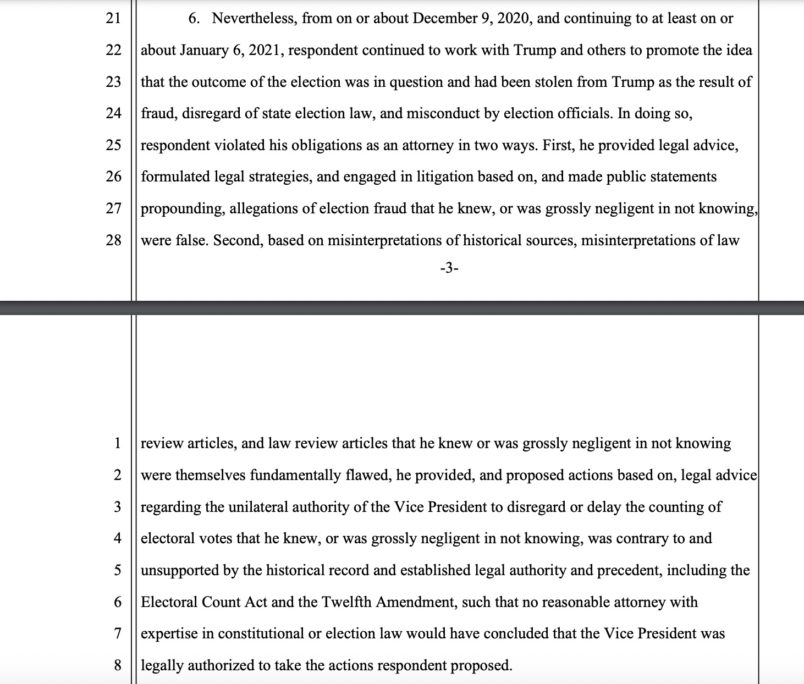
In a scathing 11-count complaint, the California state bar has moved to disbar former Trump lawyer John Eastman, the architect of the Jan. 6 coup plot. Here’s the meat of the complaint:
What’s Jack Smith Up To?
Ken Cuccinelli was spotted at the federal courthouse in DC and confirmed to CNN that he was there to testify to a grand jury but he didn’t know about what:
Cuccinelli headed into the grand jury area just before 10 a.m. ET at the federal courthouse, where prosecutors looking at efforts to undermine the 2020 election as part of special counsel Jack Smith’s investigation are also gathered.
Cuccinelli, a top official in the Trump DHS, intersected with the 2020 election subversion scheme, at various points. He cited privilege in refusing to answer some of the Jan. 6 committee’s questions, privilege claims Special Counsel Jack Smith may be able to sidestep with the grand jury:
Worth reviewing the Jan. 6 committee transcript for clues as to what DOJ might want from CUCCINELLI. He declined to answer some of the committee’s quesitons, citing privilege. Here’s an example: https://t.co/2IpOKul9gh pic.twitter.com/4LBoszkyJV
— Kyle Cheney (@kyledcheney) January 26, 2023
Trump Dealt Setback In Jan. 6 Lawsuit
A federal judge in DC declined to dismiss a civil lawsuit by Capitol Police officers against Donald Trump and others for injuries they sustained on Jan. 6.
Bouquets And Brickbats
Bouquet: “Gay and bisexual men in monogamous relationships will no longer be forced to abstain from sex to donate blood under federal guidelines to be proposed in coming days, ending a vestige of the earliest days of the AIDS crisis.”
Brickbat: “Tennessee has rejected millions of dollars from the federal government for HIV/AIDS prevention — a move that public health experts worry will politicize the response to the disease and has the potential to destabilize decades of progress in getting the epidemic under control.”
Memphis On Edge Ahead Of Release Of Police Beating Video
Memphis is expected to release Friday evening the “absolutely appalling” video of police officers beating a 29-year-old Black man to death after a traffic stop. Five police officers, all Black, have been arrested and charged in the case.
The Misinformation Is Never-Ending
Just another normal Thursday night on Fox News:
Do you like Morning Memo? Let us know!
Where Things Stand: One Attention Seeker Meets With Another Attention Seeker
Would love to be a fly on the wall for this bro-fest.
The one attention-seeker who debased himself on the House floor for an entire week in order to get his new job wanted to show the other attention-seeker, who pretended to want to buy Twitter to own the libs and then actually had to buy it, his new office.
According to several reports from the Hill it seems that Elon Musk met with House Speaker Kevin McCarthy (R-CA) today. McCarthy claims that the meeting was just a couple of old pals broing out on his birthday.
Continue reading “Where Things Stand: One Attention Seeker Meets With Another Attention Seeker”California Bar Moves To Nix Eastman’s Attorney License
The California state bar moved to revoke attorney John Eastman’s law license on Thursday, saying that he lied over and over again to support President Trump’s effort to stay in office after losing the 2020 election.
Continue reading “California Bar Moves To Nix Eastman’s Attorney License”Today in GOP Weirdos
Today in Republicans, we find that there seems to be at least signs of a real race for RNC chair, a contest that three-term incumbent Ronna McDaniel has seemed to have locked up. I suspect McDaniel still has the votes. But today Gov. Ron DeSantis of Florida, most recently seen with his poll numbers falling against ex-President Trump, has told far-right luminary Charlie Kirk that he’s backing Harmeet Dhillon, McDaniel’s top opponent.
“I think we need a change … I think we need to get some new blood in the RNC.”
Continue reading “Today in GOP Weirdos”Listen To This: 2024 Already
A new episode of The Josh Marshall Podcast is live! This week, Josh and Kate discuss early 2024 Senate projections and the discovery of yet more classified documents, this time at the home of former Vice President Mike Pence.
You can listen to the new episode of The Josh Marshall Podcast here.
Lighting Money on Fire in California?
In general, I’m of the mind that it’s not really “wasting” money to spend a lot in one place when the money is better spent elsewhere. If Dems are burning money on a hopeless race in Kentucky just because they despise Mitch McConnell it doesn’t mean that money was really on offer for a sleeper race in another part of the country. I also think campaign dollars are fairly elastic. That person who’s given candidate A $100 probably has another $100 they can give to candidate B if that other candidate catches their fancy. But TPM Reader HS makes a decent point about a possible bonfire of Dem campaign dollars about to be spent in California.
Continue reading “Lighting Money on Fire in California?”I don’t think it’s too soon to warn TPM readers away from picking a candidate for the Feinstein seat. Democratic Party activists are about to waste tens of millions of dollars (hundreds of millions?) on the Porter/Lee/Schiff race that really doesn’t matter, they all would be more than adequate.
National Archives Asks Past Presidents and VPs To Check If They Have Any Classified Documents
The National Archives is formally asking former presidents and vice presidents from the last six administrations to go through their personal belongings to make sure they’re not in possession of any classified documents.
The letter is the latest in a frenzied news cycle that only began because former President Trump fought tooth and nail for over a year to avoid handing over documents that the National Archives and, later, the Department of Justice suspected were at his property.
Continue reading “National Archives Asks Past Presidents and VPs To Check If They Have Any Classified Documents”The Great Mystery
Here’s a tweet thread by Tim Snyder, the Yale history professor whose expertise both on the borderlands between Russia and Germany (Poland, Ukraine, Belarus, Lithuania et al.) and democracy and authoritarianism have put him at the center of numerous public discussions over the last half dozen years. The thread basically looks at The Long Trump-Russia Story in the context of the arrest of Charles McGonigal, the high-ranking FBI counterintelligence agent.
Continue reading “The Great Mystery”