

Treasury Secretary Janet Yellen sent a letter to House Speaker Kevin McCarthy (R-CA) on Monday, warning that debt ceiling armageddon may be only a month away.
Continue reading “Yellen Warns McCarthy That Treasury Could Run Out Of Money To Pay Country’s Debts ‘Early As June 1’”Montana Rep Zooey Zephyr Sues To Do Her Job
Montana state Rep. Zooey Zephyr (D) sued the state of Montana and the speaker of the Montana House on Monday after Republican lawmakers voted to censure and block her from speaking.
Continue reading “Montana Rep Zooey Zephyr Sues To Do Her Job”It’s Gonna Be a Rough Ride
We’re now bearing down on crunch time in the debt-ceiling hostage-taking drama of 2023. Virtually all of the establishment press is playing to form and treating the situation as a more or less ordinary matter of legislative jockeying and negotiation. That’s a problem but not a surprise. We’ll discuss that in another post. But this morning I want to talk about something different, the story that most commentators aren’t grasping about where this situation is headed. It’s a set of assumptions that is leading most of D.C. — and, it would appear, most of Wall Street — to miss what’s coming.
Continue reading “It’s Gonna Be a Rough Ride”Abbott Slammed For Highlighting Immigration Status Of Mass Shooting Victims
Texas Gov. Greg Abbott sparked outrage after he responded to a Friday mass shooting by highlighting the immigration status of the five victims – and getting it wrong, too.
Continue reading “Abbott Slammed For Highlighting Immigration Status Of Mass Shooting Victims”Supreme Court Takes Up Case That Existentially Threatens Agency Power
The Supreme Court opened a new front in its war against the administrative state Monday when it took up a case that asks it to consider overruling a doctrine that has long helped form the basis of executive branch agencies’ authority.
Continue reading “Supreme Court Takes Up Case That Existentially Threatens Agency Power “Schumer Using House’s Absence To Launch Week Of Anti-GOP Debt Ceiling Bill Messaging
Senate Majority Leader Chuck Schumer (D-NY) said Monday morning that Democrats will use this week to launch a counteroffensive after House Republicans passed their debt ceiling bill last week.
Continue reading “Schumer Using House’s Absence To Launch Week Of Anti-GOP Debt Ceiling Bill Messaging”House GOP Whip Says He Has The Perfect Solution: Dems Should Give McCarthy Everything He Wants
House Majority Whip Tom Emmer (R-MN) said on Sunday that President Joe Biden “doesn’t have to negotiate” over the debt ceiling because “Republicans in the House, led by Kevin McCarthy, have passed the solution.”
Continue reading “House GOP Whip Says He Has The Perfect Solution: Dems Should Give McCarthy Everything He Wants”What Exactly Is Going On In The E. Jean Carroll Trial?
A lot of things happened. Here are some of the things. This is TPM’s Morning Memo.
Things Went And Got Weird
The cross examination of E. Jean Carroll in her rape and defamation case against Donald Trump is set to resume this morning in federal court in New York City. But a couple of odd developments over the weekend:
- First, there is some sort of sealed matter that the judge is overseeing related to the case. The first inkling came when the trial was delayed for a bit Thursday morning while the lawyers met with the judge. Then over the weekend, Carroll’s lawyer filed a letter on the record with the court that referenced Thursday’s “brief proceeding under seal concerning an issue that had arisen during trial.” It’s not clear what is going on exactly. MSNBC’s Lisa Rubin does a good job laying out in this thread what we do and do not know (teaser: She doesn’t think it’s a run-the-mill evidentiary issue):
And now, Carroll’s lawyers have confirmed in a letter to the court that whatever they were discussing, it is ongoing & deserving of remaining under seal. 3/ pic.twitter.com/gPL2Bi9ywl
— Lisa Rubin (@lawofruby) May 1, 2023
- Then early this morning Trump’s lawyers asked the judge to declare a mistrial over the judge’s own conduct during the trial. You don’t see this every day:
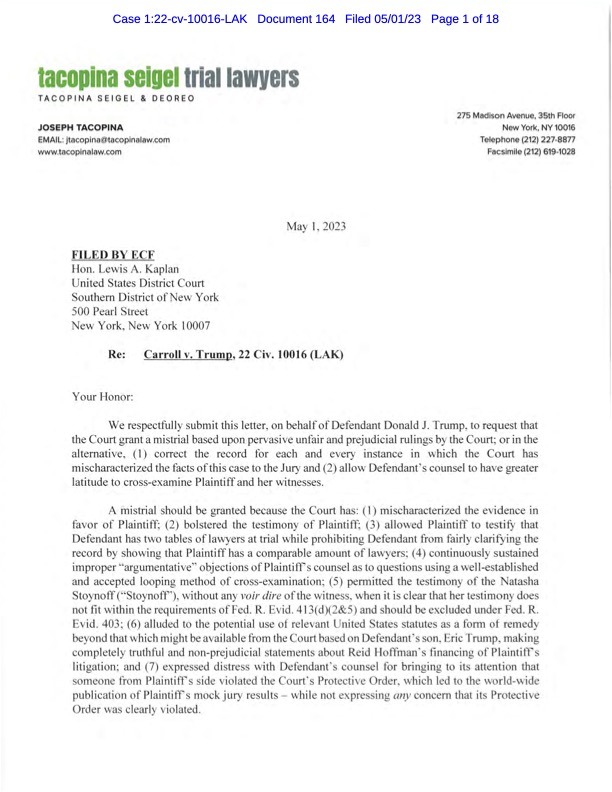
The best part of all this, however, is the complaint by the Trump team that the judge understood a literary reference that they themselves did not:
To follow the Carroll trial in real time, this is your guy: @KlasfeldReports.
The Latest On Jack Smith
- NYT: Prosecutors in Jan. 6 Case Step up Inquiry Into Trump Fund-Raising
Here’s the key bit (emphasis mine):
But the Justice Department, with its ability to bring criminal charges, has been able to prompt more extensive cooperation from a number of witnesses. And prosecutors have developed more information than the House committee did, having targeted communications between Trump campaign aides and other Republican officials to determine if a barrage of fund-raising solicitations sent out after the election were knowingly misleading, according to the three people familiar with the matter.
- WaPo: A second firm hired by Trump campaign found no evidence of election fraud
Here’s the key bit (emphasis mine):
Former president Trump’s campaign quietly commissioned a second firm to study election fraud claims in the weeks after the 2020 election, and the founder of the firm was recently questioned by the Justice Department about his work disproving the claims.
No Verdict Yet
The jury in the Proud Boys seditious conspiracy case continues to deliberate.
WTF
Gov. Greg Abbott (R) responded to a mass shooting over the weekend in southeast Texas by highlighting the immigration status of the victims (and getting that wrong, too):
NC GOP Wants To Destroy UNC
A bill to eliminate tenure in the UNC and community college systems is on the move in the North Carolina General Assembly.
ICYMI
This isn’t a story about gerrymandering. It’s about the right wing seizing hold of the courts to undermine the rule of law. And it’s on full display in North Carolina right now, where the new right-wing majority on the state’s highest court is undoing its own precedent from last year.
Good Read
Jason Zengerle, who has a book coming out on Tucker Carlson, assesses last week’s firing of the top Fox New host.
Supreme Court Scandal Watch
- NYT: How Antonin Scalia Law School cultivated ties to justices with generous pay and unusual perks to gain prestige, donations and influence.
- Chris Geidner: April’s SCOTUS scandal-fest showed us just how out-of-touch the conservative justices are
Hmmm …
Immediate past White House Chief of Staff Ron Klain making sure DOJ hears him loud and clear:
First Republic Goes Down
First Republic Bank was seized overnight in the second largest bank failure in U.S. history, with its remnants sold to JP Morgan.
Welp …
The WSJ obtained a trove of documents that includes the schedules of Jeffrey Epstein, showing him associating with a wider circle of influential and prominent people than previously known.
Dark Brandon
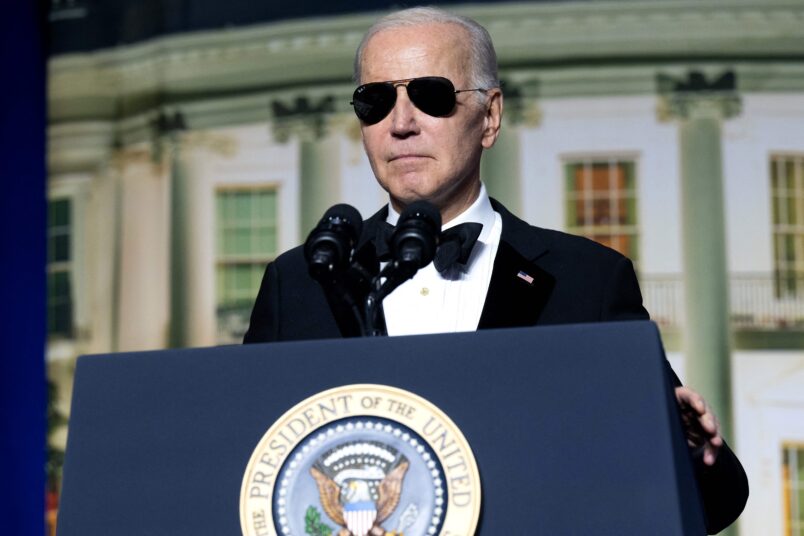
The President went full Dark Brandon to end his WHCA speech:
lmao Biden leaves the podium by putting on shades and making a Dark Brandon reference. amazing pic.twitter.com/bwNixDupTi
— Aaron Rupar (@atrupar) April 30, 2023
Thank You!
Our membership drive was a huge success! Many thanks to all of you for your support and especially to the new members who came to TPM via Morning Memo. Welcome! We’re so glad to have you here. And if you haven’t joined yet, no need to wait til the next membership drive. Join year round!
Do you like Morning Memo? Let us know!
Final Day
We’re now at 628 642 new members on the last day of our annual drive. We made it to our goal of 500 and now passed the revised goal of 600. Huge thanks to everyone who has joined over the last 30 days. We don’t want to be greedy but we want to add as many more as we can on the final day.
The truth is, it’s not greedy. The 500 number was a plausible reach goal we thought put us in a position to have the ship not taking on water and moving in the right direction over the course of the year. Joe Ragazzo and I especially sighed a big sigh of relief when we saw that we’d probably hit that goal.
With the the wave of new media site closures and layoffs just over the last week there’s been a little mini-chorus in the media debate of, “well those TPM folks really had the secret sauce, knew how to make it work, yada yada.” Well, appreciate the congrats and f— yeah and thank you, media types. But it’s a serious slog every day, running out single after single, I assure you. So driving that number higher still makes a big difference for us. So thanks to everyone who’s joined and if you’re still thinking about it make today the day. Click here.
University Of Nebraska Tweaks Its Logo As ‘OK’ Sign Became Gesture For White Supremacists
This article is part of TPM Cafe, TPM’s home for opinion and news analysis. It was originally published at The Conversation.
On April 17, 2023, the Nebraska Cornhuskers unveiled the latest version of their beloved mascot, Herbie Husker.
Herbie’s left hand no longer forms the “OK” symbol. Instead, an index finger is raised to indicate that the team is No. 1.
The change was made, University of Nebraska officials explained, because the universal symbol of approbation – curling the index finger to touch the thumb, forming an “O” – had become associated with white supremacy and hate speech.
Continue reading “University Of Nebraska Tweaks Its Logo As ‘OK’ Sign Became Gesture For White Supremacists”