Ruling Preserves TPS for Haitians
The top line here is that U.S. District Judge Ana C. Reyes of D.C. temporarily blocked the Trump administration from ending protections for more than 350,000 Haitian immigrants in the United States. In doing so, she averted, at least for now, a feared draconian roundup of Haitians who have been legally in the United States. Of particular concern was that the Trump administration would target Springfield, Ohio’s Haitian community in the same way it did with racist rhetoric and fear-mongering during the 2024 campaign, except this time with masked and armed federal agents.
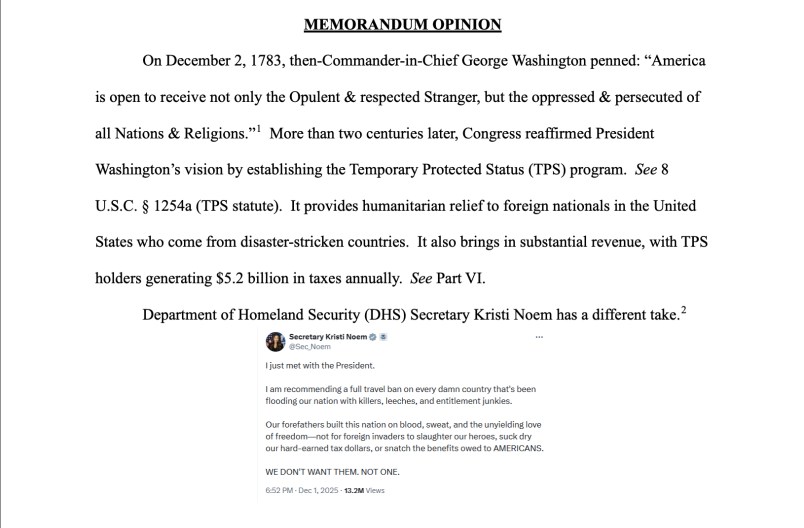
Beyond the top line, what made Judge Reyes’ ruling especially memorable was the way she obliterated the Trump administration’s arguments and zeroed in on DHS Secretary Kristi Noem, ruling that it “seems substantially likely” that Noem terminated the humanitarian protections for Haitians because of her “hostility to nonwhite immigrants.”
Reyes began by juxtaposing a 1783 letter penned by George Washington with a 2025 tweet by Noem:
From there it was a bloodbath for Noem, but Reyes wasn’t done. She concluded the 83-page opinion with a flourish by circling back to the scurrilous Noem tweet:
There is an old adage among lawyers. If you have the facts on your side, pound the facts. If you have the law on your side, pound the law. If you have neither, pound the table. Secretary Noem, the record to-date shows, does not have the facts on her side—or at least has ignored them. Does not have the law on her side—or at least has ignored it. Having neither and bringing the adage into the 21st century, she pounds X (f/k/a Twitter).
Kristi Noem has a First Amendment right to call immigrants killers, leeches, entitlement junkies, and any other inapt name she wants. Secretary Noem, however, is constrained by both our Constitution and the APA to apply faithfully the facts to the law in implementing the TPS program. The record to-date shows she has yet to do that.
Reyes ordered the protections for Haitians remain in place while he case proceeds. The Trump administration is all but guaranteed to appeal Reyes’ decision.
Trump Admin to Boasberg: Pound Sand
In the original Alien Enemies Act case, the Trump administration again rebuffed U.S. District Judge James Boasberg of D.C. in an abrupt and injudicious filing that rejected any possible avenue for giving the due process that he has ordered for the Venezuelan nationals removed under the wartime statute.
The administration’s position continues to be that there is no legal, practical, or constitutional way for it to provide the former detainees of El Salvador’s notorious CECOT prison with the due process they were denied when they were unilaterally labeled Tren de Aragua members and whisked out of the country in March.
After making an elaborate show of how much it continues to object to Boasberg’s prior “incorrect” orders and his claim to have jurisdiction in the case, the Trump DOJ concludes its latest filing by needlessly warning Boasberg it will go over his head again: “If, over Defendants’ vehement legal and practical objections, the Court issues an injunction, Defendants intend to immediately appeal, and will seek a stay pending appeal from this Court (and, if necessary, from the D.C. Circuit).”
Alex Pretti Shooting Aftermath
- A new round of mass resignations are underway in the Minnesota U.S. Attorneys Office, with eight additional government lawyers either leaving or intending to leave, the Star Tribune reports. Among the recent departures is Ana Voss, the chief of the office’s civil division. That brings the total number of resignations in the office to an unprecedented 14. The office has been decimated in recent years, the newspaper reports:
Since 2022, more than 40 assistant U.S. attorneys have quit or retired, bringing total staffing in the criminal division to fewer than 20 attorneys, according to an analysis of the office’s staffing totals by the Minnesota Star Tribune.
In prior years, people familiar with the office’s operations said, there were often at least 50 attorneys working on criminal cases.
- A federal judge lifted his order that the Trump administration preserve evidence in the Pretti shooting, ruling that the Trump administration is “not likely to destroy or improperly alter evidence” — while criticizing as “troubling” public statements about the shooting from White House Deputy chief of staff Stephen Miller and Homeland Security Secretary Kristi Noem: “They reflect, not a genuine interest in learning the truth, but snap judgments informed by speculation and motivated by political partisanship.”
- An Ecuadorian immigrant being pursued by federal agents in the lead-up to the Pretti shooting spent four hours hiding in a nearby locked business and says he witnessed the shooting.
Mass Deportation Watch: Minnesota
- Over the weekend, the U.S. Northern Command quietly took more than 1,500 active-duty troops in Alaska and North Carolina off heightened alert for possible deployment to Minnesota, the NYT reports.
- Detainees describe conditions inside Minneapolis’ Whipple federal Building: “The interviews and court documents paint a picture of a place that was never intended for long-term detention and quickly became overwhelmed after the surge in Minnesota began.”
MUST READ: DHS Smears Exposed Again
A great piece in The Guardian reveals how the Trump administration has already pulled back in court from some of its most inflammatory public allegations against an immigrant couple shot during a detention operation last month in Portland, Oregon (emphasis mine):
According to a DHS press release and social media posts issued the following day, border patrol agents were conducting a “targeted” stop of a vehicle in Portland occupied by two members of Tren de Aragua, the Venezuelan gang. Yorlenys Zambrano-Contreras, a woman in the passenger seat, had been “involved” in a Portland shooting last year, the agency wrote. …
But court records obtained by the Guardian reveal a Department of Justice prosecutor later directly contradicted DHS’ Tren de Aragua statements in court, telling a judge, “We’re not suggesting … [the driver Luis Niño-Moncada] is a gang member.” An FBI affidavit issued following the incident also suggests that in the previous shooting cited by DHS, Zambrano-Contreras was not a suspect, but rather a reported victim of a sexual assault and robbery. Neither Niño-Moncada or Zambrano-Contreras have prior criminal convictions, their lawyers have said.
You may recall the incident because it happened the day after the Renée Good shooting in Minneapolis, when the country was already on high alert to such encounters, but it has not received as much national attention because there wasn’t immediate video of the confrontation with federal agents, who were not wearing body cameras.
Great Read: DHS’ Secretive Legal Weapon
The WaPo tells the story of DHS’ use of administrative subpoenas through the experience of one retiree in suburban Philadelphia. After reading a WaPo article about the asylum case of an Afghan man, the retiree sent a brief email to a federal prosecutor urging him to show “common sense and decency.” Within hours, he received notice from Google that DHS had subpoenaed his account. “Soon would come a knock at the door by men with badges …”
Trump: ‘Nationalize’ Voting!
In a podcast interview with former Deputy FBI Director Dan Bongino, President Trump made an alarming anti-constitutional call for Republicans to “nationalize” voting. Not only did Trump’s comments run counter to the Constitution’s delegation of the running of federal elections to the individual states, but it was peculiarly specific:
The Republicans should say, ‘We want to take over,’” he said. “We should take over the voting, the voting in at least many — 15 places. The Republicans ought to nationalize the voting.
It wasn’t a federal takeover of voting per se, but a “Republican” one. The strange reference to “15” states makes no sense on its face, but Trump has a track record of telegraphing moves in advance and of seizing on specific details from cockamamie conspiracies, plans, and schemes that only become clear in retrospect. Stay tuned.
Gabbard Confirms Trump Call With FBI Agents
In a letter to Congress obtained by Politico, Director of National Intelligence Tulsi Gabbard acknowledged that she arranged a call, first reported by the NYT, between President Trump and FBI agents the day after they seized 2020 voting records from a Fulton County voting center. Gabbard said in the letter that she was present for the FBI search at Trump’s request.
What Happened to Ed Martin?!?
Yesterday’s many reports about Ed Martin’s current status at the Trump DOJ were a bit muddled in the particulars, but they all seem to agree that the multiple-hat-wearing Trump partisan reached the zenith of his power sometime last fall but has seen his star fall since then, in part because he is on the outs with Deputy Attorney General Todd Blanche. Here are all the various tendrils:
- Martin was demoted at the end of 2025 and is no longer chief of the DOJ Weaponization Working Group, the WaPo reports. It is not clear who now runs that group, which is under pressure from President Trump to ramp up is efforts, CNN says: “The Weaponization Working Group is now expected to start meeting daily with the goal of producing results in the next two months, according to the person familiar with the plan.”
- Martin also lost his title of assistant attorney general, according to the WaPo.
- Martin remains as U.S. pardon attorney, DOJ told NBC News. But he has been transferred from Main Justice to a less central DOJ office in D.C., the WaPo reports: “It is unclear whether he will remain in the pardon attorney role and, if so, for how long.”
- Martin is expected to leave DOJ entirely in the coming weeks, reports CNN, which describes his departure as “imminent.” CNN hinted that Martin may end up at the White House, where “he spent most of last week.”
Mad King Big Mad Over Harvard
Hours after the NYT reported that the Trump administration had dropped its demand that Harvard pay the government $200 million as part of a settlement of weaponized claims of antisemitism, President Trump went nuts on social media and upped the settlement demand to $1 billion — while newly threatening the university with criminal charges: “This should be a Criminal, not Civil, event, and Harvard will have to live with the consequences of their wrongdoings.”
The Destruction: Kennedy Center Edition
In the course of publicly denying he has any plans to demolish the Kennedy Center, President Trump admitted that he plans to demolish the Kennedy Center:
“I’m not ripping it down. I’ll be using the steel,” Trump told reporters Monday, when asked whether he would demolish the building. “So we’re using the structure, we’re using some of the marble and some of the marble comes down, but when it’s open, it’ll be brand new and really beautiful.”
It is a classic Trump move. To save face as artists and patrons flee the Trump-run performing arts venue, the president moves to destroy the source of his personal embarrassment.
Judge Blocks Trump’s Racist Revisionism
We began with George Washington, and we end with George Washington.
U.S. District Judge Cynthia M. Rufe of Philadelphia blocked the U.S. Park Service from making any further changes to the historic site where George Washington lived during the final six years of his presidency, but she stopped short of ordering it to reinstall the exhibits on slavery that it had removed.
Hot tips? Juicy scuttlebutt? Keen insights? Let me know. For sensitive information, use the encrypted methods here.