I’ve had a few of you take me to task recently for writing so much about polls. I’ll take that under advisement, though I hear from many readers that they like those posts. The reality is that most political people follow polls closely, even if they wish they didn’t, and they want insights into just what they mean and how to interpret them. But today I want to discuss something a bit different, albeit still somewhat adjacent to polls. That is, what’s with the Democrats’ tendency to freak out, even in the face of the most limited kinds of disappointing news in polls or other markers of campaign performance?
We’ve discussed this phenomenon from various perspectives in recent years. But, big picture, why does this happen? Why do Democrats freak out like this?
As we veer toward Election Day in just three weeks, Donald Trump’s increasingly fascistic rhetoric is setting himself up to declare any ensuing victory to be a broad mandate for disregarding the rule of law, making unprecedented misuse of the power of the state to punish his political enemies, and targeting people of color and migrants.
Over the holiday weekend, Trump’s language became more sinister, unhinged, and unapologetic, baiting his legions of supporters with promises of violence, retribution, and purifying purges. He continued to evoke key tenets of the Great Replacement Theory: America under attack by migrant invaders soiling the purity of traditional towns and villages. He threatened to unleash police and to use the military to go after “radical left lunatics.” All of this came against the backdrop of Trump refusing to abide by the results of any election he loses.
The way that Trump has ramped up his darkest rhetoric in recent weeks suggests he is building toward an Election Day crescendo that is intended (i) to activate his supporters to vote for him; and (ii) to rally them for his post-election plans to dispute, disrupt, and delegitimize any results that don’t show him as the winner.
At the same time, Trump is giving himself the opportunity to point to any victory – whether by hook or by crook – as creating a mandate for exactly the kind of hard-core, extremist, racist fever dreams he is engaging in during the campaign’s final days.
Whatever you thought of Donald Trump in 2016 or 2020 or even in the aftermath of Jan. 6, 2021, Trump is promising in no uncertain terms a new more apocalyptic and unrepentant version of himself. After a decade of listening to his jeremiads, you may be inclined to tune out Trump by now. But the rhetoric he’s engaged in now – even if it’s mixed into a slop of droning, meandering, and incoherent phrasings – is the Trump that would be elected and the version he would claim has a mandate to follow through on the worst of his threats.
In campaign appearances and national TV interviews, Trump is ratcheting up his threats to misuse and abuse the military to consolidate power and target his political foes, what he is now calling the “enemy from within”:
Trump to Bartiromo on what worries him about election day: "I think the bigger problem is the enemy from within … sick people, radical left lunatics. And it should be easily handled by, if necessary, by National Guard, or if really necessary, by the military." pic.twitter.com/twRsilNJnz
Meanwhile, former Trump national security adviser Gen. Mike Flynn was asked by a supporter if he would “sit at the head of a military tribunal to not only drain the swamp, but imprison the swamp, and on a few occasions, execute the swamp.” Flynn was, ummm, noncommittal.
‘A Fascist To The Core’
Former Joint Chiefs Chair Mark Milley fears being court-martialed if Trump wins, according to Bob Woodward’s new book, which quotes Milley as saying of Trump: “He is the most dangerous person ever. I had suspicions when I talked to you about his mental decline and so forth, but now I realize he’s a total fascist. He is now the most dangerous person to this country.”
Harris Strikes Back
Vice President Kamala Harris is dialing up her direct attacks on Donald Trump as a threat to democracy and to real people: “Donald Trump is increasingly unstable and unhinged,” she told a campaign rally in Pennsylvania on Monday.
In an unusual move, Harris played video for her rally’s audience of Trump’s weekend comments about using the military before she launched into her criticism:
"You heard his words, coming from him … Donald Trump is increasingly unstable and unhinged" — oh wow — Kamala Harris at her rally in Erie, Pennsylvania, plays the clip of Trump telling Maria Bartiromo that he would use the military against his domestic foes pic.twitter.com/nLKxyhoq4U
The Harris campaign has a new video ad up highlighting Trump’s “enemy from within” rhetoric:
Disinfo In The Real World
Armed North Carolina man arrested after allegedly threatening FEMA workers.
Aaron Blake: How reported threats in N.C. trace to Trump-fueled misinformation
Charlie Warzel: I’m Running Out of Ways to Explain How Bad This Is
North Carolina Gov. Roy Cooper (D) is forced to try to counter Trump’s misinformation.
Irony alert: After whipping up hysteria by falsely claiming Biden was withholding relief aid to Americans, Trump threatens to withhold relief aid to Americans:
Trump threatens to withhold aid to California: We'll force it down his throat and we'll say, Gavin, if you don't do it, we're not giving you any of that fire money that we send you for all the forest fires you have pic.twitter.com/EBneSYZrTG
Kate Shaw: Lawyers Should Not Assist Trump in a Potential Power Grab
WSJ: Trump Loyalists Push for a Combative Slate of New Judges
‘When Did That Become Okay?’
Brian Beutler: Barack Obama asks THE central question of the Trump era — one we should have been asking all along.
Policies That Matter
Jonathan Cohn: What Real People Get About Kamala Harris’ Big New Idea That The Political Set Can’t Grasp
2024 Ephemera
NYT/Siena poll: In Pennsylvania, Harris leads Trump among likely voters 50%-47%. In Arizona, Trump leads Harris among likely voters 51%-46%.
NYT: Harris’s Turnout Machine vs. Trump’s Unproven Alliance
The Guardian: Trump ground game undercut by slow internet that crashes app
NYT: Republican Operatives Function as Hidden Hand Behind Pro-Trump Efforts
Meanwhile, In Florida …
Politico: “Florida’s public universities are purging the list of general education courses they will offer next year to fall in line with a state law pushed for by Gov. Ron DeSantis targeting “woke ideologies” in higher education.”
Trump Gets Even Weirder
A Trump town hall event in Pennsylvania went off the rails Monday tonight. After two separate medical incidents in the crowd, Trump abandoned the Q&A session and turned the rally into a musical event, with him listening to his playlist faves while bobbing and weaving to the music:
Wow — this was weird. Trump wrapped up his "town hall" in Oaks, Pennsylvania, after just a few questions, and right after he said he would take a few more questions. More music then played while Trump stood around on stage. Deeply bizarre scenes. pic.twitter.com/C3SJpsQagV
Last week, the Supreme Court surprised court-watchers by declining to take up an emergency abortion case out of Texas, leaving the state’s near-absolute ban in place.
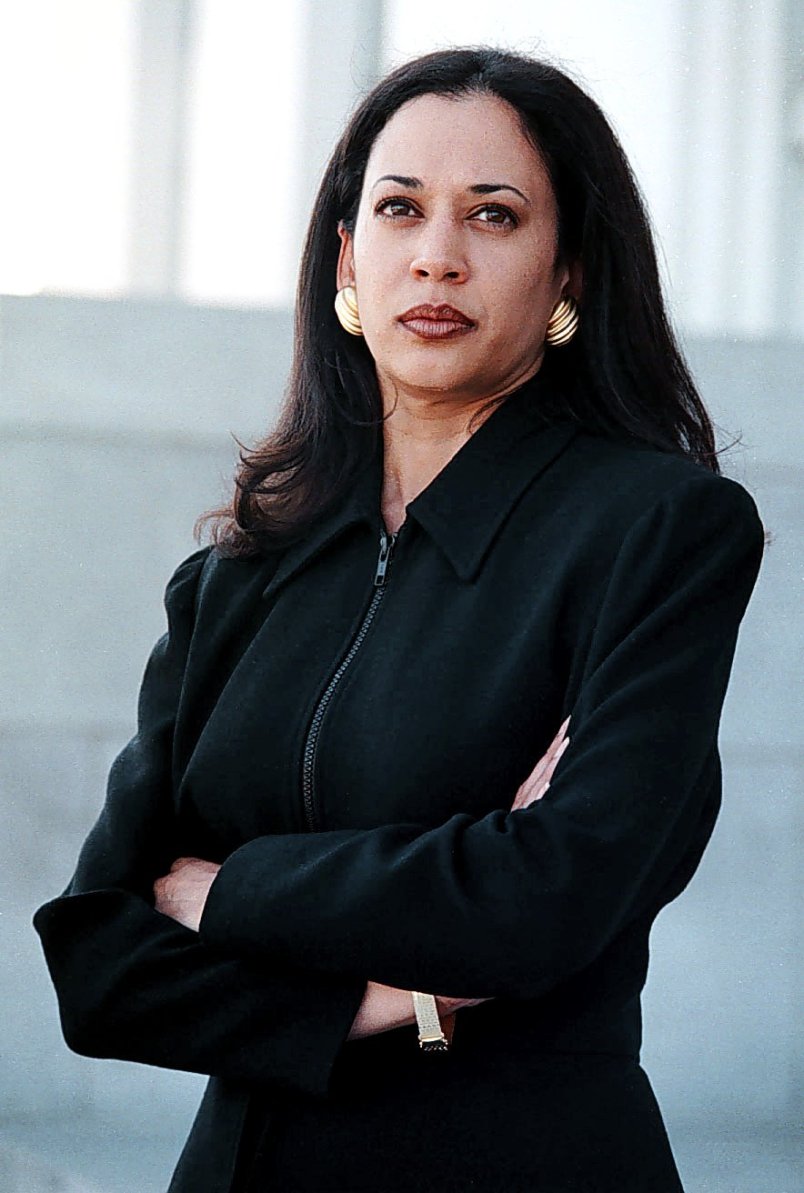
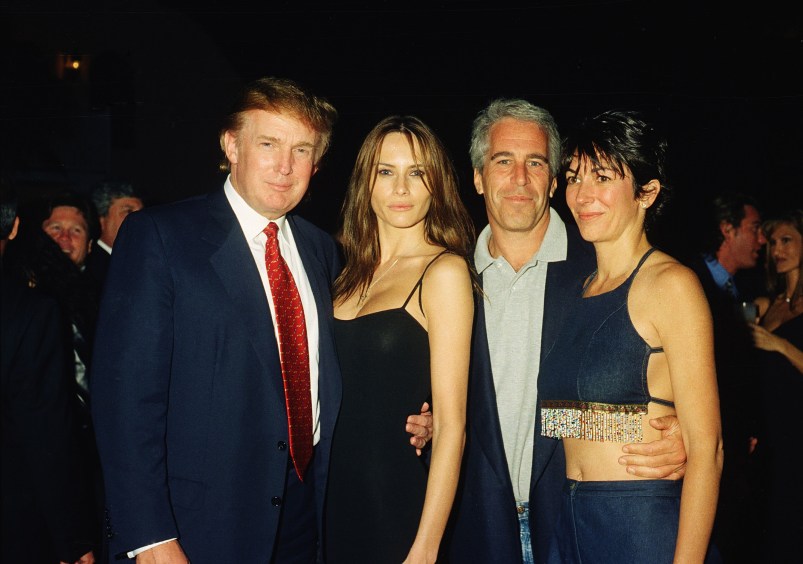
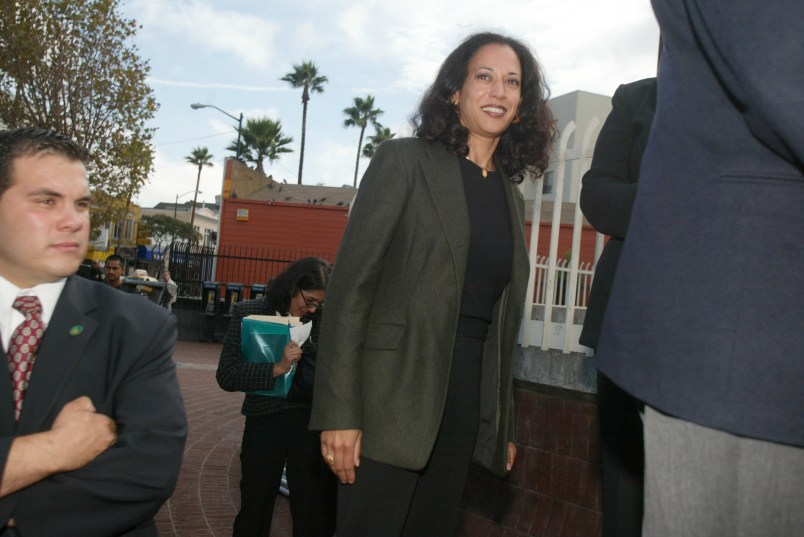
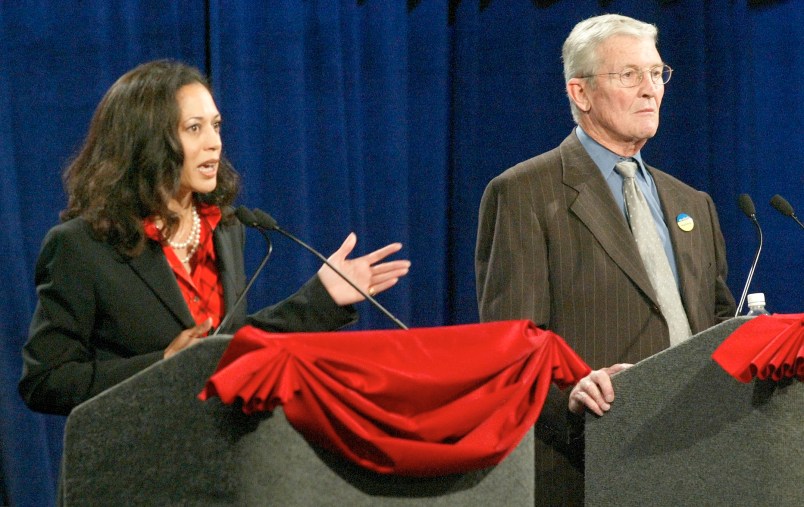
Former President Trump and Vice President Harris have spent the last 25 years in very, very different ways: Trump as a larger-than-life tabloid icon, Harris as a prosecutor and local, then state, then national politician.
Let’s take a look.
1997: Kamala Harris serves as Alameda County deputy district attorney in Oakland, California
(Photo by Mary F. Calvert/MediaNews Group/The Mercury News via Getty Images)
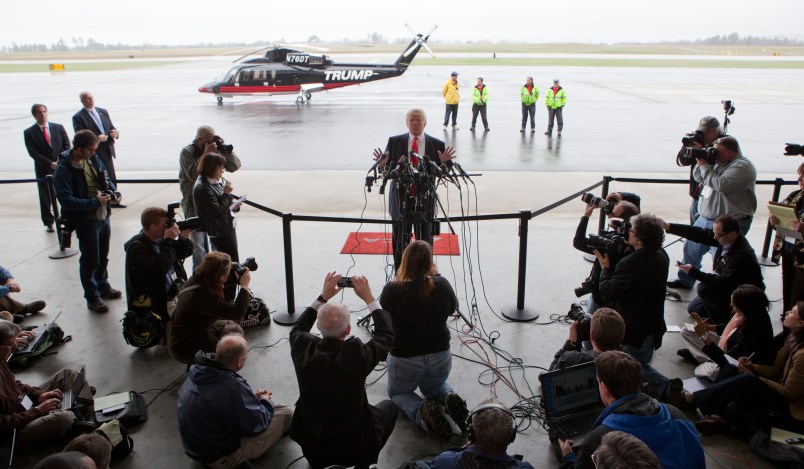
1997: Donald Trump opens Trump International Hotel and Tower in New York
(Photo by Rick Maiman/Sygma via Getty Images)
2000: Donald Trump hosts guests — including the notorious, yet-to-be-accused sex offenders Jeffrey Epstein and Ghislaine Maxwell — at his Mar-a-lago club in Florida
(Photo by Davidoff Studios/Getty Images)
2003: Kamala Harris campaigns to become San Francisco District Attorney
(Photo by Mike Kepka/San Francisco Chronicle via Getty Images)
2003: Trump breaks ground with golden shovels for the ballroom at his Mar-a-Lago club
(Photo by Davidoff Studios/Getty Images)
2003: Kamala Harris debates Terrence Hallinan in the race to become San Francisco District Attorney
(Photo By MICHAEL MACOR/The San Francisco Chronicle via Getty Images)
2003: Kamala Harris wins her race for San Francisco District Attorney, becoming the first woman and first African-American and Asian-American DA in California
(Photo by Kat Wade/San Francisco Chronicle via Getty Images)
2004: Donald Trump unveils new 12-inch Trump talking doll
(Photo by Spencer Platt/Getty Images)
2004: Kamala Harris joins hundreds of people at the MLK Jr. Freedom March in San Francisco
(Photo By LIZ HAFALIA/The San Francisco Chronicle via Getty Images)
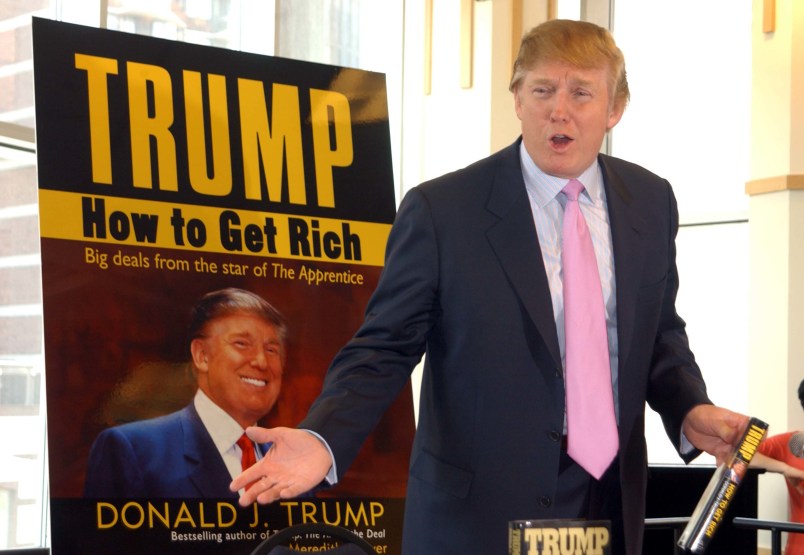
2004: Trump signs copies of his book, How To Get Rich,’ in Manhattan
(Photo by Ramin Talaie/Corbis via Getty Images)
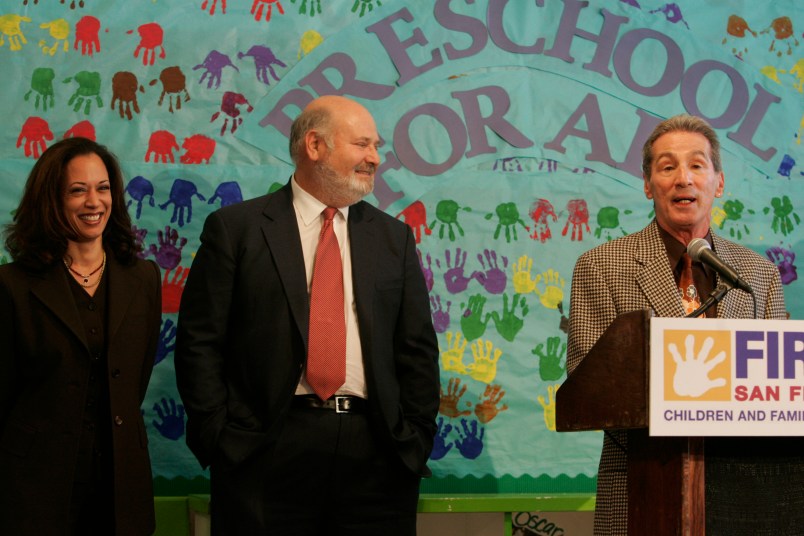
2006: Kamala Harris attends press event to announce a free-preschool-for-all program in San Francisco
(Photo By Christina Koci Hernandez/San Francisco Chronicle by Getty Images)
2007: Donald Trump unveils plans for Trump Tower Chicago
(Photo by Scott Olson/Getty Images)
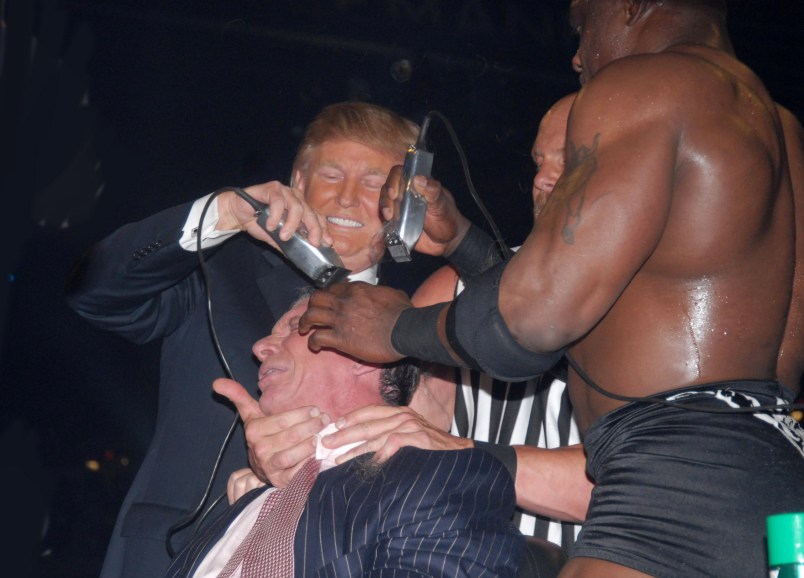
2007: Trump shaves Vince McMahon’s hair after winning the ‘Battle of the Billionaires’ match at Wrestlemania 23
(Photo by George Napolitano/FilmMagic)
2008: Kamala Harris campaigns against prop 8, which would ban same-sex marriage in California
(Photo by D. Ross Cameron/MediaNews Group/The Mercury News via Getty Images)
2008: Donald Trump is photographed with Sean ‘Diddy’ Combs at a benefit gala
(Photo by JOE SCHILDHORN/Patrick McMullan via Getty Images)
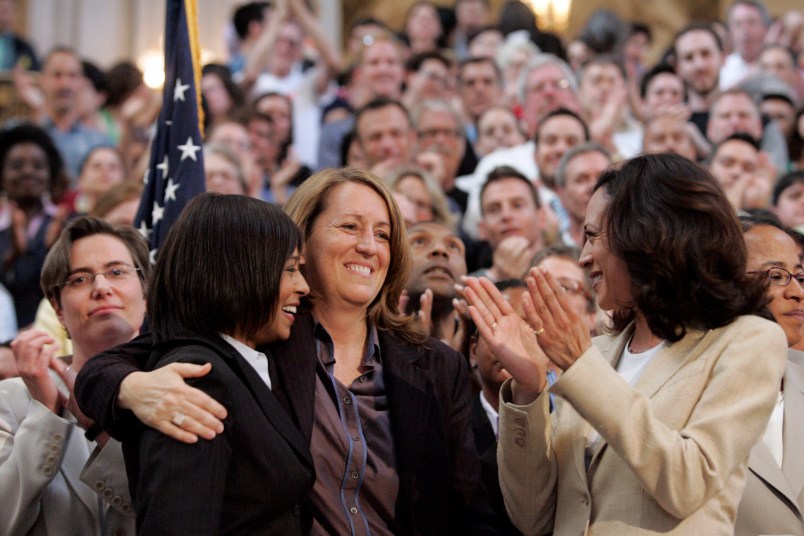
2008: Maya and Kamala Harris celebrate the California Supreme Court’s pro-gay marriage ruling
(Photo by Maria J. Avila/MediaNews Group/The Mercury News via Getty Images)
2009: Donald Trump is photographed with Harvey Weinstein at an afterparty in NYC
(Photo by Stephen Lovekin/Getty Images for The Weinstein Company)
2011: Kamala Harris is sworn in as California Attorney General
(Photo by: HUM Images/Universal Images Group via Getty Images)
2011: Donald Trump embraces Obama ‘birther’ conspiracy theories and suggests he may run for president
(Photo by Matthew Cavanaugh/Getty Images)
2011: Attorney General Kamala Harris announces that California will join a lawsuit protecting a Riverside community from pollution
(Photo by: HUM Images/Universal Images Group via Getty Images)
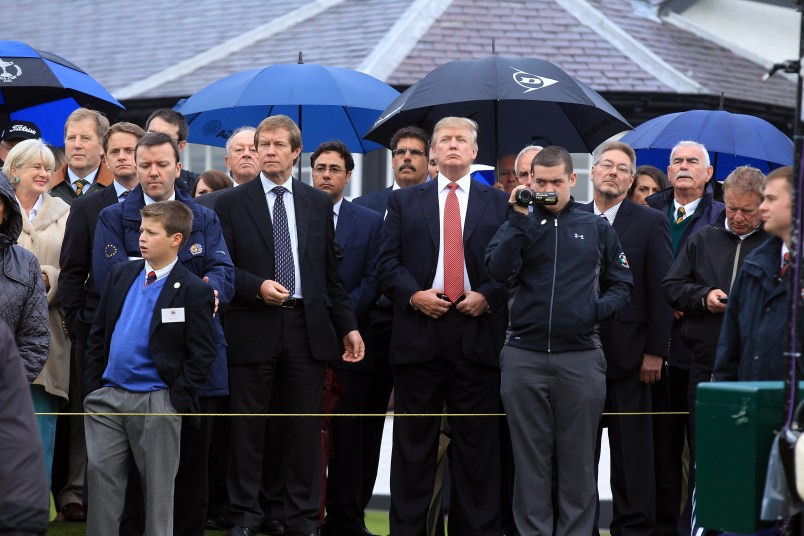
2011: Trump attends the Walker Cup golf tournament in Scotland
(Photo by David Cannon/R&A/R&A via Getty Images)
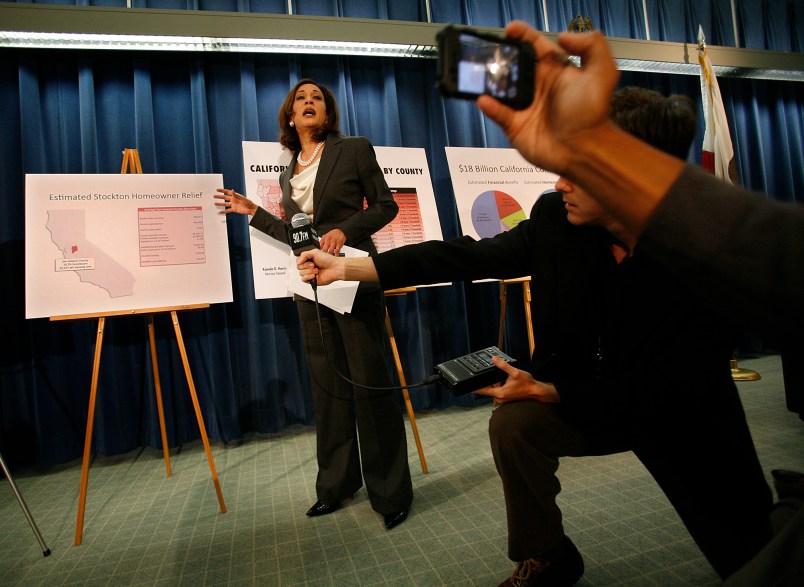
2011: In an effort to crack down on mortgage wrongdoers, Kamala Harris gathers stories about foreclosures
(Bob Chamberlin / Los Angeles Times )
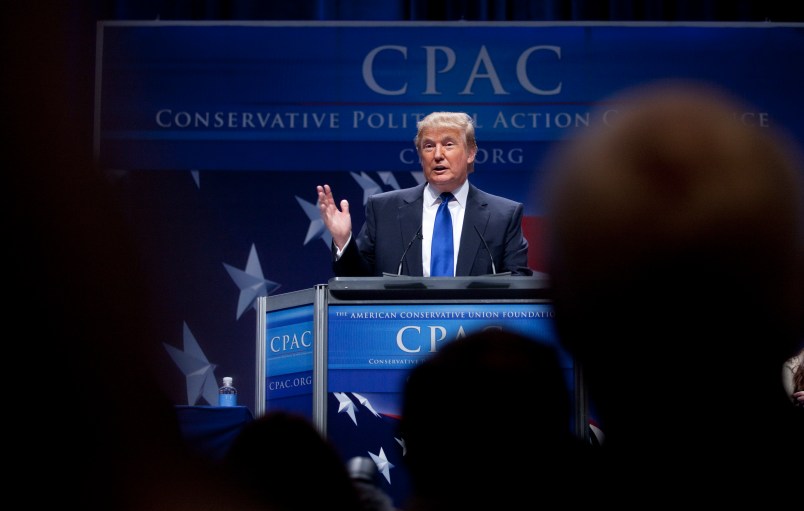
2011: Donald Trump speaks at CPAC after stating he was considering a run for president
(Photo by Brooks Kraft LLC/Corbis via Getty Images)
2012: Kamala Harris announces that California will receive up to $18 billion as part of a settlement between 49 states and five banks over their foreclosure practices
Yet, the reality is much more complex. In 2016, for example, evangelical leaders such as Jerry Falwell Jr. and Robert Jeffresscelebrated Trump’s victory and evangelicalism’s role in bringing America back to God. Others – such as Russell Moore, currently editor of the evangelical magazine Christianity Today – saw Trump as the opposite of what evangelicalism represents.
We have identified and described five varieties, or “types,” within the broader evangelical movement.
Evangelicals and their beliefs
At its core, evangelicalism is characterized by a belief in the literal truth of the Bible.
For example, evangelicals believe that the world and humans were created by God; that Jesus was literally God’s son and also born as a human; that Jesus died and physically rose from the dead; and that God currently acts through humans to achieve his ends for humanity. A hallmark belief for evangelicals is having a “personal relationship with Jesus Christ” and a focus on encouraging others to be “born again” or “saved” through Jesus.
Despite sharing the same basic theology, there are differences within evangelicalism politics and social engagement.
We used three criteria to develop our five categories: First, each type shares a basic agreement on evangelical theology. Second, they each understand themselves as existing within the larger tradition of American evangelicalism. And third, their theology motivates how they act in the world, including appropriate social and political actions.
Typologies simplify in order to explain, but they also can blur some of the finer distinctions between categories. Still, the perspectives these different varieties of evangelicals maintain shape not only who they will vote for but also why they vote a certain way.
1. MAGA-vangelicals
MAGA-vangelicals consist of the white Christian nationalist core of the “Make America Great Again” or MAGA, movement, with some Latino, Asian and Black American pastors aligning themselves with this movement.
MAGA-vangelicals have been the most vocal and visible group of evangelicals since the 2016 election.
The origins of this group trace back to the 1980s – the time of the emergence of the religious right. MAGA-vangelicals echo many of the same issues – such as opposition to abortion and LGBTQ+ rights and support for anti-immigration policies. One significant shift, however, since the Jan. 6, 2021, insurrection, is an increased acceptance of political violence. “Jan. 6 was not an insurrection,” evangelical leader Lance Wallnau has falsely asserted. “It was an election fraud intervention.” The baseless election fraud myth was the pretext for the violence on Jan. 6.
2. Neo-fundamentalist evangelicals
Neo-fundamentalists are evangelicals who are as theologically or politically conservative as MAGA-vangelicals but maintain a theological commitment to remain separate from any relationships – whether personal, social or political – that would, in their view, compromise the teachings of evangelical Christianity and their own identity as evangelical Christians.
For example, Southern Baptist Theological Seminary President Albert Mohler and Christianity Today editor Russell Moore have opposed Trump due to his, by evangelical standards, lack of values and amoral lifestyle.
However, they support how the Trump administration furthered the political goals of evangelical Christianity. In particular, they support the Supreme Court overturning Roe v. Wade and supporting evangelicals’ religious freedom to discriminate against LGBTQ+ people in their businesses.
Yet there has recently been some qualified support among neo-fundamentalists offered for Trump himself, despite their opposition to his personal morals. For example, Mohler has argued that Trump is the better candidate to achieve their goals in 2024, despite his personal shortcomings. Mohler takes the position, though, that this support largely depends on Trump remaining committed to evangelical goals on issues such as abortion.
3. iVangelicals
iVangelicals are evangelicals primarily focused on personal faith and the weekly worship experience in their churches. They are mainly concentrated in the evangelical megachurch movement.
iVangelicals want to reach large numbers of people through their popular worship services, varied social programs and small group ministries.
There is, however, a range of beliefs and commitments among iVangelicals, with some being attracted to groups such as Evangelicals for Harris, a new effort to mobilize evangelicals to move away from Republicans, Trump and MAGA and to vote for Harris. Their approach uses biblical examples and references to argue that true Christian teachings and actions are more aligned with Democrats than Republicans. https://www.youtube.com/embed/23BfwcibYJM?wmode=transparent&start=0 Evangelicals for Harris.
4. Kingdom Christians
Kingdom Christians are evangelicals who, in their churches and ministries, strive to mirror the demographic and socioeconomic mix of the neighborhoods where they are rooted.
They tend to have a more diverse racial and ethnic mix of members than other evangelical churches. Their focus is to be a part of, and to serve, their local communities in a manner that mirrors their conception of the kingdom of God on Earth.
Leaders among Kingdom Christians often critique the economic and political systems that produce poverty and racial injustice. The focus of their efforts, however, is on creating relationships with local businesses and activists in the local community and contributing to policy through engagement with local officials.
Kingdom Christians are present-oriented; the kingdom of God is to be realized in the communities where believers live, as well as in some future spiritual world.
5. Peace and Justice evangelicals
Peace and Justice evangelicals are a loose network of pastors, nonprofit leaders, professors and activists. They are a small segment within evangelicalism often embedded in larger organizations, and they focus their work on key social and political issues such as racial justice, immigration reform and environmental issues. They seek to have a wider impact than just a focus on the local community.
Peace and Justice evangelicals trace their origins to the late 1960s publication, The Other Side, originally Freedom Now, which represented a freshly emerging evangelical social consciousness around issues of racial justice. Following close behind was the Sojourners community, and Sojourners magazine, which is still active today.
This is a small but growing minority in the larger evangelical world, with many belonging to traditional evangelical institutions. For example, Alexia Salvatierra, at Fuller Seminary, is a longtime “faith-rooted” community organizer and has more recently been instrumental in forming Matthew 25/Mateo25, a group that aids immigrants and “defends the vulnerable.” Shane Claiborne, a long-time urban activist, is currently head of Red Letter Christians, a movement that combines “Jesus and justice” and seeks to “live out Jesus’ counter-cultural teachings.”
Evangelicals and the future
Following historical evangelical voting patterns, it is likely that most white evangelicals will vote for Trump in 2024. I believe many will do so with enthusiasm, while others will vote for him because of his policies, while remaining troubled by his rhetoric.
Of the evangelicals who oppose Trump, some will refuse to vote for either Trump or Harris, refusing to cast a vote for president. Others will vote for Harris, following the example of many Republican leaders who are seeking to move beyond the damage that Trump and the MAGA movement have done to the Republican Party and to conservatism.
Meanwhile, for the Kingdom Christians and Peace and Justice evangelicals, the true values of evangelical Christianity will be supported by the more progressive policies of the Democratic Party.
Regardless of how they vote in the 2024 election, evangelicals in all of these categories will continue to promote their distinct vision of evangelicalism and educate members on how they should bring their faith to bear on important social and political issues in American culture.
This story first appeared at ProPublica. ProPublica is a Pulitzer Prize-winning investigative newsroom. Sign up for The Big Story newsletter to receive stories like this one in your inbox.
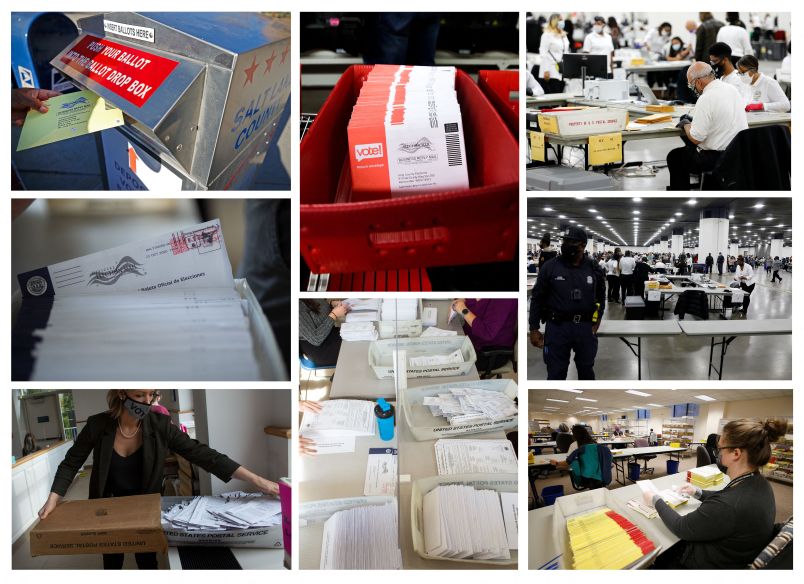
They are squat, stationary and seemingly innocuous. But ever since the high drama of the 2020 presidential election, humble drop boxes have been more than a receptacle of absentee ballots; they’ve morphed into a vessel for emotion, suspicion and even conspiracy theories.
In the battleground state of Wisconsin, especially, the mere presence of these sidewalk containers has inspired political activists and community leaders to plot against them, to call on people to watch them around the clock and even to hijack them.
They’ve been the subject of two state Supreme Court decisions, as well as legal memos, local council deliberations, press conferences and much hand-wringing.
Wausau Mayor Doug Diny was so leery of the box outside City Hall that he absconded with it on a Sunday in September, isolating it in his office. It had not yet been secured to the ground, he said, and so he wanted to keep it safe. The escapade was met with a backlash but also won the mayor some admirers online before he returned it.
“COURAGE IS CONTAGIOUS! WELL DONE SIR!” one person wrote on the conservative social media site Gettr.
As early voting for the November election begins and Wisconsinites receive their absentee ballots, they have choices on how to return them. Mail them. Deliver them in person to the municipal clerk. Or, in some communities, deposit them in a drop box, typically located outside a municipal building, library, community center or fire station.
Though election experts say the choices are designed to make voting a simple act, the use of drop boxes has been anything but uncomplicated since the 2020 election, when receptacles in Wisconsin and around the country became flash points for baseless conspiracy theories of election fraud. A discredited, but popular, documentary — “2000 Mules” — linked them to ballot stuffing, while a backlash grew over nonprofit funding that helped clerks make voting easier through a variety of measures, including drop boxes.
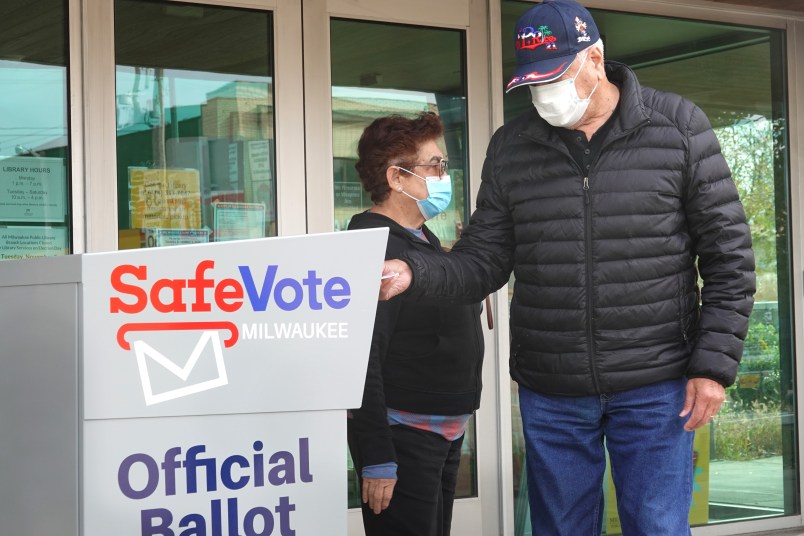
Residents drop mail-in ballots in an official ballot box outside of the Tippecanoe branch library on October 20, 2020 in Milwaukee, Wisconsin. (Photo by Scott Olson/Getty Images)
The movie’s distributor, Salem Media Group Inc., removed it from circulation in May and, in response to a lawsuit, issued a public apology to a Georgia voter for falsely depicting him as having voted illegally. A federal judge dismissed Salem Media Group as a defendant, but the litigation is proceeding against the filmmaker and others.
With all that fuss in the background, Wisconsin’s conservative-leaning Supreme Court outlawed the boxes in 2022. But then this summer, with the court now controlled by liberals, justices ruled them lawful, determining that municipal clerks could offer secure drop boxes in their communities if they wished.
The court’s latest ruling made clear it’s up to each municipal clerk’s discretion whether to offer drop boxes for voters. But the decision has done little to change minds about the boxes or end any confusion about whether they’re a boon to democracy or a tool for chicanery.
This year, four of Wisconsin’s largest cities are using drop boxes — Milwaukee, Madison, Green Bay and Racine. But numerous locales that offered drop boxes in 2020, including Kenosha, the fourth-largest city in the state, have determined they will not this year.
Voters have been getting mixed messages from right-wing activists and politicians about whether to use drop boxes, as the GOP continues to sow distrust in elections while, at the same time, urging supporters to vote early — by any means.
“Look, I’m not a fan of drop boxes, as is no great surprise, but if you have to have them, this is not a bad situation,” Catherine Engelbrecht, founder of True the Vote, which has fostered doubt about election integrity and helped inspire “2000 Mules,” said on a video posted to social media on Sept. 30. It showed her giving a brief tour of a drop box in Madison, Wisconsin’s capital and a bastion of Democrats.
With the camera trained on one of the boxes, Engelbrecht extolled that “the slot is really small, so that’s a good thing,” and that “most of these drop boxes appear to be close to fire stations,” which she also declared a good thing. About a week later, she wrote in a newsletter that True the Vote had collected exact drop box locations statewide and was working to arrange livestream video feeds of them.
Unlike in 2020 when Trump warned against the use of absentee ballots, this year he is urging supporters to “swamp the vote.” And the Wisconsin Republican Party is not discouraging voters from using ballot drop boxes if they are available in their community and are secure.
Still, Wisconsin’s GOP candidate for the U.S. Senate, Eric Hovde, has urged citizen surveillance brigades to watch the boxes. “Who’s watching to see how many illegal ballots are being stuffed?” Hovde told supporters in July, according to a recording of his remarks obtained by The Washington Post. “Look, we’re probably going to have to have — make sure that there’s somebody standing by a drop box everywhere.”
Most boxes have security cameras trained on them. Those surveillance tapes could be used as purported evidence in legal cases if Trump loses on Nov. 5.
Already, Engelbrecht has filed a public records request with the Dane County Clerk’s Office for “copies of video recordings from security cameras used to surveil all exterior and interior ballot drop boxes in Dane County for the November 2024 Election.” The county, whose seat is Madison, does not have access to camera footage, which is kept by municipalities, the county clerk told ProPublica.
After this year’s state Supreme Court ruling allowing the drop boxes, the Wisconsin Elections Commission issued guidance to the state’s roughly 1,800 municipal clerks recommending more than a dozen security practices related to the boxes.
The instructions include that they be “affixed to the ground or the side of the building,” “sturdy enough to withstand the elements,” “located in a well-lit area,” “equipped with unique locks or seals” and “emptied often.”
The commission recommended that clerks keep a record of the times and dates of retrieval, number of ballots retrieved and the names of the people doing the retrieving.
It also referred clerks to federal guidelines.
But even with updated guidelines in place and ballot harvesting prohibited in Wisconsin (individuals can only submit their own ballot, unless helping a disabled person), concerns persist.
Wausau Mayor Doug Diny removed the ballot box outside City Hall and brought it to his office. (via Doug Diny)
In August in Dodge County, some 60 miles northwest of Milwaukee, the sheriff, Dale Schmidt, emailed three town clerks, telling them he had “serious concerns” about drop boxes, according to records obtained by the news site WisPolitics. “I strongly encourage you to avoid using a drop box,” he wrote. The sheriff asked the clerks numerous questions about the boxes, explaining that: “Even if set up the best way possible to avoid the potential for fraudulent activity, criminal activity many times finds ways to subvert even the best plans.”
Two of the clerks — from the towns of Ashippun and Beaver Dam — replied to the sheriff that they would not use them and the clerk from Hustisford told Wisconsin Public Radio that, while she received Schmidt’s email, the town board had already decided against using a drop box out of security concerns. In an email to ProPublica, Schmidt said, “No one was intimidated into choosing not to use the boxes and none of them had heartburn over not using them.”
Brittany Vulich, Wisconsin campaign manager for the nonpartisan voting rights group All Voting is Local, is bothered by how mayors, council members and other officials are seeking to influence these decisions. She notes that municipal clerks — the vast majority of whom are women — are the top election officials in each municipality.
“It’s the undermining of their authority. It’s the undermining of their office,” she said. “It’s the undermining of their autonomy to do their job and to make that decision on whether to use drop boxes or not. And that is what is very alarming.”
Other towns have also balked.
In the city of Brookfield, the Common Council took up a resolution Aug. 20 and voted 10-4 not to have a drop box after reviewing a memo by City Attorney Jenna Merten who found the recommended precautions burdensome.
“The guidance states that for unstaffed 24-hour ballot drop boxes, the City would need a video surveillance camera and storage of the video footage, as well as decals, extra keys and security seals,” she wrote. “Removing the ballots from the drop box would require at least two people and the completion of chain of custody logs.”
During the debate, Alderman Gary Mahkorn, an opponent of drop boxes, argued that they served a purpose during the COVID-19 pandemic but then “became a hugely political issue, and that’s what makes me want to, you know, puke in a way.” He worried that “the further we get away from people trusting our elections, the more our democracy is at stake.”
Instead of having drop boxes, the city will have extended voting hours, 7 a.m. to 6 p.m., most weekdays during in-person absentee voting for the two weeks prior to the election.
In Wausau, the box that Diny took to his office is back, bolted to the ground and being used for early voting.
At first, Diny resisted pressure from the city clerk and members of the City Council to return it. The clerk, Kaitlyn Bernarde, reported the matter to the Marathon County District Attorney’s Office and the state elections commission. And Diny arranged to have the clerk reclaim it.
The Wisconsin Department of Justice is investigating. There have been no charges. Diny told ProPublica he believes he did nothing wrong, saying: “None of this was done in a nefarious, secret way.”
At a City Council meeting on Tuesday night, Diny attempted to force a vote on allocating additional funds for drop-box security. But the council showed no interest.
During the public comment period, residents both praised and lambasted the mayor. One local resident rose to say, “Arguing about a box is dumb.”
Justice Ketanji Brown Jackson, since she joined the Court, has taken on a singular, likely uncomfortable mantle. She’s often the only one willing to relitigate fights already lost to the conservative supermajority. Often, she does this alone, either out loud or in writing.
Recently a reader asked me why I focus on polls rather than political betting markets for insights into the race and whether I thought polls were more reliable. I was honestly baffled by the question. To me this was like asking whether I thought a scale was a better way to measure weight than dead reckoning. And I’m not trying to be critical of the reader, who is probably reading this. I gave him my answer and we had a good exchange. But I thought it was worth sharing my thoughts on this question.
My analogy about scales is certainly imperfect in a number of ways, just as polls are imperfect. Indeed, it isn’t even really a question of which is better. The most important thing to understand about the relationship between polls and political betting markets is that the latter is largely downstream of the former. Most bets in political betting markets are driven by people looking at polls and betting accordingly. So by definition they can’t be better. Because the bets are derived from the polls.
But there are a few other points that are worth noting and which are worth considering in a broader context.
I heard from a reader yesterday who saw one of the country’s top political journalists give a public presentation about the race. The run-down I got of that event crystallized something I’ve been giving a lot of thought to over the last few months and writing about here and there. At the elite level, political journalists have a basic contempt for Democrats. It’s not even very concealed because in a way it’s hardly even recognized as such. This continues to be the case despite the fact that most of the people I’m talking about, if they vote, probably vote for Democrats. They are socio-economically and culturally, if not always ideologically, the peers of Democrats. We often confuse cosmopolitan social values for liberalism. If anything, this basic pattern has become more the case over the last decade. These people are highly educated. They are affluent. They are the creatures of the major cities.
Are they secretly rooting for Donald Trump? Hardly. Or at least not in the great majority of the cases. Trump is a tiger on the savanna, dangerous but also fascinating and above all alien. That’s why the notorious rustbelt diner interview stories were and are such a staple. They’re safaris. It defines the coverage, and in ways seldom helpful for Democrats in electoral political terms.
Late into election night 2020, Donald Trump emerged with a message.
He was ahead in Pennsylvania, he said, declaring that it was “not close,” and that “with 64 percent of the vote in, it’s going to be almost impossible to catch.” There was one solution, Trump assured the country, and everyone, he said, agreed on it: “We all want voting to stop.”
“We don’t want them to find any ballots at four o’clock in the morning and add them to the list,” he proclaimed.
Contra the then-President’s wishes, Pennsylvania duly completed the rest of its vote count. Biden emerged as the winner by more than 80,000 votes.
But that multi-day period of delay in confirming the final result gave Trump a critical opportunity to lob his farcical claims of voter fraud at the public, seizing on a “red mirage” in which early results trended more Republican when compared to later-arriving Democratic results.
Next month, the country’s largest and most important swing state will likely repeat that delay. Pennsylvania Republicans have for the past four years blocked an easy fix that could allow the state to complete the count in as fast as a day, holding it hostage with a demand for strict voter ID requirements.
The fix comes down to pre-canvassing, the obscure but necessary process that allows election workers to verify the outside envelope of mail-in and absentee ballots before an election. In Pennsylvania, unlike many other states, officials are not allowed to begin that process until 7 a.m. on Election Day. In a state which, since 2019, has had expansive mail-in voting it’s a recipe for long delays and a prolonged lack of clarity around the result. And while that manifests in anxiety for most of the country, for Trump, it’s an opportunity: he can use the time, as he did in 2020, to claim any loss is illegitimate.
Delays, Conspiracy Theories and a Legislative Stalemate
Experts, politicians and local voting officials agree on the solution to this: Other states give poll workers more time — weeks, in some cases — to pre-canvass the surge of mail-in ballots. A simple legislative fix could see Pennsylvania provide a result hours, not days, after polls close. Florida and other GOP-leaning states have adopted similar solutions.
But instead, state Republicans have held legislation to make the fix hostage with a demand of their own: requiring voter ID for elections. It’s a significant stalemate amid a year-long volley of lawsuits asking courts to shape the playing field of the 2024 election, with the Republican National Committee joining in a lawsuit that seeks to deprive voters of the ability to fix errors in the information placed on the outside envelope of a mail-in ballot.
That GOP stonewalling has left Pennsylvania’s canvassing procedures unchanged, with the same 2020 delay likely to repeat itself in November.
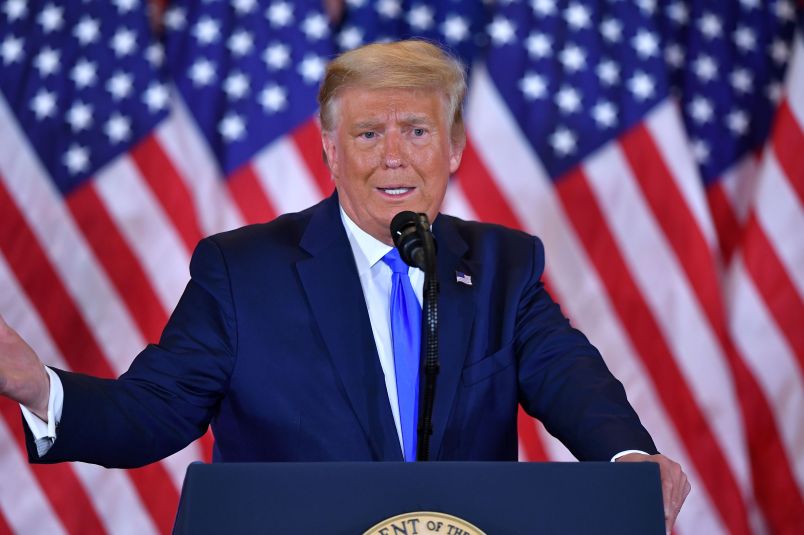
Donald Trump speaks on election night in the East Room of the White House. (Photo by MANDEL NGAN/AFP via Getty Images)
Yet the state legislature has succeeded in making another post-2020 fix: banning “Zuckerbucks,” a component of a 2020 Stop the Steal conspiracy theory which laid Trump’s defeat at the feet of Facebook founder Mark Zuckerberg. Per the conspiracy theory, which is byzantine — but relatively more grounded than fellow-traveling 2020 fantasies like ItalyGate — Zuckerberg rigged the election by contributing to a nonprofit, which then provided grants to help county election offices cope with administering the 2020 election. Per the new law, passed in 2022, it’s a crime for any non-governmental entity to fund Pennsylvania election operations.
“There are a lot of people who just focus on the conspiratorial allegations about how elections are run without knowing anything about how things actually happen,” Bob Harvie, a Democratic commissioner for Bucks County, Pennsylvania, told TPM. “I would not put it past some people who are elected officials in Harrisburg to just want this system to fail, or to at least look like it’s failing, or at least allow them to point at it and say it’s failing.”
After the 2020 election, Pennsylvania legislators did what many law-making bodies do to address a problem: They created a bipartisan commission to review questions around the election, and make recommendations. In a 2022 report, the commission recommended that the state speed up its vote-counting by passing a law that would give county offices two weeks to conduct a pre-canvass.
In 2020, the delay caused by the lack of a pre-canvass helped set the stage for Trump to muddy the waters around the election result. After unofficial results took days to come in in several counties in Pennsylvania, Trump used the delay to say that Democrats were taking the time to tamper with the results. It was an obvious lie, but it provided early fodder for Trump’s attempt to stay in power and to overturn his 2020 defeat.
“We could be getting ballots ready today to be scanned and input and counted on Election Day, but because the law doesn’t allow us to do anything, everything waits until Election Day,” Lisa Deeley, a city commissioner for Philadelphia who helps oversee voting, told TPM. “It’s unfortunate that the voters are caught in the middle because what it’s doing is it’s having a really negative impact on people’s perception and feelings about the integrity of elections — because the longer they have to wait, it just brings worry and wonder into people’s minds.”
Still, the 2024 count will likely take less time than 2020. The COVID pandemic contributed to around half of Pennsylvania’s voters avoiding in-person voting that year; election officials estimate only a third will avail themselves of voting by mail in 2024. Poll workers can, this election, use an electronic poll book to check voters, and the length of determining any winner will depend on how close the result is.
Both parties have proposed bills that would allow pre-canvassing to begin earlier. Republicans have met Democratic bills with no votes, calling for voter ID; former Gov. Tom Wolf (D) in 2021 vetoed a GOP voter ID bill that included a five-day pre-canvassing period.
“You can get votes to do that from the right, but only if you mandate voter IDs,” Harvie, the Bucks County commissioner, told TPM.
And so, with weeks to go before Election Day, the most significant legislative change to elections in Pennsylvania is one rooted in years of conspiracy-mongering from the GOP: Pennsylvania election offices can no longer accept outside money.
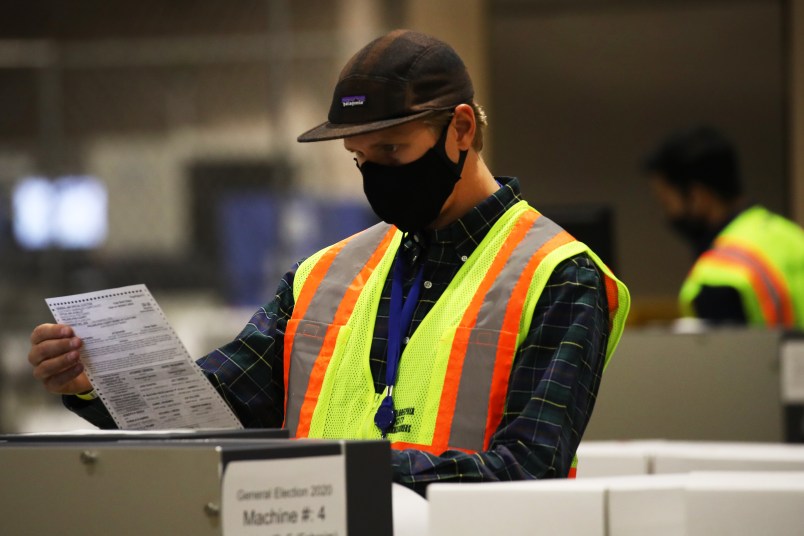
Election workers count ballots on November 04, 2020 in Philadelphia, Pennsylvania. Photo by Spencer Platt/Getty Images)
It’s an odd shift, and one that came almost entirely in response to the Zuckerbucks theory. Since 2020, Trump and other Republicans have said that a $400 million contribution that Zuckerberg made to keep election offices running during the COVID pandemic was, in fact, a stalking horse for its true purpose: a Democratic get-out-the vote operation, run by Zuckerberg-funded election officials themselves.
GOP legislators pushed a law to criminalize outside funding of election operations in the state; Democrats signed on to the bill with a proviso that state government provide counties with optional election grants.
“Nobody should want a private, partisan arms race to underwrite government-led get-out-the-vote drives in heavily Democratic or Republican towns. Mr. Zuckerberg says he doesn’t intend to reprise his Covid largesse, but lawmakers are reasonably acting to ban it because other billionaires are likely to try,” thundered the Wall Street Journal after the law’s passage. “The bad news begins with the fact that Pennsylvania still won’t let officials preprocess mail votes before Election Day.”
Just Throw Out The (Mostly) Democratic Votes
Meanwhile, another set of related fights has played out in the courts. Republicans have had mixed results in their other attempts to make voting — particularly voting by mail, which skews Democratic in Pennsylvania — more difficult.
For years, voting groups — often joined or opposed by the national Democratic and Republican committees, respectively — have wrestled with Pennsylvania’s election administrators over the exterior envelope of absentee ballots. Voters must date the envelope, despite the fact that the date is useless; administrators don’t use it for anything, including determining whether the ballot was sent on time.
This spring, the Third Circuit Court of Appeals ruled that ballots missing the date, or having an incorrect one, must not be counted. The panel reversed a district court, which had found that the requirement violated the Materiality Provision, a section of the Civil Rights Act meant to protect voters from having their ballots being tossed out for small, technical reasons. The full Third Circuit declined to hear the case en banc.
(Photo by GEORGE FREY, KENA BETANCUR, JASON REDMOND, JEFF KOWALSKY/AFP via Getty Images)
The plaintiffs sought help at both the U.S. and state Supreme Court. The PA Supreme Court, dominated by Democrats, declined to change voting laws so close to the election (absentee ballots had already been sent out to Pennsylvania voters). The U.S. Supreme Court, with its inconsistent notions about when is too soon to intervene in election administration, has yet to act on the plaintiffs’ petition for certiorari.
Under the status quo, thousands of timely sent ballots will near-certainly be thrown out.
“In the 2022 general election, county boards of elections in Pennsylvania refused to count at least 10,500 timely-received mail ballots based solely on missing or purportedly ‘incorrect’ handwritten dates on the outer return envelope,” the plaintiffs wrote in their petition to the Supreme Court.
There’s a reason the Republican National Committee, National Republican Congressional Committee and Republican Party of Pennsylvania joined this case on the side of the election administrators: In Pennsylvania about three-fourths of mail-in ballots are typically cast by Democrats.
Republicans will be less thrilled with another decision the state Supreme Court made the same day earlier this month: It will not take up the Republicans’ challenge to the “notice-and-cure” process, where voters are informed of disqualifying mistakes on their ballots and given the chance to fix them. There is a patchwork of those policies across the commonwealth; some counties let voters cure their ballots, others don’t even notify them about disqualifying mistakes.
A similar challenge to the curing process is wending its way up through state courts, though the court expressed disinclination to change the rules so close to the election in its recent orders.
The overall picture is a level of delay likely to mimic that which the country experienced in 2020, for largely the same reasons. It’s the result of conscious policy choices, both aimed at making voting more difficult and at keeping the window in which one of the largest swing states does not report its results open for as long as possible.
Lisa Schaefer, executive director of the county commissioners association of Pennsylvania, told TPM that it all manifests in tremendous pressure on individual officials.
“We’re going to be running not only the in-person election, but also processing those mail-in ballots on Election Day,” she said. “And that takes time and that takes resources.”