

Less than one month into office, the Trump DOJ has rolled out sweeping new innovations in corruption.
Continue reading “5 Points On How Trump Is Using Eric Adams To Commandeer The DOJ And NYC”Trump Must First Destroy The Gov’t In Order To Corrupt It
A lot of things happened. Here are some of the things. This is TPM’s Morning Memo. Sign up for the email version.
Stay Focused On The Real Power Dynamic
Accretion of power is the core goal of Trump’s Project 2025 opening blitz. Since power in the tripartite federal government is finite, the accrual of power by the executive branch necessarily comes at the expense of the legislative and/or judicial branches. But that highfalutin constitutional framework doesn’t quite capture the petty transactional nature of what Trump is up to.
The WaPo has a story out this morning that begins to capture this new dynamic: Members of Congress going hat in hand to the Trump administration asking for special dispensation from the latest degradations, purges, shutdowns, and freezes.
Trump II’s opening month blitzkrieg has wreaked all manner of damage and destruction – some of that undoubtedly for the pure sake of doing it – but the real power dynamic is in converting the vast array of government goods and services into a political currency that Trump can exchange for favors, leverage, control, and obedience.
What were democratically agreed upon government programs now become baubles to be awarded friends and denied foes. Congress is reduced to a supplicant trying to secure exceptions, carveouts, and special treatment for themselves and their constituents. Even if Trump succeeds ultimately in wrecking only a portion of the federal government, he will have accrued vast new power not just by stripping it from Congress but apportioning the spoils back to individual members at the time, place, and manner of his choosing, on his terms, however corrupt they may be.
Tracking The Purges
- DOD is next.
- U.S. District Judge Rudolph Contreras of DC has reinstated Cathy Harris as chair of the Merit Systems Protection Board after she was fired by the Trump administration.
IMPORTANT
President Trump issued a new executive order purporting to rein in independent agencies and expand White House power and control over, among others, the FTC, SEC, and FCC.
Keep An Eye On This Case
President Trump’s attempted removal of Hampton Dellinger as U.S. special counsel is the first Trump II case to make it to the Supreme Court. A federal district judge last week ordered Dellinger reinstated, and the D.C. Circuit Court of Appeals over the weekend denied the Trump administration’s request for relief. The administration immediately sought Supreme Court intervention, and the high court out the case on a quick schedule. Dellinger has already filed his brief with the court. Steve Vladeck explains why this case is unique and not representative of the other coming battles over independent agencies and executive power.
DOGE Watch
On the same day that U.S. District Judge Tanya Chutkan ruled there was an insufficient legal basis to issue a temporary restraining order against DOGE,
- Elon Musk’s role and what DOGE is actually doing remain clouded in secrecy and government misdirection.
- DOGE’s access to Americans’ personal data now includes the IRS, the Social Security Administration, and the Consumer Financial Protection Bureau.
- D’OH! DOGE claimed $8 billion in savings on a cancelled contract that was actually worth only $8 million.
- The GSA’s lead engineer for a government text-messaging service resigned Tuesday after DOGE requested access to sensitive data, including personal identifying information, the WaPo reported.
What Elon Musk Is Really About
Now that musk is saying he’s doing the DOGE stuff “because the globalists have plotted a Great Replacement in which they use government handouts to buy votes from illegal immigrants and urban blacks” maybe we don’t have to act like this is about deficits or cost cutting anymore
— Jake Grumbach (@jakemgrumbach.bsky.social) February 17, 2025 at 6:03 PM
[image or embed]
Cruel But Also Dumb
Errors, mistakes, screwups, and boneheadedness are part and parcel of the Trump II reign of terror:
- The Trump administration was considering destroying a stockpile of free-to-the-public COVID tests but reversed itself after the WaPo came asking questions.
- The Trump administration “accidentally” fired officials working on bird flu, and the USDA is now scrambling to try to rehire them.
An Awkward Day In Court For DOJ
The Justice Department will for the first time have to defend to a federal judge its corrupt bargain to drop criminal charges against NYC Mayor Eric Adams. U.S. District Judge Dale Ho set a hearing for 2 p.m. ET this afternoon on the government’s motion to dismiss that prompted an unprecedented wave of DOJ resignations. TPM’s Josh Kovensky will be in courthouse and file his report late this afternoon.
Harmonic Convergence: DOJ, Project Veritas, EPA
DOJ politicization collided with Trump’s impoundment effort thanks to a bogus Project Veritas video. It led to the forced resignation of a senior prosecutor in the DC U.S. Attorney’s Office who could not abide using criminal process to try to claw back $20 billion appropriated to the EPA and already sent out the door to Citibank.
Jeffrey Clark Is Back
Jeffrey Clark, the Trump I DOJ official who was an unindicted co-conspirator in the Jan. 6 case against Donald Trump and a one-time co-defendant of Trump’s in the Georgia RICO case has popped up as a senior adviser to Mark Paoletta in his role as the CFPB’s new chief legal officer. Paoletta is also the OMB general counsel. Both OMB and CFPB are currently being run by Russell Vought.
Thread Of The Day
🧵Who is opposing the Trump administration? I analysed 76 actions of the administration since inauguration and then searched for *meaningful* opposition to each. I grouped the types of opposition and considered what we can learn from both them & actions where opposition has been lacking 1/24
— Prof Christina Pagel (@chrischirp.bsky.social) February 17, 2025 at 1:42 PM
[image or embed]
Great Read
Come for Jamison Foser’s Drive-By Truckers lede and stay for the political analysis:
We aren’t in a situation in which we can pick only the “right” fights; only fights we can clearly win. Things are so much worse than that, and will be for a very long time. The cold hard truth is there aren’t very many fights we can have a high degree of confidence we can win; there’s too much stacked against us. We have to be willing to pick some fights we will probably lose, because those are pretty much the only kinds of fights we have.
Trump Shits On Ukraine As He Walks Away From It
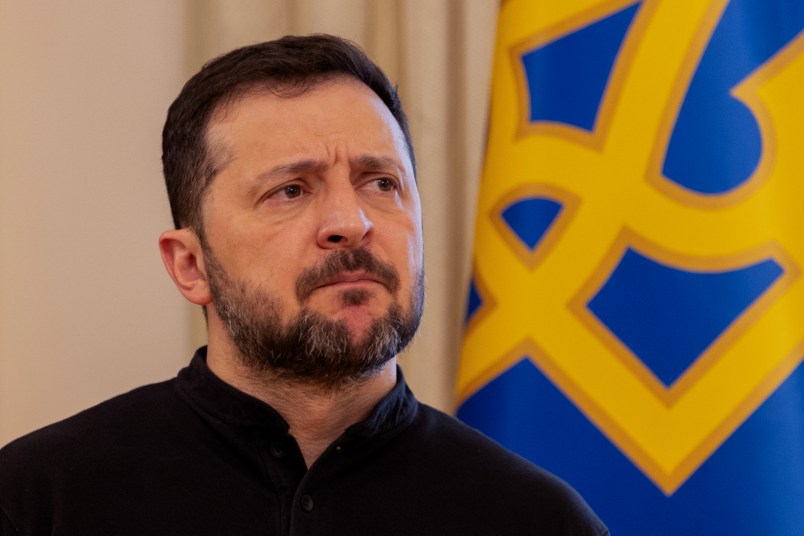
The painful abandonment of Ukraine by the Trump administration began in earnest with Russia-U.S. talks sans Ukraine producing a process to end the war that also sidelines the victim of Russian aggression.
As if that capitulation weren’t grim enough, President Trump took the occasion to blame Ukraine for being invaded. “You should have never started it,” Trump said, lashing out at Ukraine President Volodymyr Zelensky in comments that also sought to undermine him politically at home. At a press conference in his office in Kyiv, Zelensky responded: “I would like to have more truth with the Trump team.”
As Farah Stockman notes, “Europeans are waking up to the fact that they are entirely dependent on a foreign power that is no longer acting like itself. America, which once championed the liberal democratic world order, is now turning against it in ways that are shocking to its allies.”
Do you like Morning Memo? Let us know!
Trump’s First-Term Inside Man At The DOJ Has Scored A Top Post At The CFPB
Remember Jeffrey Clark, the former acting assistant attorney general in the Trump DOJ’s environmental division? He became infamous in the first days of 2021, when Donald Trump tried, unsuccessfully, to install him as attorney general mid-coup attempt. Now, Clark is reportedly back in government, in a top post at the Consumer Financial Protection Bureau. It’s an agency that Trump, Elon Musk and other allies have taken steps to paralyze in recent weeks.
Continue reading “Trump’s First-Term Inside Man At The DOJ Has Scored A Top Post At The CFPB”How It’s Going
Was getting a read out a short time ago about firings at CMS (the agency that runs Medicare and Medicaid). The cuts run deep. And giving how much of the health care economy runs through these programs that’s of course worrisome. But the most telling detail is one I’ve heard from numerous other agencies. The people actually running the agency don’t actually know how many people have been fired or who they are. If you’re in charge of and responsible for running the place you really need to know that. But as in other agencies they’re having to piece that together by doing things like seeing whose emails have been turned off or just asking them. Did you get fired? You? Can someone ask Lori if she got fired? Imagine running an agency and finding out that there had been widespread terminations but not being given any details about who they are or how many there are. That’s pretty straightforward sabotage.
Another Prominent Fed Prosecutor Resigns In Protest Of Trump Admin Political Interference
A federal prosecutor in charge of the criminal division in the Washington, D.C. U.S. Attorney’s Office resigned on Tuesday following her refusal to follow a Donald Trump administration directive to freeze assets of a Biden-era administration grant initiative, the Washington Post and Reuters reported.
Continue reading “Another Prominent Fed Prosecutor Resigns In Protest Of Trump Admin Political Interference”Is This Why Musk Keeps Using the Same Dozen Tech Micro-Bros for Each Takeover?
A few days ago I did this post on the taxonomy of DOGE, who’s actually involved in it, the people who are formally part of it and the ones who are part of Musk’s operation but have not gotten official appointments in the executive branch. In that post I asked why it is that Musk seems to continue to rely on this subset of DOGE personnel — the dozen or so under-25 techies — as the landing parties who go in and actually force their way into these departments. It happens again and again. In that post I noted that Gavin Kliger is the guy at IRS. And in a conversation with a fellow journalist I was just told that another of the original crew is the lead now in the break-in at SSA.
Continue reading “Is This Why Musk Keeps Using the Same Dozen Tech Micro-Bros for Each Takeover?”The Supreme Court’s Final Test Approaches
This article is part of TPM Cafe, TPM’s home for opinion and news analysis.
Sooner than we may think, the Supreme Court will have to decide whether it will continue to expand presidential powers beyond anything imagined in the Constitution, or if it will uphold the separation of powers it purportedly reveres. One aspect of Donald Trump’s push to stock the federal workforce with loyalists is already before the Court; more broadly, his massive, attempted funding freeze deliberately set the stage for a Supreme Court showdown that could make him — and by proxy Elon Musk — a de facto dictator over the entirety of the federal government without the checks and balances clearly embedded in our Constitution.
Continue reading “The Supreme Court’s Final Test Approaches”Trump Preened As A Strongman For Presidents Day
A lot of things happened. Here are some of the things. This is TPM’s Morning Memo. Sign up for the email version.
So Much Has Happened
Since last we convened on Friday, President Trump’s rampage against the rule of law at home and the international order abroad has intensified in alarming and unprecedented ways.
It is impossible to step away from the news for a holiday weekend and still keep track of Trump’s myriad angles of attack on the law and the real-world effects on the ground. So rather than attempt to shove every last development into a bloated Morning Memo, I’m going to focus on three main categories: the rule of law violations, the purges, abandoning Europe.
‘He Who Saves His Country Does Not Violate Any Law’
In an unapologetic social media post over the Presidents Day weekend that reinforced the grave peril we’re in, President Trump adopted a quote generally attributed to Napoleon in declaring himself above and beyond the reach of the law.
In giving himself a free pass on his constitutional obligation to “take care that the laws be faithfully executed,” Trump blessed in retrospect his renegade first month in office and warned of what is yet to come.
But it was in Trump’s preening as a strongman, the callback to the little dictator, that we were reminded that the assault on the rule of law is personal to him, his petty grievances, his simplistic understanding of the way the world works, and his addled perceptions of strength and weakness.
The Valentine’s Eve Massacre
With the mass resignations of top prosecutors in DC and Manhattan over the Trump DOJ’s politicized handling of the prosecution of NYC Mayor Eric Adams, the crisis atmosphere at the Justice Department has never been as acute.
After acting Deputy Attorney General Emil Bove implicitly threatened to can DOJ’s entire Public Integrity Section if no one would file his corrupt motion to dismiss the case against Adams, a veteran prosecutor stepped forward to do the dirty deed and spare his colleagues further repercussions. The wisdom of that decision was dubious, but here we are.
The focus shifts now to U.S. District Judge Dale Ho in Manhattan, who this morning set a hearing for Wednesday afternoon to begin considering DOJ’s motion to dismiss. It does not appear that this will be the dispositive hearing on the motion because Ho wants to use it to discuss the procedure for resolving the motion. Ho also ordered the Justice Department to provide proof of its claim that Adams has consented in writing to the dismissal of his case without prejudice, meaning the charges can be refiled at a later date. If there was any doubt that leaving the case hanging over Adams’ head would be a lever for Trump, this unsettling scene played out on national TV.
As I wrote Friday, the combination of the Adams case, the purges of prosecutors and FBI agents, and the dropping of all of the Jan. 6 and Trump cases has brought the Justice Department to the lowest point in its history. As former U.S. Attorney Carol Lam, herself a victim of the 2006-07 U.S. attorneys scandal, writes: “this Justice Department isn’t even pretending to be apolitical anymore.”
And yet … for all that has happened in the first month to tear the Justice Department loose from its moorings, it’s what it will now do as a weaponized arm of the White House that inspires the most dread. Here’s a taste: a Trump White House official asking the Justice Department to investigate a Democratic member of Congress.
Trump’s announcement that he will nominate acting DC U.S. Attorney Ed Martin for the permanent position is a sign of the quality of people we can expect to do the Trump White House’s bidding using the full might and power of the federal government unrestrained by the law.
The Purges
The most sweeping phase of the mass purges of federal workers ramped up Friday and into the weekend against some 200,000 probationary employees, who enjoy lesser levels of civil service protection. The WaPo obtained internal documents that map out an expanding purge over the next six months. Among the reported purge targets:
- NIH and other HHS agencies and components;
- a key office handling bird flu response;
- FAA staff;
- the Bonneville Power Administration
In an sign of the chaos and haphazard nature of the purges, the Trump administration raced to try to recall fired nuclear safety workers but was struggling to figure out how to reach them.
The Resignations
Alongside the purges are forced resignations or resignations under duress, among them:
- Social Security Administration: Michelle King, the acting commissioner who was handpicked by the Trump administration last month, resigned after Elon Musk’s DOGE sought access to American’s sensitive personal data.
- National Archives: The acting archivist of the United States and several senior staff members have resigned.
- FDA: A top official resigned over the widespread cuts across the agency.
ICYMI
One of the Eric Adams prosecutors in NYC penned a resignation letter for the ages to acting DAG Emil Bove.
White House Claims Elon Musk Does Not Run DOGE
In an overnight filing, the Trump administration has made the incredulous claim to U.S. District Judge Tanya Chutkan in DC that Elon Musk is not running DOGE. It doesn’t take much to find contrary evidence:
On the left: President Trump: "I am pleased to announce that the Great Elon Musk … will lead the Department of Government Efficiency ('DOGE")" On the right: Government declaration (by Joshua Fisher) submitted to Judge Chutkan stating Elon Musk is not the leader of DOGE
— Ryan Goodman (@rgoodlaw.bsky.social) February 17, 2025 at 10:52 PM
[image or embed]
Chutkan, who held an emergency hearing on Monday, a federal holiday when the courts are usually closed, did not seem inclined to grant a temporary restraining order to rein in DOGE, but did ask for details on the firings of government workers thus far. The Trump DOJ declined to provide that information even after Chutkan asked for it.
DOGE Runs Amok At IRS
- TPM’s Hunter Walker: Inside The ‘Bizarre’ Meeting Where DOGE Requested ‘Extensive System Access’ At IRS
- WaPo: Musk’s DOGE seeks access to personal taxpayer data, raising alarm at IRS
- NYT: Musk Team Seeks Access to I.R.S. System With Taxpayers’ Records
Who Is Pete Marocco?
- TPM’s Josh Kovensky: Two Jan. 6 Boosters Are Now Trump Appointees Strangling USAID From The Inside
- ProPublica: Trump Official Destroying USAID Secretly Met With Christian Nationalists Abroad In Defiance Of US Policy
- NYT: In Trump’s War on Foreign Aid, a Loyal Soldier Returns to Battle
Trump Abandons Europe And Embraces Its Far Right
Of all the grim things to happen over the Presidents Day weekend, none will probably have the historical reverberation of America’s abandonment of the international order anchored in Europe:
- Vice President JD Vance scolded European leaders and met with the leader of Germany’s far-right party, while declining to meet with German Chancellor Olaf Scholz.
- In a neo-colonial move, President Trump tried to strong-arm Ukraine into signing over its mineral wealth as payback for U.S. support against the Russian invasion.
- The Trump administration began talks with Russia over Ukraine without the involvement of Ukraine itself or the rest of Europe.
Do you like Morning Memo? Let us know!
First IRS, Now DOGE Busts Its Way Into the Social Security Administration
Hard to keep track of precisely what’s happening at these different agencies. But we just got through the headlines about DOGE demanding access to literally everybody’s and every companies’ tax returns at the IRS. It seems like they now have that access, though we don’t know that for certain. (We’re basically entirely dependent on leaks since DOGE works entirely in secret.) Now news just broke that the DOGErs appear to have busted their way into the Social Security Administration, forcing the resignation of the acting commissioner, Michelle King, when she resisted their demands to give DOGE access to the agency’s most sensitive government records.
Continue reading “First IRS, Now DOGE Busts Its Way Into the Social Security Administration”Who Needs Grids?
The Bonneville Power Administration, the largest transmission grid operator in the Pacific Northwest, will be shedding at least 600 workers as part of President Trump’s budget slashing across the federal federal workforce.