It’s not always a great idea to cover political stories that exist entirely on social media. You can end up focused on narratives and disputes that unfold largely among the most online subset of political commentators, but that don’t show up anywhere in the real world. More importantly, you run the risk of manipulation by people who are trying to use social media platforms to spread unpopular ideas and will them into gaining broader acceptance.
But, I’ll make an exception here.
Over the past few days, a fight has erupted within the MAGA right over legal immigration, specifically about whether the country should admit more high-skilled immigrants.
Rudy Giuliani is hard up for cash. He’s staring down a $148 million defamation judgment, and, as his debtors start to collect, is steadily losing access to the material rewards that a lifetime in politics and the public eye have brought him: Yankees memorabilia, a luxury car, a Manhattan apartment, several fancy watches.
This story first appeared at ProPublica. ProPublica is a Pulitzer Prize-winning investigative newsroom. Sign up for The Big Story newsletter to receive stories like this one in your inbox.
Months before voters went to the polls in November, a group of election skeptics based in North Carolina gathered on a call and discussed what actions to take if they doubted any of the results.
One of the ideas they floated: try to get the courts or state election board to throw out hundreds of thousands of ballots cast by voters whose registrations are missing a driver’s license number and the last four digits of a Social Security number.
But that idea was resisted by two activists on the call, including the leader of the North Carolina chapter of the Election Integrity Network. The data was missing not because voters had done something wrong but largely as a result of an administrative error by the state. The leader said the idea was “voter suppression” and “100%” certain to fail in the courts, according to a recording of the July call obtained by ProPublica.
This novel theory is now at the center of a legal challenge by North Carolina appeals court Judge Jefferson Griffin, a Republican who lost a race for a state Supreme Court seat to the Democratic incumbent, Allison Riggs, by just 734 votes and is seeking to have the result overturned.
The latest case is getting attention statewide and across the country. But it has not yet been reported that members of the group that had helped publicize the idea had cast doubt on its legality.
“I don’t comment on pending litigation,” Griffin wrote to ProPublica in response to a detailed list of questions. “It would be a violation of our code of judicial conduct.”
Embry Owen, Riggs’ campaign manager, disputed the challenge and called on Griffin to concede. “It’s not appropriate for this election to be decided in court, period. NC voters have already made the decision to send Justice Riggs back to the Supreme Court,” she said.
The theory Griffin is citing originated with a right-wing activist, Carol Snow, who described herself to ProPublica in an email as “a Bona Fide Grade-A Election Denier.” Snow promoted it with the help of the state chapter of the Election Integrity Network, a national group whose leader worked with President Donald Trump in his failed effort to overturn the 2020 election. The network also was behind extensive efforts to prepare to contest a Trump loss this year in other states, as ProPublica has reported, as well as in North Carolina, according to previously unreported recordings and transcripts of meetings of the state chapter.
State election officials have found that missing information on a voter’s registration is not disqualifying because there are numerous valid reasons for the state’s database to lack that those details.
Those reasons include voters registering before state paperwork was updated about a year ago to require that information or using alternate approved documents, such as a utility bill, to verify their identities. What’s more, voters must still prove their identity when casting a ballot — most often with a driver’s license. “There is virtually no chance of voter fraud resulting from a voter not providing her driver’s license or social security number on her voter registration,” attorneys for the state election board wrote in response to the RNC lawsuit.
Bob Orr, a former GOP state Supreme Court justice who left the Republican Party in 2021, said he too doubts the theory. “I appreciate fighting for every vote: If you honestly think illegal votes have been cast, it’s legitimate to try to prove that,” he said. “But the bottom line is: Did anyone vote illegally? Have you been able to prove one person voted illegally? At this point, no. And we’re weeks past the election and multiple recounts, and there’s no evidence of that.”
In modern history, the state board’s decision on who wins elections has been final, said Chris Cooper, a professor specializing in North Carolina politics at Western Carolina University. That includes an even tighter race in 2020, when a Democratic justice conceded to a Republican after protesting her 401-vote loss to the board.
“We’re used to close elections, we’re used to protests, we’re used to candidates pushing every legal action up to the point the state election board rules,” Cooper said. But, he added, there is an important difference with Griffin’s petition, which goes beyond the state election board to the courts.
“This is basically saying the state elections system is wrong, and we’re going to court to try to change the rules of the game after the game has been played — which is unprecedented.”
In July 2024, the North Carolina chapter of the Election Integrity Network convened online to plan its efforts ahead of the presidential election. Worried about a surge of voter registrations from nonwhite voters who they believed would back Democrats, the activists discussed how to assemble a “suspicious voters list” of people whose ballots they could challenge.
Then, one of the group’s board members, Jay DeLancy, said he had another idea “that’s a lot slicker.”
DeLancy said that if a candidate lost a close election, the loss could be overturned by questioning the validity of voters whose registrations are missing their driver’s license and Social Security information. “Those are illegal votes,” he claimed. “I would file a protest.”
Jim Womack, the leader of the chapter, immediately pushed back: “That’s a records keeping problem on the part of the state board. That’s not illegal.”
Later in the call Womack said, “I’m 100% sure you’re not going to get a successful prosecution.” And he told the group, “That’s considered to be voter suppression, and there’s no way a court is going to find that way.”
But DeLancy asked for backup from the originator of that theory: Carol Snow. She argued that her theory could in fact overturn the outcome of an election.
“I guess we’re gonna find that out,” Snow said.
Snow is a leader of the conservative activist group North Carolina Audit Force and lives in the state’s rural mountains. After Trump’s loss in 2020, she threw herself into questioning the election’s results. In 2022, she accompanied a pair of far-right activists to a North Carolina election office where the two men unsuccessfully tried to forcefully access voting machines, and she participated in a failed pressure campaign to oust the election director who resisted them, ProPublica previously reported.
She also began filing overwhelming numbers of records requests and complaints to state election officials, an effort that Womack praised on the July call: “I think Carol has shown a way of really harassing — not that we want to do it for harassment purposes — but really needling the Board of Elections to do their jobs by just constantly deluging them.”
Since late 2021, the state elections board had spent far more time on her requests and complaints than those of any other individual, spokesperson Patrick Gannon said in a statement. “Ms. Snow’s constant barrage of requests and complaints causes other priorities and responsibilities to suffer,” Gannon said.
Snow described her work to ProPublica as “simply taking the time to learn about my state’s electoral process” and acting for the public good. “The records I’ve requested are owned by the public. In other words, I’m asking for what belongs to me,” Snow wrote to ProPublica. “If government agencies are understaffed and unable to comply with this state’s Public Records law, they should address the issue with the entities that fund them.”
In the fall of 2023, Snow filed a complaint alleging that North Carolina’s voter registration form did not clearly require voters to provide their driver’s license number and the last four digits of their Social Security number, as required by federal law — instead that information was coded as optional. Snow later described the missing information as a “line of attack” through which bad actors could cast fraudulent votes using fake identities. (A right-wing conspiracy theory holds that this was how Biden won the 2020 election.)
But she was not able to demonstrate that the missing information had led to anyone improperly voting. After obtaining public records for hundreds of thousands of voter registrations, Snow provided the state board with only seven examples of what she called potential double voting. The state board found all seven to be innocuous things like data entry errors.
The state board quickly updated the form to require the information. But from late 2023 through the fall of 2024, six complaints, some of which were partly based on Snow’s theory, were filed with the state election board. Aside from the updates to the form, the state board dismissed the complaints.
By the time of the July call, some of Snow’s peers seemed dismissive as well.
“I’m not suggesting that we can’t arm a candidate that loses a short, a close race with the information they need to file a protest using this,” Womack said on the call. “But I would just suggest to you that that’s not the way to win on this thing.”
Yet the information did end up in the Republican National Committee’s lawsuit trying to disqualify 225,000 voters, a challenge DeLancy filed against Riggs’ victory in North Carolina’s most populous county, and, the day after that was dismissed, Griffin’s challenge to over 60,000 voters.
DeLancy wrote to ProPublica that he filed the challenge on his own and did not coordinate with Griffin. He also said he disagreed with Womack’s description of such challenges as “voter suppression.” Instead, he said, he saw it as “a proper response” to the state election board’s “violation of federal law.” “Carol Snow deserves an Order of the Long Leaf Pine for exposing this treasonous behavior on the part of the election officials,” he wrote, referring to an award bestowed by North Carolina’s governor.
Womack wrote to ProPublica that the group he leads “is a non-partisan, neutral organization” that does “not favor one party over another.”
He also said that recordings of the group’s calls are “prohibited and violate our internal policies” and “whatever bootleg recording you may have is unauthorized and may well be altered.” ProPublica has seen a video recording of the call and verified portions of it with some participants.
Though Griffin’s challenge of Riggs’ victory is now being considered in federal court, legal experts say it could still end up back where he intended: in front of the state Supreme Court.
Griffin’s petition is making what experts describe as extreme asks to the Supreme Court: to allow him to bypass the lower courts, to allow ballots to be thrown out without proving that voters did anything knowingly wrong and to essentially decide whether to change its composition to six Republicans and one Democrat.
“Even if they do their best to be open-minded and independent, the facts of the potential conflicts of interest are just too obvious to the public,” said Orr, the former Republican justice.
Griffin has described Republican Supreme Court Chief Justice Paul Newby as a “good friend and mentor,” and Newby promoted Griffin’s 2020 run for the court of appeals. What’s more, a ProPublica review of campaign finance reports show that the spouses of three justices, including Newby’s wife, donated over $12,000 to Griffin’s most recent or previous campaigns. (The husband of the Supreme Court’s other Democratic justice donated to Riggs.)
Newby and other justices did not respond to a detailed list of questions sent to spokespeople for the Supreme Court.
When announcing his candidacy for the Supreme Court, Griffin declared, “We are a team that knows how to win — the same team that helped elect Chief Justice Paul Newby and three other members of the current Republican majority.”
Officials across the country spent the four years following 2020 preparing for another deluge of violence and chaos during the 2024 presidential election.
This article is part of TPM Cafe, TPM’s home for opinion and news analysis. It was originally published at The Conversation.
Threats and harassment are pushing some politicians out of office, scaring off some would-be candidates and even compelling some elected officials to change their vote.
Those are some of the conclusions of a new study I led on political violence in Southern California.
Rising threats against public officials is a national problem.
Between 2013 and 2016, there were, on average, 38 federal charges involving threats to public officials per year, according to the National Counterterrorism Innovation, Technology and Education Center, a research center. That average sharply increased between 2017 and 2022, when an average of 62 federal charges were brought annually for threats to public officials.
When elected officials worry for their safety, it has implications for all Americans. Democracy suffers when people are governed by fear.
Our research focused on California’s three southernmost counties – San Diego, Riverside and Imperial. Together, these counties have just under 6 million residents, or roughly 15% of California’s population.
To capture as complete a picture as possible, we did a survey and interviews, reviewed news coverage and social media accounts, and scoured literature nationwide.
The first year, we focused only on San Diego County, surveying 330 mayors, city councilors, county board of supervisor members and school board and community college board members. Over 25% of survey recipients responded. Of them, 75% reported being threatened or harassed at least once in the past five years. Roughly half said the abuse occurred at least monthly.
Respondents had found their name shared on the dark web and seen cars drive past their homes in an intimidating manner. They’d been followed after public meetings and blocked from leaving. In some cases, their families were harassed.
“As a parent, [I] feel vulnerable,” one city council member said, adding that he’s become “very guarded with [my] kid in public.”
Topics that were most likely to prompt threats and harassment included COVID-19, gun control, school curricula and LGBTQ+ rights.
“Since the pandemic, people have been mobilized into different silos or groups of people,” said a school board member interviewed in 2023. “[R]espectful discourse has been lost in all of this.”
In year two, we sent surveys to 785 elected officials in all three counties. Two-thirds of respondents reported having been threatened or harassed at least once in the previous five years. Roughly the same number said verbal attacks had become a routine part of public service.
These attacks come from the public, they told us, and from other elected officials. Officials have been accused of corruption, called idiots and told they should die. School board members face allegations that they “don’t care about kids.”
The threats “are verbal, at council meetings, outside of meetings, during breaks,” said one interviewee serving on a city council. “I’ve been harassed by city council members, staff members, the city manager and the city attorney.”
A troubling trend
In simple terms, our research suggests that at least two of every three people who serve in public office in Southern California will be threatened, intimidated or harassed during their tenure.
Survey results suggest the average female elected official who experiences abuse is threatened or harassed at least six times as often as her male peers. Men reported being on the receiving end of abuse about once a year, while women suffer abuse almost monthly.
The attacks against women are more likely to be personalized – referring to their looks or their family members – and have a sexual nature.
It was “slanderous stuff,” one school board member told us of abusive text messages that started in 2022 after many years of service. “Language of being evil … of not being a Christian woman.”
Her husband was also followed by a car, and her home was circled by the same vehicle. No one else on her board reported similar abuse.
We heard many accounts like this from female elected officials in Southern California. One city councilwoman filed two police reports against men who threatened, harassed and stalked her. A second was threatened throughout her campaign and time in office, including by a man who used a racial slur and threatened to “take care of” her with his AK-47.
Even so, our most recent survey revealed that male elected officials are most concerned about political violence. Sixty-four percent reported that things had become worse during their time in office, compared with 50% of women.
Counterintuitively, white, male, rural and conservative respondents all reported that threats and harassment had gotten worse more often than their nonwhite, female, urban and liberal counterparts – even though nonwhite, female, urban and liberal respondents reported more threats and harassment overall.
This finding may reflect a meaningful shift in how threats are used in politics. We believe that those responsible for abuse previously targeted the most vulnerable elected officials – namely women and other underrepresented groups.
But as it becomes more common to use threats and harassment as a means to influence decision-making, everyone is a target.
Most of the abuse we documented is, thankfully, not physical. But “hostile, aggressive or violent acts motivated by political objectives or a desire to directly or indirectly affect political change or change in governance” is, by definition, political violence.
And our research shows that this constant, low-level abuse is taking its toll on people and communities.
Fear-based governing
Our study results mirror findings from other research on growing political violence in the U.S.
The Capitol insurrection of Jan. 6, 2021, demonstrated for many Americans the threat of political violence. Brent Stirton/Getty Images
Most Americans don’t need these data points: Three-quarters of Americans already believe political violence is a problem, according to the States United Democracy Center.
Constituents have a right, even an imperative, to make their opinions known to the individuals they elect. Accountability and representation are essential to democracy. But there is a line between expressing disagreement and using intimidation or violence to influence policy decisions. And the latter can have some distinctly undemocratic outcomes.
Six percent of the elected officials we interviewed said they had actually changed their vote on a specific issue due to the climate of fear. And 43% of our survey respondents said that threats and harassment have caused them to consider leaving their post.
“I don’t think it’s fair to have to fight so hard,” said one relatively new school board member. “I’m mad at myself for letting the bullies win.”
The climate of fear is also keeping people from serving. Nationwide, 69% of mayors surveyed by the Mayors Innovation Project said they knew someone who had decided not to run for office due to threats or fear of violence.
When fear – rather than the needs of community – becomes a driving force in politics, democracy loses. That’s rule by the powerful, not rule by the people.
Here’s some Christmas Eve entertainment for you. By perhaps making Mike Johnson unelected as speaker (not a done deal but a real possibility), last week’s Trump/Elon drama may leave Republicans Jan. 6ing themselves this year this time. Ironic! This Roll Call article gets into the details. But the gist is that if they can’t elect Mike Johnson (or someone else) between January 3rd and 6th, they can’t properly constitute themselves to officially receive the electoral votes. There won’t be a properly constituted or sworn-in House, at least not in the way it’s been done for the couple centuries-plus. The Roll Call article makes clear there are probably workarounds, maybe, largely because the constitution leaves it to the House to make up its own rules. So the House can probably, maybe(?), make up a new rule to resolve the problem. But it won’t be pretty.
This article first appeared at ProPublica. ProPublica is a Pulitzer Prize-winning investigative newsroom. Sign up for The Big Story newsletter to receive stories like this one in your inbox.
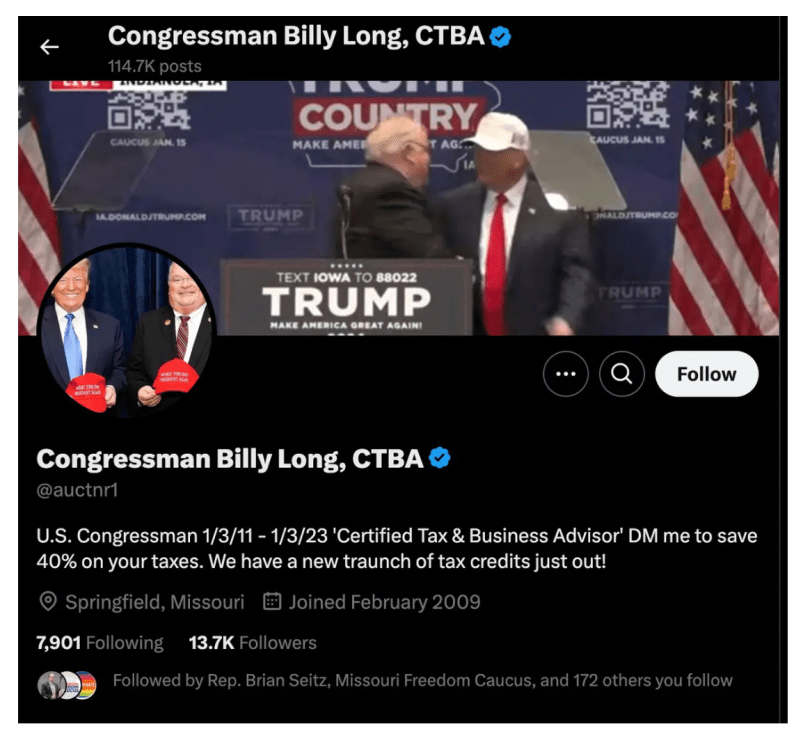
Former U.S. Rep. Billy Long of Missouri, whom President-elect Donald Trump has named his nominee to head the IRS, touts his expertise in tax matters.
He advertises his credential as a certified tax and business advisor, and he adds CTBA to his name on his X profile. That profile encourages people to message him to “save 40% on your taxes.”
Long identifies himself as a certified tax and business advisor, a designation created by a small firm that only requires attendance at a three-day seminar. Credit:X
But tax experts told ProPublica that they have never heard of CTBA as a credential in the tax profession. The designation is offered by a small Florida firm, Excel Empire, which was established just two years ago and only requires attendance at a three-day seminar. That is in stark contrast to the 150 credit hours and the rigorous exams required to become a certified public accountant, a standard certification for tax accountants.
In most tax cases, only lawyers, CPAs and enrolled agents — federally authorized tax practitioners — can represent taxpayers at the IRS.
“The cost of relying on tax advice from somebody that is solely focused on minimizing the tax liabilities that you have — as opposed to somebody that’s focused on both minimizing the tax liabilities and complying with the tax law — can be extraordinarily high if you are found to be in violation of the standards,” said Nathan Goldman, an associate professor of accounting at North Carolina State University.
Excel Empire’s three-day certification course has been advertised for as much as $30,000; its upcoming session is advertised at $4,997. Matthew Pearson, one of its founders, said this summer in a podcast that about 135 people have earned the CTBA designation, which the firm designed to help people without tax backgrounds to become advisors.
Nina Olson, a prominent taxpayer advocate, said that the modern tax industry has seen “a proliferation of different groups and entities that are providing tax advice” and that consumers have no way of knowing who is competent.
“It could just be that you’ve taken a very short course, and paid a large fee for that course, and that gives you the ability to put some initials after your name,” said Olson, who served as the IRS’ national taxpayer advocate from 2001 to 2019. She is now executive director of the Center for Taxpayer Rights, a Washington-based nonprofit that promotes fairness and access to justice in tax systems.
Tax experts said that Long’s years of experience as a real estate agent and as an auctioneer — before spending a dozen years in Congress — pales next to the deep experience in tax policy or management of the people who have held the job. For instance, the current IRS commissioner, Danny Werfel, previously served as acting IRS commissioner and held leadership roles at the Office of Management and Budget. He also worked in the private sector as a managing director at Boston Consulting Group.
Long’s experience in the tax world has been more narrowly focused. In the two years since he left Congress, he worked to bring in customers for at least two firms that marketed the employee retention credit — a pandemic-era benefit designed to support businesses that kept workers despite revenue losses or disruptions caused by COVID-19.
The credit also attracted fraud, eventually landing on the IRS’ “worst of the worst” list for tax scams. Two Democrats on the Senate Finance Committee on Wednesday announced an investigation into the firms, noting Long had neither a “background in tax preparation nor any credential as a licensed accountant, attorney or enrolled agent.”
Worth up to $28,000 per employee, the credit was available for the 2020 and 2021 tax years and has been widely used by both for-profit companies and nonprofit organizations across the country. However, the IRS raised significant concerns about aggressive promoters pushing ineligible businesses to file questionable claims. Red flags included inflated payroll numbers, claims for all quarters without proper eligibility or citing minor government orders that did not directly impact business operations.
The IRS says it has recovered over $1 billion from businesses that voluntarily reported improper claims. And it has launched hundreds of criminal investigations to try to recoup what it says could be billions of dollars more.
In a prepared statement in November, Werfel said businesses should review their claims and see if they were misled by firms marketing the tax credit.
“They should listen to trusted tax professionals, not promoters,” he said.
In a 2023 podcast discussing his work for the two firms, Long joked that he had a hat bearing the name of the credit glued to his head. He said his work marketing the tax credit had caused some clients to question their CPAs’ advice.
“Hey, this auctioneer, real estate broker, former congressman told me I’m going to get $1.2 million back,” he said. “Uh, you’re my CPA. Why didn’t you tell me that?” And he said the response of CPAs would be: “That’s a joke. That’s a fake deal. That’s not true. You’re going to have to pay all that money back. You’ll get audited.”
But he said the firms he worked for had never seen the IRS turn down one of their claims.
There is no evidence that either Excel Empire, Long or the firms that he worked for — Lifetime Advisors of Hudson, Wisconsin, and Commerce Terrace Consulting of Springfield, Missouri — engaged in wrongdoing. In the same 2023 podcast, Long emphasized he and his colleagues had helped only taxpayers who were entitled to the benefit.
Neither Long, Lifetime Advisors nor Commerce Terrace Consulting responded to requests for comment.
If Long is confirmed and succeeds Werfel, he’ll have the power to influence how Americans pay their taxes and how the federal government collects revenue. Trump has promised to end IRS “overstepping,” while Republicans have said that they would slash billions of dollars in funding passed under the Biden administration to modernize the IRS and enhance tax enforcement.
The IRS and the Trump transition team did not respond to requests for comment.
During his time representing Southwest Missouri in Congress, Long pursued legislation to abolish the IRS and establish a national sales tax. Billionaire Elon Musk, a Trump advisor, recently asked on X if the agency’s budget should be “deleted.”
Like Long, members of Excel Empire suggest that accountants don’t feel it is their role to save their clients money because they prioritize compliance over planning and are too busy during tax season to discuss strategies. The company’s website claims the firm has saved taxpayers hundreds of millions of dollars.
Edward Lyon, who is listed on Excel Empire’s website as chief tax planner and tax attorney, writes on his personal website that the seven most expensive words in the English language are “My CPA takes care of my taxes.”
Lyon elaborated on a podcast last year, noting that accountants “generally are rule followers,” but when it comes to lawyers, “we are trained to understand the rules but we’re trained to stretch the rules and bend the rules and poke at the rules and do an end run around the rules. It’s a much more proactive focus.” Still, he has consistently emphasized that his company acts “legally, ethically and morally.”
On its website, Excel Empire claims that certified public accountants are not focused on saving their clients money and says their advisers are better equipped to identify tax breaks. Credit: Excel Empire
The company’s co-founder, Pearson, once described Lyon on a podcast as the “preeminent proactive tax attorney in the country.” Lyon and Pearson declined to comment.
The Ohio Supreme Court suspended Lyon’s law license in 2005 for failing to meet registration and fee requirements on time, and he hasn’t regained it. He also does not appear to be registered with the Securities and Exchange Commission as an investment advisor.
Despite this, Lyon says he has trained tens of thousands of tax and finance professionals. As the author of several books and a column, he claims to be one of the country’s most widely read tax strategists and commands speaking fees of $15,000 and first-class travel arrangements.
Lyon has also developed several tax certification programs. On the Excel Empire website, some officers, including Pearson, use a title created by Lyon: tax master.
Appearing on another podcast, Lyon discussed how small businesses can be used as tax shelters. As an example, he asked the host, Heather Wagenhals — who also carries the CTBA title — if she had a swimming pool at her home, where she records her show.
“I do,” Wagenhals said. “That’s why I picked this one.”
Lyon responded: “All right, so I’m gonna rock your world in five words, ready? On-premises employee athletic facility.”
“Oh my God!” Wagenhals said.
Lyon added: “It’s really there in the tax code, and nobody’s told you that.”
In another podcast, Pearson brags about firing an accountant who balked at his request for advice about how to use a new Corvette “to keep from paying taxes.”
Olson said that attitude was disturbing and that simplistic answers can create problems for taxpayers in IRS audits and in the courts. “A swimming pool in someone’s home, even if employees are working in the home and using it, still would require the court to look at the percentage of employee use versus personal use — and they would look really closely at that,” she said.
President Joe Biden on Monday commuted the sentences of all but three death row inmates to life imprisonment without the possibility of parole, briefly citing Donald Trump’s bloodlust as a motivating factor.
“In good conscience, I cannot stand back and let a new administration resume executions that I halted,” he said in a statement.
He did not commute the sentences of Dylann Roof of the 2015 Charleston church massacre, Robert Bowers of the 2018 Pittsburgh synagogue mass shooting or Dzhokhar Tsarnaev of the 2013 Boston Marathon bombing. In his statement, Biden pointed to the exception for “terrorism and hate-motivated mass murder” in his administration’s moratorium on federal executions.
The move comes on the heels of his granting clemency to 1,500 people who were serving out their sentences in home confinement and issuing pardons to 39 more earlier this month. He’s also issued sweeping pardons for low-level marijuana offenses, and for members of the military convicted for having gay sex.
Biden’s pardon powers came under intense scrutiny when he pardoned his son, Hunter Biden, who had been awaiting sentencing on federal gun charges and tax evasion.
Biden’s protection of his son, his (infuriatingly) tacit acknowledgement that Hunter wouldn’t be safe under the Trump administration, extends to this clearing out of death row. Trump has advocated for expanding the use of the death penalty, and killed a whopping 13 federal inmates during his first term, the most of any president in the modern era.
Democrats have, lately, lost their footing on the threat of a Trump restored to full power, beaten down by their election losses, convinced that normal people can no longer be moved by his brutality. Biden only alluded to Trump’s thirst for violence in a passing quip, and never spelled out why he felt compelled to shield Hunter from the vengeance of Trump’s Justice Department.
Democrats’ inability or unwillingness to communicate Trump’s thuggishness empowers him to act with impunity. But Biden’s clearing of death row, like his pardon of his son, was indisputably an act of grace for people who would have been in grave danger under the coming Trump regime.
Just an update: There are currently 47 tickets remaining for TPM’s first live podcast taping, which will take place on January 15th in Washington, D.C. You can get your tickets here. Remember, tickets are $75 but if you are a Prime or Prime AF member, tickets are $50. If you are an Inside member, they are free. (You should have received a discount code via email. If not, feel free to email me directly Joe at talkingpointsmemo dot com.)
The House Ethics Committee released a long-awaited report Monday, stating that it had found “substantial evidence” that former Rep. Matt Gaetz (R-FL) violated House rules and laws “prohibiting prostitution, statutory rape, illicit drug use, acceptance of impermissible gifts, the provision of special favors and privileges, and obstruction of Congress.”