Romney Pushes Back On Trump Effort To Suppress Mail Voting: ‘We Want People To Vote’

Sen. Mitt Romney (R-UT) said Friday that he sees mail voting as “more secure” than in-person electronic voting, challenging President Donald Trump’s months-long attack on mail voting as fraudulent to boost his chances of re-election. 

“I don’t know of any evidence that voting by mail would increase voter fraud,” Romney told the conservative Utah-based Sutherland Institute during a videoconference Friday, adding when asked about the potential for fraud that his biggest concern was hacking of electronic voting machines and tabulation systems — not mailed ballots.

“In the case of voting by mail, the good news is that if there were some allegation of impropriety, you would be able to get the physical ballots,” Romney said.

Some states have used Direct Recording Electronic (DRE) Systems for in-person voting that employ computers to record votes directly – sometimes without a paper trail.

The Republican lawmaker, who has often been a critic of President Trump said that he supported “providing additional funds to states that don’t have as effective voting systems as we do here in Utah, voting by mail.” 

The comments come as Trump has indicated in news conferences and interviews that he is trying to cripple the expansion of mail voting by blocking much-needed additional funding to the US Postal Service. 

Romney urged that effort be made to ensure that voters are able to cast ballots in November, calling it “essential” for the United States — a leader of Democratic nations — to show that elections can be held in a free and fair manner.

“We want people to vote,” Romney said.

Trump’s attack on the USPS to bolster his own dwindling chances amid unfavorable poll numbers, intensified early Saturday when he suggested in a tactical tweet early Saturday that “The Democrats know the 2020 Election will be a fraudulent mess. Will maybe never know who won!”

Late last month general counsel for the Postal Service Thomas Marshall warned in letters to election officials in Pennsylvania and other electoral battleground states like Michigan and Florida that “certain deadlines for requesting and casting mail-in ballots are incongruous with the Postal Service’s delivery standards.”

Marshall’s letter urged states to push up deadlines for requesting ballots to at least 15 days before an election, a move that would leave voters much less time than the four days required under some state laws to request a ballot.

The USPS’ internal investigator also announced Friday that it would initiate a probe into controversial policy changes affecting mail delivery by Trump ally, postmaster general Louis DeJoy, a former Republican mega-donor.

“We should make every effort to assure that people who want to vote get the chance to vote and that’s even more important than the outcome of the vote,” Romney said. “We have got to preserve the principle of democracy or the trend we’re on is going to continue to get worse.” 

Which Side Are You On?

I’ve written at various points about my dark view of most police unions in the country. Much of that dark view has been shaped by Pat Lynch, the head of the main NYPD police union. Lynch is almost a caricature of the municipal police union chief: intemperate, often contemptuous to civilian control, drenched in grievance. Yesterday, Lynch went to President Trump’s Bedminster resort where the President is spending the weekend and delivered the union’s endorsement for Trump, apparently the first time in living memory the union has endorsed for President.

Obama: GOP ‘So Scared’ Of People Voting That They’re ‘Undermining’ American Life

When pressed on which election concern keeps him up at night, former President Barack Obama quickly identified the Trump administration’s attack on the postal service.

Continue reading “Obama: GOP ‘So Scared’ Of People Voting That They’re ‘Undermining’ American Life” →

USPS Watchdog Probing Changes At Postal Service, Postmaster’s Ethics

The United States Postal Service’s internal investigator will review controversial new policy changes at USPS, as well as whether the GOP donor-turned-Postmaster General Louis DeJoy has complied with ethics rules.  Continue reading “USPS Watchdog Probing Changes At Postal Service, Postmaster’s Ethics” →

ICYMI: Your TPM Weekend News Roundup

Biden Taps Kamala Harris, And Trump Revives Birther Conspiracy

  • The 2020 presidential campaign entered a new phase on Tuesday, with former Vice President Joe Biden choosing his own veep, California Sen. Kamala Harris.
  • Harris, the daughter of Jamaican and Indian immigrants, is the first Black woman to appear on a major presidential ticket.
  • The Trump campaign issued a predictably unhinged statement after Biden announced Harris as his running mate. During a press conference Tuesday evening, President Trump repeatedly called Harris “nasty.” Trump then doubled down, calling Harris a “dangerous choice.”
  • Later in the week, Trump’s attacks on Harris took a racist turn. On Thursday, Trump revived his racist birther campaign, this time directed at Harris, who was born in Oakland, California, and is fully eligible to serve as president and vice president.
  • The President’s son-in-law, Jared Kushner, kept the birther ball in the air on Friday, refusing to say whether or not he believed Harris was eligible to serve.

It’s Sabotage

  • Trump made his efforts to cripple the U.S. Postal Service explicit this week, confirming that he is holding up emergency funds for USPS to hamper mail-in voting.
  • “Now they need that money in order to make the post office work so it can take all of these millions and millions of ballots,” Trump told Fox Business Network. “But if they don’t get those two items, that means you can’t have universal mail-in voting.”
  • The Biden campaign called Trump’s admission “an assault on our democracy and economy by a desperate man.”
  • Despite railing against mail-in voting at every opportunity, Trump has requested a mail-in ballot for next week’s Florida primary.
  • The head of the Postal Workers Union called Trump’s efforts to sabotage the Postal Service “truly shameful.”

QAnon In Congress

Trump Supporters Trawl Sturgis Motorcycle Rally Looking To Turn Bikers Into Voters

STURGIS, S.D. (AP) — It’s a Friday night at a crowded biker bar in South Dakota when Chris Cox, founder of Bikers for Trump, takes the stage. While many have come to the Sturgis Motorcycle Rally for some combination of riding and partying, Cox’s focus is on something else: voting.

The coronavirus pandemic may have squashed most in-person get-out-the-vote efforts across the country, but Cox’s group remains unbothered by public health recommendations. As the Trump campaign struggles to gain momentum less than 90 days from the election, Bikers for Trump has taken advantage of recent motorcycle rallies to make direct appeals to register to vote.

While the group has gained a significant online following for its bravado in providing security at some Trump 2016 rallies, it remains to be seen if it can get bikers — many from the suburbs Trump is targeting — to show up at the ballot box.

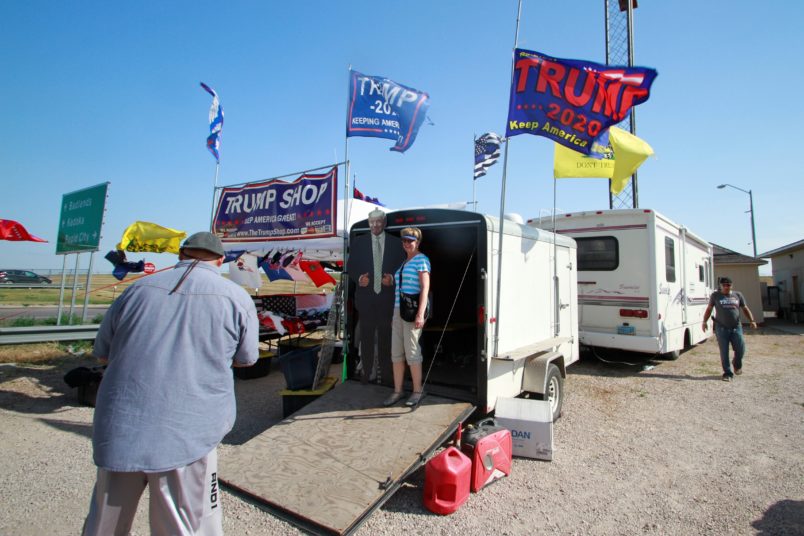
Motorcycle riders on their way to the Sturgis Motorcycle Rally stop at a stand selling Trump displays in Wall, S.D., on Saturday, Aug. 8, 2020. (AP Photo/Stephen Groves)

To make his appeal, Cox enlisted scantily-clad female bartenders to join his nightly “Trump rallies” atop bars at One Eyed Jack’s Saloon. Most of the rallies consisted of reciting the Pledge of Allegiance and singing the national anthem. As members of the predominantly male audience removed their hats, one bartender who was topless except for a pair of strategically placed American flag stickers performed the Star-Spangled Banner in sign language.

“If you live in Wisconsin, North Carolina, Arizona, Ohio, Pennsylvania or Florida the campaign needs you to double-down because those are the states that we need to carry this thing,” Cox bellowed to the crowd.

Cox’s list of battleground states contained a tacit acknowledgment that many places Trump carried in 2016 are now in doubt. But his praise for the president drew cheers from the crowd, a display of Trump’s lasting favor among those who still see him as an outsider in defiance of the political elite.

“Trump tapped into all this fear and anger and frustration,” said Bill Thompson, a sociologist at Texas A&M University at Commerce who studies biker culture. “Man, he’s a master at whipping that up.”

Bikers listen to the national anthem during a Bikers for Trump event at the Sturgis Motorcycle Rally in Sturgis, S.D., on Friday, Aug. 7, 2020. (AP Photo/Stephen Groves)

Cox, who started the group in 2015, has shown a knack for generating political drama. He gained media attention during the 2016 election for assembling a quasi-security force at rallies and forming what he called a “wall of meat” to keep protesters from disrupting Trump’s inauguration. More recently, he has enlisted bikers to give Amish and Mennonite Trump supporters motorcycle rides to rallies in Pennsylvania.

Since the last election, Cox has tried to build Bikers for Trump into a political machine, registering a political action committee. Its Facebook group has more than 350,000 followers, and 180,000 people have signed up for a mailing list. Cox did not give numbers on how many had registered to vote.

Turning bikers into voters could prove difficult. Cox experienced that firsthand this year when his bid to represent South Carolina in Congress got less than 10% of the vote in the Republican primary.

“A lot of people want to participate, wearing T-shirts or maybe waving flags,” he said. “But the only way to really raise the bar and move the needle is to identify people who otherwise don’t vote and get them to vote.”

Chris Carr, the Trump campaign’s political director, urged members of the crowd at a rally Thursday to get their neighbors registered to vote.

“Chris Cox right here is a huge ally,” Carr said. “The president loves this man.”

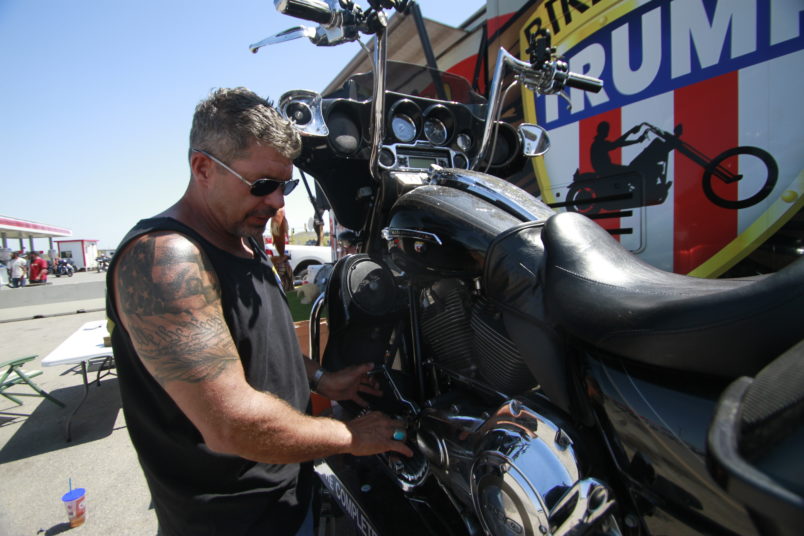
Chris Cox, the founder of Bikers for Trump, examines his motorcycle on Saturday, Aug. 8, 2020, outside the Bikers for Trump trailer he brought to the Sturgis Motorcycle Rally, in Sturgis, S.D. (AP Photo/Stephen Groves)

With hundreds of thousands of people rumbling into Sturgis through this weekend, Cox may be in the right place to reach the suburban voters that the Trump campaign is desperate to win over. Despite the stereotype of the grizzled, tattooed biker, a significant number are what’s known as “Rolex riders,” professionals who can afford to travel across the country with expensive motorcycles. A growing number are female, college-educated and married, according to the Motorcycle Industry Council.

Cox said that women, including those from the suburbs, are willing to overlook Trump’s character to vote for his economic policies and support for law enforcement.

“It’s not always about liking the leadership, but it’s more about respecting the leadership and seeing the direction of your future,” Cox said.

Genevieve Schmitt, who founded an online biker magazine called Women Riders Now, said that she sees just as many liberals as conservatives among women riders. They often see the sport as an “expression of freedom, independence, to express herself in the outdoors,” she said.

“If you start to throw flyers at her, whatever side you are on, they kind of just turn their nose up at it,” Schmitt said. “They just want to ride.”

Cox also tried to brush aside criticism of Trump’s handling of the COVID-19 crisis. Cox called it a “plandemic, not a pandemic,” suggesting a misguided notion that the coronavirus crisis is politically motivated and will disappear.

That message may resonate with some bikers, who echoed the sentiment that the coronavirus is not as serious as health experts have warned.

“If you’re going to get it, you’re going to get it,” said Linda Harrison, who came from Ohio. “Deal with it.”

But even at the Sturgis rally, where displays opposing Hillary Clinton were common in 2016, there was an undercurrent of exasperation with the president this year.

Phillip Geary, a rallygoer from Washington, strolled the streets in a “Make America Kind Again” T-shirt. He said that he had gotten fist bumps amid the leather-clad crowd, and someone even bought him lunch.

“I think there’s more sentiment against the president,” he said. “It’s just beneath the surface, beneath the facade.”

Acting DHS Sec. Wolf And Deputy Cuccinelli Aren’t Valid Office-Holders, GAO Finds

The top officials at the Department of Homeland Security don’t have any legal basis to be doing those jobs, a congressional watchdog said Friday, strengthening the foundation for legal challenges to the Trump officials’ decisions in office.

Continue reading “Acting DHS Sec. Wolf And Deputy Cuccinelli Aren’t Valid Office-Holders, GAO Finds” →

Where Things Stand: Concrete Plans To Challenge The Election

Like any good manipulator, President Trump has been signaling for weeks that he plans to be very mad about the election. The preemptive complaints about mail-in voting, the race-baiting, the showy displays meant to signal law-and-order — he’s building a sturdy base narrative to stand on when things don’t go his way in November.

The Trump Administration Is Predicting a Drastic Drop in Demand for US Visas for Years to Come

This article first appeared at ProPublica. ProPublica is a Pulitzer Prize-winning investigative newsroom. Sign up for The Big Story newsletter to receive stories like this one in your inbox.

The Trump administration is predicting years of dramatically reduced international demand for U.S. visas, and planning for drastic budget cuts to visa services worldwide as a result, according to an internal memo seen by ProPublica.

The projections made by the U.S. State Department in a memo signed by Secretary of State Mike Pompeo on Monday contrast with the rosier outlook expressed repeatedly by President Donald Trump. As recently as Aug. 5, Trump predicted that the coronavirus “will go away” and that a vaccine will be available before the end of the year. But internally, the memo shows, the government is planning for the pandemic to drastically reduce international travel to the U.S. through at least 2022.

The memo projects steep reductions, in particular, to non-immigrant visas. Trump has issued restrictions on some categories of non-immigrant visas, citing the economic impacts of the pandemic, but the majority of non-immigrant visas processed by the State Department are temporary visas for business travel and tourism.

The memo outlines several ways the agency is cutting costs, including expanding a hiring freeze, which it acknowledges will affect consulates’ ability to process visa applications.

A State Department spokesman, Noel Clay, declined to comment on internal communications.

Fees collected to process visa applications from people hoping to visit or move to the United States, as well as passport application fees paid by U.S. citizens, bring in around $3.5 billion a year to the State Department. Those fees pay for U.S. consular operations worldwide. The near-total halt to visa and passport services will drive that down by $1.4 billion this year, senior State Department official Ian Brownlee told a congressional committee last month.

International travel collapsed this spring as the coronavirus spread. The number of people going through security checkpoints run by the Transportation Security Administration fell by 95% on some days in April, compared with the prior year, according to TSA data. Many consulates around the world were shut down entirely for much of the spring and summer, or closed for all but emergency appointments. Between the operations shutdown and the collapse in demand, visa approvals plummeted from over 670,000 in January to around 45,000 in April (with similar numbers in May and June, the last month for which the State Department has statistics available).

At the same time, vast differences between Democrats, Republicans and the White House over the scale and scope of new coronavirus relief funding have dimmed hopes for any additional aid to make up for the massive disruptions caused by the coronavirus. That affects both the State Department’s projections of future demand and its prospects for direct aid from Congress to make up the shortfall.

“International travel has become a shadow of what it was even a few short months ago,” said the State Department memo, also known as a cable. “We anticipate having to make very difficult trade-offs in the face of reduced revenue.”

State Department officials predict an 82% drop in visa applications in 2021 compared with 2018, according to data provided in the cable. Even into 2022, the administration is preparing for 2.6 million applications, around 22% of the over 12 million applications made two years ago.

The administration is responding in part by freezing the consular hiring of diplomats’ family members, the memo said, in addition to a freeze on the hiring of local staff, which it implemented in March. Family-member employment by embassies and consulates is a popular program that often provides the only available work options for the spouses of diplomats, depending on the country they are assigned to.

“If you’re telling officers, your spouse no longer has a job opportunity, I think it really just hurts morale,” said Chris Richardson, a former U.S. consular officer who is now an immigration lawyer.

The cable asked consulates to find cost savings at their posts, and it said the State Department is cutting back on greeters, reducing call center hours and closing sites in Mexico, Brazil and Colombia that collect biometric data from applicants.

The State Department memo acknowledges that the family-member hiring freeze “will likely have an impact on posts’ processing capacity.”

A similar crisis is affecting U.S. Citizenship and Immigration Services, under the Department of Homeland Security, where three-quarters of the workforce face a furlough if Congress cannot make up a $1.2 billion shortfall by the end of August.

“Across the immigration system, cuts are a pressing problem,” said Sarah Pierce, a policy analyst at the nonpartisan Migration Policy Institute. “At some future date when demand for immigration increases, our system will be woefully inadequate to meet it. This was already true for refugee resettlement and USCIS, and now the State Department.”

At both USCIS and the State Department, fee revenues are down due to a combination of Trump administration restrictions on immigration and travel, and the drop in demand caused by the pandemic. It is unclear what assumptions the State Department is making in its estimates, however — and it’s possible that lifting or reversing restrictive Trump policies could result in higher application levels and higher revenues.

Even before the pandemic hit, the number of applications for non-immigrant visas fell nearly 4% between 2018 and 2019, according to figures provided in the cable.

“To me it feels very much like a continuation of the current atmosphere, where they anticipate there will be bans,” Richardson said. “They anticipate all of Trump’s immigration regulations to remain in effect.”

The existing U.S. visa system is antiquated, slow and shuts out thousands of tourists, workers and students each year, argued Bethany Milton, a former U.S. foreign service officer, in a recent opinion piece. She called for the successor to the Trump administration to take advantage of the pause in international travel to create a “modernized and equitable visa process.”

The drastic decline the State Department is projecting is only possible if demand for international business travel and tourism to the U.S. remains severely depressed for the next two years, above and beyond any restrictions imposed by the administration.

An executive proclamation signed by Trump in late May barred people from coming to the U.S. on certain temporary work visas through the end of 2020. The categories of visas most affected made up around 10% of all visa approvals under pre-pandemic conditions, according to a ProPublica analysis of State Department data. Tourist visas, for personal travel, business travel or both, make up over 60%.

Those visas aren’t directly affected by presidential policies. But demand for them will likely remain low as long as the U.S. fails to contain the coronavirus. Many countries require people to self-quarantine upon return from the U.S.

In March, Congress gave the State Department an extra $588 million ($264 million in an initial emergency spending package and $324 million in the CARES Act) to pay for coronavirus-related “diplomatic programs” expenses, including maintaining consular operations. But that is far too little to make up for the near-shutdown in visa applications. The extra money was also supposed to pay for evacuations and emergency preparedness.

In fact, the cable obtained by ProPublica explicitly warns employees not to dip into the “diplomatic programs” fund in order to cover shortfalls in the Consular and Border Security Programs account where they anticipate the shortfall to be greatest.

A Senate Democratic aide said on condition of anonymity that congressional officials for months had raised concerns with State Department leadership about the impending budget crunch. Until recently, the agency’s top officials were “oblivious or not caring.” Legislators hoped to include provisions in the next stimulus bill to address and alleviate the shortfalls, the aide said.

But negotiations over a new round of stimulus have fallen apart in recent weeks, and the prospects for any further relief look dim.

“I’m not sure anyone should go to the bank right now on anything that might happen soon from the Hill,” the aide said.

There’s at least one task, though, that the memo’s authors don’t want consulates to cut back on entirely. The memo instructs consulates to continue travel to investigate “urgent cases” of potential immigration fraud.