Bundy Arrested At Idaho Statehouse, Wheeled Away By Cops While Sitting In Office Chair

BOISE, Idaho (AP) — Authorities on Tuesday arrested anti-government activist Ammon Bundy at the Idaho Statehouse after he refused to leave a meeting room where a few hours earlier angry protesters forced out lawmakers.

Bundy didn’t respond to a reporter’s shouted questions as he was wheeled into an elevator in a chair he apparently refused to get out of. At least two others were also arrested after police cleared the room, and they also refused to follow police commands to leave. Another person was taken into custody earlier in the same room where protesters shouted down lawmakers.

The incident follows another on Monday when angry protesters forced their way into the Idaho House gallery that had limited seating because of the coronavirus pandemic, the window of a glass door getting shattered as protesters jostled with police. Protesters were ultimately let in when Republican House Speaker Scott Bedke stepped in, seeking to avoid violence.

Lawmakers are meeting in a special session called by Republican Gov. Brad Little because of the coronavirus pandemic. Bundy and other protesters are opposed to a proposed liability law intended to shield schools, businesses and government entities from lawsuits from people who get COVID-19. Some lawmakers also oppose the legislation they say will remove accountability.

Tuesday’s unrest started when the committee chairman, Republican Rep. Greg Chaney, directed two people sitting in an area reserved for credentialed members of the media to leave those seats. Press credentials are controlled by the Capitol Correspondents Association.

“I’m not sure precisely what their goal is, but I’m absolutely sure that the two individuals whom I asked to leave were intending to create a scene,” he said. “At times in the last 24 to 36 hours, this building has descended into complete chaos, and the only way to make sure that all citizens feel comfortable coming here to be heard is to make sure that we don’t allow rule deviations in general.”

The committee considering that legislation left the meeting room as at least a dozen Idaho State Police formed a shield between them and the crowd of more than 100.

Bundy, who led the 2016 occupation of the Malheur National Wildlife Refuge in Oregon, took one of the credentialed media seats after lawmakers left the room. He said police and lawmakers were itching to exert their authority after Monday’s incident. He said he hadn’t instructed anyone to disrupt the meeting, and he challenged those who qualified as a credentialed member of the media.

“What does credentialed mean? Who is the freedom of the press for? Those who have credentials? No, it’s not,” he told The Associated Press. “The freedom of the press is a protection for the people. Your credentials are great, and I think you guys do a much better job at it than we do, but the fact is the government is not supposed to say this person has the freedom of the press and has a right to be in a certain place and these people don’t.”

The committee convened later in the day in a different room with heavy security and approved a public hearing for the liability legislation.

Meanwhile, another committee earlier in the day killed legislation intended to allow greater opportunity for in-person voting for the Nov. 3 general election amid the coronavirus pandemic.

The House State Affairs Committee voted 10-5 to kill the legislation that was a primary reason Republican Gov. Brad Little called the part-time Legislature back for a special session.

The legislation would have allowed counties to create voting centers where residents from different precincts could vote. Elections officials say they are facing a shortage of poll workers and potentially polling sites in November because of the pandemic.
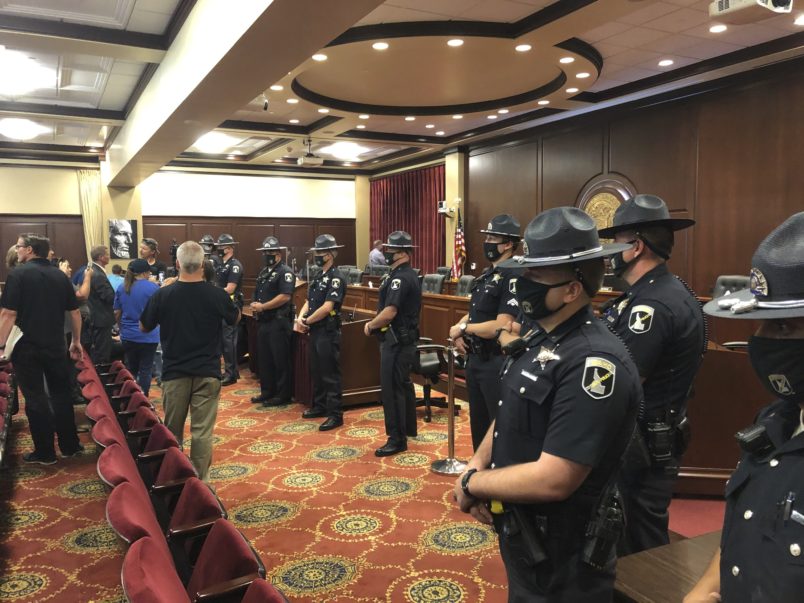
Idaho State Police form a row in a committee meeting room in the Idaho Statehouse in Boise, Idaho, on Tuesday, Aug. 25, 2020. One person was taken into custody and lawmakers abandoned the room after spectators at a House committee meeting at the Idaho Statehouse became disruptive. The committee left the room as at least a dozen Idaho State Police formed a shield between them and the crowd of more than 100. (AP Photo/Keith Ridler)

The Falwell Endorsement at the Time

As I’ve mentioned a few times, today it seems obvious that an evangelical leader like Jerry Falwell, Jr. would endorse and support President Trump. After all, almost every major conservative evangelical leader strongly supports President Trump. But it wasn’t like that back in late 2015. Trump’s irreligion and libertinism were obvious obstacles to becoming the candidate of conservative evangelicals. Perhaps the iron alliance we’ve now known for four years was always in the cards. But Jerry Falwell’s endorsement – in January 2016 – was a key bridge to getting there.

With that in mind I thought I’d go back and look at press coverage at the time, without the gloss and overlay of subsequent events. Remember that at this moment Trump was locked in a pitched battle for evangelical voters in Iowa with Ted Cruz, then a leading candidate of the evangelical right. Falwell had actually allowed Cruz to launch his campaign at Liberty University back in March 2015. Cruz would win the battle in Iowa – he came in first and Trump second. But of course he would lose the war.

Let me share a few snippets.

Marjorie Greene Says She Was Invited To The WH For Trump’s Acceptance Speech

Marjorie Greene, a QAnon supporter who is likely headed to Congress this fall, tweeted Tuesday that she had been invited to the White House for President Donald Trump’s Republican National Convention acceptance speech.

Continue reading “Marjorie Greene Says She Was Invited To The WH For Trump’s Acceptance Speech” →

House Investigating As Pompeo Prepares To Speak At RNC In Violation Of Own Policy

A House committee announced Tuesday that it will be investigating Secretary of State Mike Pompeo due to a speech he’ll be giving at the Republican National Convention in direct violation of his own guidance.

Continue reading “House Investigating As Pompeo Prepares To Speak At RNC In Violation Of Own Policy” →

Draw Distinctions in Response to Police Shootings

If I were younger and living in Kenosha, Wisconsin, I would have been in the streets protesting the police shooting a Black man in the back as he got into a car with his three children already seated there. There may have been extraordinary extenuating circumstances, but based on the video, it would seem that this was as egregious an act as the killing of George Floyd and that the officers involved should be prosecuted and that the city’s police department dramatically reformed. Continue reading “Draw Distinctions in Response to Police Shootings” →

After Sturgis Motorcycle Rally, Health Officials Worry That COVID-19 Will Move Far, Fast

SIOUX FALLS, S.D. (AP) — The hundreds of thousands of bikers who attended the Sturgis Motorcycle Rally may have departed western South Dakota, but public health departments in multiple states are trying to measure how much and how quickly the coronavirus spread in bars, tattoo shops and gatherings before people traveled home to nearly every state in the country.

From the city of Sturgis, which is conducting mass testing for its roughly 7,000 residents, to health departments in at least eight states, health officials are trying to track outbreaks from the 10-day rally which ended on Aug. 16. They face the task of tracking an invisible virus that spread among bar-hoppers and rallygoers, who then traveled to over half of the counties in the United States.

An analysis of anonymous cell phone data from Camber Systems, a firm that aggregates cell phone activity for health researchers, found that 61% of all the counties in the U.S. have been visited by someone who attended Sturgis, creating a travel hub that was comparable to a major U.S. city.

“Imagine trying to do contact tracing for the entire city of (Washington), D.C., but you also know that you don’t have any distancing, or the distancing is very, very limited, the masking is limited,” said Navin Vembar, who co-founded Camber Systems. “It all adds up to a very dangerous situation for people all over the place. Contact tracing becomes dramatically difficult.”

State health departments have reported 103 cases from people in South Dakota, Minnesota, Wisconsin Nebraska, Montana, North Dakota, Wyoming and Washington. Health officials in South Dakota have said they don’t know how many people were exposed and have issued public warnings of possible COVID-19 exposure at five businesses popular with bikers.

South Dakota Gov. Kristi Noem, a Republican, has defied calls to cancel large gatherings and opposes requirements to wear masks. She welcomed the event, which in previous years brought in about $800 million in tourist spending, according to the state’s Department of Tourism.

“I sat at a bar elbow-to-elbow with guys. No one was wearing masks,” said Stephen Sample, a rallygoer who rode back to Arizona last week.

He had visited a bar where health authorities later issued warnings — One-Eyed Jack’s Saloon — but said he had not had any COVID-19 symptoms. He discussed quarantining with his wife after he returned, but decided against it.

Other bikers said they had gotten tested for COVID-19 after they returned home and received negative results.

In a country where each state has been tasked with doing the heavy-lifting of responding to the pandemic, tracing every infection from the rally is virtually impossible. But the city of Sturgis is doing what it can to head off a local outbreak by holding mass testing for asymptomatic people.

The city, which is a sleepy tourist destination for most of the 355 days of the year outside the rally dates, was a reluctant host this year. After many residents objected to holding the rally during a pandemic, city leaders decided to pay for mass testing with money they had received as part of federal coronavirus relief funding.

About 850 people will be tested, according to Daniel Ainslie, the city manager.

On Monday morning, Linda Chaplin drove with her husband to get tested in the parking lot of the Sturgis Community Center. They had left town during the rally, but the crowds that came before and after concerned them.

While the results from the test will take a couple days to process, the region is already seeing an increase in coronavirus cases.

“For a long time, people would say, ‘Well, do you know anybody that has COVID?’ and I would say, ‘No, I don’t, but I’m watching the news,'” Chaplin said. “Now, I do know some people that we’ve heard have COVID.”

While Chaplin said the people she knows who have been infected had not participated in the rally, she said that many residents were relieved it’s over.

But like many places across the country, the city is trying to navigate the tension between health and economic concerns. Some residents, like Eunice Peck, were not concerned about the potential for an outbreak. She rented her home out to rallygoers as a way to make extra money. She had avoided the crowds that fill the city’s downtown and didn’t feel the need to get a test.

“It’s a very good thing for the town,” Peck said of the rally.

But events like Sturgis concern health experts, who see infections spreading without regard to city and state boundaries. Without a nationally-coordinated testing and tracing system, containing infections in a scenario like Sturgis is “almost impossible,” said Dr. Howard Koh, a professor at the Harvard School of Public Health who worked at the Department of Health and Human Services under former President Barack Obama.

“We would need a finely orchestrated national system and we are far from that,” he said. “We are really witnessing a 50-state effort with all of them going in different directions right now.”

Kris Ehresmann, infectious disease director at the Minnesota Department of Health, on Friday advised people to quarantine for two weeks if they attended the rally.

She said, “We’re expecting that we’re going to see many more cases associated with Sturgis.”

____

Follow Stephen Groves on Twitter: https://twitter.com/stephengroves

Pompeo Flouts His Own State Department Guidance To Speak At GOP Convention

WASHINGTON (AP) — Secretary of State Mike Pompeo sent a cable to all U.S. diplomatic missions last month warning American diplomats that under federal law they should not take overt sides in the presidential campaign. On Tuesday, he plans to ignore his own warning by speaking to the Republican National Convention endorsing President Donald Trump for a second term.

Pompeo’s message to State Department employees reminding them of restrictions on political activity under the Hatch Act was not unusual. Similar, if not identical, cables have been sent by successive secretaries of state every presidential election year. None of his predecessors, however, has disregarded those instructions so obviously.

Despite State Department assurances that Pompeo will be speaking to the convention in his personal capacity and won’t violate the Hatch Act, Democrats and other critics have cried foul. They accuse the country’s top diplomat of inappropriate political behavior that has been anathema to his predecessors and of trashing his own admonition to State Department staffers.

“The department works to advance the national interest abroad on behalf of all Americans in a non-partisan fashion,” Pompeo said in the July 24 cable. Known as an ALDAC, short for the distribution list to “ALL DIPLOMATIC AND CONSULAR” posts, the cable was sent over Pompeo’s signature as are all such messages from State Department headquarters.

“It is important to remember that in order to avoid any confusion or misperception in this regard, the department’s longstanding policy is that U.S. citizen employees and family members may not engage in partisan political activity while posted or on TDY abroad, even on personal time,” the cable said. TDY is an acronym for Temporary Duty.

“Similarly, presidential and political appointees and career (senior executives) are subject to significant restrictions on their political activity; they may not engage in any partisan political activity in concert with a partisan campaign, political party, or partisan political group, even on personal time and outside of the federal workplace,” the cable said.

The cable was released late Monday by Rep. Eliot Engel, D-N.Y., the chairman of the House Foreign Affairs Committee and a fierce Pompeo critic who is engaged in multiple battles with the secretary over what he believes to be inappropriate and possibly illegal partisan behavior. The Associated Press obtained a copy of the cable independently and verified its authenticity.

“Once again, the rules go out the window for Secretary Pompeo when they get in the way of serving his political interests and Donald Trump,” Engel said in a statement. “Mr. Pompeo should show real respect for American law, diplomacy, and diplomats, and should follow his own guidance, cancel the speech, and watch the RNC from his hotel room after the workday is done.”

The State Department has defended Pompeo’s decision to appear at the convention. Officials have noted that Hatch Act rules for Senate-confirmed political appointees like the secretary are slightly less restrictive than those for rank-and-file diplomats.

“Secretary Pompeo will address the convention in his personal capacity,” the department said. “No State Department resources will be used. Staff are not involved in preparing the remarks or in the arrangements for Secretary Pompeo’s appearance. The State Department will not bear any costs in conjunction with this appearance.”

Meanwhile, a person close to Pompeo said four teams of lawyers, including the State Department legal counsel, have reviewed the speech that will be recorded in Jerusalem and broadcast in prime-time at the Republican convention on Tuesday to ensure that it does not cross ethical lines. The person was not authorized to discuss the matter publicly and spoke on condition of anonymity.

That person and the State Department said no taxpayer money was used in the production of the video, which was filmed in Jerusalem on Monday on the first stop of a multi-nation trip to the Middle East that is dominated by official government business.

“Looking forward to sharing with you how my family is more SAFE and more SECURE because of President Trump,” Pompeo tweeted after the RNC announced his appearance. The State Department followed quickly with comments distancing the agency from the planned remarks.

The person close to Pompeo said the short address would focus on Trump’s accomplishments in making Americans and the world safer and promoting his “America First” foreign policy. The speech will not delve into Pompeo’s own activities as secretary of state, the person said. Pompeo is likely to tout Trump’s Mideast policies and the recent agreement between Israel and the United Arab Emirates to normalize relations.

Critics, though, say Pompeo is violating the spirit, if not the letter, of the Hatch Act by using government resources to travel to the venue and jeopardizing long-standing tradition that domestic politics ends at the water’s edge when it comes to diplomacy.

At the same time, they complain that in using Jerusalem as the venue, Pompeo is further politicizing the U.S.-Israel relationship with a pitch for Trump’s reelection.

“It is unprecedented and highly unethical for a sitting secretary of state to address a political convention while on official foreign travel,” said Halie Soifer, the head of the Jewish Democratic Council of America. “In addition to violating the Hatch Act, Secretary Pompeo’s plans to speak at the Republican National Convention from Jerusalem underscore the president’s ongoing effort to politicize the U.S.-Israel relationship.”

Trump has proudly claimed the mantle of being America’s most pro-Israel president ever and as proof pointed to his decisions to recognize Jerusalem as the capital of the Jewish state, move the U.S. Embassy to the holy city from Tel Aviv, recognize Israeli sovereignty over the Golan Heights and sideline the Palestinians. Such actions have won him high praise from conservative Israelis and American Jews but also appealed strongly to evangelical Christians in the United State whose support Trump is counting on in November.

While previous secretaries of state have naturally supported the policies of the presidents they served, they have steered clear of public political endorsements, sometimes going to great lengths to avoid their parties’ conventions.

Previous secretaries of state have shunned overtly partisan rhetoric, and some have made a deliberate point of being out of the country and unavailable during their political parties’ presidential nominating events.

Like two of his predecessors, John Kerry and Hillary Clinton, both of whom were unsuccessful Democratic Party nominees for president, Pompeo was a member of Congress before joining the executive branch. But both Clinton and Kerry eschewed the Democratic National Convention while they served as America’s top diplomat.

When President Barack Obama was officially nominated for a second term during the party convention in 2012, Clinton was half a world away, traveling to the Cook Islands, Indonesia, China, East Timor, Brunei and far eastern Russia. When Clinton was nominated in 2016, Kerry was traveling in Europe and Southeast Asia.

It’s not just Democrats. When Republicans nominated John McCain in 2008, Secretary of State Condoleezza Rice was on a trip to Portugal, Libya, Tunisia, Algeria and Morocco.

US Finally Speaks On Alleged Poisoning Of Putin Critic

MOSCOW (AP) — The Kremlin brushed off allegations Tuesday that Russian opposition leader Alexei Navalny was the victim of an intentional poisoning orchestrated by authorities and said there were no grounds for a criminal investigation so far since it hasn’t been fully established what caused the politician to fall into a coma.

The insistence by the Russian government that Navalny wasn’t necessarily poisoned — comments amplified by Russian doctors and pro-Kremlin media — came a day after doctors at a German hospital where the 44-year-old is being treated said tests indicated he was poisoned.

Moscow’s dismissals elicited outrage from Navalny’s allies, who say the Kremlin was behind the illness of its most prominent critic.

Kremlin spokesman Dmitry Peskov said the accusations against the government “absolutely cannot be true and are rather an empty noise.”

“We do not intend to take it seriously,” Peskov said.

Peskov said he saw no grounds for launching a criminal investigation at this stage, saying that Navalny’s condition could have been triggered by a variety of causes and determining what it was should come before such a proble..

“If a substance (that caused the condition) is found, and if it is determined that it is poisoning, then there will be a reason for an investigation,” Peskov said.

Navalny, a politician and corruption investigator who is one of Putin’s fiercest critics, fell ill on a flight back to Moscow from Siberia on Thursday and was taken to a hospital in the city of Omsk after the plane made an emergency landing.

Over the weekend, he was transferred to the Charité hospital in Berlin, where doctors on Monday said they have found indications of “cholinesterase inhibitors” in his system.

These act by blocking the breakdown of a key chemical in the body, acetycholine, that transmits signals between nerve cells. Navalny is being treated with the antidote atropine.

Navalny’s wife, Yulia Navalnaya, has been visiting her husband daily and made no comment to reporters as she arrived Tuesday.

Chancellor Angela Merkel personally offered Germany’s help in treating Navalny and has called for a full Russian investigation — a sentiment echoed Tuesday by officials from the United States, France and Norway.

U.S. Secretary of State Mike Pompeo said that if reports about Navalny’s poisoning “prove accurate, the United States supports the EU’s call for a comprehensive investigation and stands ready to assist in that effort.”

In response to statements from European officials, the speaker of the State Duma, Russia’s lower parliament house, charged Tuesday that Navalny’s condition could have resulted from a Western plot.

Duma speaker Vyacheslav Volodin in tasked lawmakers to look into what happened to Navalny to make sure it wasn’t “an attempt by foreign states to inflict harm on the health of a Russian citizen and create tension in Russia” in order to ”come up with more accusations” against the country.

Charité said Monday that Navalny had undergone extensive examination by a team of physicians and that “clinical findings indicate poisoning with a substance from the group of cholinesterase inhibitors.”

That covers a broad range of substances that are found in several drugs, but also in pesticides and nerve agents. Charité said the specific substance to which Navalny was exposed isn’t yet known but that a further series of comprehensive tests had been started.

The suggestion that Navalny was poisoned has been vehemently rejected in Russia, where a number of Kremlin critics fell victims to suspected poisonings in recent years, since last week. Government officials, medical specialists and state-controlled media offered a variety of possible explanations for Navalny’s condition.

Doctors in Omsk, a city in Siberia where Navalny was first hospitalized, ruled out poisoning as a diagnosis 24 hours after the politician was admitted and said “a metabolic disorder” was a likely diagnosis.

The editor-in-chief of the RT state-funded TV channel, Margarita Simonyan, speculated that the politician must have suffered from a sharp drop in blood sugar. Some pro-Kremlin news outlets alleged that Navalny mixed moonshine with sleeping pills.

The Charité statement on Monday prompted another array of denials.

The chief intensivist with Russia’s Heath Ministry, Igor Molchanov, questioned whether detecting “substances affecting cholinesterase” five days after Navalny fell ill was at all possible.

Doctors in Omsk said they tested the politician for cholinesterase inhibitors and didn’t find any.

Peskov said Tuesday that specialists in Omsk noted “lowered levels of cholinesterase” — an obstruction of cholinesterase enzymes can be detected by blood tests, experts say — in his body in a matter of “hours” after he was brought in, but that it could have been triggered by a number of causes, including by “taking various medications.”

Navalny’s spokeswoman, Kira Yarmysh, on Tuesday said the government’s reluctance to launch an investigation was expected.

“It was obvious that the crime would not be properly investigated and a culprit found. However, we all know perfectly well who that is,” Yarmysh tweeted.

Western experts have cautioned that it is far too early to draw any conclusions about how the agent may have entered Navalny’s system, but note that Novichok, the Soviet-era nerve agent used to poison former Russian spy Sergei Skripal and his daughter in Britain, was a cholinesterase inhibitor.

“Cholinesterase inhibitor poisons can be given in many ways, they can be transported in many forms, and are very potent,” said Dr. Richard Parsons, a senior lecturer in biochemical toxicology at King’s College London. “This is why they are a favored method of poisoning people.”

Dr. Thomas Hartung, of the Johns Hopkins Bloomberg School of Public Health in Maryland, said such substances are easy to detect, even days and weeks after the poisoning, and that “we will know soon which substance was used.”

“The Novichok nerve agents, used in the 2018 poisoning of the Russian double agent Skripal in England, also belong to this category of substance,” he said. “I said at the time that the Russians could have have just left a business card at the crime scene, because the substances can be so clearly traced.”

___

David Rising reported from Berlin. Angela Charlton in Paris contributed to this report.