Top Election Official Rips Arizona GOP’s Sham Election ‘Audit’ In Scathing Preview

A lot of things happened. Here are some of the things.

This Audit Is Bad And You Should Feel Bad

Arizona Secretary of State Katie Hobbs released an analysis of the state Senate GOP’s incoming report from its so-called “audit” of the 2020 election results carried out by Cyber Ninjas, a firm led by a pro-Trump conspiracy theorist.

  • In her 46-page analysis, Hobbs ripped the “audit” for:
    • “lack of security and chain of custody procedures”
    • “lack of transparency”
    • “lack of consistent, document quality control practices, policies, and procedures”
  • There are “numerous examples of failures” in Cyber Ninjas’ review process, Hobbs said.
    • “Any one of these issues would deem an audit completely unreliable, but the combination of these failures renders this review meritless.”
  • Hobbs pointed out that the primary reason for the audit was Republicans’ refusal to accept the election results that led to Trump’s solid defeat.
    • As a result, they held an audit that “undermined public confidence in accurate and secure elections that were conducted in 2020.”
  • Stephen Richer, Maricopa County’s GOP county recorder and top elections official, also released a fiery prebuttal to the audit flatly rejecting his fellow Republicans’ stolen election narrative.
    • “Nobody stole Maricopa County’s election. Elections in Maricopa County aren’t rigged,” he wrote.
  • The audit report is expected to be released soon.

Oregon Requires Teachers To Get Vaccinated

All teachers and other staff in Oregon’s K-12 schools, both public and private, must be vaccinated for COVID-19, Gov. Kate Brown (D) announced during a press briefing yesterday.

  • Washington, California and Hawaii have similar vaccine mandates for teachers but vary between allowing weekly testing as an alternative to receiving the vaccine and whether university educators are included in the mandate, as is the case with Washington.

School Board Member Peddles Wack COVID-19 Conspiracy Theories

David Banks, the vice chair of Georgia’s Cobb County school board, has been emailing parents mind-boggling conspiracy theories about the virus from his official account.

  • The emails allege, among other things, that White House COVID-19 expert Anthony Fauci paid a Chinese lab to research COVID-19, and that vaccines for the virus have toxic chemicals that “penetrate the brain with injury, and infect the entire human body.”
  • CNN also received an email on “useless” masks from Banks’ account that cited a “study” that was actually just tweets from some entrepreneur in Texas.
  • “Nothing has been debunked,” Banks told a parent who had replied to his email by debunking the misinformation he was pushing.

A Harrowing Image

The city of Jacksonville, Florida confirmed to local outlet First Coast News that this Reddit photo of several COVID-19 patients curled up in agony in the Jacksonville Public Library while awaiting Gov. Ron DeSantis’ (R) touted monoclonal antibody treatment is real:

Texas Lt. Gov. Dan Patrick Goes Fully Mask Off

COVID Hits Vaccinated Senators

Sens. Roger Wicker (R-MS), Angus King (I-ME) and John Hickenlooper (D-CO), who have all been fully vaccinated, announced yesterday that they tested positive for the virus.

  • All of them reported experiencing only mild symptoms.
  • That’s four senators in total who have had breakthrough cases of COVID-19. Sen. Lindsay Graham (R-SC) was the first in early August.

Wow!

A jaw-dropping 95% of eligible voters in Georgia are now registered to vote, according to newly released data from the U.S. Election Assistance Commission.

  • Georgia now has one of the highest registration rates in the country. Only eight other states had higher rates.
  • Automatic voter registration at driver’s license offices was the main driver of the dramatic increase from the registration rate in 2016.

GOP Congressman Challenges Internet Rando To Literally Fight Him, Coward

Rep. Clay Higgins (R-LA) got into a Facebook pissing match with some guy in Alaska named Joel Dolphin (yes, really), during which the congressman invited Dolphin to choose a fighting arena for a throwdown when he travels to Alaska with Rep. Don Young (R-AK) next year.

  • “Locate us a ring, or a dojo,” Higgins wrote. “I’ll give you a few rounds to make your point. Be seeing you.”
  • The Republican lawmaker ended his missive with an internet mic-drop: “Higgins out.”

Meanwhile In New York

GOP New York City mayoral candidate Curtis Sliwa is out here courting the coveted pigeon vote:

Do you like Morning Memo? Let us know!
Man Who Claimed To Have Bomb Surrenders To Police Near Capitol

A man who parked a pickup truck outside the Library of Congress Thursday and threatened to detonate a bomb has surrendered to law enforcement.

Capitol Police chief Tom Manger identified the suspect as Floyd Ray Roseberry of North Carolina.

Roseberry appears to have posted videos to a now-deleted Facebook page Thursday morning in which he addresses President Biden and describes calling in a bomb threat.

A standoff stretched into the afternoon as law enforcement negotiated with Roseberry. It remains unclear whether the vehicle contained a bomb.

Follow our coverage below:

Eyewitness Who Snapped First Picture Of Would-Be Bomber Gives Her Account

Sydney Bobb, a rising senior at the University of Wisconsin, Madison, snapped the first picture to publicly circulate of Floyd Ray Roseberry, the man police have identified as the would-be bomber, outside the Library of Congress.

Continue reading “Eyewitness Who Snapped First Picture Of Would-Be Bomber Gives Her Account”

Inspired by Trump

In this video from early Tuesday morning, retrieved from Facebook by TPM, Capitol bomb suspect Ray Roseberry refers to himself and those like him as the “last generation” willing to stand up for America. He then says that Trump will be reinstated as President once Joe Biden is driven from office and Democrats are imprisoned. He says Trump will then pardon everyone and he hopes for a pardon himself.
Continue reading “Inspired by Trump”

Watch The New Episode Of The Josh Marshall Podcast: A Rough Spot

A new episode of The Josh Marshall Podcast is live! This week, Josh and Kate discuss a group of House centrists trying to decouple the infrastructure bills, the start of the redistricting process and the ongoing COVID-19 pandemic of the unvaccinated.

Watch below and email us your questions for next week’s episode.

You can listen to the new episode of The Josh Marshall Podcast here.

Videos from Capitol Bomb Threat Suspect

For the last hour I’ve been watching videos created by the suspect in the Capitol bomb threat situation. He explicitly references the fall of Kabul in an August 16th video, claims Joe Biden has given US military hardware to the Taliban.

In another video from early on August 16th he says that once Biden is driven from office, Trump will become President again. He says he expects Trump, once he becomes President again, will pardon him – presumably for whatever crime he commits coming to Washington.

“It’s time to quit Biden.”

Repeatedly refers to himself and those like him as “the last generation”. He appears to have originally planned something for Labor Day. He references having people rendezvous at a local park the Friday before Labor Day before heading north to Washington, DC.

In a video from last Tuesday night, the suspect said it would be his last video until Labor Day weekend. But in a video early this morning he seems to suggest that over night he decided to move up his schedule.

More to come.

Capitol Police Announce ‘Active Bomb Threat Investigation’ Near Library Of Congress

Editor’s note: For ongoing coverage of this breaking news story, please follow TPM’s liveblog.

U.S. Capitol police announced Thursday morning that they are conducting an “active bomb threat investigation” tied to a suspicious vehicle near the Library of Congress.

Continue reading “Capitol Police Announce ‘Active Bomb Threat Investigation’ Near Library Of Congress”

When Hotter And Drier Means More—But Eventually Less—Wildfire

This article is part of TPM Cafe, TPM’s home for opinion and news analysis. It first appeared at The Conversation.

There is abundant evidence that changes in the climate, both increased temperature and reduced precipitation, are making wildfires worse in the western U.S. The relationship between climate and wildfire seems obvious and universal: hotter + drier = more and worse wildfire.

Yet the diversity of wildland areas in the western U.S. means that not all ecosystems respond in the same way to a hotter and drier climate. Understanding how and why climate change has different effects on wildfire is essential for effective management of our natural areas.

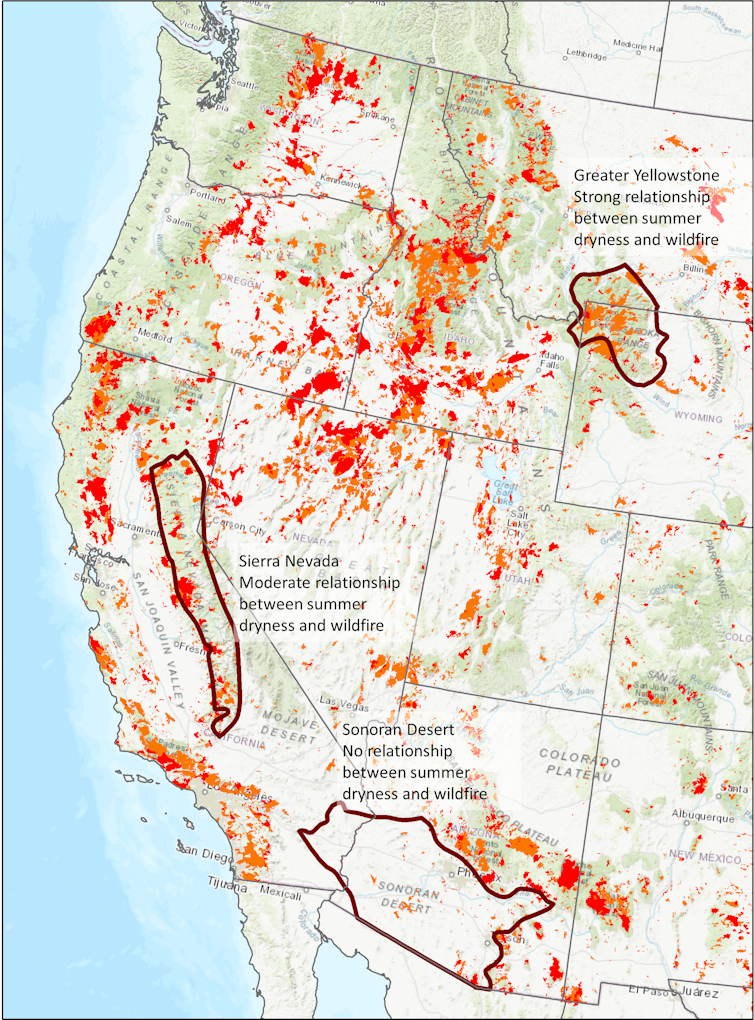
A satellite-view map showing fire area with Yellowstone, the Sierra Nevada and the Sonoran Desert ecoregions marked
All wildfires over about 12 acres in size from 1984-2019. Red indicates fires from 2010-2019.
Jeremy Littell

Why do areas respond differently?

Similar to campfires, wildfires require fuel to burn: parts of trees and shrubs, the leaves, twigs and branches. Dried grasses, too, will work. The growth of this vegetation depends on water, and water availability depends on the climate.

How hot and dry the climate is in an area influences the amount of fuel that is available to burn and the strength of the relationship between wildfire and climate. Ecologists such as us calculate how closely related wildfire area burned is to how hot and dry it is during the summer, and we have found that the relationship does indeed vary.

Areas that are historically cool and wet have a lot of fuel, but the fuel has to be dry enough to burn, so the relationship in these areas between wildfire and climate is very strong. Areas that are historically warm and dry have less fuel, often not enough fuel for a large wildfire even if it is very dry.

Let’s consider one extreme. The Sonoran Desert in Arizona is persistently hot and dry, and vegetation is sparse. The dryness of the summer, what we call the “summer water deficit,” does not control the extent and severity of wildfires. Summer is almost always hot and dry enough to burn, and how much it burns depends on the amount of fuel. No matter how much hotter and drier the climate becomes, wildfire is not going to increase unless more fuel appears on the landscape. Unfortunately, exotic grasses that are adapted to wildfire are invading much of the American Southwest, including the Sonoran Desert, providing that extra fuel.

At the other extreme are mountain forests, such as Yellowstone National Park and the surrounding area, that have abundant vegetation and fuel and are cooler and wetter. There, the amount of land that burns is strongly related to the summer water deficit. Hotter and drier summers are likely to increase wildfire activity.

What about areas in between these two extremes?

Where hotter and drier can eventually mean less fire

In California, wildfires in the dry forests of the Sierra Nevada are partly controlled by summer water deficit. For a while, hotter and drier summers are likely to increase the amount of land burned each year.

We ran computer simulations of the interactions among climate, plant growth and wildfire for one area within the Sierra Nevada. In the first decade of the simulations, an initial burst of large areas burned each year. This first pulse of wildfire burned more area in a scenario with increased drought and temperature than in the historical climate, just as we are seeing in the recent extreme fire seasons in the Sierra Nevada.

Over time, however, climate change will modify how plants grow. Persistently hotter and drier climate over decades will increase the number of dead and dying trees and decrease new growth. Eventually less fuel is available to burn as the dead trees decompose and fewer live ones replace them.

The same computer simulations show that the initial pulse of wildfires removes a lot of dense vegetation, and subsequent fires become smaller compared with fires in historical climate conditions and with increased drought and temperature. Furthermore, because hotter and drier conditions can eventually lead to less fuel development, the wildfire area burned over 60 years may be smaller with increased drought and temperature than in the historical climate.

Less wildfire due to climate change may sound like good news, but how it occurs is not necessarily a desirable outcome for these forests. In the simulations, reduced wildfire is a consequence of extreme water limitation that results in reduced forest biomass. This means less tree growth and more dying trees that eventually result in a thinner and less productive forest. If the climate changes enough, the trees may even be replaced by shrubs, which have their own unique relationship between climate and wildfire.

The problem with quickly putting out every fire

Human actions, in particular putting out every fire, have changed how dry forests burn.

Some fires are started by lightning, but Indigenous peoples burned the landscape frequently, reducing fuels, so the spread and intensity of subsequent wildfires was more limited. After European colonization, the U.S. government spent more than a century actively suppressing wildfires. As a result, many forests became choked with excess fuels. Even without climate change, excess fuels increase the wildfire hazard.

The effect of that fire suppression on current wildfire hazards can also vary from region to region.

In cooler and wetter areas, climate change can have a stronger effect on wildfires than fire suppression. These are the areas with naturally abundant fuel and strong relationships between climate and wildfire. In drier systems, where fuels were historically low and had limited wildfire spread, suppression over the past century can have a stronger effect on current wildfire hazard than in wetter areas. It is important to consider climate change, regional characteristics and land management, all of which affect the fuels that are available to burn in a wildfire.

What to do about wildfire

There is no single solution to the increasing wildfire activity and declining health of forests.

The global solution would be to slow and eventually reverse climate change. More locally, combining prescribed fires, which are intentionally set in relatively mild weather conditions, with mechanical removal of small trees and ground fuels is the best way to prevent more severe wildfires.

Increasing the use of prescribed fire or allowing wildfires to burn under safe conditions can restore some forests to be more resilient – those that have excess fuel from fire suppression – and reduce the hazards that the western U.S. is seeing now. Past wildfires can limit the spread of new wildfires by reducing the amount of vegetation and fuel available to burn.

Wildfire burn perimeters near Yosemite National Park, Calif., 2000-2019. The largest is the 2013 Rim Fire. MTBS

Over the past five years, wildfires in the U.S. burned an average of 7.8 million acres annually, which cost an average of US$2.4 billion per year to fight.

Managing forests in the face of the threat of larger, more severe wildfires in a warming climate presents a huge challenge to fire managers, given the costs of treatments and the millions of acres that could benefit from them. Plenty of wildland is still primed to burn, and understanding the intricate relationship among climate, fuels and wildfire can help managers prioritize areas where more fire will be beneficial and areas where different approaches may be preferred.


Maureen C Kennedy is an assistant professor of Quantitative Fire Ecology at the University of Washington.

Don McKenzie is a professor of Environmental and Forest Sciences at the University of Washington.

Jeremy Littell research ecologist for Climate Impacts at the US Geological Survey.

This article is republished from The Conversation under a Creative Commons license. Read the original article.