A lot of things happened. Here are some of the things.
Rosen And Donoghue Tell Their Stories
Former Acting Attorney General Jeffrey Rosen and former acting Deputy Attorney General Richard Donoghue gave testimony this weekend on then-acting civil division chief Jeffrey Clark’s attempts to weaponize the DOJ to help Trump steal the 2020 election.
Rosen and Donoghue testified in front of the Senate Judiciary Committee for more than six hours and about five hours, respectively, on Saturday. Rosen met with investigators at DOJ inspector general Michael Horowitz’s office for two hours on Friday, the New York Times reports.
Rosen reportedly told Horowitz’s investigators that he discovered Clark was having unauthorized discussions with Trump on how the DOJ could cast doubt on the legitimacy of Biden’s win.
The ex-acting attorney general also said that Clark admitted in late December that he had met with Trump and promised to Rosen not to do it again, according to the Times.
Rosen reportedly hastened to speak with Horowitz’s office and the Judiciary committee on Clark’s skullduggery before anyone, including Trump’s legal team, could stop him.
Trump’s pressure campaign against Rosen to overturn the election “was real, very real” and “very specific,” Senate Judiciary Committee Chair Dick Durbin (D-IL) told CNN on Sunday.
Sen. Richard Blumenthal (D-CT), a member of the committee, said Rosen provided “dramatic evidence of how intent Trump was in overthrowing the election,” the Times reports.
Over The Final Infrastructure Hurdle
The Senate voted 68-29 to invoke cloture on the bipartisan infrastructure bill last night, meaning we’re FINALLY set for the vote on actually passing the damn thing by Tuesday.
Meanwhile, plans to move along Senate Democrats’s weeping $3.5 trillion infrastructure proposal are moving forward: They’ll be unveiling the budget resolution today, Budget Committee chair Bernie Sanders (I-VT) told Punchbowl.
Treasury Secretary Janet Yellen will tell the Senate to lift the debt ceiling not through reconciliation but “on a bipartisan basis,” something Senate Minority Leader Mitch McConnell (R-KY) has flatly stated he and his GOP colleagues have no interest in doing.
A Key COVID-19 Vaccine Milestone
As of today,
there are more Americans fully vaccinated than there are Americans who are not
I know we have a lot of work to do to get more people the shot
Melissa DeRosa, New York Gov. Andrew Cuomo’s (D) top aide, resigned on Sunday night after state Attorney General Letitia James’ investigation found that Cuomo had sexually harassed 11 women.
“Personally, the past two years have been emotionally and mentally trying,” DeRosa said in a statement.
One of the 11 women, a Cuomo staffer who accuses the governor of groping her, has filed a criminal complaint. She spoke out in a pre-taped CBS interview earlier on Sunday, saying that “what he did to me was a crime.”
CBS THIS MORNING EXCLUSIVE: The aide who accused NY Gov. Cuomo of groping her speaks publicly for the first time: "What he did to me was a crime," Brittany Commisso tells @CBSThisMorning & @timesunion. "He broke the law." Watch Monday at 7a, only on CBS. https://t.co/W9SGPNSf1Spic.twitter.com/kRulD0ViUD
Meanwhile, Lt. Gov. Kathy Hochul (D) is quietly preparing to take the reins in case Cuomo resigns (which he has declared he will not do) or is impeached by the state Assembly (a majority of whom have said they support doing), according to the New York Times.
A Huge Wake-Up Call
Humans have driven global warming at an “unprecedented” speed and some of the changes are “irreversible,” according to an alarming new report by the Intergovernmental Panel on Climate Change (IPCC).
Limiting the warming to the 1.5°C threshold “will be beyond reach” unless “there are immediate, rapid, and large-scale reductions in greenhouse gas emissions,” one of the IPCC top officials warned.
Other climate scientists also sounded the alarm over the report:
The new IPCC 6th Assessment Report (AR6) provides an unprecedented degree of clarity about the future of our planet, and the need to reduce – and ultimately eliminate – our emissions of greenhouse gases.
In this thread I take a look at some key findings from the report: 1/27
Key analysis: “A Hotter Future Is Certain, Climate Panel Warns. But How Hot Is Up to Us.” – The New York Times
The State Of Texas Democrats’ Fight For Voting Rights
Twenty-two of the more than 50 Texas House Democrats who fled the state to kneecap the passage of their GOP colleagues’ anti-voting bill are suing Texas Gov. Greg Abbott (R) and House Speaker Dade Phelan (R).
The Democrats accuse Abbott (who has vowed to have them arrested) and Phelan (who has already signed a civil arrest warrant against one of the legislators) of violating their constitutional rights, including freedom of speech.
The lawsuit seems to be largely symbolic; the Democrats are claiming only $15 dollars in damages overall.
Trump’s Brain Worms In Action
Trump: Could you imagine if I were President right now and we had this massive attack from the Coronavirus. You know they like to call it the, they have new names and they’ll have other new names but it’s exactly what we had. pic.twitter.com/HwAqce3S60
The Senate voted Saturday afternoon to end debate on the bipartisan infrastructure bill. What happens next is unclear — a number of disputes remain over amendments. Senators’ efforts to solve those could stretch into next week as the legislation moves slowly through procedural hurdles. Or it could all wrap up much sooner.
The much-heralded bipartisan mini-bill actually seems on its way to passage in the Senate. On the critical (and mind-numbing) vote to allow a majority vote, 18 Republicans ended up voting in the affirmative. It now seems very likely that Biden will get his bipartisan deal while also managing to pass close to his entire fiscal, infrastructure and climate agenda. If that happens – and it is likely to happen notwithstanding a few more months of haggling and drama – it will be a major, major accomplishment.
Yet in a guest opinion piece Friday in The New York Times Alex Pareene argued that it is in fact a “pyrrhic victory in a broken Senate.” I’m almost never in the practice of responding to people in the Editors’ Blog. But I wanted to do so in this case because Pareene is a gifted writer and incisive political observer. So it’s important to explain why he’s wrong.
I’ve heard from a number of you about this post last night about updated data from Oregon. I realize that I was writing in shorthand and referencing points made or context discussed in earlier posts. So let me clarify a bit about what I’m trying to do here.
This article is part of TPM Cafe, TPM’s home for opinion and news analysis.
In 1991 Los Angeles Times Pulitzer Prize-winning syndicated sports columnist Jim Murray called Milt Campbell “as magnificent an athlete as anyone who came before or after him.” Nine years later, the legendary Olympic filmmaker Bud Greenspan said that Campbell was “the greatest athlete who ever lived.”
But if you don’t recognize the name, you’re not alone.
Campbell won the silver medal in the decathlon at the 1952 Olympic games in Helsinki, Finland and secured the gold medal four years later in Melbourne, Australia — the first African American to prevail in that Olympic sport. But he lived most of his post-Olympic life in relative obscurity, especially compared with other Olympic decathlon winners who translated their athletic success into visible and lucrative careers in sports and entertainment.
Jim Thorpe became the first Olympic celebrity when he won the decathlon in the 1912 summer Olympics in Stockholm. When awarding Thorpe his prize, King Gustav said, “You, sir, are the greatest athlete in the world.” The description stuck. Every decathlon gold medalist since has worn that label.
Participants compete in ten events over a grueling two days, including the pole vault, long jump, high jump, shot put, discus, javelin, 100-meter dash, 400-meter dash, 110-meter hurdles, and 1,500-meter run. Decathletes may not be the best in the world at any single event, but must display a remarkable diversity of athletic skills (running, jumping, and throwing) that require speed, strength, agility, spring and endurance.
During the Cold War, whichever country could claim the “world’s greatest athlete” had bragging rights that went beyond the world of sports.
Between 1948 and 1976, Americans won six out of eight decathlon gold medals. Of those winners, all but one became household names and global celebrities, garnering lucrative commercial endorsement contracts and even acting roles. Bob Mathias (who won the gold in 1948 and 1952) appeared in several movies and TV shows before serving as a U.S. congressman from California for four terms. Rafer Johnson (1960) became a popular sportscaster, appeared in a dozen Hollywood films, and was a confidant of the Kennedy family. (In 1968, standing on the podium behind Senator Robert Kennedy at the celebration of his victory in the California presidential primary, Johnson wrestled the gun from Kennedy’s assassin at the Ambassador Hotel.)
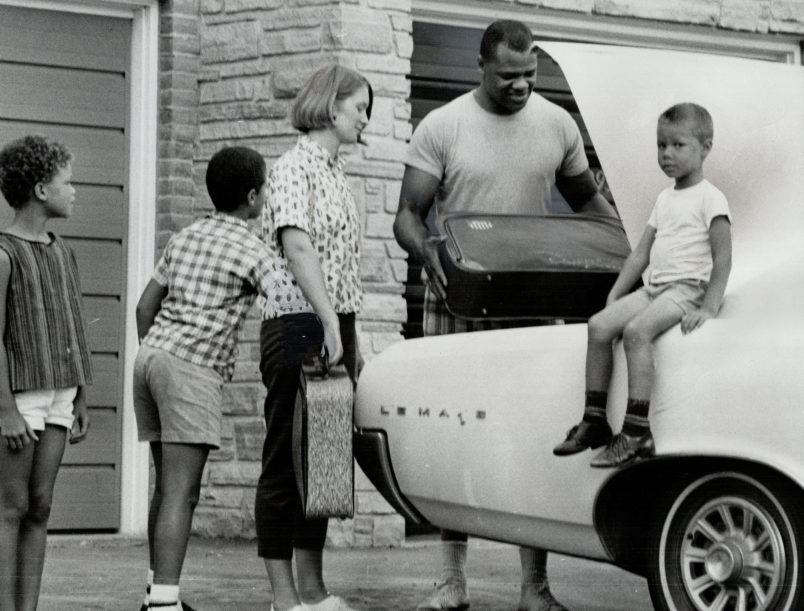
Milt Campbell and family return to the U.S. after 8 years in Canada. (Photo by Mario Geo/Toronto Star via Getty Images)
Bill Toomey (1968) turned his Olympic celebrity into a career as a TV broadcaster, marketing consultant, and head track and field coach at the University of California at Irvine. Bruce Jenner (1976) translated his gold medal victory in the Montreal Olympics into a money-making career in television, films, auto racing, business, as a Playgirl cover model, and, in 2007, as part of the reality television series Keeping Up with the Kardashians with his wife Kris Kardashian. He achieved another kind of notoriety in 2015 when he publicly came out as a trans woman and became known as Caitlin Jenner. Jenner is currently running for governor of California as member of the Republican Party.
An American didn’t win the Olympic decathlon gold medal again until Dan O’Brien in 1996, followed by Bryan Clay in 2008, and Ashton Eaton, in 2012 and 2016. Each of them converted their Olympic fame into successful careers in sports, business, and public service.
Soon after his Olympic success, however, Campbell almost disappeared from public attention.
Campbell was an outstanding football player and a national hurdles champion at Plainfield High School in New Jersey. But he was an all-around outstanding athlete. When a fellow PHS student told Campbell that Black people lacked the aptitude for swimming, he took up the sport and became the swim team’s top sprinter and an All-American swimmer.
During his junior year in high school, Campbell entered the Olympics decathlon trials despite having never participated in the ten-sport competition before. He won the 1952 national championship and then flew to Helsinki for the Olympics, where the 18-year old Campbell finished second to Mathias. That year, Track and Field News named Campbell “High School Athlete of the Year.”
After graduating from high school in 1953, Campbell attended Indiana University on a football scholarship. In his two years at IU, he won the NCAA and AAU high hurdles championships and played defensive back and halfback on the football team. When he occasionally tried his hand at judo, karate, bowling, wrestling, and tennis, he beat all comers.
He left IU in 1955 and joined the Navy. While stationed in San Diego, he kept up his training for his next shot at the Olympics.
He won the decathlon gold medal in 1956, setting an Olympic record of 7,937 points for the ten events. UCLA’s Rafer Johnson won the silver medal that year. The Soviet Union’s Vasily Kuznetsov earned the bonze.
Despite his victory in Melbourne, no companies asked Campbell to make commercials or become a spokesman. No Hollywood producers asked him to do a screen test for a movie.
He continued to compete in track and field, setting world records in the indoor 60-yard high hurdles and the outdoor 120 high hurdles in 1957. (He remains the only Olympic decathlon gold medalist to have held a world record in an individual event.)
At the time, amateur athletes were not permitted to get paid for participation in sports, and Campbell needed to make a living. He joined the Cleveland Browns, which had drafted the 6-foot-three-inch 220-pound halfback. He spent the season backing up another rookie, Jim Brown, who went on to become one of the greatest running backs in NFL history. Campbell saw little playing time, rushing for 23 yards on seven carries.
Before the start of the 1958 season, Browns coach Paul Brown called Campbell into his office. He asked Campbell why he had married a white woman (Barbara Mount) during the off-season. Campbell told Brown it was none of his business, he later recounted. The Browns cut Campbell the next day.
According to Campbell, no other NFL team would hire him. “I was blacklisted because I had an interracial marriage,” he once said.
Instead, he went to Canada, playing professional football for the Hamilton Tiger-Cats, Montreal Alouettes, and Toronto Argonauts until 1964, with much less pay and visibility than if he’d remained in the NFL.
After race riots exploded in Newark and Plainfield in 1967, Campbell returned to New Jersey. He co-founded a community center and alternative school in Newark, the Chad School, that focused on Black history and culture, and earned a modest living as a motivational speaker.
The sports world continued to snub Campbell. In 1983, the U.S. Olympic Committee announced the first 20 athletes to be inducted into its Hall of Fame. They selected Mathias and Johnson, but not Campbell, who wasn’t added until 1992. The National Track and Field Hall of Fame opened in 1974, but Campbell wasn’t inducted until 1989. The International Swimming Hall of Fame inducted its first 21 members in 1965, but waited until 2012 to include Campbell. He also wasn’t inducted into the New Jersey Hall of Fame until June 2012, five months before he died of cancer at 78.
He lived most of his post-Olympic life outside the limelight, especially compared with the other decathletes who had earned the accolade as “world’s greatest athlete.”
Why?
“America wasn’t ready for a Black man to be the best
athlete in the world,” Campbell insisted. While other athletes turned their gold medal into gold, “I got absolutely nothing.”
“I’ve paid my dues,” he said on another occasion, “but the advertising and commercial worlds don’t call me.”
Some would argue that African American Rafer Johnson’s later fame and fortune after he won the decathlon gold medal in 1960 undermines Campbell’s point, but the timing is important.
The 1960 Olympics, held in Rome, were the first to be televised in the United States. That year, and ever since, the Olympic star athletes became household names.
Campbell won his gold medal before the major upsurge of civil rights activism. True, Rosa Parks sparked the Montgomery bus boycott in 1955, but it wasn’t until the lunch counter sit-ins began in February 1960 (and the Freedom Rides the following year) that the freedom struggle became part of America’s daily news diet. Johnson’s 1960 gold medal was viewed as a civil rights victory as well as an athletic one.
Moreover, the Cold War provided a backdrop to the 1960 games. News coverage focused on the number of medals — particularly gold medals — won by Americans and Russians. The athletes themselves were often friendly rivals, but the politicians and journalists viewed them as warriors in a global battle for hearts and minds. This was particularly the case with the decathlon, and the competition between Johnson and his Russian counterpart, Kuznetsov. To accentuate the struggle, Johnson was selected as the flag bearer for the United States at the opening ceremony. The two athletes had competed against each other in different contests around the world, but the Olympics was center stage. Johnson’s gold medal was viewed as a victory in the Cold War. (Kuznetsov captured the bronze medal, behind silver medal winner Yang Chuan-Kwang of Taiwan, who had trained at UCLA with Johnson.)
Another factor: Campbell went to college in Indiana, outside the media limelight. Johnson, who grew up in California, attended UCLA in Los Angeles, where Hollywood reached out to him following his Olympic victory.
Campbell had little mentoring in high school or college as either an athlete or student. He competed in his first decathlon at the 1952 Olympic trials. In contrast, Johnson was carefully nurtured as a decathlete in high school and carefully mentored at UCLA. Campbell was one of the few Black students at Indiana University and was treated more as an athlete than a student, recruited as much for his prowess in football (which attracted more fans and money) than track and field. He dropped out before earning a degree. Johnson picked UCLA because of its history of recruiting and encouraging Black students, including Jackie Robinson. His fellow students elected him UCLA’s student body president and he completed his undergraduate degree.
Campbell was in high school when he won the silver medal and in the Navy when he won the gold. Johnson was a sophomore at UCLA when he earned his silver medal at the Melbourne game. He missed two seasons due to injury so he was still a student at UCLA, under the careful watch of world-class coaches, when he was training for the 1960 Olympics, when he won the gold.
Both Campbell and Johnson grew up poor, but Johnson had Hollywood good looks and a middle-class demeanor, while racist stereotypes consigned Campbell as a product of the New Jersey ghetto.
Campbell was also outspoken about racism and bitter about his mistreatment, qualities that may have made white people uncomfortable and hampered his post-Olympic success.
Both athletes were involved in public service, but while Johnson was part of the glamorous Kennedy world, Campbell worked in Newark and Plainfield, mentoring Black students.
This year, countries will provide huge rewards for their Olympic medal winners, many of whom will additionally garner lucrative commercial endorsements. Sports pundits and broadcasters have already described Canada’s Damian Warner, who won the decathlon gold medal on Thursday, as the “world’s greatest athlete.”
As they describe Warner’s accomplishments, he should be put in the same company as other outstanding decathletes. The odds are pretty good that the name Milt Campbell won’t be part of that conversation. That’s a tragedy.
Peter Dreier is professor of politics at Occidental College and author of “The 100 Greatest Americans of the 20th Century: A Social Justice Hall of Fame.”
As we’ve been discussing in recent days, I’ve been looking for apples to apples data on the trends of vaccine efficacy around the US. Changes are likely driven by the Delta variant. But some waning of immunity among the vaccinated could also be playing a role. So could expanding immunity among the unvaccinated – because so many of them are getting sick. That would reduce the difference in infection rates between the two groups even though protection from the vaccine remains unaffected.
MyPillow CEO Mike Lindell has been on a destructive path for some time, buckling himself to the former president’s Big Lie crusade with near blind allegiance.
One of New York Gov. Andrew Cuomo’s (D) sexual harassment accusers, an unidentified executive assistant, has filed a criminal complaint against the governor on the allegation that he groped her last year.