


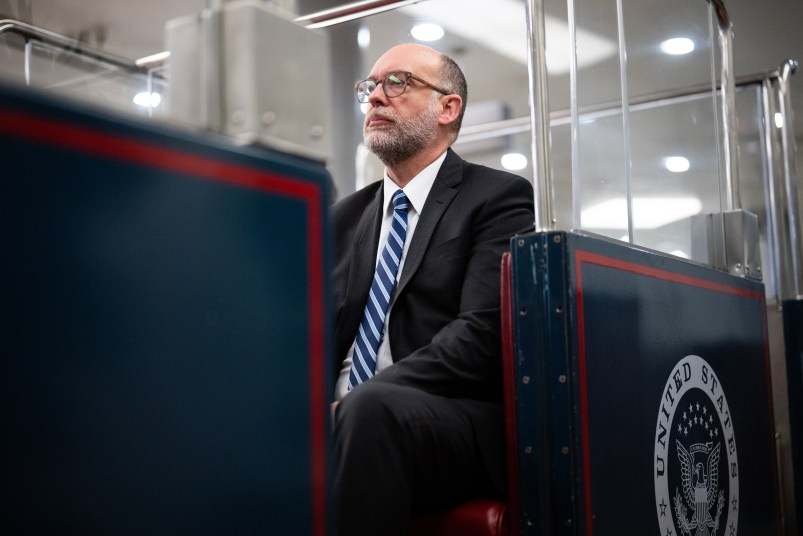
Senate Republicans will tweak President Donald Trump’s $9.4 billion rescission request — the White House’s attempt to give a figleaf of legitimacy to the Department of Government Efficiency’s rampage through the federal government — in order to get key Senate GOP holdouts onboard.
The deal arrived on the same day that Trump’s Office of Management and Budget Director Russ Vought trekked to the Capitol Hill to press Republican senators to vote for the package, which seeks to slash funding for public broadcasting and legalize many of DOGE’s cuts to foreign aid by giving Congress, the branch that approves spending, a chance to vote on them.
Sen. Eric Schmitt (R-MO), who is leading the efforts around the rescission request in the upper chamber, said the Senate would remove a $400 million cut to the President’s Emergency Plan for AIDS Relief (PEPFAR) — a President George W. Bush-era global HIV and AIDS prevention program — from the rescissions bill, bringing the total amount of cuts in the package to $9 billion.
White House Budget Director Russ Vought told reporters the White House is “fine with adjustments.”
“This is still a great package, $9 billion, substantially the same package,” Vought told reporters as he exited a meeting with the Senate Republican caucus on Tuesday. “The Senate has to work its will, and we’ve appreciated the work along the way to get to a place where they think they’ve got the votes.”
That change comes as several GOP senators have been expressing concerns, both publicly and privately, over the cuts to the program the White House has been trying to force on to Congress. Senators have objected to the cuts to public broadcasting, the cuts to foreign aid, and the constitutionally backwards process, which saw the executive branch make cuts to spending and only months later seek Congress’ approval.
Congress has until Friday to approve the package, which will expire 45 days after the White House first submitted it.
Sen. Susan Collins (R-ME), the chair of the Senate Appropriations Committee, has been indicating she has concerns over the cuts to PEPFAR for weeks.
Collins even asked the Office of Management and Budget for details last week on how the proposed cuts in the rescissions package would be implemented. Other Republicans, including Sen. Todd Young (R-IN), spoke up in support of Collins’ request at a closed-door lunch with Vought, per Punchbowl.
It is yet to be seen if the changes will be enough to move Collins and others who have expressed concerns over the $8.3 billion in cuts to foreign aid.
Senate Majority Leader John Thune (R-SD) indicated during a Tuesday press conference that he expects the removal of PEPFAR cuts to be the only change to the rescissions package.
“There was a lot of interest among our members in doing something on the PEPFAR issue, and so that’s reflected in the substitute,” Thune said. “And we hope that if we can get this across the finish line in the Senate, that the House would accept that one small modification that ends up making the package about a $9 billion recessions package.”
That all suggests the bill will not see changes to save funding for public broadcasting.
Sen. Mike Rounds (R-SD), who alongside Sen. Dan Sullivan (R-AK) wanted changes to the bill in order to protect some public radio stations, specifically those serving remote parts of the country like Native American reservations and parts of rural Alaska, announced that he made a deal with the White House for his support on the rescission package — though the way in which he presented that deal left many unanswered questions.
“We worked with the Trump administration to find Green New Deal money that could be reallocated to continue grants to tribal radio stations without interruption,” Rounds said on social media. “We appreciate OMB Director Russ Vought and Senate Leadership for working with us to favorably resolve this issue.”
I will now vote to support President Trump’s rescissions package to clawback $9.4 billion in federal spending.
— Senator Mike Rounds (@SenatorRounds) July 15, 2025
We wanted to make sure tribal broadcast services in South Dakota continued to operate which provide potentially lifesaving emergency alerts. We worked with the Trump…
The “Green New Deal,” of course, is an all-purpose, Biden-era Republican boogeyman — but is not legislation that ever passed Congress. Rounds told reporters on Tuesday that the deal he made with the White House is not a part of the bill and does not require any amendments to the rescissions package.
Perhaps clarifying how purported “Green New Deal” funds could address his concerns, he added that the White House had promised $9.4 million — which he said would come from the Department of the Interior allocations that were not yet committed — for 28 rural stations in nine different states to make up for the funding they would lose if Congress approves the rescission request cuts to the Corporation For Public Broadcasting.
Rounds told reporters that the deal he made “resolves my concern with these Native American radio stations that otherwise would have been shut down.”
Looming over the effort to make DOGE’s cuts legitimate through rescissions is a gambit that the White House has indicated it may try in September to cut the funds for good without congressional approval. The untested maneuver — pocket rescissions — purports to find a loophole in the rescissions process that would make future, relatively piecemeal rescissions packages like the one before the Senate this week unnecessary. It would draw challenges in court.
“We’ve heard Congress, and we’ve used the impoundment Control Act to send up a normal rescissions package,” Vought said when asked about the possibility of the White House using pocket rescissions on Tuesday. “We’re excited about what is going to happen. We believe this week, we want to have a strong vote, and, you know, we’ll get to those kinds of conversations down the road.”




Too bad Senators and House members don’t experience staff cuts in their own individual offices.
Screw these POS’s.
In order to even stay in the Republican party much less succeed they have to become the absolutely worst version of themselves from rubber-stamping, soulless zombie on down.
So… Republicans can manage to do basically everything they want without worrying about the filibuster. But nearly all Democratic efforts are blocked by the filibuster. I am starting to think that maybe the filibuster really only benefits one party…
The less people know and the more ignorant and misinformed they can be kept, the more they are going to like Trump and the Republicans. It is truly hard to pick the worst of them, but Stephen Miller and Russ Vought sure do look the part.
Embroiled in all of this maladministration, cruelty, and corruption now, I just cannot fathom how it will all end.