


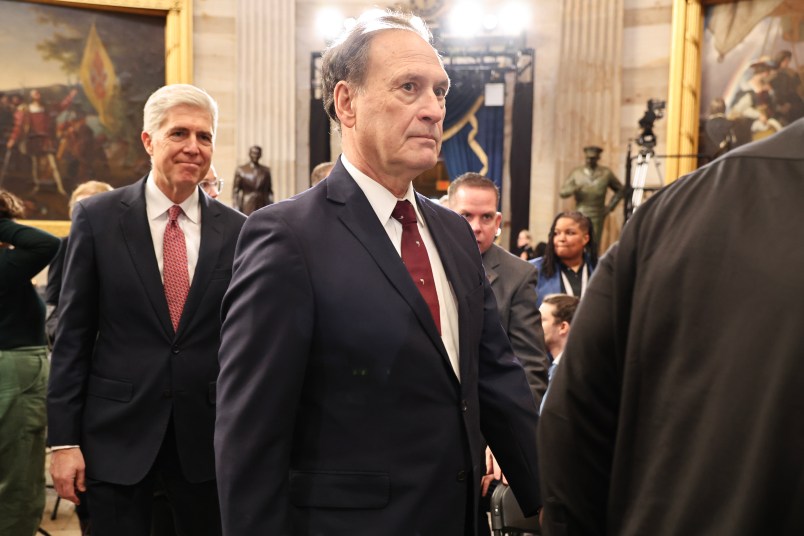
The Supreme Court on Monday lifted a stay on an old Alabama map that had been found to intentionally dilute Black voters, likely setting the state up to eliminate at least one Democratic district.
In the ruling, handed down on the shadow docket, the unnamed majority did not bother to explain its reasoning. This is all the more stark given that Justice Samuel Alito in Louisiana v. Callais — the decision that killed the remnants of the Voting Rights Act in late April — took pains to insist that his ruling did not overturn Allen v. Milligan, the case on the Alabama map. This is likely because the Court decided that case just three years ago, and Alito was searching for some reason to differentiate it from Callais — landing on the fact that the Alabama map also violated the 14th Amendment, a piece missing from Callais.
That cobbled-together reasoning held up for all of two weeks.
In her dissent, Justice Sonia Sotomayor — joined by Justices Elena Kagan and Ketanji Brown Jackson — pointed out the majority’s absurd heel turn, noting that “Callais also insisted that this Court’s prior decision in Allen remains good law.”
“That constitutional finding of intentional discrimination is independent of, and unaffected by, any of the legal issues discussed in Callais,” she added. “Vacatur is thus inappropriate and will cause only confusion as Alabamians begin to vote in the elections scheduled for next week.”
In theory, lifting the stay sends the case back down to the district court, which could find that the map is still unconstitutional. But Alabama will try to run out the clock, aided by another possible assist from the Supreme Court, which has a habit of finding that maps that hurt Republicans are imposed too close to elections.
Alabama lawmakers had already passed a plan to allow the state to hold new primaries if the Supreme Court let them use the old map.
Read Sotomayor’s dissent here:





Color me shocked! Shocked, I tell you!
Court reform needs to include the forced retirement of the Chief Justice, the Chief Racist, and the Chief Uncle (Tom).
Like pornography, no need to explain, they know what benefits Republicans when they see it.
SCOTUS Unblocks Alabama’s Racially Discriminatory Map, Showing That Alito Was Lying
SHAME ON ALITO
Everyone in government lies
My only consolation in all of this is that Alito’s dog is a progressive dog who would crap right on the Alito’s front doorstep except that he has the decency and integrity not to do so unlike his so called master