


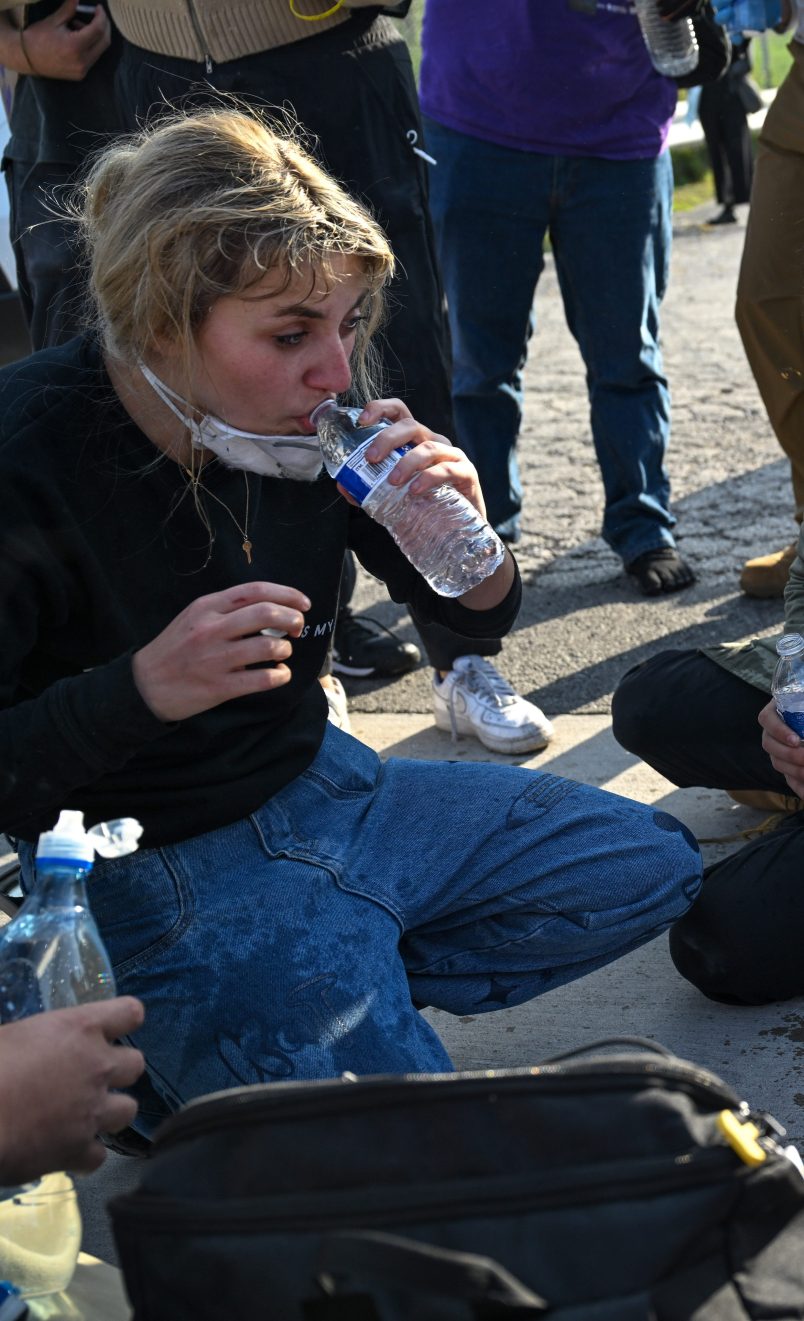
The Broadview Six case didn’t collapse at once. Over the last few months, the case slowly crumbled, piece by piece, with federal prosecutors trying — and eventually failing — to salvage it.
The end result was that after months of fighting and chipping away, the tables have been turned on Chicago federal prosecutors in the case. The judge encouraged the defendants to pursue a claim of vindictive prosecution; the case has now devolved into a long referendum on how far alleged instances of prosecutorial wrongdoing may have gone and who knew what, when.
Much of that process, attorneys involved in the case told TPM, turned on how aggressive prosecutors initially were in charging the Broadview Six, a group of six protesters during the Trump admin operation in Chicago whose charges emerged from an incident in which they allegedly obstructed a federal vehicle. The six that were charged had become increasingly involved in protests against ICE and the federal surge into the city in September; they’re mostly involved in Chicago Democratic politics.
Instead of accusing each defendant in the case of assaulting a federal officer and leaving the matter at that, prosecutors went further, and argued that the group had engaged in a conspiracy to intimidate, injure, and block a federal law enforcement officer. Prosecutors were forced to retreat from that claim over the following months, with defense attorneys raising critical questions around what the grand jury was told, court filings show.
Putting the Trump DOJ on the defensive was hard.
The case was born out of the Trump administration’s Operation Midway Blitz, in which CBP and ICE agents stormed Chicago last fall. Protestors began to converge daily on the suburban Broadview detention facility, where potential deportees were being held. A protest on Sept. 19 saw one group teargassed and Kat Abughazaleh, an influencer and candidate in a Chicago-area Democratic congressional primary, thrown to the ground by a federal agent. On Sept. 26, protestors returned and surrounded a slow-moving federal vehicle.
At the time, the Trump administration was gearing up for a fight against “Antifa,” its catch-all descriptor for left-wing groups that the administration disfavors. In a since-deleted statement issued that day, DHS called the Broadview protestors “Antifa-aligned rioters.” Abughazaleh and others kept returning to Broadview. On the day of another protest, Oct. 3, then-DHS press secretary Tricia McLaughlin told Fox News that Abughazaleh was “dishonest, desperate.”
Weeks later, a grand jury returned an indictment against Abughazaleh and five others. Instead of accusing each one of them of assault of a federal officer — the statute favored by the Trump DOJ in its national crackdown on ICE protestors — prosecutors opted for a rare conspiracy statute. It was the first time that statute had ever been brought in Chicago federal court, per defense attorneys.
Senior Trump officials hailed the charges. Then-Deputy Attorney General Todd Blanche issued a statement accompanying the indictment saying that “no one is above the law and no one has the right to obstruct it.”
Over time, the case began to wither.
Defense attorneys demanded in January that prosecutors provide more detail and explanation about the charges. That motion failed, but things began to change in the case. Sheri Mecklenburg, the original prosecutor on the matter, left the case for a detail to the Senate Judiciary Committee. Prosecutors also began to pare back the indictment, withdrawing their case against two of the defendants. Instead of accusing the Broadview Six of conspiring to intimidate, injure, and block a federal law enforcement officer, they revised the charge to only accuse the group of conspiring to intimidate.
That may seem like a minor change. But to defense attorneys, it raised questions over what prosecutors had told the grand jury about the charge. In early April, they asked the judge to order prosecutors to hand over grand jury transcripts, saying they had a “concrete, non-speculative” concern over what had happened before the grand jury.
At the same time, Chicago federal prosecutors were taking an increasingly strident tone in the case. In one exchange the week before, prosecutors accused the Broadview Six of acting “pusillanimously” in an attempt to get information about whether the case was brought for political reasons.
“The unavoidable conclusions to be drawn from these accusations is that the four-line Assistant United States Attorneys (AUSAs) who have been assigned to this case and their supervisors who reviewed and approved the indictment, including the Front Office, have not only acted in bad faith but have committed prosecutorial misconduct,” the filing reads. “Indeed, defendants would necessarily have this Court—and the public—believe that these prosecutors purposefully and consciously engaged in a conspiracy to violate the defendants’ constitutional rights by targeting them for selective and vindictive prosecution for exercising those rights.”
The Chicago U.S. Attorney’s Office had faced a rough few months that were largely of its own making. In the aftermath of protests at Broadview and reactions to Operation Midway Blitz, it began to charge protestors for incidents across the city. The vast majority of those foundered on contact with the judicial system. At one point, prosecutors dropped a case against Marimar Martinez, a woman shot several times by a CBP officer who bragged about the incident. A spokesman for the office didn’t return TPM’s request for comment.
By late April, the judge in the case — April Perry — was growing increasingly skeptical of the prosecutors. The DOJ had provided versions of the grand jury transcripts in the case, but had redacted key portions of the colloquy — when the prosecutor instructs the grand jury on the law. It’s almost always kept secret; Bruce Green, director of the Louis Stein Center for Law and Ethics at Fordham Law School, told TPM that it’s “exceedingly rare” for it to see the light of day.
Judge Perry demanded that prosecutors bring the full transcripts to an April 29 hearing. There, the DOJ said that it would further downgrade the charges: now, the case would be a misdemeanor, with the conspiracy charge removed. When Perry asked at the hearing whether she would receive the grand jury transcripts in full, a federal prosecutor replied that the issue was “moot” because the DOJ was no longer pursuing the conspiracy charge.
“So we have brought you, in compliance with your order, the unredacted
versions; but since we are moving to dismiss Count 1 and their motion and your order were directed to that, I think that that issue should be moot,” the prosecutor, William Hogan, said.
Later in May, Perry said that she would review full, unredacted grand jury transcripts. Two days later, she demanded that any prosecutor who helped redact the transcripts appear in court.
Then, it all came out.
At a May 21 court hearing, Perry said that she had found three instances of potential prosecutorial misconduct by Sheri Mecklenburg, the prosecutor who left the case for the Senate in February. Mecklenburg had improperly used her own credibility to vouch for the case, had “communications of a substantive nature” with grand jurors outside of the room, and removed grand jurors who disagreed with the case from deliberations, Perry said.
On top of all that, the judge said, prosecutors redacted all of this out of the transcripts that they first provided.
“I do believe deeply in the presumption of regularity and that most government attorneys are doing the best they can to do the right thing,” Perry, who was nominated in 2023 to be the U.S. Attorney for the Northern District of Illinois before then-Senator J.D. Vance (R-OH) blocked it, said. “That trust has been broken.” She added that she had “never seen the types of prosecutorial behavior before a grand jury that I saw in those transcripts.”
The case was dismissed with prejudice. At the hearing, U.S. Attorney Andrew Boutros appeared and apologized, saying that he was “upset” over the fiasco and that he was unaware of any alleged prosecutorial misconduct until late April.
On Wednesday, Boutros issued an announcement promising “remedial” steps for Chicago federal prosecutors “to address root-cause issues” in how the office presents cases to grand juries.
That same day, several media outlets reported, another Trump opponent found herself under investigation: E Jean Carroll. Boutros’ office is reportedly investigating. He denied on Thursday that the probe is criminal.
Correction: This article originally misstated the number of people on the original indictment.



Good to see JD"s dirty hands involved in this but really no surprise.
Confession is good for the soul:
I came in here to post that confession and to note that this is an exceptionally high level of comprehension for a Trump appointee. It’s damned shame that the comprehension wasn’t accompanied by a similar level of self-reflection.
If you want government targeting you for prosecution because you disagree with it, then vote Republican. They’ll eventually get around to you.
I’m always suspicious of people who use the word “pusillanimously.”