


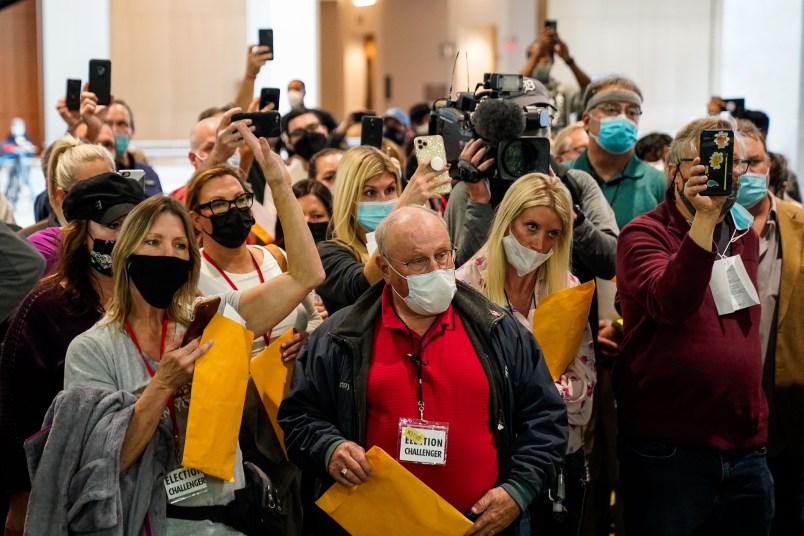
Detroit election officials accused the Justice Department of using “thin gruel” to create a “pretext” to justify sending voting monitors to the city for Michigan’s August 4 primary, letters exclusively obtained by TPM show. That includes what city officials suggested was a false claim about federal monitors during the 2024 election.
In the first letter, dated June 24, 2026, DOJ Voting Section Deputy Chief Timothy Mellett wrote that DOJ voting monitors — which Mellett claimed were present at some polling places in Detroit during the 2024 election — had identified serious concerns during voting.
But Detroit City Clerk Janice Winfrey replied that the city had no record of any federal monitors there during the 2024 election.
“According to our records, there were no representatives from the Department of Justice, and if so, they did not comply with regulations requiring them to identify themselves and sign in with supervisory staff at the polling place,” Winfrey wrote in a July 7 response letter to Mellett, obtained by TPM.
A DOJ spokesperson returned TPM’s request for comment on Wednesday, saying, “The Department has long monitored elections to help ensure compliance with federal voting laws. Observation efforts are coordinated through a variety of channels, including in circumstances where in-person access is not provided.”
The DOJ did not immediately return TPM’s request for comment about what election monitors Mellett was referencing in his letter.
In his letter to Detroit officials, Mellett used this claim to argue that the city’s 2024 election had been marred by long voting lines, possibly caused by supposed confusion around provisional ballots and non-operational voting terminals.
“Department of Justice attorney monitors visited sixty-five (65) polling sites used for the general election in Detroit,” Mellett wrote. “The concerns identified by our monitors included the lack of provisional ballots in at least one polling location, confusion about when provisional ballots should be provided to voters, and Voter Accessible Terminals that were not operational in multiple polling locations.”
He also demanded that Detroit provide several categories of records: the current training manual for polling officials, an explanation of its staffing for the 2026 primary and steps around voter accessible terminals for the 2026 primaries.
Winfrey said in the response that her office would provide the information and that it had “welcomed” monitors in the past. But, she added, the DOJ had drawn a “baseless conclusion that then becomes the pretext for additional monitoring of Detroit elections.”
Provisional ballots, she wrote, are regular ballots handled via a separate process. No precinct ran out of ballots, she wrote. She argued that the claims Mellett made could not have contributed to long lines — providing provisional ballots or a voter terminal takes place “outside of the standard flow.”
“These claims are not a valid pretext for increasing monitoring in Detroit,” she added.
The Justice Department sent similar letters to Lansing and East Lansing election officials, according to The Detroit News. Michigan Attorney General Dana Nessel responded to the DOJ by saying that states run elections, not the federal government.
“We encourage everyone to participate and see for themselves how secure and fair our elections are — but make no mistake, my office stands ready to hold accountable those who attempt to unlawfully interfere with or intimidate Michigan election workers,” she said.
Since 2020, President Trump and his supporters have seized on Detroit as one of several hotbeds for their conspiracy theories about rampant election fraud in mostly blue cities. Days after that election, a group of people, many linked to right-wing voter fraud alarmist groups, tried to storm the Detroit center where ballots were being counted. GOP groups had told supporters to go to the center to monitor the count of late-arriving absentee ballots. Special Counsel Jack Smith later cited the incident as an example of how President Trump sought to undermine the credibility of the election.
“Stop the Steal” activists haven’t dropped their 2020-era campaign to import conspiracy theories about the supposed theft of that year’s election into current and future election practices. In one episode that TPM documented, a group of election deniers obtained a trove of ballot images from Detroit’s 2020 election in a little-noticed FOIA lawsuit. They’re now performing what they describe as an “audit” of the records, with the hope of enticing politicized federal law enforcement into the state’s elections.
At one point earlier this year, DOJ Civil Rights Division Chief Harmeet Dhillon sent a letter to Wayne County, where Detroit is located, demanding that the clerk hand over records from the 2024 election, saying that she intended to probe allegations of voter fraud in the state. That request had a problem: Dhillon had addressed the letter to the wrong office. Cities and townships manage Michigan elections, not county clerks.
Read the letters below:




I am getting nervious about this years election. My granddaughter is going to be having our first great grandchild the end of October so my wife and I have planned to remain here until early November. That means I need to vote absentee. If that Trump asshole and his fascist DOJ thugs keep me from voting I will be less than pleased. I imagine there are probably millions of other Americans who are going to want to vote absentee for similar reasons. .
Validity is not a concern in the current DOJ. Dominance and confusion are the game, the claim serves the latter, the demand for compliance the former. This is the corruption of democracy in action.
Conservatism consists of exactly one proposition, to wit: There must be in-groups whom the law protects but does not bind, alongside out-groups whom the law binds but does not protect. – Frank WilhoitOff topic but WRT duplicity, it appears none of the Republican senators claiming to have spoken with McConnell did so in person (McConnell speaks to Republican leaders as speculation swirls about his health, remains hospitalized). Even assuming their claims are truthful (a dubious assumption), how do we know they were not speaking with an appropriately trained AI?
Good pushback by the City Clerk.