


In Church, Merch, and State, Sarah Posner writes about the intersection of religion and politics in the United States. This column is part of Cafe, TPM’s home for opinion and news analysis.
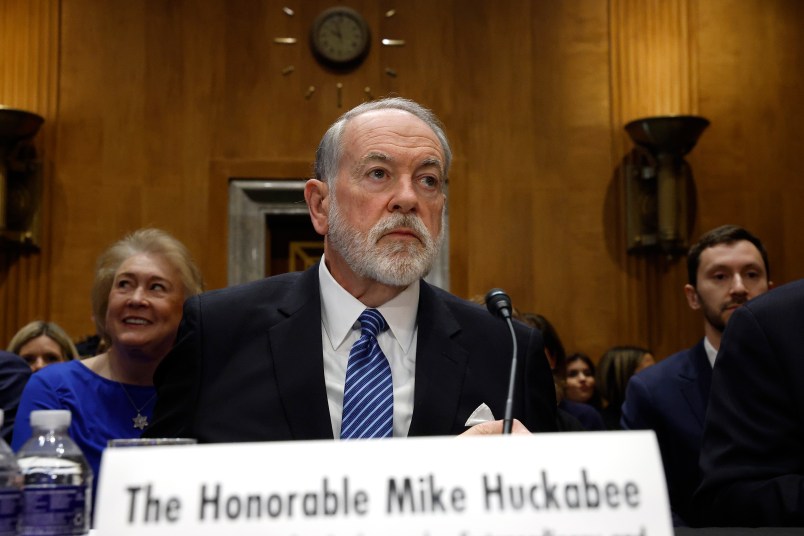
In an early sign that evangelical leaders are planning for a post-Trump future that doesn’t include Vice President JD Vance, Christian Broadcasting Network reporter and well-known evangelical whisperer David Brody is planting some seeds for 2028 on behalf of Mike Huckabee, the current U.S. Ambassador to Israel. Writing at All Israel News, a site run by Joel Rosenberg, a fervent Christian Zionist known for his apocalyptic-minded books and right-wing television broadcasts, Brody gives some oxygen to the presidential prospects of the 70-year-old former pastor, Arkansas governor, Christian broadcaster, and twice-failed presidential candidate. Brody writes that he was inspired to explore a Huckabee candidacy by the Christian nationalist organizer David Lane, who wrote in a newsletter he sends to 70,000 pastors: “We’ll throw Mike Huckabee’s name in the hat for 2028.” Based on that suggestion, Brody proceeds to make the case that Huckabee, for reasons of political experience, affable temperament, and theological commitment to America’s relationship with Israel, might just be the one to bring MAGA’s anti-Israel contingent together with its zealously pro-Israel Christian Zionists.
These are early days, of course, and many caveats are in order. First, Rosenberg, Brody’s editor at All Israel News, is very friendly with Huckabee, and frequently hosts him on his YouTube channel and program on Trinity Broadcasting Network. Second, over many years Brody has made a name for himself by promoting his scoops from inside evangelical power centers, and this column could reflect either a real plan or merely a hopeful but ultimately ridiculous trial balloon among friends. Huckabee has not said anything publicly about running in 2028, which of course one presumes would require him to be in the United States, not Israel, to campaign. In any event, the fact that the potential 2028 primary field is being publicly discussed is a sign that the crucial evangelical bloc of the GOP wants to both acquire Trump’s MAGA and reshape it to shed its anti-Zionist and antisemitic baggage.
The Lane newsletter in question dates back to June, after Huckabee gave a speech in Jerusalem in which he reiterated America and Israel’s “unbreakable bond,” called on Americans to be thankful to Judaism and Israel for our freedoms, and declared that Iran “will never have a nuclear weapon.” Lane portrayed Huckabee as a strong truth-teller, unafraid to stand up to America’s and Israel’s enemies, as well as his own critics. Brody wrote this week, “for all the conversation about who inherits MAGA after Donald Trump, there’s another question Republicans may eventually have to answer: who inherits the bulk of Trump’s evangelical voters?”
For the GOP, this is the post-Trump conundrum. Trump has consumed the party whole, bent it to his will, and turned the government into his own supercharged corruption machine. What is the post-Trump GOP, exactly? How do prospective leaders of the party discuss it now as anything but a monument to the man they’ve deified for the past decade? Notably, in Brody’s column, there is absolutely no whiff of the notion that Trump would (unconstitutionally) run again, or worse, try to stay in power post-election. These leaders and influencers are definitely planning for the post-Trump era, possibly one in which he is even more unpopular than he is now. Second, Brody’s column appears remarkably skeptical of Vance and even, it seems, Secretary of State Marco Rubio, who strenuously sought to win their votes when he ran and lost to Trump in the 2016 GOP presidential primary. Brody glosses over the fact that Huckabee will be 73 in 2028, not exactly beating anti-gerontocracy arguments, or that he ran in 2008 (losing to John McCain) and again in 2016, losing, along with Rubio, to Trump.
Evangelicals’ promotion of Huckabee is a bit of a presidential primary Groundhog Day. Back in 2007, a number of evangelical heavy-hitters did a lot of advance work for a Huckabee primary candidacy, launching him into the national conversation. After that unsuccessful run he has maintained a two-decade relationship with the evangelical base, often focused on his Christian Zionist beliefs. But now, as I have written here recently, Christian Zionists who for decades have been agitating for even closer U.S. ties with Israel and a war with Iran are running up against declining public support for both, even in their own party. Notably Brody’s piece acknowledges something that is rare in these circles, that antisemitism is a problem on the right, rather than solely blaming antisemitism on Israel’s critics from the left. Brody notes that Sen. Ted Cruz (R-TX), who denounced right-wing antisemitism at Christian Zionist leader John Hagee’s church last year, could be a 2028 prospect.
Huckabee, Brody argues, can bridge the gap between followers of Tucker Carlson and Christian Zionists like himself, by tapping into his roots as a populist on economic issues, while making robust arguments for America’s support for Israel, even in the atmosphere of increasingly visible antisemitism and anti-Zionism on the right. Brody describes him as “a populist conservative who was talking about the struggles of working-class Americans long before MAGA existed,” something that is true, but also made him a target of the right flank of the party when he ran in 2008. Brody suggests that “Huckabee’s your friendly neighborhood Populist and Zionist in one.”
To bolster his case, Brody includes some quotes from leaders of the Christian right’s old guard weighing in on Huckabee’s perceived strengths, including Family Research Council President Tony Perkins and former Republican National Committee Director of Faith Engagement Chad Connelly, who told Brody that the ambassador could “make the case that supporting an important ally does not mean giving that ally a blank check. That approach could resonate with Republicans who want an America First foreign policy while still recognizing the strategic importance of Israel.” The “blank check” language is certainly an acknowledgement that these evangelicals are beginning to recognize that unquestioning support for Israel is no longer tenable, even for the GOP. Huckabee’s own statement this week that a Jewish settler siege of a Palestinian home in the West Bank was “a horrific act of terror” is certainly a new development for him.
Evangelicals are a crucial chunk of the GOP base, and are very motivated to vote in primaries. But Trump’s victory in 2016 showed that they no longer need the candidate to be “one of us,” nor do they want to be told who to vote for by the evangelical leadership, which largely coalesced around Ted Cruz in 2016, only to back Trump after it was clear he was going to be the nominee. The only thing that is clear from this early Huck-mania is that these leaders would like to return to their pre-Trump era of evangelical kingmaking, but are worried that Trump, by courting both them and the anti-Zionist, antisemitic wing of MAGA, and then bungling the Iran war, has complicated their inheritance.


“Of all bad men, religious bad men are the worst.” – C.S. Lewis
(posted for the bazillionth time…)
Just saying, but the Republican party did not go anywhere that it did not want to go. Republican politicians previously just thought that they could not get away with it.
Edit to make timeline of political belief obvious.
It doesn’t matter if the guy who is guided by his religious beliefs or the current guy who still doesn’t understand that he’s not the CEO of the USA, they don’t seem to understand that the POTUS position is suppose too govern and not rule.
Here we go, folks. Judge Luttig isn’t crying wolf here.
Of course it won’t be Vance, he’s Catholic. While Catholics may be accepted when it benefits the Evangelicals, they aren’t counted among the “true Christians” as they perceive them.