

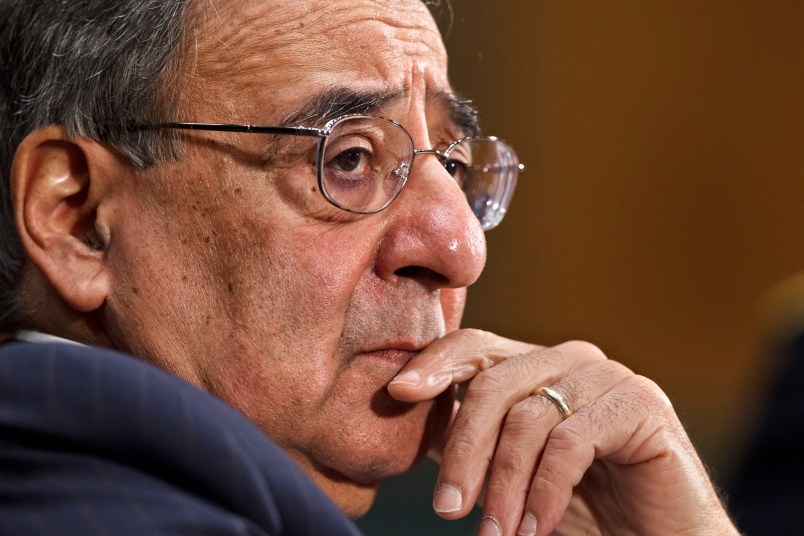
WASHINGTON (AP) — Former Defense Secretary Leon Panetta is criticizing President Barack Obama for leaning toward, then deciding against military action against Syria for its use of chemical weapons.
“By failing to respond, it sent the wrong message to the world,” Panetta says in a new book in which he reveals his differences with the president over the decision to withdraw completely from Iraq in 2011.
In August 2012, Obama said the U.S. would reconsider its opposition to military involvement in the Syrian civil war if President Bashar Assad deployed or used chemical or biological weapons. “That’s a red line for us,” the president said. “There would be enormous consequences if we start seeing movement on the chemical weapons front, or the use of chemical weapons. That would change my calculations significantly.”
But even after Assad used chemical weapons, killing hundreds of Syrian civilians, Obama planned a Rose Garden address in which it was widely expected to announce airstrikes against Assad, Obama instead said he would consult with Congress.
“President Obama vacillated, first indicating that he was prepared to order some strikes, then retreating and agreeing to submit the matter to Congress,” according to an early copy of the book purchased by The Associated Press. “The latter was, as he well knew, an almost certain way to scotch any action. By mid-2013, a majority of Congress could not agree on what day of the week it was, much less a resolution authorizing the use of American force in the Middle East.
“The result, I felt, was a blow to American credibility. When the president as commander in chief draws a red line, it is critical that he act if the line is crossed. … Assad’s action clearly defied President Obama’s warning.”
Panetta’s book, “Worthy Fights,” is scheduled for release next week.
Earlier this year former Secretary of State Hillary Rodham Clinton published a memoir in preparation for an expected presidential campaign in which she outlined differences with Obama, including over Syria.
On the deadly 2012 siege of the U.S. diplomatic post in Benghazi, Libya, Panetta said the administration had no indication of an attack coinciding with the Sept. 11 anniversary. U.S. Ambassador Chris Stevens and three other Americans were killed in the violence.
Panetta, who also served as director of the CIA, said he questioned “from the beginning” the CIA’s initial assessment that the attack was the work of a mob of protesters rather than an organized assault. “It seemed to me that most spontaneous demonstrators don’t arrive for a protest carrying rocket-propelled grenade launchers,” he said.
But Panetta defended the intelligence agency, saying such work is difficult and often contradictory. “It was not clear at the time that there were two separate incidents, separated by distance and by several hours,” he said.
On Iraq, Panetta chided Obama for not keeping a residual U.S. force behind, which he said could have helped provide training and security to Iraqi security forces and blunt the Islamic State group’s recent takeover of parts of northern and western Iraq.
“My fear, as I voiced to the president and others, was that if the country split apart or slid back into the violence that we’d seen in the years immediately following the U.S. invasion, it could become a new haven for terrorists to plot attacks against the U.S.”
Panetta also blamed former Iraqi Prime Minister Nouri al-Maliki for deteriorating conditions in Iraq, saying he exacerbated sectarian divisions already getting worse in his country.
“The news from Iraq bothered me to no end. In my view, the ISIS offensive in 2014 greatly increased the risk that Iraq will become al-Qaeda’s next safe haven,” Panetta wrote, using an acronym for the Islamic State group. “That is exactly what it had in Afghanistan pre 9/11. After all we have done to decimate al-Qaida’s senior leadership and its core, those efforts will be for naught if we allow it to rebuild a base of operations in the Middle East.”
State Department spokeswoman Jen Psaki said many former administration officials who have been critical of Obama’s foreign policy decisions were involved in and supported strategies when they were developed, including “the fact that we were not going to allow our troops to stay on the ground (in Iraq) without the protections they needed.”
“The political situation on the ground was that the Iraqis did not want to have a big troop presence on the ground,” Psaki said. “There were political challenges to getting it through, but it was clear they did not want that. So that was what we were dealing with at the time.”
___
Associated Press writers Bradley Klapper and Josh Lederman contributed to this report.
Copyright 2014 The Associated Press. All rights reserved. This material may not be published, broadcast, rewritten or redistributed.



Warmongers are ugly people.
Panetta was always a loose cannon when he opened his mouth, but this is just concern trolling bait for the right wing to buy his book.
Another selective-memory project quickly written before his critics could write books that make him look like the feckless toady he actually is. Please note that Panetta defends the CIA/Bush-Cheney torture regime and doesn’t consider that a blow to US credibility.
Oh.
If we’re playing the result, as these criticisms so often do, would those airstrikes have resulted in the destruction of Assad’s chemical weaponry stockpiles? Because negotiations through Russia accomplished that.
If we’re so concerned about the process, how can Panetta ignore that in this case a different process was followed that, while LBJ or Nixon might have considered this type of “vacillation” shameful, did not put Americans at risk (or spend the combination of treasure and blood needed to strafe the Alawites) with an optimal result? We subtracted the chemical weapons without expanding the war or creating a further Syrian vacuum to be filled by Daesh.
In other words, if Panetta is being process oriented, he should factor in contemporary and not just historical results to determine whether the process he envisions really yields the best possible results. Game theory is worse than useless if you don’t properly understand the incentives, which is why, in reference to McNamara/McGeorge Bundy/the non-LeMay hawks in the 60s national security council, it was said the Vietnam War was brought to us in small, seemingly-rational increments by the Beltway chapter of the Harvard Alumni association. (Wish I could remember the attribution of the quote - sounds like someone glib and anti-elite – Spiro Agnew maybe?)