


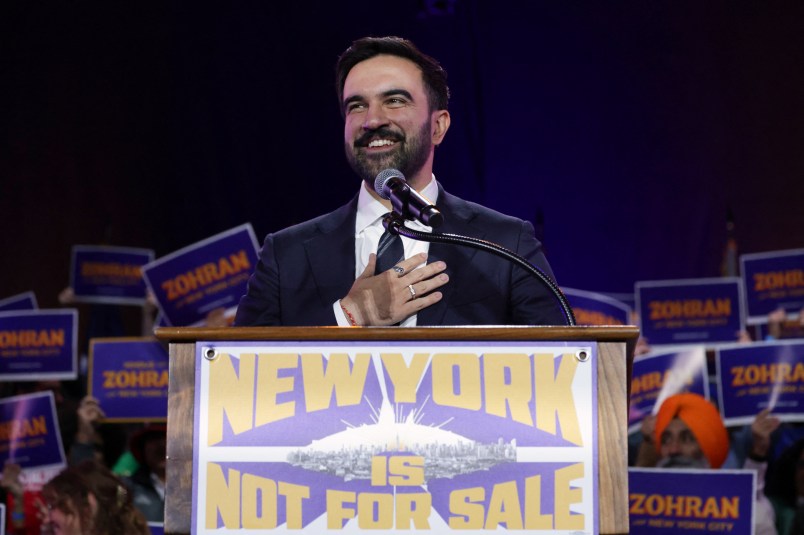
By electing Zohran Mamdani, New Yorkers have just launched one of the most high-profile experiments on the future of the Democratic Party and its opposition to Donald Trump. Mamdani, who won a clear-cut victory, is a young Democratic Socialist who vaulted from relative obscurity in the state legislature to City Hall in the span of about a year, thanks to an ambitious policy agenda and a relentless digital offensive tailor-made for the age of TikTok and Instagram.
The Associated Press called the race at 9:34 p.m. ET, with Mamdani pulling in 50.4% of the vote ahead of former Gov. Andrew Cuomo with 41.3% and Republican candidate Curtis Sliwa with 7.5%.
According to the city’s Board of Elections, more than 2 million voters cast ballots — the biggest turnout in a New York mayoral race since 1969, per the New York Times.
Now, Mamdani faces the challenge of actually running America’s largest and loudest city. It’s a place that is infamously hard to govern, and there is a long history of prior mayors who have seen their careers stop dead in City Hall. Mamdani’s tenure will have major implications for his fellow Democrats — and particularly the party’s insurgent left wing.
As one of the first major races following the presidential election cycle, New York City’s mayoral election tends to prompt the chattering classes to turn the race into a referendum on national politics — even when that framing doesn’t quite apply. For example, around this time four years ago, outgoing Mayor Eric Adams was being cast by many as a major voice in Democratic politics and perhaps even a presidential candidate. In reality, rather than a coherent political force, Adams was an eccentric who won a crowded race after a career largely defined by veganism and a self-promotional streak. Ultimately, Adams’ apparent corruption brought him down and led him to abandon re-election after one scandal-scarred term.
Now, with Mamdani, the hype cycle is repeating itself. In spite of the lessons from the recent past, there are more reasons to see Mamdani through a larger, national lens. Mamdani has arrived at a moment when Democrats are struggling to find themselves. There is a power vacuum in the party and polls show its base is dissatisfied with the leaders they do have.
Mamdani is clearly a natural political talent, but he also has far more of a political blueprint than his predecessor. Other than a willingness to focus on crime in a post-pandemic moment when it was an outsized concern, Adams offered little in the way of a potential model for other Democrats. Mamdani’s unique candidacy, on the other hand, provides several potential lessons for others in his party. The simplest among these is the focus on savvy short-form video that helped propel his underdog campaign and helped voters get to know him as a candidate.
But Mamdani’s rise was about more than flash. His message broke though on many platforms because it was resonant and substantive. Mamdani honed in on the issue of affordability and crafted an ambitious agenda designed to counter the crisis of rising costs with a suite of policies including a rent freeze for certain eligible units, a free bus program, and an effort to launch city-owned grocery stores.
Mamdani was also boosted by a strong ground game that included some 100,000 volunteers fueled in no small part by the Democratic Socialists of America, of which he is a member. While other Democrats might be reluctant to embrace the DSA, Mamdani’s victory showed the need for others to inspire allies to put boots on the ground.
The spotlight on Mamdani has led to appearances on national news broadcasts and personal attention from former President Barack Obama. But the prominence has also brought backlash. Another president, Donald Trump, also has his eye on Mamdani.
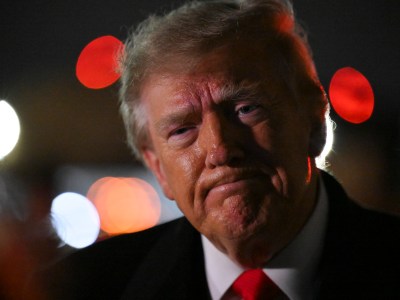
On Monday, the eve of election day, Trump took to his Truth Social platform to endorse Cuomo, who became an outspoken critic of the left after leaving office consumed by scandals of his own and ran as an independent after losing in the Democratic primary. That endorsement was accompanied by a threat to deprive New York City of federal funds if Mamdani wins. Trump has also raised the spectre of responding to a Mamdani mayoralty by calling in the National Guard and having the kind of heavy-handed federal presence in New York that has caused violent clashes in other cities including Los Angeles and Chicago.
Mamdani has been clear-eyed about knowing the challenges he could face from Trump. After leading a march across the Brooklyn Bridge on Monday, Mamdani addressed the president’s threats and vowed to use a mix of the “bully pulpit” and “the courts” to “ensure that every dollar that a municipality is owed is a dollar that is paid.”
“I will take every single day, after this election, to put together my city government, my city hall, to ensure that it is prepared not only for the threats from Donald Trump, but also the threats from an affordability crisis that has put one in four New Yorkers in poverty,” Mamdani said.
Trump is not the only one on the right who has been eager to zero in on Mamdani. Republicans and commentators have cast Mamdani’s socialism in apoplectic terms, accused him of antisemitism for his support of Palestine, and launched Islamophobic attacks against him. On Tuesday morning alone, the National Republican Senatorial Committee’s rapid response team sent seven press releases in just 11 minutes comparing different Democratic candidates in Iowa, Georgia, Maine, North Carolina, Minnesota, Michigan, and Texas to Mamdani.
“Socialist Zohran Mamdani is not just winning in New York City, but has become the blueprint for radical Democrats in messy primaries across the nation,” one of the NRSC messages declared.
The efforts to tie the entire party to Mamdani — and vice versa — are hyperbolic, particularly as some more moderate Democrats have spoken out against him. Indeed, Senate Minority Leader Chuck Schumer, one of the highest ranking members of the party in Mamdani’s own state, notably avoided making an endorsement as the race entered its final hours.
Still, fairly or not, Mamdani is clearly being elevated to one of the more prominent figures in the party. While this might help him with the “bully pulpit” that he hopes to use against Trump, it also sets up a situation where his every move will be seen as a referendum on progressivism and a more leftward path for Democrats. That’s particularly true in a world where many media outlets and purveyors of conventional wisdom increasingly lean to the right and are clearly eager to demonize socialism and even modest social programs as something akin to Soviet Russia. It’s a high- stakes position for a 34-year-old lawmaker with a relatively thin legislative resume and fairly short list of longtime allies in the corridors of power.
All of this sets up Mamdani’s administration as a pivotal opportunity for progressive politics. The entire country is watching.




It’s officially a three Depends night for the Fat Don.
file:///var/mobile/Library/SMS/Attachments/75/05/F12C6F13-D621-42D8-BE9F-1CD7F24B7C41/video000000.mp4
trump’s gonna have kittens over this.
Good
Huzzah!!
I asked myself, “How is the Atlantic going to react, and how mad is it going to make me?”
And they managed to surprise me with their almost Onion level self parody.