

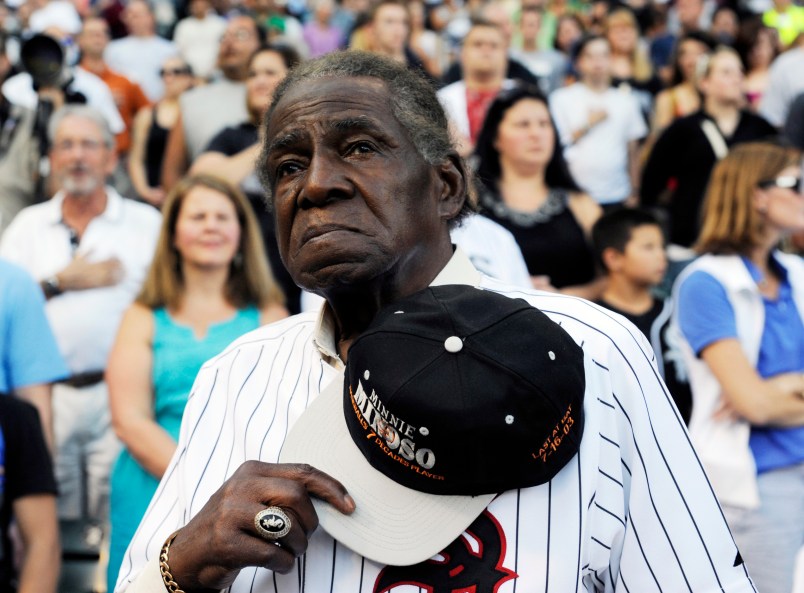
CHICAGO (AP) — When Minnie Minoso broke into major league baseball, the “Cuban Comet” was part of a wave of black players who changed the game forever. By the time he played in his final game 35 years ago, he was a beloved figure with the Chicago White Sox.
It was one amazing ride for the seemingly ageless slugger, who died early Sunday morning after helping clear the way for generations of minority ballplayers, including a long list of stars from his home country.
“We have lost our dear friend and a great man,” White Sox owner Jerry Reinsdorf said in a release. “Many tears are falling.”
Minoso, who made his major league debut just two years after Jackie Robinson and turned into the game’s first black Latino star, died of natural causes, according to the Cook County medical examiner’s office. There is some question about Minoso’s age, but the medical examiner’s office and the White Sox said he was 90.
Minoso’s death comes on the heels of the loss of Chicago Cubs great Ernie Banks, who passed away last month at age 83.
Minoso played 12 of his 17 seasons in Chicago, hitting .304 with 135 homers and 808 RBIs for the White Sox. The White Sox retired his No. 9 in 1983 and there is a statue of Minoso at U.S. Cellular Field.
For Minoso’s many admirers, his absence from the Hall of Fame remains a sore spot. President Barack Obama, a longtime White Sox fan, praised Minoso for his speed, power and “resilient optimism” while helping integrate baseball in the 1950s.
“Minnie may have been passed over by the Baseball Hall of Fame during his lifetime, but for me and for generations of black and Latino young people, Minnie’s quintessentially American story embodies far more than a plaque ever could,” Obama said.
Minoso made his major league debut with Cleveland in 1949 and was dealt to the White Sox in a three-team trade two years later. He became major league baseball’s first black player in Chicago on May 1, 1951, and homered in his first plate appearance against Yankees right-hander Vic Raschi.
It was the start of a beautiful relationship between the slugger and the White Sox.
Minoso, a Havana native who spent most of his career in left field, is one of only two players to appear in a major league game in five different decades. He got his final hit in 1976 at age 53 and went 0 for 2 in two games in 1980 for the White Sox, who hired him as a team ambassador after his playing career and repeatedly lobbied for his inclusion in Cooperstown.
“I think that everybody has to respect his legacy because he did so much for the Latin players, for the Cubans, for everybody because when he arrived here it was a tough time because of racism and discrimination,” said White Sox shortstop Alexei Ramirez, another Cuban star. “He wrote a huge legacy for all of us.”
Saturnino Orestes Armas Minoso Arrieta was selected for nine All-Star games and won three Gold Gloves in left. He was hit by a pitch 192 times, ninth on baseball’s career list, and finished in the top four in AL MVP voting four times.
Despite the push by the White Sox and other prominent Latin players, Minoso never came close to making it to the Hall. His highest percentage during his 15 years on the writers’ ballot was 21.1 in 1988. He was considered by the Veterans Committee in 2014 and fell short of the required percentage for induction.
“My last dream is to be in Cooperstown, to be with those guys,” Minoso said in an informational package produced by the team for a 2011 Cooperstown push. “I want to be there. This is my life’s dream.”
Minoso, who made his major league debut with Cleveland in 1949, hit .298 for his career with 186 homers and 1,023 RBIs. The speedy Minoso also led the AL in triples and steals three times in each category.
Playing in an era dominated by the Yankees, Minoso never played in the postseason.
“Every young player in Cuba wanted to be like Minnie Minoso, and I was one of them,” Hall of Fame slugger Tony Perez said. “The way he played the game, hard all the time, hard. He was very consistent playing the game. He tried to win every game. And if you want to be like somebody, and I picked Minnie, you have to be consistent.”
Minoso finished that first season in Chicago with a .326 batting average, 10 homers and 76 RBIs in 146 games for the Indians and White Sox. He also had a major league-best 14 triples and an AL-best 31 steals.
It was Minoso’s first of eight seasons with at least a .300 batting average. He also had four seasons with at least 100 RBIs.
“I have baseball in my blood,” Minoso said. “Baseball is all I’ve ever wanted to do.”
___
Associated Press writer Caryn Rousseau contributed to this report.
Copyright 2015 The Associated Press. All rights reserved. This material may not be published, broadcast, rewritten or redistributed.





What a beautiful face.
All he ever wanted to do was play baseball, and he did it well.
Great player & person whose career began at an especially ugly time in race relations, a time when black players could not stay in the same hotel as their white teammates.
From the NYTimes:
"When Minoso made his major league debut with Veeck’s Cleveland Indians in 1949, two years after Jackie Robinson broke the majors’ modern color barrier, he struggled with English and had to endure the segregation of the times.
‘I was prepared for the racial insults from opposing players and fans in towns we visited,’ he told Danny Peary in the oral history ‘We Played the Game’ (1994). 'They’d say, ‘You black …’ and I’d flash an insincere grin. Sometimes I’d insult them back in Spanish, warning them, ‘I can tell you worse things than you said to me without you knowing what I said.’
Chico Carrasquel, a Venezuelan White Sox shortstop who was white, became good friends with Minoso after Minoso joined the team in 1951.
'Sometimes he couldn’t get into a restaurant because he was black, so I’d go in and get the food,”'Carrasquel said.
Minoso finished second to the Yankees’ Gil McDougald in the baseball writers’ balloting for the American League rookie of the year in 1951, his first full season in the majors, but was acclaimed the leading rookie by The Sporting News in balloting by players.
On May 1, 1951, having just been traded by the Indians, he became the White Sox’ first black player and hit a home run at Comiskey Park off the Yankees’ Vic Raschi in his first at-bat with Chicago."
George Will is picking stories for TPM?