


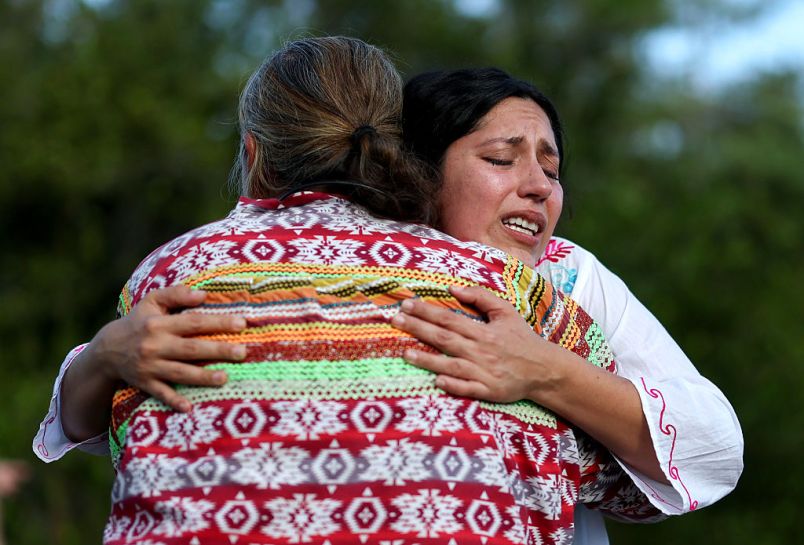
When President Donald Trump toured Florida’s so-called “Alligator Alcatraz” immigrant detention camp on July 1, he cast its location in the Big Cypress National Preserve as a remote and inhospitable place.
“We have a lot of bodyguards and a lot of cops that are in the form of alligators,” Trump told reporters. “I wouldn’t want to run through the Everglades for long.”
Despite his description of a punishing landscape, there are Native Americans who have been living in the area for generations, including just adjacent to the controversial detention camp. On August 1, the Miccosukee Tribe joined a lawsuit filed against the project because, their intervening complaint alleged, the federal and state agencies involved in the construction of the camp were not “adhering to required environmental review procedures.” The complaint also specified that the tribe “attaches historic, cultural, and spiritual significance to the areas affected by the construction and operation” of the detention facility.
“It’s an abomination to the whole concept of sovereignty,” William “Popeye” Osceola, the secretary of the Miccosukee Tribe’s Business Council, toldTPM earlier this week during a conversation about their reasons for fighting the detention camp in court.
Along with general threats to the environment, Osceola said the construction, activity, and heavy vehicle traffic at the site cause harm to the tribe’s ceremonies.
“For us, we have traditional practices,” Osceola said. “Our medicine men need access to a clear night sky for certain traditional practices.”
Osceola also said that, while the Miccosukee reservation is about a 10 or 15 minute drive from the detention camp, there are tribe members who live in traditional camps far closer to the site. He suggested that the project would be disruptive to them and also raised safety concerns brought by the speedy hiring of security contractors at the site.
“The facility is about 900 feet down from a traditional village and, at that village, we do have kids who go to our school. So, our buses do go across that route as well,” Osceola said. “And just looking at history … not even just with native tribes, but just looking at the Middle East, for example, whenever you’re bringing these outside security forces to a community, it doesn’t turn out well. … Seeing how they’ve kind of approached staffing, they don’t seem to be looking for — they’re not sending their best. Let’s just say that.”
Along with the Miccosukee, the plaintiffs in the suit include two environmental groups, Friends of the Everglades and the Center for Biological Diversity. Those organizations originally filed the suit against a group of federal and local officials including Department of Homeland Security Secretary Kristi Noem and Florida Division of Emergency Management Executive Director Kevin Guthrie on June 27, days after plans for the detention camp were first announced. It alleged the project “has gone through no environmental review as required under federal law, and the public has had no opportunity to comment.” As they announced the litigation, the environmental groups described the detention camp as a risk to the sensitive wetlands.
“This massive detention center will blight one of the most iconic ecosystems in the world,” Elise Bennett, Florida and Caribbean director and attorney at the Center for Biological Diversity said. “This reckless attack on the Everglades — the lifeblood of Florida — risks polluting sensitive waters and turning more endangered Florida panthers into roadkill. It makes no sense to build what’s essentially a new development in the Everglades for any reason, but this reason is particularly despicable.”
Of course, environmental issues are just one of the reasons this detention facility has attracted national headlines and vehement opposition. Attorneys and other advocates have alleged detainees are facing brutal conditions and abuses of due process at the site. TPM has previously documented how state agencies are evading transparency by dodging public records requests and hiding documents related to the project. Political opponents have also raised concerns about the high costs and manner in which contracts are being awarded. However, the environmental issues and the objections of the Miccosukee have been central to a key legal fight over the camp: Earlier this month, their suit resulted in a judge’s order halting construction at the site.
The Miccosukee Tribe’s complaint echoes the claim that there was no Environmental Impact Statement or Environmental Assessment conducted in conjunction with the project as would be required “for any major federal action significantly affecting the quality of the human environment.” It cites statements made by Trump during his tour, and argues that “Florida has no authority or jurisdiction to enforce federal immigration law” and that, as a result, the camp is “necessarily subject to federal control and responsibility” that triggers these environmental requirements.
“To plaintiffs’ knowledge, no EA or EIS has been prepared by DHS, ICE, the [Florida Division of Emergency Management], or any cooperating agency,” the tribe’s complaint says.

In addition to the alleged lack of review, the complaint argues there was no “opportunity for notice and comment” by the tribe or the general public. It also accuses DHS and ICE of violating the National Historic Preservation Act, which has regulations that “carve out a detailed consultation process for Native American Tribes.”
“The Tribe’s cultural resources and sites are historically and culturally interrelated and interconnected throughout its ancestral lands generally,” the complaint says, adding, “Both the state and federal governments are well aware … of the numerosity and significance of historic Tribal properties throughout Big Cypress.”
The detention camp was built after Florida Gov. Ron DeSantis (R) directed state officials to facilitate the construction of facilities to assist with Trump’s mass deportation agenda. Based on this directive, state attorney general James Uthmeier, who was DeSantis’ chief of staff and presidential campaign manager before assuming his current role, proposed building what he dubbed “Alligator Alcatraz” at the defunct Dade-Collier Training and Transition Airport in the Big Cypress National Preserve. Florida is spending an estimated $450 million on the project but is expected to seek reimbursement from the Trump administration. State officials used emergency powers granted by an executive order that DeSantis signed in 2023 — a response to what he described as an “alarming influx of migrants” — to quickly secure the funds and begin construction. Last month, TPM documented how contracts issued via the governor’s order and the Department of Emergency Management showed the high costs and rapid pace of the operation.
The Miccosukee Tribe is seeking a halt to further activity and construction at the site “unless and until” the government complies with the review processes it believes are required by federal regulations. Spokespeople for DeSantis, the Department of Homeland Security, and Florida’s Department of Emergency Management did not respond to questions from TPM about the tribe’s arguments or whether an Environmental Impact Statement or Environmental Assessment have been conducted in conjunction with the project. In court, lawyers representing the state, county, and federal officials named in the suit have argued the facility is not subject to federal law because it is being constructed and operated by the state.
So far, the court has shown a degree of skepticism about these arguments from officials. On August 7, District Judge Kathleen Williams ordered the state to halt additional construction and excavation — including the installation of lighting — for 14 days.
“I think that evidence is sufficient to support the plaintiffs’ claims,” Williams said.
Amid opposition to the “Alligator Alcatraz” project, DeSantis has claimed it will have “zero impact” on the Everglades. In court, the environmental groups presented a declaration from a pilot and ecologist who flew over the site and obtained photo evidence that, the plaintiffs said, indicated there were multiple areas of “new road and asphalting.” Before officials began removing documents from transparency databases, TPM also found indications of planned paving in a terminated contract associated with the facility.
Osceola, the secretary of the Miccosukee Tribe’s Business Council, noted he and other tribal leaders have not been allowed to inspect the site. However, Osceola said he has witnessed activity that calls the governor’s claims into question.
“They don’t allow us access inside. … They haven’t extended the invitation to us as a government, even though this is in our traditional lands,” Osceola said. “So, I have not seen anything like that firsthand, but I have seen the vehicles going by with fill and all this other equipment. As much as they try to hide it, it’s pretty obvious.”
Osceola also explained to TPM how significant the forests and swamps around Big Cypress are to his tribe.
“We’ve always known this part of the land. You know, we have certain medicine plants, pretty much wherever that medicine plant was found, that was considered our traditional ranging lands,” Osceola said. “After the Seminole Wars, that’s when we settled here in the Everglades on a more permanent basis.”
Osceola recounted how a Native American leader named Abiaka encouraged tribes to seek refuge in the swamps during those 19th Century conflicts, which raged as the U.S. government sought to remove indigenous people from Florida.
“He is kind of like a Miccosukee Moses. He basically told our people, you know, ‘Follow me … to the swamp. … It’s going to protect us. It’ll save us,’” Osceola recounted. “They listened to him and he was right. So, for us, the Everglades are the only reason we’re here, Miccosukee and Seminole, the unconquered tribes of North America. It’s because of the Everglades.”
That history has left the Miccosukee with a deep commitment to protecting the land. Osceola noted this duty “to conserve our land and resources for future generations” is enshrined in the preamble of their tribal constitution.
“It’s quite simple for us: we have to protect and save what protected and saved us,” Osceola said. “There’s really no other perspective other than that at the end of the day.”
He claimed DeSantis was previously seen as an ally in the tribe’s fight to preserve the swamps.
“I will give the governor credit for, you know, helping us pursue restoration of the Everglades. That is important,” Osceola said. “It’s unfortunate that this is happening because it’s kind of undoing that progress,”
While the Miccosukee have put in decades of work to protect these traditional lands, Osceola said the court fight is bigger than his people.
“We are trying to make sure our sovereign rights as worked on over the years with the governments around us are respected,” Osceola said. “Because if they can bypass the sovereign rights of one people, it gets easier to do that for all people.”
Osceola said he hoped the tribe’s effort to “take a stand here on our sovereign rights” would serve as a guide to others with “indigenous ties.” He noted this includes some of the “people here with indigenous backgrounds from Central or South America” who are being detained as part of Trump’s deportation push.
“It’s important to us to make sure that as long as there are indigenous people here, that we help each other out however we can that doesn’t infringe on each other’s sovereignty,” Osceola said.
Along with providing safety to the Miccosukee and other Native American groups who were persecuted by the U.S. government, the Everglades played host to so-called “Black Seminoles” who settled there to escape slavery and enjoyed friendly relations with the local tribes. Now, this place that once provided refuge to peoples’ who were targeted by official violence has become a site where they are being imprisoned. For his part, Osceola said the situation was “not a surprise to us.
“The detention facility being put there so fast was a surprise, but the sense of history echoing isn’t,” said Osceola. “If you look at this country, obviously, natives were the first to face the brunt of — I like to just call it ‘American fascism,’ because that’s what it was. Natives have always had to deal with that.”
This post has been updated.




Glad the Miccosukee are adding their voices to the opposition to this demented project.
Can we all just start calling them concentration camps? That is precisely what they are. Besides, the neofascists will be delighted by the comparison.
It might be a swamp to a lot of people but the Everglades are home to the Miccosukee people. They are very serious about protecting their home. The last thing they want is a big prison facility and all the pollution that implies.
Recently their efforts have helped in the revival of the Florida panther (a subspecies of mountain lion.) .They constantly monitor water levels and movement. Think of it this way Trump and Desantis have invaded their sovereign land and shit all over it. I wonder if this is 2025 or 1825. It seems like Trump is trying to pick a modern Indian war.
I would doubt that Trump gave the Miccosukee (or any other tribe) any consideration at all. If he wants something, he takes it. It doesn’t matter if it’s illegal or if someone else owns the land. His narcissism doesn’t acknowledge that other people’s rights exist.
Trump’s and DeSantis’ actions certainly could lead to a renewed conflict with native tribes, but I don’t think it is through any conscious effort on their parts, just their personality defects that prevent them from treating anyone with dignity.
Well because the Miccosukee aren’t white. Native People are losers in DonOLD’s eyes. And what is especially vexing to DonOLD are some of the tribes’ casinos. You know because they haven’t bankrupted the tribes like he was bankrupted. It’s just not fair!!