


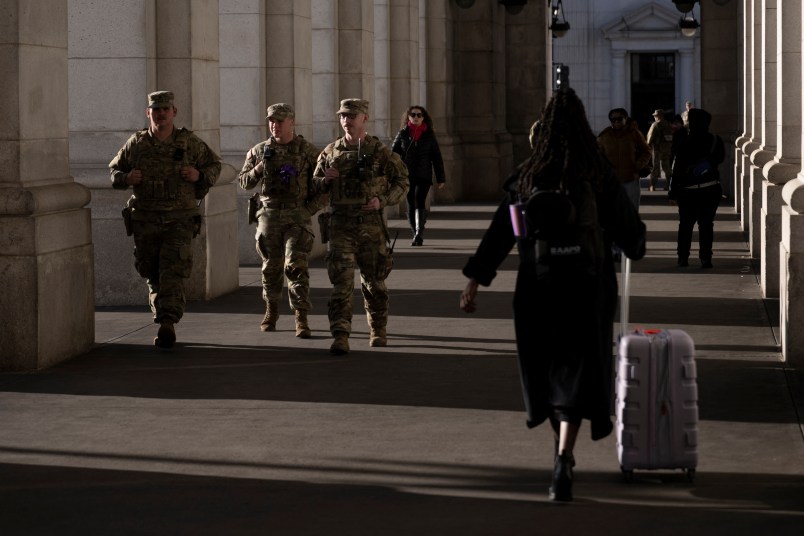
The Supreme Court upheld a block on the National Guard’s deployment to Chicago Tuesday, dealing the Trump administration a significant blow and embracing an interpretation of the laws that govern the Guard’s activation that differs considerably from the administration’s.
The majority was unsigned, though Justice Brett Kavanaugh wrote a separate concurrence. Justice Samuel Alito, joined by Justice Clarence Thomas, wrote one dissent, and Justice Neil Gorsuch wrote another.
The decision will reverberate throughout Trump’s attempt to deploy the Guard into Democratic cities across the country; multiple other cases have been in limbo awaiting the Court’s delayed ruling.
The majority and Kavanaugh embraced an interpretation of when the Guard can be federalized born from one amicus brief on which the justices requested further briefing. The statute reads that the Guard can be federalized when the president is “unable with the regular forces to execute the laws of the United States.” Georgetown University Law Professor Marty Lederman argued in his amicus brief that “regular forces” refers to the active duty military, not to civilian law enforcement, as many have assumed.
Practically, that interpretation would mean that Trump has to meet the standards of the Insurrection Act, send in the military, and watch them be overwhelmed before he could send in the Guard. “It’s meant as a kind of backstop to the backstop of the Insurrection Act,” as one expert put it to TPM.
“Because the statute requires an assessment of the military’s ability to execute the laws, it likely applies only where the military could legally execute the laws,” the Court majority wrote. “Such circumstances are exceptional…”
“At this preliminary stage, the Government has failed to identify a source of authority that would allow the military to execute the laws in Illinois,” it added.
Kavanaugh, while broadly agreeing with the majority’s take, points out an obvious risk of the newly embraced interpretation of the law: “One apparent ramification of the Court’s opinion is that it could cause the President to use the U. S. military more than the National Guard to protect federal personnel and property in the United States.”
Alito, joined by Thomas, disagrees with the majority’s interpretation, taking particular umbrage that the argument outlined in the amicus brief was introduced late into the proceedings. They would have heard the case under the assumption that the “regular forces” are civilian law enforcement, and given great deference to Trump’s assessment that the police and federal law enforcement were unable to do their jobs due to the behavior of protesters. Alito huffs that the district court should have given Trump at least “a modicum of deference.”
Alito also throws in a troubling flag for right-wing litigants to take up in the future: “I would not take for granted that the Posse Comitatus Act applies to federalized National Guard units, another question that this Court has never addressed.”
The Posse Comitatus Act prevents the military from engaging in law enforcement activities.
Gorsuch is shiftier. He would have come down the same way as Alito and Thomas under the old interpretation of the National Guard statute, but doesn’t weigh in on any of the bigger issues, calling for a more thorough briefing and oral argument. Tuesday’s ruling came down on the shadow docket in an emergency posture.
The brief ruling radically changes the landscape for Trump’s Guard deployments, likely meaning the end of similar occupations in other blue cities. It also all but goads Trump to invoke the Insurrection Act, something he’s been talking about doing since his first term.
Lederman is quick to point out in his amicus brief that his position should not be read as a free pass for the president to take the Insurrection Act route instead — that a president can only invoke it at the plea of a governor asking for help, or to enforce a federal court order.
The next showdown may center on the Court’s willingness to enforce the boundaries of that Act, despite Trump’s enthusiasm for seeing armed soldiers policing American streets.
Read the ruling here:



Good. Not good enough for me to change my mind about Supreme Court reform.
Cheers to Illinois Governor Pritzker, the ACLU, and all the others who fought against Trump all the way to the Supreme Court.
Likewise good on California and Oregon people who have stood up to Trump.
By contrast the TN governor rolled over for Trump and allowed black-majority Memphis to be occupied by the NG. The Texas governor sent his state’s NG to Chicago (Meal Team Six) to gain favor with Trump too.
Dayyyyam (as my Southern friends would say). Johnny the Robber Baron, the beer drinker and the Handmaiden actually rendering an (unsigned) decision that is based on actual Constitutional law and precedent. Has Sus scrofa domesticus finally mastered the Bernoulli’s Principle?
Well, that’s surprising. Did somebody drug Kavanaugh’s beer? Because his usual partners-in-crime wrote dissents. We’re kinda used to Amy Coney Barrett jumping back and forth; which side did she land on this time? And Roberts. I really want to know which side Roberts was on.
I’d like to know if it was 5-4 or 6-3. 6-3 could throw a scare into them;
5-4 could be treated as a fluke.