

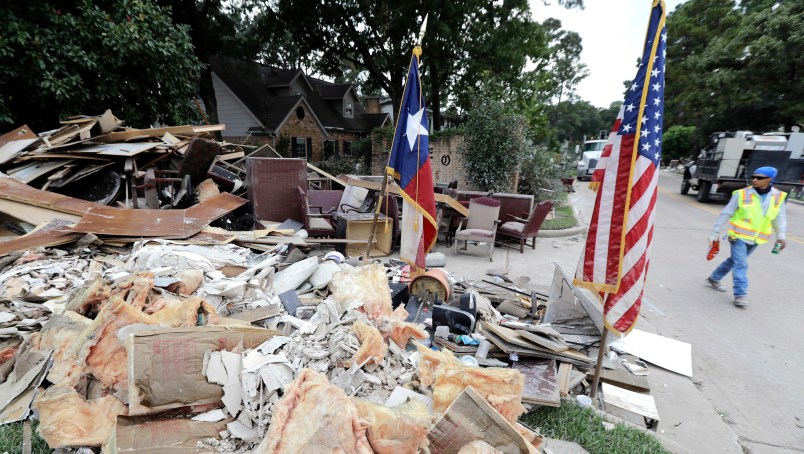
WASHINGTON (AP) — With federal disaster reserves running out, the House is swiftly moving to pass President Donald Trump’s request for a $7.9 billion first installment of relief for victims of Harvey.
GOP leaders also hope to use the urgent Harvey aid bill to solve a far more vexing issue: Increasing the U.S. debt limit to permit the government to borrow freely again to cover its bills.
Wednesday morning’s vote comes as the government’s response to Harvey is draining existing disaster reserves, with Federal Emergency Management Agency’s disaster accounts hovering at $1 billion or less. FEMA is warning lawmakers that disaster funds run out on Friday, even as a much more powerful hurricane, Irma, is bearing down on the eastern U.S.
This week’s measure is to handle the immediate emergency needs and replenish reserves in advance of Irma. Far more money will be needed once more complete estimates are in this fall, and Harvey could end up exceeding the $110 billion government cost of Hurricane Katrina.
The Harvey aid bill is the first major item on a packed fall agenda and, GOP leaders such as Speaker Paul Ryan hope, would allow lawmakers to quickly take on the more challenging job of increasing the government’s $19.9 trillion borrowing cap. That plan was gaining momentum Tuesday, with even some top House conservatives sounding resigned to the idea.
“I think it’s a terrible idea,” said House Freedom Caucus Chairman Mark Meadows, R-N.C., who conceded that conservatives were getting outmaneuvered.
“I think at this point there are bigger issues that we have to focus on,” Meadows said.
House action on Wednesday would set up a Senate debate that, as of Tuesday, would follow an uncertain path. A spokesman for top Senate Democrat Chuck Schumer said the New Yorker is seeking assurances that minority party Democrats will be treated fairly as Congress advances through its lengthy to-do list, which includes extending a popular children’s health program, federal flood insurance, and, perhaps, a small-bore budget outline that would ease tight budget “caps” on both the Pentagon and domestic agencies.
Schumer was a key force in winning aid of more than $50 billion to help New York and New Jersey recover from Superstorm Sandy five years ago. And he supported former President Barack Obama’s successful efforts in recent years to block Republicans from using debt limit increases as blackmail to win other GOP priorities.
So Schumer is keeping his options open despite initially acting cool to the idea of pairing the debt limit with flood funding.
Senate Majority Leader Mitch McConnell, R-Ky., said that increased Harvey costs show the importance of acting swiftly to increase the government’s debt cap to make sure there’s enough borrowed cash to pay out the surge in disaster aid.
“In the case of the debt limit, we need to act quickly given the new uncertainty from the large costs of storm recovery,” McConnell said.
Analysts at the Bipartisan Policy Center, a Washington think tank, say Harvey aid wouldn’t cause a cash crunch for weeks.
Democrats recognize that their votes are needed to help GOP leaders pass any debt limit increase but they also aren’t threatening to withhold those votes.
“We’re dealing with all these things at this point in time anyway,” said House Democratic Caucus Chairman Joe Crowley of New York. “Democrats have said we’re for a clean debt ceiling and we’re also for making sure the people from Texas, Louisiana, and elsewhere who’ve been severely damaged by these storms — with one more on the way as well — that their needs need to be addressed as well.”






Is it still too early or inconvenient to talk about climate change? It’s OK to expend $100 billion of tax dollars on each hurricane relief, clean-up, repair effort - but it’s not OK to regulate business and industry to cut back on the human elements causing climate change and the increases in number and severity of climate-related events like hurricanes, wild fires, tornadoes, etc.? Oh wait, I know the solution - tax cuts for corporations and the rich, and let’s have some more discrimination against blacks and throw out some more browns.
Meanwhile, in Puerto Rico…
I thought all their tax cuts would reduce the deficit in no time? Isn’t that how Raygun did it…ha ha ha ha ha…
With projected clean-up costs of $190 billion, this initial relief package will go far.
Personally, I think even that figure is a pipe-dream.
Shhh. Rethugliklans are busy watching Superfund sites flood so they can ignore them.
Pruitt: “Out of sight, out of mind.”