

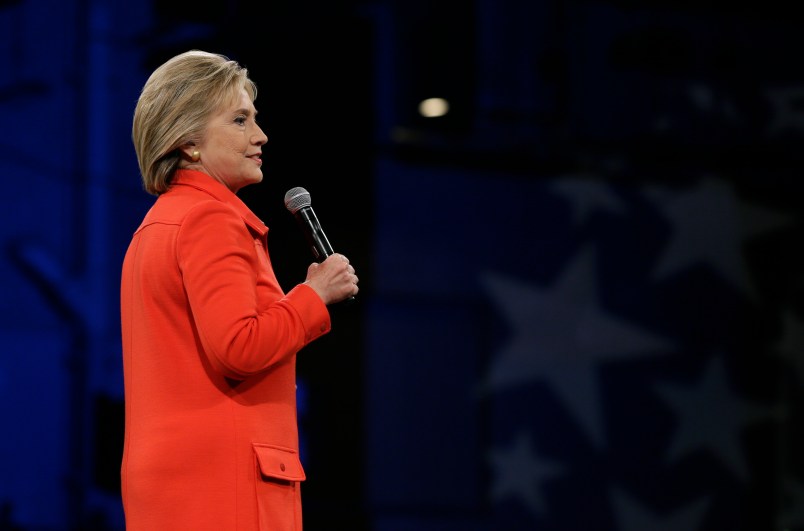
NORTH CHARLESTON, South Carolina (AP) — Hillary Rodham Clinton soaked in standing ovations and weathered protesters over a day of campaigning intended to solidify her advantages in the African-American community and highlight criminal justice and economic policies that she says will treat blacks more fairly.
The Democratic presidential favorite watched silently Friday evening at an NAACP banquet in South Carolina as family members of “The Emanuel 9” took part in a memorial for nine people slain in June by a white gunman during a Bible study a historic black church in Charleston.
“People in this room … have shown grace and resilience,” Clinton said later, during remarks that drew multiple rounds of applause. She added that the city has inspired Americans she said often “don’t know what to do about that kind of hate and violence stalking our land.”
Clinton framed the Emanuel slayings and the April killing of Walter Scott, a black man shot by a North Charleston police officer who has since been fired and charged with murder, as part of a trend. “The last few years have shone a bright light on the systemic effects of racism and injustice,” she said.
The answers, she said, include overhauling the U.S. criminal justice system, tightening gun regulations and expanding economic and educational opportunities in communities held back by generations of institutionalized racism.
Clinton delivered a similar message earlier Friday in Georgia. But the otherwise friendly audience at Atlanta Clark University, a historically black campus, included several protesters from the Black Lives Matter movement.
They sang and chanted for nearly 12 minutes several feet from the podium as Clinton tried to shout over them. Rep. John Lewis, a hero in the civil rights movement, urged them to stop, as did the musician Usher.
The group — fewer than 10 — eventually left the college gymnasium only after the crowd of more than 2,000, most of them young African-Americans, chanted, “Let her talk!”
“I’m sorry they didn’t listen, because some of what they demanded I am offering and intend to fight for as president,” Clinton said. “We have to come together as a nation,” she added.
The Georgia-South Carolina campaign swing, which Clinton will continue Saturday in Charleston, is part of her increasing emphasis on Southern states that dominate the early weeks of the nominating contest.
South Carolina holds its Democratic primary Feb. 27, after Iowa and New Hampshire begin the process a few weeks earlier. Georgia is one of almost a dozen states from Virginia to Texas that follow in March. African-Americans could make up a majority of the Democratic electorate, or close to it, in several of those states, a potential boon for Clinton, given that her closest rival, Vermont Sen. Bernie Sanders, has struggled to attract support from black voters.
Clinton, Sanders and former Maryland Gov. Martin O’Malley each have pitched criminal justice overhauls as they court African-Americans. The issue resonates among both traditional civil rights organizations like the NAACP and the younger activists of Black Lives Matter, though that movement’s leaders say they aren’t interested in participating in conventional politics by endorsing Clinton or anyone else.
Clinton called Friday for eliminating sentencing disparities between crack cocaine crimes and those that involve powder cocaine. The changes would build on a 2010 act of Congress that narrowed the disparity between crack crimes — which are concentrated among minorities — and powder crimes, which are more likely to involve whites. Clinton’s plan would make the change retroactive.
She proposed a legal ban on racial profiling by police. The policy would forbid federal, state and local officers from “relying on a person’s race when conducting routine or spontaneous investigatory activities,” unless they have information linking a suspect to a crime. Clinton hasn’t detailed how her idea would go beyond existing law, but her campaign cited previous congressional proposals that would make it easier for alleged profiling victims to recover damages from government agencies in civil court.
Clinton also embraced the movement to “ban the box,” or prevent the federal government and contractors from asking about criminal history during initial job applications. Studies have shown that employers are reluctant to consider applicants with a criminal history, but job prospects improve for former felons if hiring managers hear about their qualifications before their criminal records.
“I believe in second chances,” she said in South Carolina.
——
Follow Barrow on Twitter at https://twitter.com/BillBarrowAP .
Copyright 2015 The Associated Press. All rights reserved. This material may not be published, broadcast, rewritten or redistributed.



Black Lives Matter needs to have its targeting computer adjusted. First Bernie Sanders, and now Hillary Clinton? Are they showing up at Trump events? Cruz rallies?
BLM needs to avoid this common mistake:
In a series of tweets, Clinton said the United States needs to end private prisons and mass incarceration. Clinton also criticized punishment for drug offenses and other aspects of criminal justice that she said disproportionately affect African-Americans.
Meanwhile …
Lobbyists for two major prison companies—Corrections Corporation of America and the Geo Group—are serving as top fundraisers for Hillary Clinton’s presidential campaign.
The implication is that laws governing crime and incarceration will deliver more inmates and profits to private prison companies if Clinton is elected.
Lee Fang reports at The Intercept:
Last week, Clinton and other candidates revealed a number of lobbyists who are serving as “bundlers” for their campaigns. Bundlers collect contributions on behalf of a campaign, and are often rewarded with special favors, such as access to the candidate.
Richard Sullivan, of the lobbying firm Capitol Counsel, is a bundler for the Clinton campaign, bringing in $44,859 in contributions in a few short months. Sullivan is also a registered lobbyist for the Geo Group, a company that operates a number of jails, including immigrant detention centers, for profit.
As we reported yesterday, fully five Clinton bundlers work for the lobbying and law firm Akin Gump Strauss Hauer & Feld. Corrections Corporation of America, the largest private prison company in America, paid Akin Gump $240,000 in lobbying fees last year. The firm also serves as a law firm for the prison giant, representing the company in court.
If lobbyists for private prisons are bundling for Hillary, what does this imply? I can’t think of an answer.
That they think they need to have access to get her to change her mind.
Has anyone checked who else the lobbying firms have members bundling for? Granted that a Republican administration would be an economic disaster and that most businesses know that, it remains the case that most such firms raise money for both sides because they need to have access to whoever wins.