


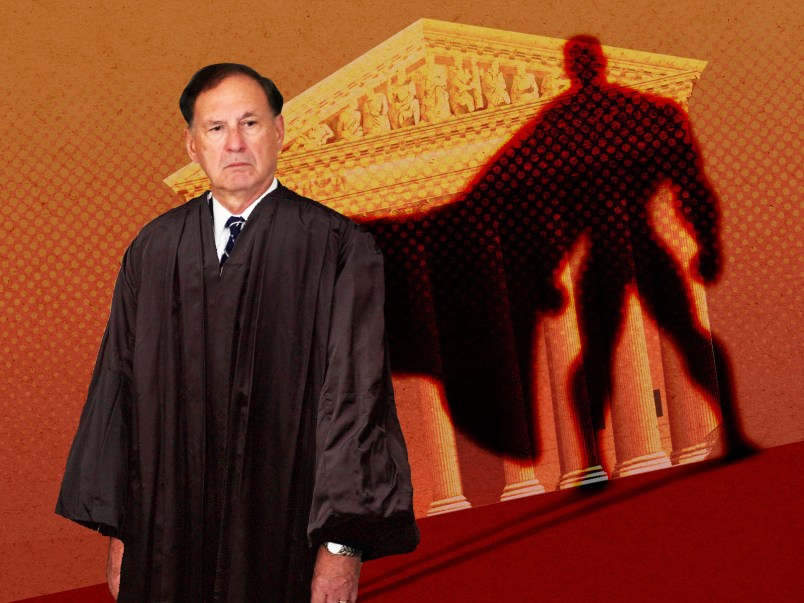
At first glance, Federalist Editor-in-Chief Mollie Hemingway’s Alito: The Justice Who Reshaped the Supreme Court and Restored the Constitution is certainly delusional, but not in a way that’s particularly interesting or insightful for a MAGA movement rooted in a cult of personality.
The hagiography of the Court’s most openly partisan archconservative, premised on insider access to the justices and those in their orbit, reads like the gushing raptures of a K-pop stan.
“Years before the attacks on the Court intensified and conservative justices could still be seen in public, Justice Alito and his wife attempted to get brunch in New Haven, Connecticut, after a speaking event at Yale. Turned away because of a long line and lack of reservation, they ‘calmly walked away and went down the street,’” she writes, his not forcing himself into a packed restaurant apparent proof of a rare moral rectitude.
But as I reread, the humor in her labored attempts to dredge up proof of the curmudgeonly justice’s humanity — his devotion to the Phillies does much of the heavy lifting — curdled into something much darker.
Hemingway seeds her book with the omnipresent threat of leftist violence from its opening pages, where her treatment of anti-Kavanaugh protesters (with no mention of why they were protesting his nomination) puts them on par with the January 6 insurrectionists.
“One woman scaled the gigantic statue Contemplation of Justice on the left side of the main steps and perched, first raised, on the marble lap of the seated female figure. The activist later justified her lawbreaking by declaring, ‘This is our court, these are our steps, these are our institutions!’” she writes.
That harrowing anecdote, page 3, is around where her examples of left-wing violence untether from reality completely.
Hemingway is writing in a period extremely fraught for someone of her political bent: Her party controls every branch of government. She has long made her peace with President Trump and her liberal enemies are completely locked out of power. All that winning presents a real problem for the reactionary movement Hemingway belongs to: The grievances are getting stale (readers imbibe a heaping portion of the injustices faced by Robert Bork), and threats to the Republican hegemony — particularly to the Court’s right-wing supermajority — remain theoretical.
Paeans to Alito’s brilliance and humility can only produce so much juice; this book, like the MAGA movement, needs at least the threat of violence to justify its sense of being under siege.
In her telling, the still mysterious leak of Alito’s Dobbs opinion, which would overturn Roe v. Wade, is less a shocking piercing of the Court’s well-insulated bubble and more an open declaration of war on the conservative justices.
“Abortion supporters had an incentive to kill one or more of the justices in the majority to change the outcome,” she writes, straight-faced.
The liberals weren’t laboring over the most significant dissents of their tenures — they were malicious collaborators with the unidentified pro-choice assassins, giving them more time to strike. Hemingway’s proof of this grand conspiracy is one person who turned herself in to the police and told them of her aborted plan to kill Justice Brett Kavanaugh, and many lurid descriptions of nonviolent protests.
Her rock-ribbed conviction of liberal bloodlust occasionally strays into potentially dubious legal territory as she devotes pages to naming the law clerks of the liberal justices she suspects — again, without evidence — of culpability. As to the possibility that it was her camp behind the leak: “Some liberal journalists suggested that a conservative clerk or justice had leaked the opinion to shore up the majority, an idea not taken seriously inside the Court.” That settles that then.
Some of her conspiracy theories are so foreign to those of us not hooked up to a Fox News IV drip that they prompt a double-take, including her assertion that it was only the COVID pandemic that prevented liberals from physically preventing Amy Coney Barrett’s confirmation.
“The difficulty of mounting a campaign based on physical confrontation and disruption made it almost impossible to keep Barrett off the Court,” she writes.
From there, the book descends into less interesting conservative schlock — Justices Sonia Sotomayor and Ketanji Brown Jackson, DEI hires, are intellectual lightweights who bully their staff and ask “inconsequential questions” from the bench. Liberal dissents are “temper tantrums,” while the incredible recent win rate of conservative causes is attributable to Alito’s brilliant questioning, confounding his opponents, rather than the Court’s 6-3 slant.
“At a time when the Court’s conservative bloc is at its most intellectually rigorous level in history, two of the three left-leaning justices have been selected more for their race and sex than for their legal prowess, and it shows,” she sneers.
Justice Anthony Kennedy was more of a “politician” than a judge, Clarence Thomas a perpetual victim of the villainous “corporate media,” John Roberts a weak-willed dilettante “known to carefully follow news about himself.”
In Hemingway’s telling, the right’s political domination, and Alito’s leading role in it, is a just and long overdue correction from the supposed liberal excesses of past Courts that tyrannically imposed their will (desegregation, rights for accused criminals) on a resistant public.
“Since the years of the Warren Court, it had functioned as a super-legislature, enacting the Left’s policies by a majority vote of justices, no matter what the Constitution said,” she writes.
The Roberts Court is stocked not with partisans groomed and promoted to deliver political wins to the right, but with originalists whose unimpeachably correct interpretation of the Constitution just so happens to align with Republican preferences 100 percent of the time.
And as to the times that even Hemingway can’t credibly paint Alito, forever reverse engineering decisions to advance his political aims, into a detached and technocratic originalist? He’s right then too.
“It requires a justice with the humility to stay focused on the specific facts of a case and remain appropriately skeptical of comfortable theories of textual interpretation,” she writes.





And how does she describe Mrs. Alito’s flag obsession? Any mention of Sam’s citation of the witch-burning jurist in the Dobbs opinion? Just wondering, since I’m as likely to read this book as I am to bathe in a tub of sulfuric acid.
Funny how Hemingway can be wrong about everything, even the role of the real driver of this court, John Roberts. Alito is simply the grumpy front man, Roberts is the real power, the man who more than anyone, has turned the court into the most effective branch of the Republican party. I recommend reading Without Precedent by Lisa Graves if you want the real story behind the unrelenting fanatic masquerading as just a smiling caller of balls and strikes.**
Alito is a known leaker of unreleased opinions. He had obvious motive to do so with Dobbs: shoring up some wavering colleague who might have defected to Roberts’ half-measure concurrence, thereby denying Alito an outright majority and the force of law. Releasing his draft majority made it clear that Alito had at least five votes on his side, exposing any defector as a traitor to the cause. And it would have been simple and obvious for him to do it through someone outside the Court, such as a trusted former law clerk or a FedSoc type.
Alito is the presumed leaker until proven otherwise.
What do these people smoke?
Formaldehyde