


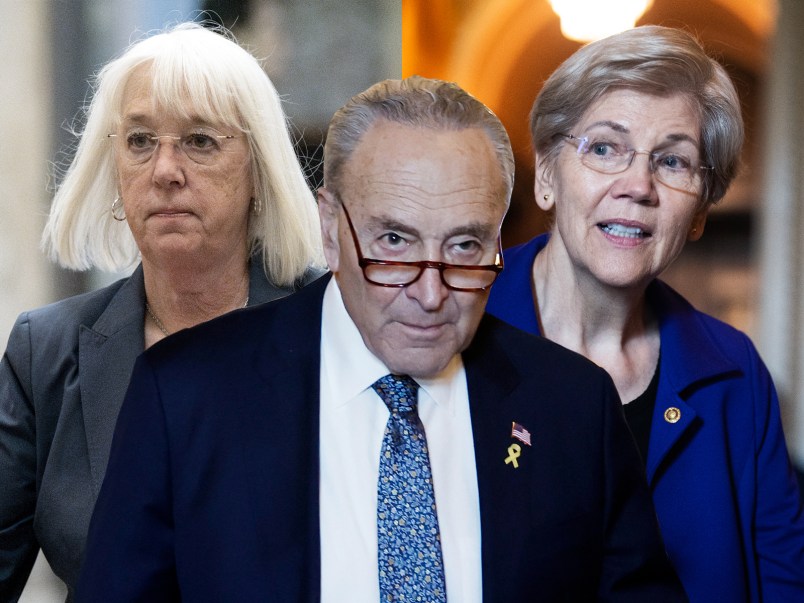
When Congress returns from its lengthy August recess, lawmakers on Capitol Hill will only have a few weeks to work something out before the government runs out of funding at midnight on Sept. 30.
And Senate Democrats will quickly have to make a decision.
In the upper chamber, legislation to fund the government is subject to the filibuster and requires 60 votes. That means Republican leadership will need a handful of Democratic votes and won’t be able to avert a government shutdown without the help of their colleagues across the aisle.
Meanwhile, the White House has spent much of 2025 freezing funds Congress has already appropriated, essentially robbing from the legislative branch its power of the purse. In July, congressional Republicans voted through a recissions package, signaling their approval of a small sliver of President Donald Trump’s funding freezes using a legislative process that required only 50 votes. No Democrats voted for the bill.
“Now you have a dynamic where Republicans in Congress can make cuts with 50 votes to things that had to be agreed to with 60 votes,” Devin O’Connor, senior fellow at the Center on Budget and Policy Priorities, told TPM. “And that’s a really poisonous dynamic.”
That set of facts hangs over the budget process to come.
“Why should Democrats come to the table and negotiate in good faith and throw our support behind a quote-unquote bipartisan bill, only for Republicans to turn around after the deal is done and, somewhere down the line, delete any parts of the deal Trump doesn’t like?” Sen. Elizabeth Warren (D-MA) asked in a Senate floor speech last week.
Dems Prepare to Pick Their Path on Appropriations
This complicated reality is foreshadowing an internal fight among Democratic senators — and possibly within the larger Democratic Party — that is on the horizon.
Senate Democrats can decide that they will strike a deal with Republicans, eventually giving them the votes they need to avoid a government shutdown, and cooperate with what would likely be a lengthy, bipartisan appropriations process. That is what might have happened under normal circumstances, in bygone eras when the executive branch hadn’t been holding up congressionally appropriated funds. A group of Democrats could also join Republicans to support a short- or long-term continuing resolution (CR) to keep the government open.
Or Democrats could decide they want to stand up to the ongoing impoundment by the Trump administration and follow Warren’s urging, refusing to vote for legislation unless the White House guarantees that funds will be distributed as appropriated. Doing so could lead to a stalemate if the White House refuses to cooperate, putting the country on track for a government shutdown — which Republicans in Congress would surely attempt to blame on Democrats, despite their own unwillingness to stand up to Trump to protect Congress’ power of the purse.
Even if Democrats choose to cut a deal with Republicans, it will be very difficult to work out a bipartisan group of bills in the time frame senators will have following the August recess. The fiscal year ends on Sept. 30.
But more significantly, it is unclear whether Republican senators could get the White House to agree to any deal they might strike with Democrats — especially one that attempts to mandate an end to the administration’s lawless funding freezes. Office of Management and Budget (OMB) Director Russell Vought has already said he wants a “less bipartisan” appropriations process, part of his defense of the Trump administration’s strategy of impoundment and rescissions packages.
“You cannot make a deal with someone who doesn’t want to make a deal,” Bobby Kogan, senior director of federal budget policy at the Center for American Progress, told TPM. “It is not possible to force someone to make a deal with you.”
Even if Democrats could extract a deal from Senate Republicans, experts tell TPM, there are serious questions around whether Democrats can and should trust Republicans when it comes to any bipartisan deal they might make to fund the government.
“How can you actually make a deal if one side’s ready to do a partisan breaking of the deal through rescissions later,” Kogan said.
The Government Accountability Office, a nonpartisan legislative branch watchdog agency, has already issued several rulings saying the Trump administration violated the Impoundment Control Act by illegally withholding funds.
Impounding funds and using the rescissions process in this way is not only illegal but is also dangerous for the future of the appropriations process, experts said.
“It would be very difficult to justify giving your vote to something that you can’t trust and something that might be kind of ripped up or revised shortly after you think you’ve reached a deal,” O’Connor said. “How will Democrats know that Republicans aren’t going to basically cut education spending, cut medical research funding, cut disaster preparation funding unilaterally, after-the-fact, in a disguised way. And so if you’re a Democrat and you care about those things, what commitment can Republicans give you that says they’re not going to do that?”
Democrats should want guarantees because, unlike normal times, “nothing will be final when the funding deal is passed,” O’Connor added.
An Appropriations Bill, a CR or No Deal?
O’Connor emphasized that both the Senate and House are currently controlled by the GOP, making the president’s party the leading voice in putting together a bipartisan deal.
“They are going to be the ones to put the deal together, but they need the 60 votes. So either they need to end the filibuster and do it all alone or they need to figure out that the burden should really be on them,” O’Connor, who was previously OMB’s Associate Director for Economic Policy, told TPM.
With the reality of the government funding deadline, it is almost inevitable that Congress will have to pass a CR — legislation to keep the government funded at current levels — if Democrats decide they want to stay away from the shutdown path while also avoiding a deal on an appropriations bill.
Earlier this year, in March, a group of Senate Democrats joined Senate Republicans and voted for a GOP-backed full-year continuing resolution, saying that a shutdown would be “much, much worse.” At the time, a handful of Democrats in the upper and lower chamber attempted to extract some sort of commitment from the White House, that the funds would be spent as appropriated, in order to earn their support for the CR. Republican leadership did not take that proposal seriously and enough Democrats ultimately backed the measure to secure its passage without a commitment. That decision led to staunch criticism from many in the Democratic base, much of which was directed at Democratic leadership, and, specifically, Senate Minority Leader Chuck Schumer (D-NY).
If Democrats decide to coalesce around a short-term CR, that could give the White House an opportunity to continue to illegally withhold funds that were previously approved by Congress. That’s because “short term CRs tend to give the administration more flexibility for very legitimate budget execution reasons,” Kogan told TPM.
The Risks and Benefits of Taking a Stand
Democrats can also go the opposite direction and refuse to support funding the government so long as the White House insists on having the final say on what gets spent. Since any funding agreement requires 60 votes in the Senate, that would likely trigger a government shutdown.
But this approach also isn’t without downsides. During a shutdown, the executive branch can decide which parts of the government stay open by deciding what is essential and what is not. So the White House could continue to not spend congressionally approved funds — but, now, under the excuse that they are not essential services.
“I am not confident, in fact, I’m genuinely concerned that if there were a funding hiatus under Trump 2.0, that most of the government would not reopen, that Vought would find a way to interpret the law — break the law — to empower the Treasury to pay people for this work,” said Charles Kieffer, who served in high-level roles in the OMB during the Reagan, Bush and Clinton administrations and who was the staff director of the Senate Appropriations Committee. “So in essence, the only parts of government that would continue are the parts of government that Russ Vought and President Trump want to continue.”
Others acknowledge that although a shutdown is always a bad option when it comes to discussions around government funding, the inability to make bipartisan deals with the GOP would require Democrats to roll over and accept that the executive branch is actively impeding Congress’ power of the purse.
“We’re kind of having a partial, selective shutdown of the government every day because the White House is choosing which programs they’re going to stop funding and which programs they’re going to restrict in a way that almost mirrors a shutdown,” O’Connor told TPM. “The dynamic between what things will look like if there is a government shutdown versus what things will look like if there is not is just a lot closer than it’s ever been before.”




The GOP never paid a political price for shutting down the government. And, in this case, Trump/GOP will own the effects of the shutdown when Trump chooses what to fund and what not to fund IF the Democrats keep shouting that that is what is happening anyway - Trump funds what he wants - so there is no purpose behind a deal.
Shut it down till Trump follows the law.
It’s the easiest message ever, but it looks like Schumer and Co are looking to fumble the ball into the end zone again. If he can’t get it right this time, he needs to go.
Senate Dems should do everything they can to extort a guarantee out of the GQP that the funding will be dispersed. They should block everything in their power until that guarantee is given.
But don’t be surprised if it’s Lucy with the football again and the GQP is laughing all the way to the midterms as to how ineffective the Dems are.
“Nationalism is not to be confused with patriotism. Both words are normally used in so vague a way that any definition is liable to be challenged, but one must draw a distinction between them, since two different and even opposing ideas are involved. By ‘patriotism’ I mean devotion to a particular place and a particular way of life, which one believes to be the best in the world but has no wish to force on other people. Patriotism is of its nature defensive, both militarily and culturally. Nationalism, on the other hand, is inseparable from the desire for power. The abiding purpose of every nationalist is to secure more power and more prestige, not for himself but for the nation or other unit in which he has chosen to sink his own individuality.” ― George Orwell
Yup, the message shut it down until Trump follows the law is how to message this. Congress and only Congress has the power of the purse.