

This story was originally reported by Mel Leonor Barclay of The 19th. Meet Mel and read more of their reporting on gender, politics and policy.
In the aftermath of Donald Trump’s second election, voting for legislation to boost immigration enforcement could have seemed like a safe choice to some Democrats, who tied Donald Trump’s second presidential victory to a rejection of their party’s handling of immigration.
Forty-six Democrats broke with their party to support legislation named after the murdered Georgia college student Laken Riley. Now, for some, that vote is a potential liability, as primary opponents say the votes cosigned Trump’s mass deportation agenda.
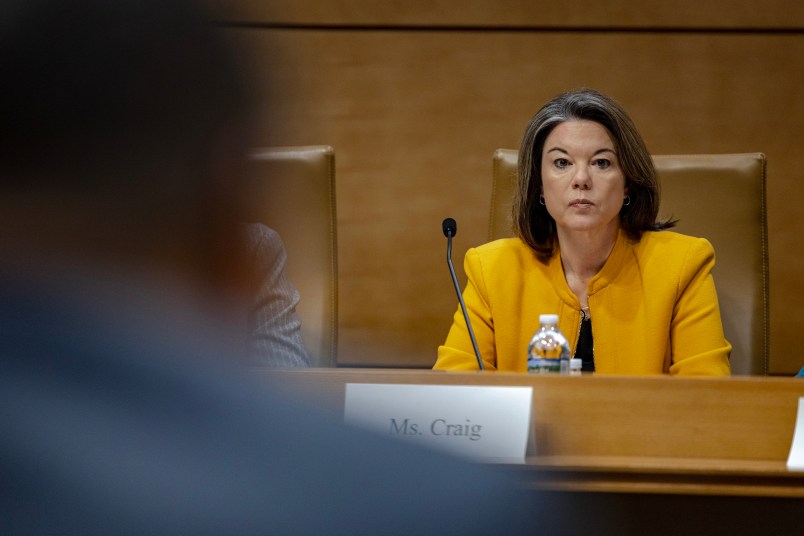
In Minnesota’s Democratic primary for an open Senate seat, Lt. Gov. Peggy Flanagan has made Rep. Angie Craig’s vote in favor of the Laken Riley Act a key focus of the campaign, calling it “disqualifying,” even after Craig walked back support of the law. Democrats in primary races in Maryland and Arizona have also faced attacks based on their support of the law this cycle, while others have expressed regret over their votes.
“Voting three days into the second Trump administration for Donald Trump’s immigration bill that allowed him to terrorize our communities, the loss of life, the economic impact, the trauma — it’s horrific,” Flanagan said Monday night during the final debate ahead of the August 11 primary.
Trump and fellow Republicans held up Riley’s February 2024 murder by an immigrant without permanent legal status in the lead-up to the fall elections that year, using the case to cast unauthorized immigrants as dangerous and violent, and argue that the influx of immigrants during President Joe Biden’s term had made the country less safe. The law named after Riley requires federal law enforcement to detain and deport immigrants charged with nonviolent crimes, including shoplifting, even if those charges never result in a conviction. Riley’s convicted murderer had been arrested and released in New York before the murder in Georgia. Forty-six Democrats joined Republicans to pass the law in early 2025, despite criticism that the law denied immigrants due process.
Only a few of those lawmakers have walked back their support for the law, but the backlash facing some Democrats in competitive primaries suggests an evolution on the politics of the issue since Trump took office and dramatically ramped up raids, arrests, detentions and deportations.
Polling consistently shows the majority of Americans disapprove of the president’s handling of immigration. While Republicans remain overwhelmingly supportive, 92 percent of Democrats and 60 percent of independent voters said they strongly or somewhat disapprove, according to a July survey by Winthrop University and YouGov.
“The support for something like the Laken Riley Act was speaking to what I think some voters had expressed — wanting a government that can manage the the border and the chaos — but those same voters have shown us in the last year that they also reject indiscriminate arrests, the killings of people, masked agents,” said Lorella Praeli, co-president of Community Change, a Democratic super PAC and nonprofit focused on turning out infrequent voters of color.
In the Minnesota Senate race, the issue is particularly salient following the administration’s “Operation Metro Surge,” which involved the sudden deployment of federal agents to the state and saw ICE ramp up aggressive tactics to detain immigrants, including pursuing them outside of schools. The enforcement campaign led to clashes between agents and protestors, and the killing of two U.S. citizens — Renée Good and Alex Pretti — by federal agents.
“As I stood at the Whipple detention center, as I met with constituents who were being literally rounded up by ICE in Minnesota under Operation Metro Surge, I couldn’t help but regret giving this administration any additional authority,” Craig said in an interview earlier this month, reiterating her comments from a March op-ed in which she first expressed regret over the vote.
“I wanted to be honest with the people of Minnesota. I will tell you when I get it wrong, and I got that one wrong.”
In a statement to The 19th, Craig said that Flanagan’s attacks over her vote on the Laken Riley Act don’t take into account her work fighting the administration on the issue. Craig said that from her seat in Congress, she took on the administration by conducting oversight, helping get constituents released from custody and fighting against the opening of new detention centers in Minnesota.
“The attacks from my opponent fall flat when this moment calls for leaders who can take accountability and take on tough fights – not watch from the sidelines,” Craig said.
In Maryland, Rep. April McClain Delaney overcame a primary challenge from former Rep. David Trone, but not before she walked back her support for the Laken Riley Act. Trone made McClain Delaney’s support for the law one his main lines of attack — arguing she sided with Trump and stripped immigrants of due process — and played up criticism from Maryland lawmakers and immigrant rights groups.
In interviews, McClain Delaney said she regretted the vote and that at the time, she didn’t envision the Trump administration carrying out its mass deportation promises.
“I don’t think I totally focused as much as I should have on the ‘accused of a crime’ [part],” she said in a December interview with the Baltimore Banner. “But I will say that this was in the beginning of my term. And I never thought that ICE immigration and the horror of what has happened would happen.”
McClain Delaney said that her decision to disavow the vote came after receiving thousands of messages from constituents raising concerns about the administration’s immigration policies and also asking for help from their local representative. More than 50 percent of her constituent services casework at the end of last year was related to immigration, she told the Banner.
McClain Delaney defeated Trone by six points.
In Arizona, Rep. Greg Stanton, the former mayor of Phoenix, easily fended off a challenge from progressive activist Kai Newkirk, but Newkirk’s criticisms of Stanton, including over support for the Laken Riley Act, attracted attention to the race.
Separately, two other Democrats have publicly walked back their support of the law. Sen. Mark Warner, a Democrat from Virginia, said he regretted his vote during a campaign appearance last summer, before his reelection in November. Last April, Democratic Rep. Jahana Hayes of Connecticut said during a CNN town hall that she wishes she had voted differently.
“As I’ve thought about it over the past couple of months, I probably would have voted differently. It’s a vote that I regret,” Hayes said.
Not all Democrats are expressing regret. Sen. Jon Ossoff of Georgia has been criticized by Republicans for voting against an earlier version of the law in 2024 but has stood by his vote for the Laken Riley Act ahead of his high-stakes reelection campaign this November.
Immigration – including how Democrats respond to Trump’s policies and communicate a different vision on the issue to voters — is one of the key issues of the 2026 campaign cycle, already a historic one for Democrats as their leaders and base voters grapple with the direction of the party ahead of the 2028 election.
Rep. Ro Khanna, a progressive Democrat from California widely seen as a 2028 presidential contender, said in May that support for the law should be disqualifying.
“Nine swing-state Democrats gave permission for mass deportation,” Khanna told the Bulwark in May.“No one who voted for the Laken Riley Act should have any role in the future leadership of the Democratic Party in this country. … It’s disqualifying, just like the Iraq War vote.”
Heading into November and beyond, Lorella said, Democrats have an opportunity to shift the dynamic of the immigration debate. At the time of the Laken Riley Act vote, she said, Republicans created a “boogeyman” out of immigration, and there was nothing competing against that vision.
“Now we’re a year and some change into what it means to execute a mass deportation agenda. People understand these are neighbors, childcare providers, people who take care of us,” she said. “If all they hear is Democrats say we need to abolish ICE, I think what falls short. They can lead with a governing vision, an affirmative vision for immigration.”





First?!
Anyone who voted to support his agenda demonstrated they didn’t understand the threat of his 2nd term and should not be in Congress during this time.
Good, it should be a disqualifying vote
Voting for the Laken Riley Act isn’t the only disqualification for Craig running as a Democrat. Throw in her support of Crypto and introducing her BFF Eric Trump as the keynote speaker the Wyoming Blockchain Symposium and her support for AI data centers…
Wow. Reps. Angie Craig and Rep. April McClain Delaney’s pathetic excuses for voting for the act are alone disqualifying because they clearly demonstrate a serious lack of cognitive ability and awareness of Project 2025, SCOTUS, and Trump’s MO.
How could any person with half a brain think that what ended up happening wouldn’t occur? It’s like a drunk getting into a car and killing someone on the way home from the bar. Of course they regret it! But apologizing and expressing regret does not in any way mean that they should ever be allowed to drive again.
It’s getting ugly for Angie in this primary. She hasn’t a leg to stand on.
Yes, she showed up for the protests in Minneapolis, but voting for this law was a really bad and stupid forced error.