


If you’re not a regular listener to our podcast, I hope you’ll listen to the episode that will come out later this afternoon. It was, I think, a particularly good episode, in large part because we had such critical issues to discuss: Callais, the wave of emergency redistrictings across the southern tier of the old Confederacy and what seems to be a sea-change moment on Supreme Court reform among establishment Democrats. I want to expand today on some points about Supreme Court reform, offering some of the historical background for this present moment.
Every current member of the Supreme Court comes out of what we might call the elite academic-judicial nexus, which is to say they’ve been law professors at elite universities and judges in the federal judiciary. I believe this applies to all the current justices. It didn’t used to be this way. It used to be relatively common to have justices who had never served as judges before and had never been law professors. Frequently they were ex-politicians. Famously, William Howard Taft was an ex-president when he became chief justice. Earl Warren was a popular Republican governor of California who had never served as a judge until president Eisenhower nominated him as chief justice. If you go further back, many justices never even went to law school, though this was more a matter of the evolution of legal education. The last non-law school justice was James F. Byrnes. (In earlier history, you generally learned the law as a kind of apprentice and then passed the bar to practice.) There was a brief boomlet of chatter when Bill Clinton was elected that he should or would try to re-inject this “politician on the Court” tradition back into the system. Of course that didn’t happen. The idea has scarcely been entertained since.
JoinFrom an Anonymous TPM Reader …
Read MoreApologies for the extremely lengthy response, but your post today hit upon a perennial hobby horse of mine!
It strikes me that in addition to their own self-image, law professors (and elite lawyers generally) aren’t able to be honest brokers in discussions about court reform because of the enormous quid pro quo and tight knit social ties created by judicial clerkships. The number of students that obtain clerkships plays a big role in law school rankings. Partly as a result of this, having clerked at least for a circuit clerk is now seen as a de facto requirement to be hired as a law professor, barring a PhD in another field (and even then, most still clerk). Professors who clerk help place students with their judges and so on and so forth. There is an *enormous* professional taboo against quitting a clerkship or criticizing the judge that you worked for no matter how bad the experience. It’s viewed as professional suicide, some law schools will effectively ice you out of their career services as you do it, and certain firms will effectively be closed to you for the entirety of your career. Conversely, stay close with your judge and you can expect them to be a letter of rec and introduction-maker for life. All of this adds up to elite law school faculty and elite lawyers having a sizeable material professional and social stake in revering judges, in addition to their psychological investment in feeling learned.
I want to share with you a letter from fellow TPM Reader DA. He makes a point I fully agree with but didn’t make clear enough in yesterday’s post. I fully agree there is such a thing as legal expertise. I’ve made that clear in my actions over a couple decades by paying for some of the very best (and priciest) legal counsel — mostly though not exclusively on 1st Amendment and libel law. It of course goes beyond this. Law, in its largest scope, is a complex set of rules and practices that we as a society have agreed on — sometimes explicitly, usually implicitly — to govern ourselves by and through which we resolve the countless range of disputes — civil and criminal — that arise among us. But it is in the nature of any specialized and professionalized craft to cast a penumbra of authority beyond its actual area of expertise.
JoinTPM has a new Youtube channel. It’s right here. Can you click that link and just hit the subscribe button? That’s it. Takes like five seconds. And it helps us A LOT build out our new channel.
A couple days ago I found myself in a brief online (social media) argument with a Court-reformer member of the legal academy insisting that, contrary to my claims, it’s totally false that there are no reformers in the academy. Of course I never said there were no reformers in the academy. What I said, what I think is undeniable, is that the legal academy as a group or a community, and especially its most powerful voices, have been deep in the SCOTUS-reverencing camp. And for more clarity here we’re talking really about the liberal + mainstream academic legal community. It goes without saying that this applies, on a contingent basis certainly, to the conservative legal movement which not only participates in the corruption of the Roberts Court but is in effect its deep root structure, from which the Roberts Court is simply the degenerate, swaggering oak dominating the canopy and blocking out the sun which civic democracy needs to flourish.
Read More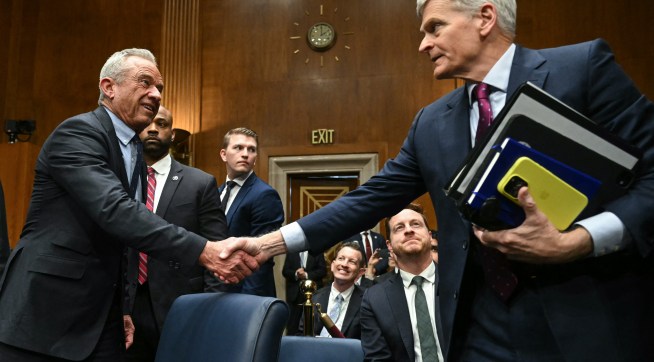
Sen. Bill Cassidy (R-LA) was defeated in a three-way primary against two Trump-aligned challengers tonight. Emine Yücel has our story.
Rep. Julie Letlow (R-LA), endorsed by Trump, and Louisiana’s state treasurer, former congressman John Fleming, will proceed to a runoff next month. Cassidy, with about 25 percent of the vote, will not.
Read More
The more I speak with people both in the political world and in what I’ve called the legal academic-judicial nexus, the more I see just what a sea change is underway about Court reform. It’s come in successive waves: Dobbs, the immunity decision, Callais. There are various models of reform. But I don’t know anyone who has seriously considered the matter who thinks that you can have serious reform without expanding the Court. In these conversations, a few people have raised the question: what if the Court rules that a Court expansion law is itself unconstitutional? To put it slightly differently, what if the Court decides that the limits on its authority the Constitution creates, the paths for accountability it creates, are themselves unconstitutional.
This is question that is once absurd but also in a certain specific way important to prepare for.
JoinAs some of you may have seen on Saturday, we’ve made some changes to our Weekender newsletter. We want to use it as a space to step back from the 24-7 news cycle to reflect on What It All Means and write about some of the entertaining, strange, surreal elements of our politics and political culture that we don’t always get to cover on-site. (It’s the weekend, after all!) We’ve also introduced some recurring segments, including No Words (an image that captures the spirit of the week), From TPM’s Group Chat (social media posts that made the staff chuckle or raise an eyebrow), Trivia Time (a little mini news quiz) and more.
I’ll be leading up the new Weekender alongside our Head of Product Derick Dermaier, and you’ll also still regularly hear from our other editors and reporters, including the indefatigable Nicole LaFond, who often anchored the Weekender in the past. She’ll also be helming Where Things Stand for you Monday through Thursdays.
Please give me a shout at allegra@talkingpointsmemo.com if there are things you love/hate about the look or content of the new Weekender.
And subscribe here to get it in your inbox on Saturday mornings!
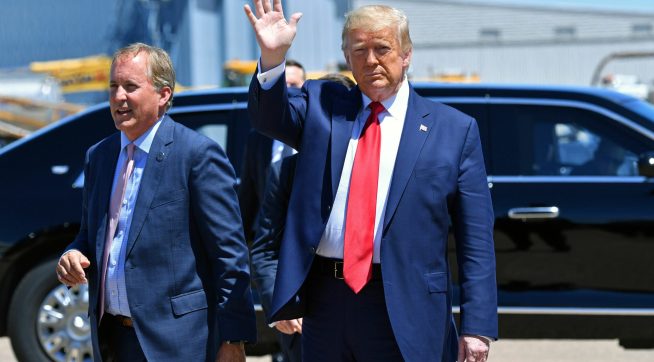
You’ve seen the kind of stunning, kind of not stunning news that President Donald Trump has endorsed Ken Paxton for the GOP Senate primary runoff in Texas. Two months ago, Trump was on the cusp of endorsing Sen. John Cornyn, apparently already had the statement written out. Paxton rolled Trump and rolled him hard. The most obvious explanation for this is that the polling is showing that Cornyn is going to lose and Trump absolutely never wants to back a loser. It may be that. But I see something a little different. Trump has been taking out a lot of not-100% MAGA members of Congress. Louisiana Sen. Bill Cassidy is the latest example of that. There were those state senate holdouts in Indiana. It’s happened again and again. On that front, he feels like he’s on a roll. But it’s not just that either.
JoinThere will be a lot of discussion today of a Trump-backed automaton’s victory last night over Rep. Thomas Massie (R-KY), the eccentric libertarian who was perhaps the last Republican in Congress to reliably choose his right-wing but distinct ideology over Trump’s demands whenever he felt the two diverged. But don’t overlook Tuesday’s primaries for offices that will run Georgia and oversee its elections. The state has, of course, been a hotbed for MAGA hijinks and efforts (still!) to overturn Trump’s 2020 loss. Last night, Brad Raffensperger, the secretary of state who famously resisted Trump’s demand that he “find 11,780” votes, lost the GOP gubernatorial primary to two election deniers, one of whom served as a fake elector in Trump’s 2020 scheme. The deeply Trumpy Vernon Jones, meanwhile, is one of two Republican candidates to advance in the race for secretary of state.
Georgia’s runoff is June 16.