


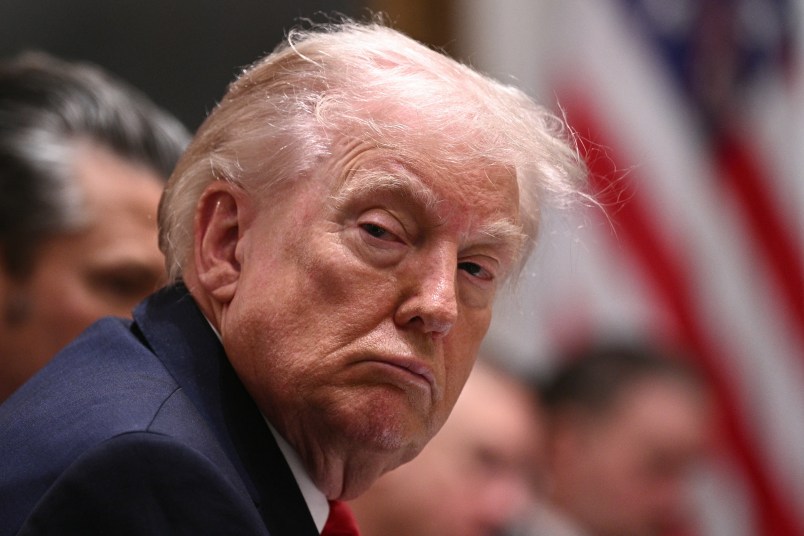
A few days ago Donald Trump said he’s deciding to “nationalize” American elections. He then made the comically insane claim that he won the fairly, though not totally, blue state of Minnesota three times. (Reality: 2016: -1, 2020: -7; 2024: -4). What precisely Trump means by this isn’t totally clear and in fact is totally not the point. It’s a bit like asking what the front man from a third-rate punk band means when he dives into a mosh pit for a crowd surfing adventure. It’s just not a linear thing. Not at all. To the extent we can connect it to anything, it is that same central thread as everything else beginning early last fall: Trump is getting less and less popular and, as he does, he is lashing out constantly, both from a desire to hold on to a dominant position in the attention economy and to exert some level of control over his adversaries’ fear. Both at home and abroad he is leaning into prerogative and other powers which are untrammeled as a kind of compensating salve for his loss of popularity and power.
I’ve seen a lot of people respond to this with a mix of fear, anger and most of all outrage. That is the wrong response. And by that I mean it’s the wrong public response. Obviously, you should respond on your own with whatever you actually feel. But the posture we assume and the words we use in the public square aren’t the same thing.
We live in a political era of highly kinetic public conversation with a moral economy in which humiliation and contempt play a very large part. This is very rooted in the Trump era. In a way it’s a world of jousting and bravado that Trump created. But it’s not only that. It is part of our politics that has existed for two or three decades and one in which Democrats had always seemed ill-equipped. Twenty-plus years ago I coined the term “bitch slap politics”, the way in which our national politics especially seldom turned on questions of policy or the topics they were notionally about. They were competitive performances of power, rhetorical performances of power which signaled — accurately or not — how a leader would operate in the actual management of power, providing safety or chaos for an electorate that seldom had the time or attention span to delve deeply into different policy proposals. Trump brought all of this to a totally new level. The performance was no longer implicit. It’s no accident that Trump existed on the margins of the world of pro wrestling before and during his turn to politics. Trump brought that world into the world of politics: the performative aggression, the over-the-top, half-comic style. That is one part the political sickness of our age. But the political lexicon is real. We cannot thrive in this political world without understanding how to operate in that emotive space, without understanding its idioms.
Let me say something about that.
Outrage is the wimpiest register we can use to communicate in contemporary politics. On its own it is purely reactive. It’s operating on your back foot. It’s like saying it hurts after you get punched. Of course it does. That’s not a response.
Trump doesn’t want to “nationalize” elections. Before the semi-walkback by Press Secretary Karoline Leavitt, the closest he and his toadies came to explaining what he meant is that he wants Republicans to take over running elections in some 15 places where he constantly loses and where he is upset about losing. This is really the biggest loser energy imaginable. He lost and he’s so stung by it that next time he wants to brings his own refs. Again, that’s just the biggest loser energy imaginable. And what’s motivating all of this is that he’s getting less popular every damn day and it’s straight up killing him. He’s homing in on a massive ego injury in November and he’s lashing out right and left.
There are few things that the Constitution is more clear on than the fact that states administer our national elections. Congress has a significant but still limited ability to set uniform ground rules and standards for those elections. But states administer them. The federal government has only a very limited ability to get its hands into that process and it goes through the courts.
This is a textbook instance where the subordinate but separate sovereign authority of the states comes so powerfully into play. They are separate sovereignties, the states and the federal government. There just aren’t levers or tethers connecting them to each other in this sense. For all his vast powers, a president can never order a governor or mayor or, for that matter, a dog catcher to do anything. He can’t fire them. They are part of a separate sovereignty. And it’s driving Donald Trump completely up the wall.
Great! Let him suffer. Glory in it. And most of all lean into it.
Trump’s supporters are abandoning him. He’s getting less popular. He’s losing. So he wants his Republican friends to start counting the votes. So he can win and feel less sad.
Big loser energy! Thank you for your attention to this matter.
The Constitution is so clear on this point it’s unlikely even our thoroughly corrupted judiciary will go along with any of it. What feels like an outrage and is an outrage like so much else happening in our world today is just the wildest and rawest expression of Loser Energy imaginable. Not to lean into a swaggering contempt for that and the humiliation that Trump should feel (and — truth be told — does feel ) for his weakness and fear of defeat and constant demand for special rules and his own refs and all the rest is just a willful obliviousness and paradoxical arrogance about the language of politics today.
In a democratic republic (and really in all times and places), the slavish hunger to be in the thrall of a strongman or a king is the ultimate moral degeneracy. It is a perverse form of moral weakness. The mores of civic democracy are rooted in strength, and self-respect. One of the strangest aspects of contemporary politics is the way that what were once the emblems of weakness and humiliation became rebranded as a kind of power: grievance, special pleading, whining, the demand for protection from the sting of defeat. It’s extremely weird. Trump is, more than anything else, a loser. He fears defeat and he can’t take it and he’s making wild claims to try to wriggle out of accountability and the public rebuke that he experiences as a moral death. Contempt, scorn and, yes, laughter are the only proper responses to Trump’s claims and demands. They’re weakness rather than strength, and no one should be fooled into treating them any other way.