


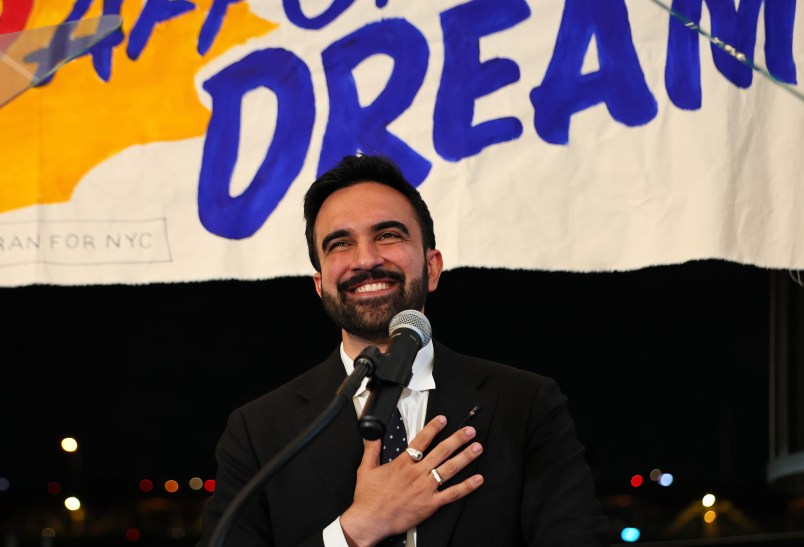
Since I haven’t written about this here, I wanted to share a few thoughts about Zohran Mamdani’s big Democratic mayoral primary win in New York. If you’ve been saturated by coverage of this race, these won’t strike you as terribly original points. I’m just sharing my perspective.
First, I see three reasons why Mamdani won.
The first is the simple fact that Democratic voters are angry and dissatisfied with the incumbent Democratic political class. We see this everywhere. It’s much less about ideology than it is often portrayed. We live in an angry, distrustful, populist age. Since the greatest expression of this mood has come from the right, Democrats have often been in the uncomfortable position of leveraging against this tendency, holding the line for institutional continuity, preservation over destruction and many other situationally understandable impulses. But the twin effects of Trump’s comeback victory and the often fractured and feeble response to it by the Democratic leadership in Washington has washed all of that away.
Andrew Cuomo is of course a damaged and baggage-saddled candidate far beyond these more general anti-establishment impulses. But that’s at least a bit less relevant than it may appear from outside New York. As governor, Cuomo kept the state GOP on life support in the legislature to maintain himself as the fulcrum of state politics. That sowed all manner of grievance against him both in the left wing of the state Democratic Party and in New York City generally, where he antagonized the city as part of this same fulcrum-ing. His scandals played a big role in this outcome, but they largely confirmed, justified and intensified a pre-existing animus. (For what it’s worth, I have always thought the COVID “scandal” claims were greatly overblown and often tendentious. The harassment accusations speak for themselves.) I note all this to say that Cuomo suffered from a New York-specific version of the anti-incumbent mood that is intense nationwide among Democrats.
I saw someone call Cuomo’s campaign lazy and entitled. I don’t disagree with that but I’d put it differently. It had the feel to me of an NFL coach announcing that he was ready to coach your mid-rank college program. You don’t ask questions; you just hire him. On paper it kinda makes sense. He’s a three-term governor and was once a widely anticipated presidential candidate. And now he’s coming back down from the stratosphere to be mayor. But that’s not how it played.
Second, Mamdani ran on the cost of living. In key respects that’s the issue Trump won on last year. Of course, the real bones of Trump’s campaign were the standard greatest hits of far-right populism — authoritarian government, immigrant expulsion, punishment of domestic enemies. But those weren’t the issues that drove his support among swing voters who are mostly only loosely plugged into the political system. The issue for those voters was overwhelmingly inflation and cost of living. Just because Trump had no actual plans to do anything but drive prices up should not blind us to the salience of the issue.
Given some of the coverage especially outside of the New York City area you might have gotten the idea that he ran on socialism or the Palestinian intifada, a topic we’ll get to in a moment. But while those both clearly played a role with core supporters, the actual campaign was totally different. It was all about a series of proposals, good or bad, focused on the cost of living — specifically a rent freeze, city-run grocery stores, better and free public transportation. Cost of living is the ultimate kitchen-table, pocket book issue. It’s particularly resonant coming off the biggest inflationary shock in the adult memory of the vast majority of voters. It should also loosen up our preconceptions about whether “pocket book” issues is code for politics as usual or doing stuff other than opposing Trump.
Third, Mamdani is an extremely able politician. This is the one part of the equation which I’m not sure is fully clear outside the Greater New York City region. I wasn’t covering this race and had my hands full with other DC stories I was covering and the normal family responsibilities with teenage boys, including getting one ready to head off to college. So my impressions of the race were mostly from TV ads and the ubiquitous social media ads from Mamdani, someone who I was at first inclined to see as just the standard issue, DSA-style candidate in the race. Whatever you think of his politics, you can’t see the guy’s ads and not pretty quickly realize you’re watching someone with standout, perhaps generational political talent. His ads were almost entirely him talking to the camera. There were a ton of them, like they were rattling off a few a day. They reminded me of Trump (gimme a chance here …) in that they seemed less like planned and choreographed messaging than the actual candidate being in regular contact with potential voters. (That’s always been a big, big part of Trump’s power.) Artifice of course is a central element of the greatest political talents and there’s nothing wrong with that. But the point is simply, especially if you didn’t experience the race locally, don’t underrate the role of Mamdani being a standout political talent.
For the half point, I’ll briefly discuss the Israel issue and claims of antisemitism, simply because these are issues I write about frequently and have strong views on so it would seem weird if I didn’t address them.
I’ve seen nothing at all that makes me think that Zohran Mamdani is an antisemite. That’s the main thing I want to say on this issue. Another key part of this is that Israel and Palestine were not really a major part of his campaign, in terms of what he was saying on the campaign trail or his messaging. That whole part of the campaign was either largely or entirely about him getting pressed to address, justify or denounce things he’d said in the past. That is fair. Every candidate is responsible for addressing views or statements from their own past record. (I note the distinction here because it’s important to understand the actual campaign Mamdani chose to run.) Mamdani is clearly quite anti-Israel in his politics. That’s a pretty consistent through-line back to his student activism days — which were only back in Obama’s second term. He’s endorsed BDS and various cultural boycotts; he’s a big critic of the occupation, which many of us are. He has used lightning-rod words like “genocide” and “apartheid.”
These are not my positions or views, certainly. But there are lots of political positions I disagree with. All of that speaks for itself. I wanted to address this in two ways, what I disagree with in Mamdani’s views and ways, with those views, he could work to be a more effective candidate and mayor if he’s elected.
Pushing through all his past statements, the one overriding impression of Mamdani’s views that seem significant to me is one he shares with a lot of the current “pro-Palestine” left, which is that Zionism in its core, essential elements was illegitimate from the start and was simply part of the far larger and now rightly discredited project of European colonialism. Second, he thinks the idea of a Jewish right to national self-determination — a concept which has been treated largely as a given for almost every other people on the globe for either one or two centuries depending on how you want to judge things — is basically a sham. I fundamentally disagree with both those claims. I have plenty of friends who believe those things. Doesn’t stop me from being friends with them. People disagree about lots of things. My point is simply that these are disagreements that go beyond catch-phrases or endorsing a particular boycott.
At least in principle, one’s views on those questions shouldn’t have anything to do with tax or rent policies in New York City. Of course, in the real world it’s not that simple. I want to conclude with some brief comments about Mamdani’s defense of the phrase “globalize the intifada.” He went on the Bulwark podcast in the final days of the campaign and refused to denounce the slogan, a move which then became an issue.
“Globalize the intifada” is certainly not an antisemitic statement. It’s a slogan of Palestinian nationalism and a rejection of at least the occupation of the 1967 territories. It’s also a kind of tres chic rallying cry for the international left in which pro-Palestine activism represents a set of aspirations that transcend the specific questions of those pieces of land. In any case, it’s not antisemitic. It is an expression of Palestinian nationalism and their rejection of living under what is now fairly called perpetual military rule.
But it’s not only that. The Second Intifada involved a hideously brutal terrorist campaign primarily against civilians and mostly within 1967 Israel. Violence against civilians is far from uncommon in these kinds of struggles. But it is definitionally the case that many Jews, even ones who don’t care particularly about anything going on in Israel and don’t support its current government, will find that slogan menacing. The Second Intifada is the one most people think about now when they use the term, fairly or not; something like a thousand Jewish Israelis were killed in various attacks during its course, with the overwhelming percentage of them civilians; if you talk about “globalizing” that, it’s not crazy that a significant number of people will think it means bringing that violence to them if they’re Jews. I know that there are people who use it to mean “take this conflict out of beatings and skirmishes in the West Bank and put it at the center of the global conversation.” The reality is that this phrase not only can mean a lot of things, it does mean a lot of things. That’s how language works. The ambiguity is part of it. Every good political slogan contains a range of possibilities. That’s what gives a slogan its resonance and power. Everyone who thinks seriously about these questions of language and power knows this.
Now, we have free speech. People can say what they please. And I get why Mamdani, with his history of activism on this issue, doesn’t want to denounce or get tone-policed about what he sees as the expression of a just cause. But you can refuse to denounce things that you nonetheless decline to say yourself. And I hope Mamdani can explore the possibilities that exist in that space. I don’t think it’s enough to say: “You don’t understand. That’s not what it means.” Words mean lots of things. If you want to be the mayor of the city with more Jews than any city in the world, you need to work with that reality. I don’t think Mamdani wants Israel-Palestine to be a key component of his campaign or potential mayoralty. I think some more dexterity in that space, as I described above, would go a long way to reassure those whose apprehension is real and not just a cudgel used against him, a characterization that applies to many of his critics.