


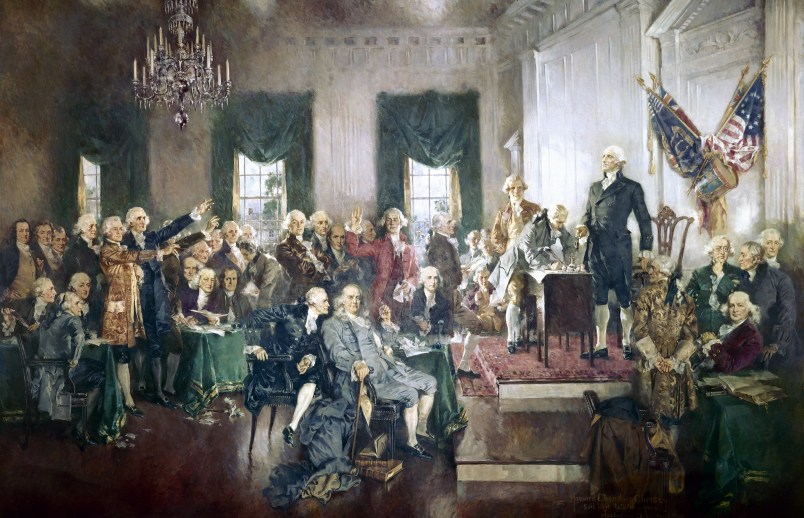
I got a number of fascinating replies to yesterday’s post about the federal calendar and presidential holidays, specifically whether we should ditch Columbus Day in favor of a national holiday celebrating Abraham Lincoln. I also learned a bit more about how Lincoln never got a national holiday originally because the states of the old Confederacy, whose representatives and senators had outsized seniority throughout the 20th century, simply wouldn’t hear of it. Indeed, the 1968 federal law which clustered federal holidays into long weekends and which in effect though not formally consolidated Washington’s birthday into “President’s Day” was still under the shadow of southern resistance to anything commemorating Abraham Lincoln.
Today I want to step back to Washington himself. As some of you know, I spent most of my 20s getting an American history PhD. My advisor, Gordon Wood, was and is a renowned historian of the Revolutionary and post-Revolutionary era. I note this to say that I spent a lot of time studying that period in which George Washington is in many ways the dominant figure. But I hadn’t really considered Washington as an individual until I wrote this New Yorker review essay about David McCullough’s 1776. As the book’s title suggests, it’s about the critical year of 1776, a year that was critical not simply as the year in which the United States declared its independence but also because it was the year that Washington had to get through with his army intact. The Americans didn’t win the Revolutionary War in 1776, but it was the year they could most easily have lost it. And the Americans mainly won the war by not losing it. I described it this way in that essay …
The key fact about the Revolutionary War is that the colonists didn’t have to win their independence from Britain so much as they had to fend off Britain’s efforts to snatch it back. Before the revolutionary crisis began, in the seventeen-sixties, British dominion had rested lightly on the American colonies. Merchants in port towns who shipped goods overseas had to contend with the King’s laws and tariffs, but few other Americans had much contact with either. In the century and a half after the first colonies were established, the mother country had tried to exert real control for only a few short spells. Each time, Crown and Commons soon shifted their attention to some other pressing matter, and the colonists were once more left to their own devices. Royal authority in America collapsed as swiftly as it did because it was scarcely entrenched to begin with, not because there was overwhelming support for the patriot cause.
But McCullough’s book got me thinking about something different about Washington, who is a much more fascinating character than the man we usually see in the history books — fascinating in a paradoxical and deeply artificial way.
Washington wasn’t terribly creative. He wrote nothing of note. He didn’t have terribly original ideas. He wasn’t even always that good of a general. But the people around him pretty universally held him in a sort of awe. Almost all the craftier and more notable members of the Revolutionary generation had great confidence in his presence, the fact that he was around, the fact that he was commanding what then passed as the United States Army. They felt reassured that he would be the first president. So what was that confidence about?
The gist is that Washington had an immense reserve of personal dignity and a kind of stoic, impassive demeanor. For many Americans of the late 18th century he seemed to embody the kind of classical and republican ideals the educated members of his generation had all been raised on. He was Cincinnatus surrendering dictatorial power when his service to his country was done. He could be portrayed as embodying the values of this or that classical figure at various points in his career.
What’s so interesting to me about this is that it was all an act. From early in life, Washington was extremely focused on modeling himself on various classical figures and virtues and in a way play-acting the person we know as George Washington. It is a tremendous act of self-fashioning because he play-acted this role, this person for so long that in a way he became that person. Washington wrote no Gettysburg Address or Declaration of Independence. His document was himself, the character of “George Washington.” And that idea of self-fashioning, the idea that we can build new things, become new people by logic and effort and self-discipline untrammeled by the past is very much part of the English-speaking world’s late 18th century Enlightenment ethos that he and his peers were reared on.
Another excerpt from that essay …
Yet here is the crook in the path, something that McCullough reveals but never quite explains: it was all a put-on, an act. For us today, character is bound up with authenticity; someone with “character” doesn’t put on airs, doesn’t tailor his actions to impress others. Those weren’t the standards of Washington’s era. When the young Henry Knox first met Washington, he marvelled at the General’s “vast ease and dignity.” Such ease was not acquired without effort. As McCullough says, Washington was a man of “almost excessive self-command.” From an early age, he submitted his entire persona to the most rigorous discipline, shaping everything from his physical bearing to the degree of intimacy that he allowed himself with friends and associates. By the time he took command of the Army, outside Boston, in July, 1775, there was little about him that was not the product of years of conscious artifice. Few men could have been more keenly sensitive to their standing in other men’s eyes or more acutely aware of how words and deeds could diminish or enhance their reputation.
As I note here, we are today all about authenticity. The age that unfolded in the decades after Washington’s death in 1799 was similarly focused on the authentic self. Artifice was fakery. But Washington comes from a different era, one that revered self-mastery and playing out certain stock virtues. Look closely at John Adams and he’s a man riddled with self-doubt and angst and kind of terribly neurotic. Jefferson is glib and dilettantish and can’t help but be a hypocrite again and again. You can look at him and see a kind of renaissance man with a hand in everything or you can see a clever and privileged man who just took a stab at various things. You can’t really get into Washington, not even reading his letters. He comes down to us as a figure carved out of white marble. And when you see him up close in his letters or accounts of his conversations he’s also at least half white marble. He had made himself into this avatar of the classical republican virtues that his peers had all been raised on, despite spending their early lives loyal to a king. It worked.
This makes Washington a very hard person to figure. I had always thought of Washington as not really in the league of Lincoln. He’s Washington because he was the first president. And he was the military commander of the Revolutionary War. And you kind of have to say the first one was awesome because that’s just what you do. But what did he do besides kind of act out of a series of roles over about 25 years and not make any big mistakes?
Well, that is what he did.
But you look closely and there really are these repeated moments where his presence, the vision of him and this kind of impassive dependability held everything together. And it wasn’t some native genius in the old sense of the word or some charisma. It was an act of will, a grinding down of all the spontaneity and expressions of one’s inner self — with our torments and our dreams and fears and exuberances — that we today so laud. He made himself into this almost-marble-in-life actor-out of resolve, disinterest, self-denial and republican virtue. And that really did play a crucial role in holding together and then shaping the young republic.