


In press conference comments today, Homeland Security Secretary Markwayne Mullin threatened that state election officials could face jail time if they fail to cooperate with the White House’s purported efforts to “secure” the midterm elections, which seems to involve a range of illegal demands from the White House, Department of Homeland Security and the Justice Department. The specific demand is for states to feed their voter rolls into the federal “SAVE” database which purports to identify noncitizens on the rolls. Mullin seems to be saying that if states refuse to bend to these illegal White House demands, the federal government will then scrutinize those states’ election returns (by seizing ballots?) and hold state election officials criminally responsible for any illegal voting. (Assistant Attorney General Harmeet Dhillon has already sent out threats all 50 states and D.C. along these lines).
We have here again the old story. States run elections in the United States. This is guaranteed and mandated by the federal Constitution. Congress can set uniform rules for administering elections. The executive branch plays no role at all in setting rules for elections or administering them. The White House’s strategy is to use illegal means (threatened criminal punishment against state officials) to assert power or compel authority the Constitution simply doesn’t allow. This isn’t how anything works. A president cannot legitimately create by force powers that the Constitution specifically denies him.
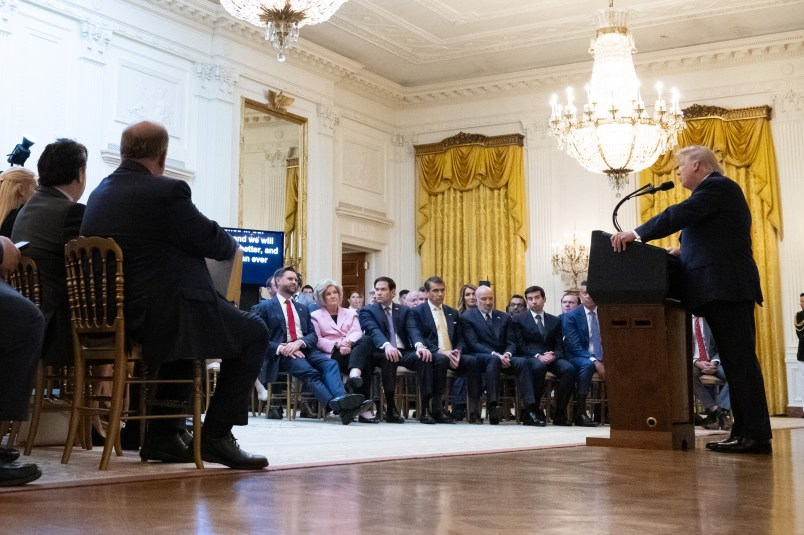
We saw in yesterday’s Oval Office address the odd duality of this moment. You have in President Trump someone who recognizes no limits, no laws or constraints on his power and is motivated only by the will to dominate. You can’t put anything past him. Unlike in 2020, he has loyal anti-constitutional appointees at all the key loci of state power — DOJ, DHS, DOD. At the same time we saw in that speech yesterday an image of desperation and decay and a public and even a press corps newly unwilling to buy his lies. As journalist and Columbia Journalism School professor Bill Grueskin said on Bluesky, it seemed like a watershed moment where most mainstream media organizations were unwilling to give Trump the assumption of good faith or reality usually granted to all presidents. Even Fox seemed mostly unimpressed.
That speech wasn’t even well put-together propaganda. And in recent months Trump has faced repeated reverses in the courts for almost all his election subversion angles. The man and his White House have the stiff stench of a loser around them. He seemed sickly, aggrieved, weak and deranged. The whole effort is best seen as a tantrum kicked up by what is mostly the failure of his election subversion dreams, an aging would-be tyrant shaking his fists at the clouds. As we’ve noted again and again, you successfully achieve authoritarian takeovers in periods of relative popularity, not when you’re deeply unpopular and have a head of state in increasingly palpable state of physical and mental decline.
And yet, even a decrepit and degenerate president has great powers of executive action. Trump has executive authority, which in most cases means him acting and others being forced to react. They say that possession is nine-tenths of the law. And executive power has a similar dimension. It’s the ability to act affirmatively, to refuse and disregard — things that go beyond the formal dictates of law.
The key, as we’ve discussed many times, is that the states are also sovereigns. They are subordinate to federal law. But they are also executive actors and they have governments separate from the ligaments and levers of power of the federal government. There’s a reason why Trump, along with the enablement of a corrupt Supreme Court, can seemingly do anything he wants within the federal government but not in the state governments. He can’t fire governors, order town councilors or mayors to do this or that. That separate sovereignty, without the connecting devices allowing the power of the one to operate within the ligaments of the other, is the sheet anchor of civic democratic power in this critical moment of American history.
Obviously these various Trump stratagems will get litigated in the courts. And many or most of them will fail. That’s probably how all this will play out. But there’s a critical shift in basic assumptions and mentality that is necessary for every state official to make to prepare themselves for this moment. That is especially true when there is a rogue and criminal president occupying the White House. Defying a rogue president can seem like defying federal authority or even the constitutional structure of government itself. Nothing could be further from the truth. Refusing these illegal demands is defending the federal constitution and the integrity of the federal government itself against its current rogue occupants.
Most of us were raised with the assumption that there are political disagreements, courts settle those disagreements, and you move on from there. That’s a good set of assumptions for normal times. These are not normal times. We’re talking here about the most basic building blocks of governing power, ones that the federal constitution clearly and unconditionally grants to the states subject to congressional law. States run their elections and send their representatives to Washington. The president has no say in the matter.
It is incumbent on those state officials not simply to “resist” but to refuse, to lean into the full power of their state sovereignty under the federal constitution. States have just as much authority to defend the integrity of the federal constitution and obedience to it as the White House or, for that matter, the Supreme Court. Not every question of what the U.S. Constitution means is up for genuine debate. This one, for example, is not. States are not only entitled to insist on their constitutional authority to administer federal elections — they are obligated to do so. That’s critical in part because when courts limit executive action, they often do so well after the fact. Those delays aren’t acceptable in cases like this. What’s required is a contest of executive authorities. These are fundamental questions of the constitutional order that transcend the decisions of courts.
What does this mean in practice? It means that every illegal demand from the White House and Trump’s federal officers gets a flat no from state officials. If courts back Trump’s anti-constitutional demands, that doesn’t matter. If Trump and his appointees threaten illegal force against state officials, it’s incumbent on those state officials to refuse the threats and demands and accept the risks of illegal presidential violence. As I noted above, sovereignty and executive authority are a bit like possession being nine-tenths of the law. The states possess their sovereign authority and only they can really relinquish it. That is the deep well of state sovereignty and power state governments and state elected officials have at their disposal and need to lean into.
As I’ve mentioned numerous times, I am cautiously optimistic about the midterm elections. I don’t think Trump has the power (not the authority, that’s obvious, but the power) to significantly tamper with it. A majority of the country is already against him and that is a very weak position from which to mount an anti-constitutional coup. The forces of civic democracy are in the far stronger position. But the sovereign authority of the states is the key sheet anchor on which everything depends. So state officials must be ready to use it, to lean into it in every dimension.