


I’ve written a number of times over the years about the fact that Americans mostly believe that the post-World War II world order is the normal state of things. Of course, it is not. The last 80 years are unparalleled in global history for their general prosperity, lack of great power wars, a fairly predictable system of global rules. One has to say the obligatory caveats about all the ways the United States honored its values and rules in the breach, the slow run of proxy conflicts it participated in or fomented around the world. But these caveats only serve to illustrate the larger point in a paradoxical way. Things can always get worse and getting worse — conflict, instability, mass death — are the normal order of things in world history. Even a thin appraisal of the American ascendency shows its close to uniqueness in this regard.
It’s a great stroke of luck to find yourself in an island of history in which this basic order of things is put on hold, held in relative abeyance, even more to be part of the great power which undergirds these social goods and inflects the whole system — subtly but decisively — in its own favor. But for the last decade we’ve been actively dismantling that system. The middling attempt to reassert or rebuild it in the Biden years of course proved ephemeral and nostalgic, an unintentional demonstration of the American republic’s inability to defend the system it had built almost a century earlier.
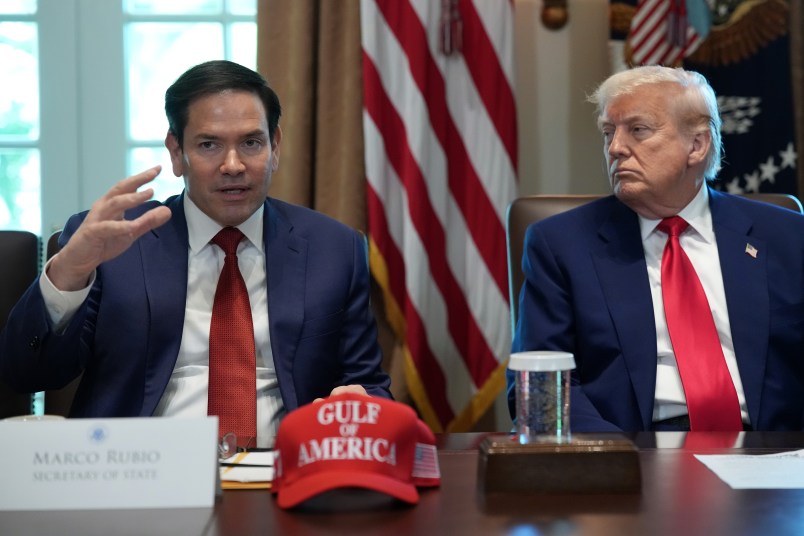
I note this because just over this last week we are seeing this work of dismantlement both accelerating and entrenching itself. The new national security strategy document the administration released last week essentially says the United States will retreat to the Western Hemisphere and focus on a kind of neo-Yankee imperialism in which it seeks to dominate the countries of its own hemisphere while leaving western Eurasia to Russia and Asia to China.
Yet the most revealing parts of the document comes in the animus expressed toward Europe. The content is dressed up as part of a larger geostrategy. But beneath this thin sheen is an open statement of great replacement ideology: Europe is an unreliable ally because it risks “civilizational erasure” and a near future when it will no longer be white.
There’s not much fig leaf.
At the beginning of the Trump era, 2015-16, the truth was that I was always more personally worried about the impact of Trumpism abroad than at home. (I didn’t say this a lot because it sounds like it contains an indifferent privilege to things that happen at home. To me, thinking otherwise shows an easy obliviousness to how rapidly the world abroad can upend our security and brass tacks physical safety at home.) Even with the turbocharged Trumpism of the second term, I still largely feel that way. This is an incomplete and partly notional analysis. But things we screw up at home we can at least in theory undo. When the public puts its mind to something, things can change quickly. It’s not the same with the global state system. We can’t simply put trends we’re unleashing into the world today back into their bottles or their boxes. Once the chaos is unleashed, you can’t just undo it because you decide unleashing it wasn’t a hot idea. To add to the litany of doom, even the most unpopular president retains his vast powers abroad. At best we’re only one year into this, with three to go.