


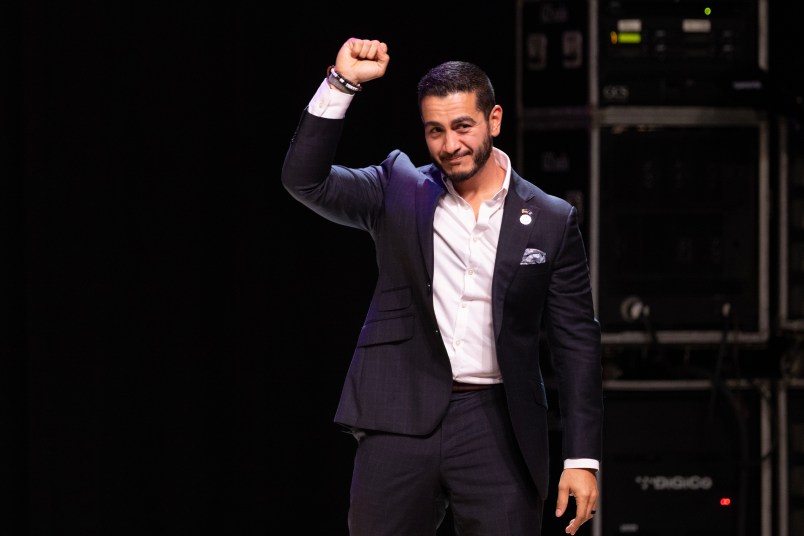
Jon Cohn has a good piece in The Bulwark on the challenges ahead for Abdul El-Sayed. The “brutal path ahead,” Jon calls it. I’ll note here that Jon is based in Michigan, despite beginning his journalism career in the East Coast cities where most political journalists are based. (In other words, his report isn’t based on parachuting into the state for a few weeks.) He notes the two, equally accurate narratives coming out of this primary battle. El-Sayed built a potent and victorious movement. Sanders-style progressive Democrats seldom win these contests in purple states. El-Sayed did. And he did it in the face of concerted opposition from the state’s Democratic establishment, the national establishment and an ocean of outside money, mostly from AIPAC.
It’s also true that Republicans will now run a viciously Islamophobic campaign against him, which will get extra traction from his association with the willfully inflammatory Hasan Piker. There’s another dynamic we’ve seen across numerous establishment-progressive battles. The Platner campaign pitched itself as appealing to working class or at least culturally working class voters who are usually unreachable by Democrats. But the polling showed that the demographic profile of Platner’s supporters looked pretty similar to what most Democrats have gotten over the last couple decades, and especially since Trump — the educated and affluent. The loose outlines of El-Sayed’s victory in Michigan look similar. Both make a pitch about young voters but they tend to appeal most to educated and downwardly mobile voters — so again, another version of standard early 21st century Democratic coalition.
Jon writes …
But other patterns more troubling for Democrats emerged in the returns as well. They include a divide between college-educated and non-college-educated voters—or what Ron Brownstein famously called the “wine track” and “beer track.” El-Sayed did better with the former than the latter, in the same way Democrats nationally have for most of the last two decades. And that feeds the second narrative out of the race, which is every bit as true as the first: El-Sayed has real deficits he needs to make up with key voting blocs if he wants to win in November.
Black voters meanwhile went overwhelmingly for Haley Stevens. A lot of commentary has portrayed this as driven by ads which appeared to suggest that President Obama had endorsed her. (He’d actually endorsed her in an earlier campaign; she did play a key role in the auto bailout under his administration which is, of course, a big deal in Michigan.) But Jon suggests it’s much more organic than that and simply a matter of Obama appearing to giver her the nod.
Then there’s swing voters. This is a fairly bleak outlook for the campaign. I’m more optimistic than Jon on this front. But I’m not sure if that is based more on just a desire to be optimistic, or perhaps what I believe is a salutary skepticism about some of the more doomery claims that El-Sayed is simply unelectable.
I’ll restate a few basic points. Republican Mike Rogers isn’t a strong candidate. Yes, he doesn’t have feral MAGA coding. So he’s someone who may seem acceptable to some moderate Republicans. People make a lot of that, and there’s a real truth to it. The other side of that coin is that Elissa Slotkin beat Rogers even in a bad year for Democrats. And if 2024 was a bad year for Democrats, 2026 looks like a catastrophic year for Republicans. Rogers has to answer for Trump, the Iran War, high costs. Put those all together and any Republican starts in a fairly deep hole. El-Sayed has also identified a number of strong lines of attack on Rogers personally — he left politics to cash in as lobbyist, moved to Florida, etc. And El-Sayed is very good on the attack.
The real question, I think, is how much traction Republicans will get with the kind of caustic, Islamophobic campaign they are certain to and have already started to run against him. The politics of Israel have transformed in Democratic politics. And they’ve shifted significantly in Republican politics, albeit in different ways. And El-Sayed has leaned heavily into that. How much more ooomph does that give Republicans to disqualify him with swing voters as a scary Arab Muslim? I genuinely don’t know. That’s a more central question than most are willing to state explicitly. Because if you look at El-Sayed’s politics he’s not that left-wing outside of the vehemence of his rhetoric on Israel/Palestine and the ways that Republicans can mobilize that in an Islamophobic, xenophobic campaign against him.
One additional part of the equation is that El-Sayed is aggressive. He has other sides. But one side is a caustic — verging on nasty — side. He can be a bit of a trash talker. In most ways, that’s what Democrats are looking for. They want fighters. And in the hothouse Trump era, that kind of pugilistic edgy posture is potent. But just as female candidates are often portrayed as cold or unlikeable for mannerisms taken as unremarkable or expected in male candidates, I wonder how much those traits can be mobilized against him in a campaign aimed at disqualifying him as an angry, extremist, scary Muslim Arab.
Zohran Mamdani’s mayoral campaign is another analog to Platner’s and El-Sayed’s. But in general it’s best to put Mamdani into a different category. He’s a generational political talent and — far more importantly — New York City is an overwhelmingly non-white, young and immigrant city. You can’t compare that to any other part of the United States outside one or two big cities, and certainly to no state.
The New York Times’ Michelle Goldberg has what serves as a good companion piece to Cohn’s. It focuses on El-Sayed but makes a broader case about the electoral argument that underlies most populist left campaigns: that the policy agenda of the progressive left is much more popular than most consultants and commentators believe. If you make that argument in a clear and unapologetic way, you’re going to get more traction than most analysts imagine and — this is critical — activate segments of the electorate that aren’t currently participating. (Young disaffected voters, occasional voters, etc.)
Goldberg argues that candidates like Wisconsin gubernatorial candidate Francesca Hong are operating in what is really a bubble, radically underestimating how alien or unpopular many of the policies which seem commonsensical or plausible in left-wing milieus really are — defund the police, abolish Thanksgiving, etc. If you’re familiar with my thinking, you won’t be surprised that I’m a pretty receptive audience for this argument, to put it mildly. Indeed, there’s a strain in a lot of progressive left thinking that suffers from a kind of over-logic. People should support Medicare for All. (Everyone hates their health insurance company, right?) So since they should, it stands to reason that they do. Here’s a passage from Goldberg’s piece.
[P]olls show the democratic socialist Francesca Hong running away with the nomination for governor. Hong is a particularly stark example of the left-wing populist tendency to overestimate the popularity of its own positions. When I interviewed her earlier this year, I was unnerved by the way she either didn’t see or wouldn’t acknowledge that many of her views, regardless of their validity, are fairly marginal.
She didn’t think that calls she once made to defund the police, which she doesn’t disavow, would hurt her, because, she said, “a lot of people are losing trust in law enforcement, especially in the time of ICE.” She thought that people in small towns and rural areas have a natural affinity for socialism because of the way neighbors took care of one another. “There is this element of mutual aid and community care that is a big part of democratic socialism, that we aren’t always making that connection,” she said.
This conversation has nagged at me because it suggested a refusal or inability to understand where people with competing perspectives are coming from. Neighborliness can coexist with lots of different political philosophies; conservatives abhor socialism precisely because they fear replacing community relationships with the state. Democratic socialists are certainly wise to try to make inroads in new places by emphasizing common values. The mistake, I think, is assuming that people with good values will inevitably end up where you are if only they’re shown the way.
As I said, Goldberg is preaching to the choir with me on this general argument. But from my limited knowledge of El-Sayed he doesn’t seem that left wing to me, and he seems a lot shrewder than Hong on this front. I’m not sure this concern really applies to him. Again, I think disqualifying El-Sayed and, thus, getting voters to set aside their deep dissatisfaction with Trump and his enablers rests much more squarely on a xenophobic and Islamophobic campaign which will rely on mining his Israel-Palestine and Gaza activism.
As I said, I’m not as pessimistic on El-Sayed’s chances as Cohn and Goldberg seem to be. In fairness, at least Cohn may be more stating the pessimistic case than adopting it. I’m not trying to put them in some firmly opposite camp to mine. My impressions of this campaign are much more fluid and uncertain than that. I think most of us simply don’t know what’s going to happen here. We’re in a moment of deep, deep social, economic and political upheaval in the United States. And it is hard to know which truisms and dependable certainties continue to apply.